
Most owners in Jacksonville have heard the same lazy advice, Florida has no corporate income tax. That line is wrong in the way that matters, because Florida absolutely has a corporate income tax, and the trap is that you can owe nothing and still have a filing obligation. If you run a growing company, the question is not whether Florida is “tax friendly,” it's whether your books, entity choice, payroll, and apportionment are clean enough to keep you out of trouble.
The compliance risk is bigger than many assume. Florida's rules start with federal taxable income, move through Florida-specific adjustments, and then get sliced by apportionment for multistate companies, which means the headline rate tells you very little by itself. If you want a practical reference point before you hand this off to your CPA, the top Florida bookkeeping pros can help you see how the tax and the books connect.
The Myth That Florida Has No Corporate Income Tax
The myth survives because people confuse no personal income tax with no corporate income tax. Those are different things. Florida's corporate income tax is real, and the filing trigger is broader than many owners expect, especially for foreign corporations doing business, earning income, or existing in Florida under the administrative rule text that leaves little room for a casual “we don't owe anything, so we don't file” attitude. The practical question is not whether Florida is tax free, it's whether your company has created an F-1120 filing obligation without realizing it.
That distinction matters for Northeast Florida owners with remote sales, a Florida office, or a pass-through entity that elected corporate treatment. I see this confusion constantly in practice, and it usually starts when someone assumes that no tax due means no return due. That's how people miss compliance obligations and discover them only after a notice, an extension problem, or a year of incomplete books.
Practical rule: if your entity touches Florida, don't guess at filing duty. Check the return requirement first, then figure out whether you owe tax.
The state's own framework starts from federal taxable income, then moves into Florida adjustments and apportionment, so the tax conversation is never just about one rate. For a broader compliance view, owners should also understand where filing fits inside bookkeeping, payroll, and planning, not just inside the tax return. If you need outside eyes on that process, compare your current process against a Florida corporate income tax filing and bookkeeping resource before the year closes.
A business can have zero Florida tax due and still be exposed to filing risk, recordkeeping risk, and penalty risk if the return never gets prepared correctly.
How the 2026 Rate and Exemption Actually Work
Florida's current corporate income tax rate is 5.5%, and the first $50,000 of net income is exempt before tax is calculated. That means the tax is not a straight-line hit on every dollar of profit. It starts after Florida-apportioned net income has been determined, so the rate only matters after the base has been built correctly.
The history matters too, because owners still hear old numbers from old returns. Florida temporarily reduced the rate to 4.458% for taxable years beginning on or after January 1, 2019 and before January 1, 2021, then to 3.535% for taxable years beginning on or after January 1, 2021 and before January 1, 2022, before returning to 5.5% in 2022. Florida TaxWatch also notes the rate has remained 5.50% since 1984, which is why a lot of older owners still talk about the tax as if nothing ever changed. The state's revenue materials show the same core structure today, so there's no mystery here, just a rate history many businesses never bother to learn.
What that means in plain English
Start with federal taxable income, then apply Florida additions and subtractions to get adjusted federal income, then apply apportionment if the company operates in multiple states. Only after that does the $50,000 exemption come into play. Florida Revenue's corporate tax guidance and the state handbook both make that structure clear, and the formula is not optional for multistate businesses.
| Florida Corporate Income Tax Rate History | ||
|---|---|---|
| Period | Statutory Rate | Notes |
| Taxable years beginning on or after January 1, 2019 and before January 1, 2021 | 4.458% | Temporary reduction |
| Taxable years beginning on or after January 1, 2021 and before January 1, 2022 | 3.535% | Temporary reduction |
| Taxable years beginning on or after January 1, 2022 | 5.5% | Current rate |
A Jacksonville retailer with Florida-apportioned taxable income above the exemption is not dealing with a theoretical tax. The business is dealing with a real liability that needs to be tracked monthly, not scraped together in March. If your books don't let you see federal taxable income, Florida adjustments, and apportionment cleanly, you're not planning. You're guessing.
C-Corp Versus S-Corp Treatment in Florida
A C corporation is the entity Florida corporate income tax was built for. If your business is taxed federally as a C corp, you're in the Florida corporate return world, and the tax math follows the state's income base, exemption, and apportionment rules. A properly elected S corporation is different, because the entity itself generally does not pay Florida corporate income tax in the same way a C corp does.
That's where owners get sloppy. They treat the S corp election like a magic shield and then ignore payroll discipline. It isn't a shield, it's a different tax posture, and the salary versus distribution split still has to make sense on the books, in payroll, and on the return. If you're comparing entity choices, the LLC vs S Corp comparison is a useful starting point, but it does not replace a tax review built around your actual numbers.
A Northeast Florida contractor who elected S corp status to reduce self-employment tax still needs a defensible wage structure. If the owner's salary is pulled out of thin air, the IRS, payroll reports, and financial statements stop agreeing with each other. That's where tax prep turns into cleanup.
Entity choice and payroll choice belong in the same conversation. A business can't claim S corp treatment, run weak payroll, and expect Florida compliance to sort itself out. For owners who also want to understand how entity choice can affect deductions at the federal level, the QBI deduction overview helps frame the bigger picture.
Bottom line: if you're not sure whether you're a C corp or an S corp for tax purposes, stop assuming. Pull the entity documents, confirm the federal election, and reconcile payroll before the return is due.
Nexus and the Three-Factor Apportionment Formula
Florida does not tax every dollar of a multistate company's income just because the company has some connection to the state. The state first looks at whether the business is in the Florida filing net, then it applies apportionment to determine how much income belongs here. That is why a company with heavy out-of-state operations can have a very different Florida result than a local-only company with the same profit.
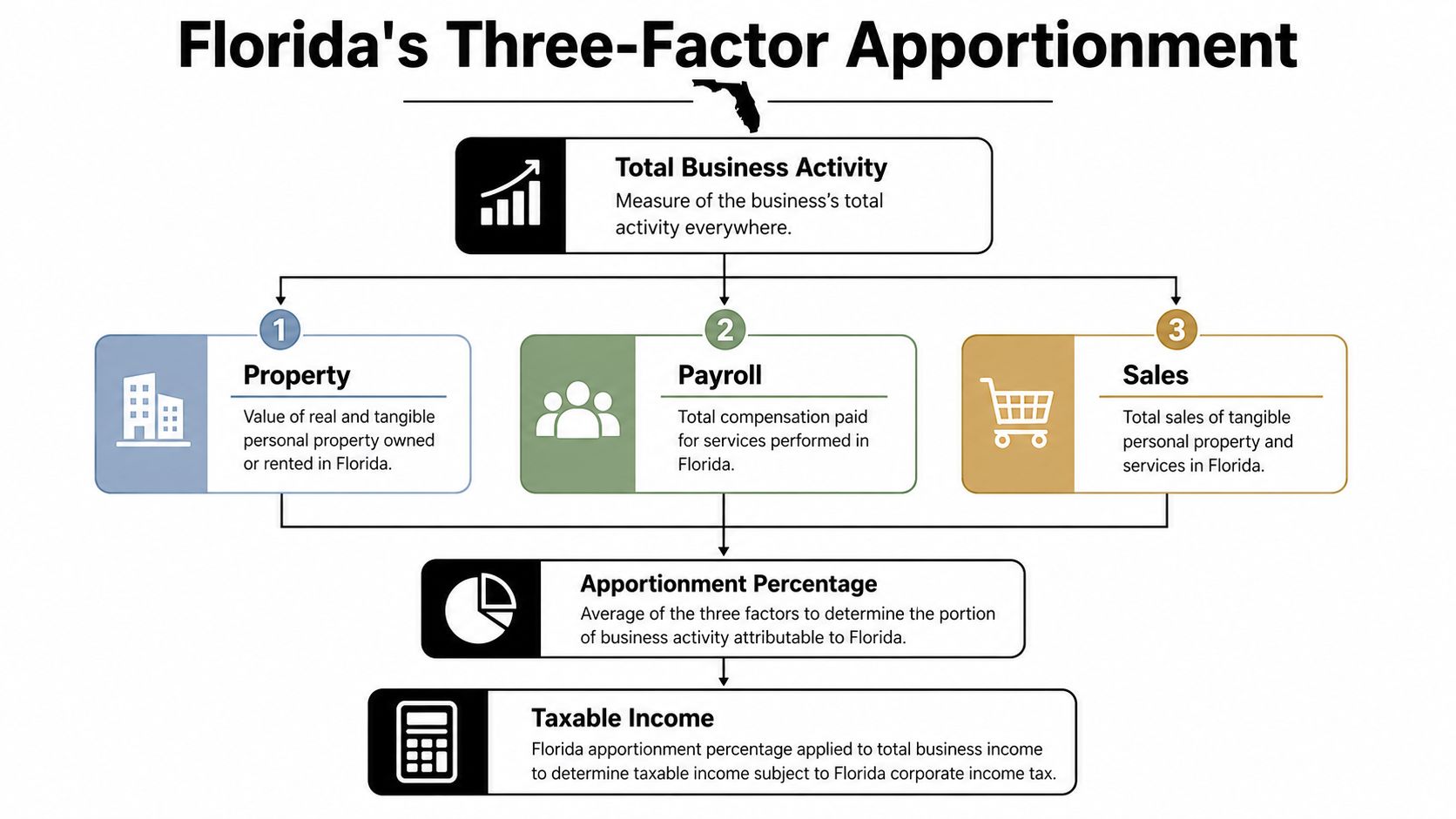
Florida uses a three-factor apportionment formula based on 50% sales, 25% property, and 25% payroll, and that sales factor is the dominant piece of the model. The state corporate guidance makes that structure explicit, and that's why multistate companies need bookkeeping that can separate Florida revenue from non-Florida revenue without hand-waving. If you also need to understand how sales records tie into your broader state compliance stack, the sales tax compliance services page is worth reviewing alongside the income tax file.
A practical contractor example
Take a construction company doing jobs in Florida and Georgia. If the company has Florida payroll, Florida equipment, and Florida customer sales, those factors can pull income into the Florida return even when the owner mentally thinks of the company as “regional.” A service business can get even trickier because income sourcing can depend on cost-of-performance rules, not only where the customer sits.
That's the part owners usually miss. They think nexus is the only test, then they act surprised when the apportionment result is the primary driver of tax due. Nexus gets you into the filing system. Apportionment decides how much of your income is taxed here.
Practical rule: if your company sells across state lines, track property, payroll, and sales every month. If you wait until year-end, you've already lost control of the calculation.
Filing Forms, Deadlines, and Available Credits
Florida corporate taxpayers generally file Form F-1120, and the filing timeline usually follows the federal corporate return schedule, including extensions. That means the return process is not something to think about at the last minute, because the filing date, extension request, and payment planning all have to line up. If you miss the timing, you don't just create a paperwork problem, you create a cash problem.
The credits and incentives matter, but only if someone asks about them before the file is finished. The $50,000 exemption is the baseline, not a negotiation point. Other targeted items can include contributions tied to the Florida Tax Credit Scholarship Program, Step Up For Students, along with other state incentives that a good preparer should review during planning, not after the books are already closed.
What owners should have ready
- Current general ledger: without clean books, the return is a cleanup project instead of a tax filing.
- Payroll reports: officer compensation, withholding, and payroll taxes should agree with the return.
- Apportionment support: sales, property, and payroll data should be easy to separate.
- Prior-year return: Florida treatment often makes more sense when compared against last year's file.
- Credit documentation: contributions and incentive claims need support, not memory.
Estimated payments matter too, and owners who ignore them usually do it because they assume the exemption means they're off the hook. That assumption gets expensive fast. The estimated quarterly tax payments guide is a good reminder that tax planning is a cash flow issue, not just a filing issue.
Don't wait until the return is being drafted to ask about credits. By then, the best planning opportunities are usually gone.
Common Pitfalls for Northeast Florida Small Businesses
The mistakes I see in Jacksonville are rarely exotic. They're boring, repeated, and expensive. Owners mix personal and business expenses, run payroll inconsistently, and then act shocked when the Florida return takes longer than expected or the numbers don't reconcile.
The usual failure points
- Personal spending inside business books: this muddies the general ledger and makes tax prep slower and less reliable.
- Missed nexus triggers: remote sales, a temporary Florida office, or occasional in-state work can create filing exposure before anyone notices.
- Arbitrary S corp salaries: a number chosen out of habit is not a payroll policy.
- No monthly close: if the books aren't closed every month, mistakes pile up until the tax return exposes them.
- Payroll not tied to the ledger: if payroll reports and accounting records disagree, somebody is going to spend time cleaning up the mess.
The problem is not just bookkeeping. It's that many owners confuse bookkeeping with review. A bookkeeper can enter transactions. Someone still has to ask whether the tax position makes sense, whether payroll matches the entity election, and whether the company has created a Florida filing obligation it didn't expect. That's why a controller-level review matters, especially for companies with multiple locations, remote revenue, or a growing team.
A lot of small businesses also skip estimated payments because the exemption feels like a free pass. It isn't. If the business is profitable and apportioned income rises, the tax still needs to be tracked, and the cash has to come from somewhere. If you also carry operational risk, consider how insurance and bonding intersect with tax and compliance obligations through insurance and bond for small business.
How a Fractional CFO Stays Ahead of Compliance
Florida corporate income tax is not a standalone problem. It sits beside payroll, sales tax, entity structure, county-level obligations, and year-end reporting, and most owners do not have the internal bandwidth to track all of that correctly. That's why a fractional CFO model makes sense for companies that have outgrown casual bookkeeping but do not need a full-time finance hire.
Bookkeeping and Accounting of Florida Inc. fits that gap with full-charge bookkeeping, tax preparation, payroll support, QuickBooks ProAdvisor setup, and senior financial guidance for businesses that need more than data entry. The practical value is control. Clean books make the Florida return easier, but controller-level oversight makes the decisions better before the return is even due.
What the right support actually does
- Keeps monthly records current: so Florida adjustments and apportionment are visible before year-end.
- Reconciles payroll to the ledger: so officer compensation and tax reporting agree.
- Surfaces filing obligations early: so owners don't miss an F-1120 requirement.
- Flags tax planning issues: so credits, exemptions, and payment timing are handled on purpose.
- Gives owners a finance lead: so the business isn't run on guesswork.
For businesses that also need to stay organized on the non-tax side, a fractional finance lead is often the difference between control and chaos. The firms that win here are the ones that stop pretending a shoebox and a spreadsheet count as a system.
If you want real help with Florida corporate income tax, clean books, payroll, and the filing risk that owners usually miss, schedule a review with Bookkeeping and Accounting of Florida Inc.. We'll look at your entity, your books, and your compliance picture, then tell you plainly what needs to change before the next deadline.