
You run a consulting firm, cleaning company, repair shop, or software business in Florida. A customer pays an invoice, the revenue lands in your bank account, and you move on to the next job. Then a letter from the Florida Department of Revenue asks why sales tax wasn't collected.
Thank you for reading this post, don't forget to subscribe!That surprise usually starts with a reasonable assumption: Florida doesn't tax most services, so my service must be exempt. The assumption is sometimes correct. It can also leave a business with uncollected tax, weak exemption records, and a compliance problem that becomes more expensive to fix over time. Florida sales tax for services is narrow, but “narrow” doesn't mean simple.
Why Florida Sales Tax for Services Catches Business Owners Off Guard
Florida taxes only the services that state law specifically names. Everything else is generally exempt. That rule sounds simple until a Tampa marketing consultant sells strategy, campaign planning, reporting, and related deliverables under one large engagement.
The consultant may reasonably treat the work as exempt because accounting, legal, and consulting services are generally outside Florida's sales-tax base. Months later, a Florida Department of Revenue notice can require records showing exactly what the customer purchased, where the primary benefit was received, and whether the contract included a taxable component. A service business needs those answers before an audit, not after one begins.
Florida's state sales tax rate is 6%, and taxable sales also may carry a county discretionary surtax. The Florida Department of Revenue sales tax guidance explains that tax applies to the price of taxable goods or services at the time of sale. Chapter 212 identifies particular taxable services, including protection services, while many professional services remain exempt unless another taxable element changes the transaction.
The exemption assumption creates risk
Commercial cleaning, commercial pest control, and detective or burglar-protection services are clear taxable categories. Calling the work “labor,” “maintenance,” or “facility support” does not change its legal classification. The actual service and the governing statute control, not the label printed on the invoice.
Bundled contracts create another gap. A facility-management agreement might combine consulting, cleaning, minor repairs, and supplies. Recording the entire contract as one exempt service can produce under-collected tax, especially when the business has no line-item detail or written method for separating taxable and exempt revenue. An audit is the wrong time to reconstruct that classification.
Practical rule: Classify every service line before classifying the company. One business can earn both taxable and exempt revenue.
Florida's history also explains why broad statements cause trouble. In 1986, the Legislature passed Chapter 86-166, which would have repealed more than 100 exemptions and taxed a broad range of services beginning July 1, 1987. The measure was repealed before taking effect. The proposed expansion included advertising, legal, accounting, transportation, construction, auto repair, personal grooming, and investment counseling, as described in this academic review of Florida's sales tax on services.
The practical lesson is direct: document the transaction, separate bundled deliverables, and test the customer's primary benefit location. For remote work or customers across counties, a fractional CFO and CPA can configure invoicing, tax mapping, and exemption records before a classification error becomes a notice. Ask: What exactly did we sell, where was the primary benefit consumed, and does Florida specifically tax it?
How Florida Decides Which Services Are Taxable
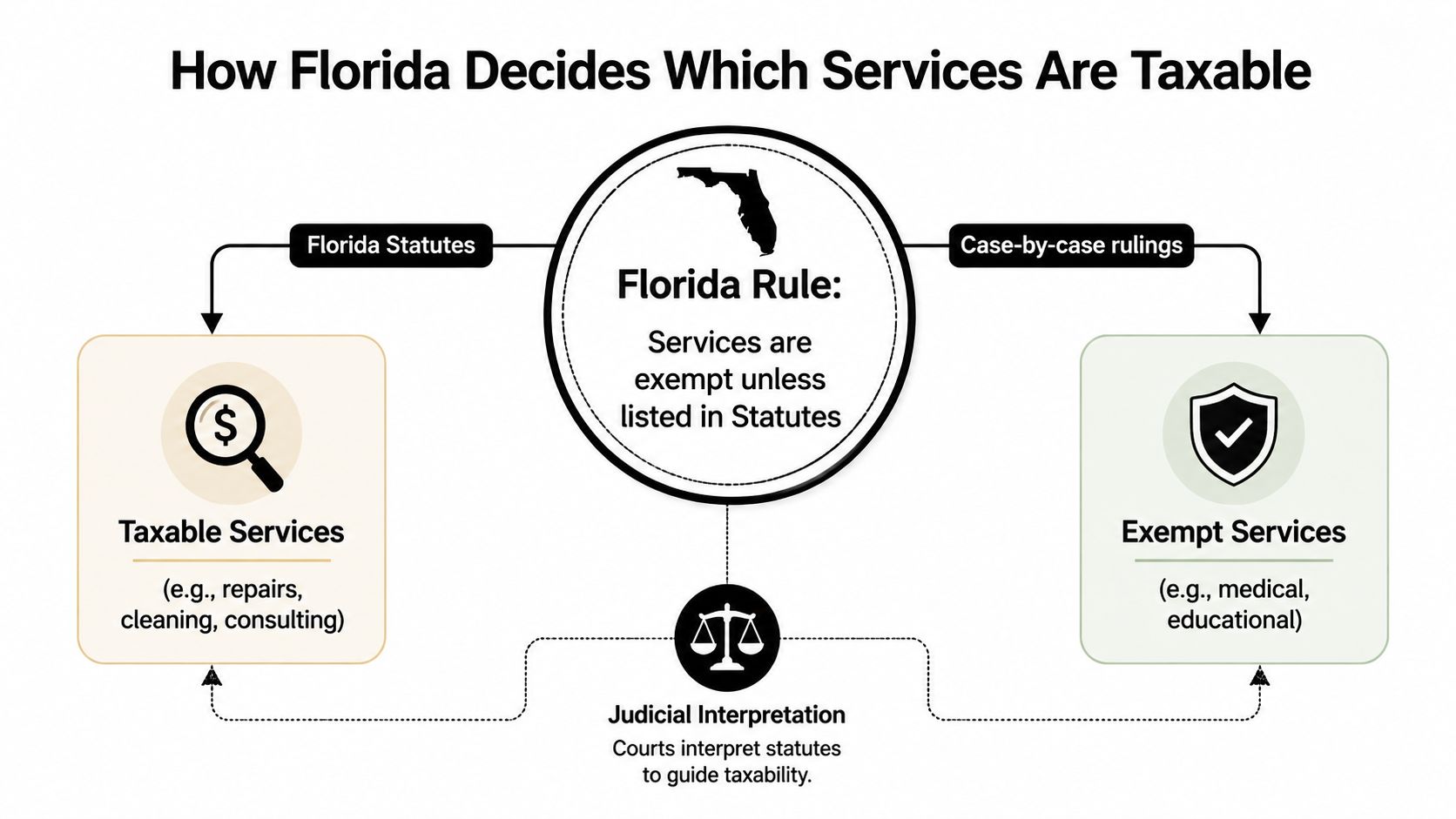
Florida starts from a rule many owners find counterintuitive: a service is generally exempt unless a Florida statute specifically makes it taxable. Chapter 212 provides the statutory foundation, while Department of Revenue publications and administrative rules help apply the law to particular transactions.
For a taxable service, begin with three questions:
- What did the customer buy? Identify the actual deliverable, not the brand name of the business.
- Does a statute or rule specifically include that service? A service becomes taxable because Florida law brings it into the tax base.
- Did the transaction also transfer tangible personal property? A product, material, part, or other tangible deliverable can change the analysis.
The state rate on a taxable transaction is 6%, before any applicable county discretionary surtax. The Florida Department of Revenue service-tax publication identifies detective and burglar-protection services, interior nonresidential cleaning, and nonresidential pest control as taxable examples. It also identifies accounting, legal, and consulting work as generally exempt professional services.
Don't confuse service tax with product tax
A consulting engagement can be exempt while a separate sale of equipment, materials, or other tangible personal property is taxable. A repair business may perform labor, but the transaction can involve parts or materials that affect the tax treatment. An invoice with separate lines doesn't automatically make every line independent for tax purposes.
That distinction is where many owners get into trouble. A company might describe a contract as “maintenance services,” but the customer could be receiving taxable cleaning, pest control, repair work, or tangible items. The accounting system must preserve the underlying detail, including contracts, work orders, invoices, exemption documents, and resale certificates.
Use the rule, not intuition
Florida's administrative rule on taxable services and use tax also introduces the primary benefit test. When a service is delivered remotely, bundled with other components, or used across locations, the tax analysis can depend on where the primary benefit is used or consumed. The Florida administrative rule on taxable services and use tax addresses situations involving Florida real property, tangible personal property, or purchaser activity.
That means a software, consulting, or digital-service invoice shouldn't be classified solely by the customer's billing address. Review the contract, the deliverable, the place of use, and whether the charge is for resale or an exempt use. If the answer isn't clear, get a CPA involved before collecting the wrong amount or failing to collect anything.
Taxable Versus Exempt Services by Industry
Industry labels are useful for a first review, but they aren't the final answer. Your exact service package, contract language, tangible deliverables, customer location, and use of the service control the analysis.
| Industry | Service Example | Tax Status | Statutory Reference |
|---|---|---|---|
| Marketing and consulting | Strategy, campaign planning, and consulting | Generally exempt | Florida Department of Revenue guidance on generally exempt consulting services |
| IT and software | Consulting or digital support | Requires transaction review | Primary benefit and use analysis under Rule 12A-1.0161 |
| Cleaning and pest control | Commercial facility cleaning or pest control | Taxable when specifically covered | Florida Department of Revenue service-tax guidance and Rule 12A-1.0161 |
| Security | Detective, burglar protection, and related protection services | Taxable | Chapter 212 and Florida Department of Revenue guidance |
| Construction and repair | Work involving taxable repairs, materials, or fabrication | Fact-specific | Chapter 212 and applicable administrative rules |
| Health and wellness | Services that aren't specifically enumerated as taxable | Often exempt, subject to the exact transaction | Florida's enumerated-service structure |
| Legal and accounting | Legal, accounting, and professional advice | Generally exempt | Florida Department of Revenue service-tax guidance |
| Property management | Management, maintenance, cleaning, or bundled facility services | Separate the components | Applicable statute or rule for each service |
Common examples
A digital marketing agency that provides strategy, media planning, and reporting will generally be handling exempt consulting work. If the same agency adds signage installation, sells tangible promotional items, or places taxable services inside a facility-management contract, the added components require separate review.
An IT firm faces a different concern. Remote consulting may be exempt, but software access, implementation work, equipment, and customer use across multiple locations can create classification and sourcing questions. Don't assume that the word “SaaS” settles the Florida sales tax question.
Commercial cleaning and pest-control businesses should be more direct with themselves. The Florida sales tax rules for nonresidential cleaning and pest control identify these services as taxable at 6% of the total sales price or cost price. The tax applies to each taxable service transaction, not to a company's year-end net revenue.
Separate records before revenue grows
If your business has both taxable and exempt work, create separate service codes in QuickBooks or your accounting platform. Use distinct invoice lines, retain exemption documentation, and reconcile taxable sales to the sales tax return.
A clean invoice is helpful, but a clean transaction history is what protects you during a review.
Don't let an exempt consulting line hide taxable cleaning, protection, repair, or tangible-property revenue. Mixed businesses need a written classification policy and someone accountable for reviewing new offerings before sales staff start selling them.
Hidden Compliance Traps for Remote and Multi-County Services
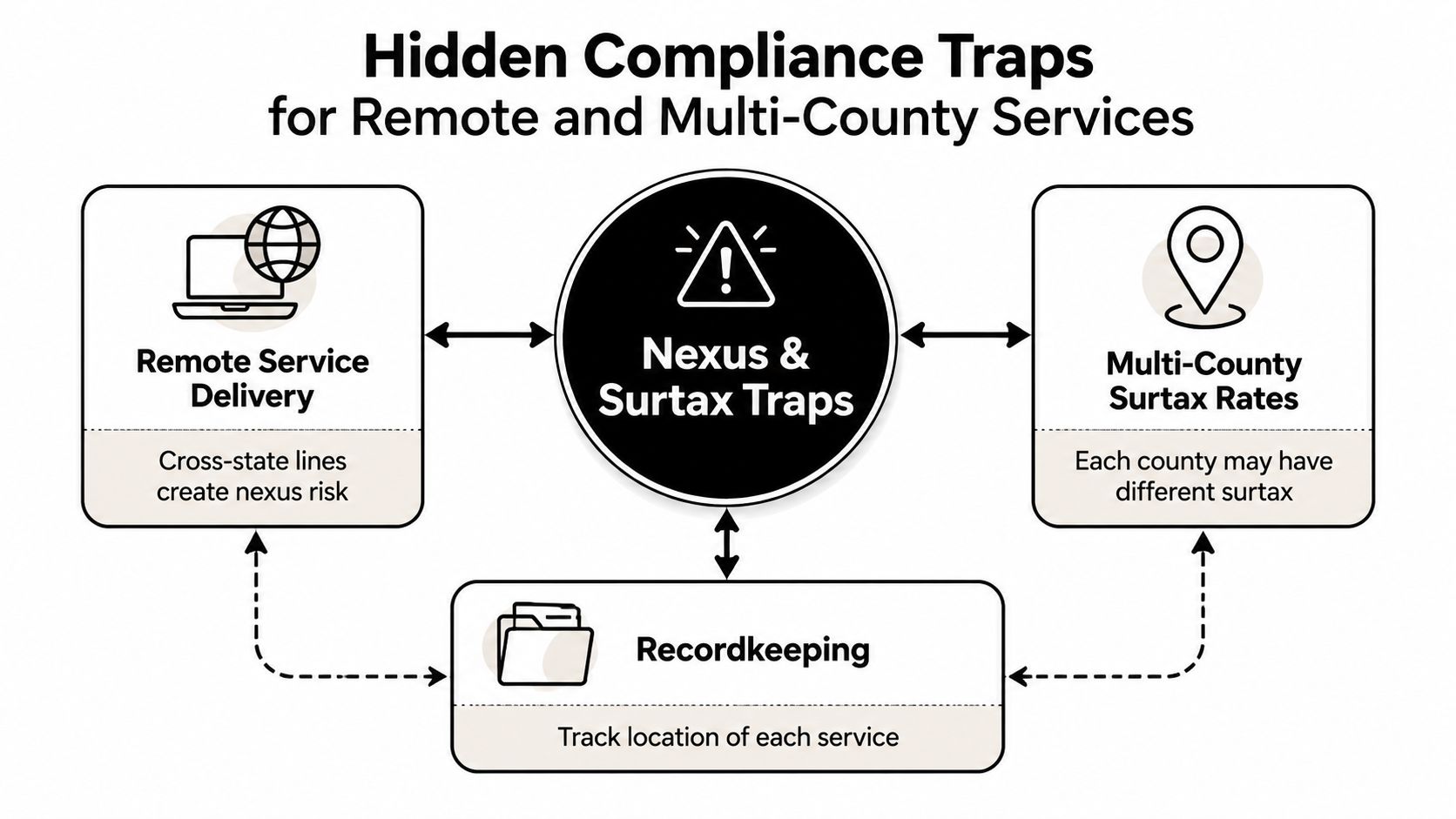
Remote delivery changes the question from “Is this service taxable?” to “Where is the primary benefit consumed?” A Florida consultant can serve a client with operations in several states. An IT provider can configure software for users in multiple offices. A construction consultant can advise on a Florida property while working from another location. The billing address alone may not resolve the tax treatment.
Florida's primary benefit test can pull a service into tax when the benefit is used or consumed in Florida. The administrative rule points to factors such as the location of Florida real property, tangible personal property, or the purchaser's activity. For a growing firm, that means contracts should identify the service location, customer use, deliverables, and any resale arrangement.
County surtax requires transaction-level discipline
Florida's state rate is 6%, but a county discretionary surtax may also apply based on where the sale is sourced, as explained in this Florida sales tax guidance for small businesses. The total rate can therefore exceed the state rate. A business serving customers across county lines can't use one statewide rate in every invoice template.
Recent coverage also identifies 2026 county surtax changes, including Palm Beach County's surtax drop to 0.5%, as discussed in this Florida tax law coverage of county surtax changes. Rate changes create a practical billing risk. If your accounting software, tax table, or invoice template isn't updated, you can under-collect from customers or overpay from company funds.
A remote service provider should retain:
- Service location: Record where the customer receives or uses the primary benefit.
- Contract terms: Preserve language describing deliverables, locations, resale, and exemptions.
- County evidence: Keep the customer address, project address, and sourcing decision supporting the surtax.
- Transaction detail: Separate taxable services, exempt services, products, and reimbursed charges.
SaaS and digital services deserve their own review because the service may be delivered from one place, accessed in another, and used by employees in several jurisdictions. The primary benefit may be tied to Florida activity even when your team never visits the customer's office.
For broader planning, use this complete guide to sales tax compliance as a reference point for remote and multi-state obligations. Then have a CPA apply the analysis to your contracts rather than copying a generic internet-sales workflow.
Registration Collection and Filing Requirements
Once Florida law makes your service taxable, compliance becomes an operating process. The Florida Department of Revenue requires dealers to register, collect, report, and remit sales and use tax before beginning business operations in the state, as stated in its business tax registration guidance.
Register before collecting
Complete the Florida Business Tax Application, Form DR-1, and obtain the applicable sales tax registration. The state issues registration documentation, and the certificate should be available at each business location where the requirement applies. Don't wait until your first audit question to determine whether the business should have registered.
Your accounting setup should include:
- A taxable-service revenue category.
- An exempt-service revenue category.
- A sales-tax payable account.
- County sourcing fields or customer-location records.
- A document folder for resale certificates and other exemptions.
The Florida sales tax filing resource can help you organize the filing workflow, but your classifications still need to match the services you sell.
Collect, document, and remit
Add the applicable state tax and county surtax to taxable invoices. Don't treat tax collected as revenue. Post it to a liability account and reconcile that balance to the return before payment.
Florida recognizes exemption categories that include government entities and certain nonprofit organizations. A resale exemption depends on proper documentation, including a valid Florida Annual Resale Certificate. Keep certificates with the related customer records, not in an unorganized email folder.
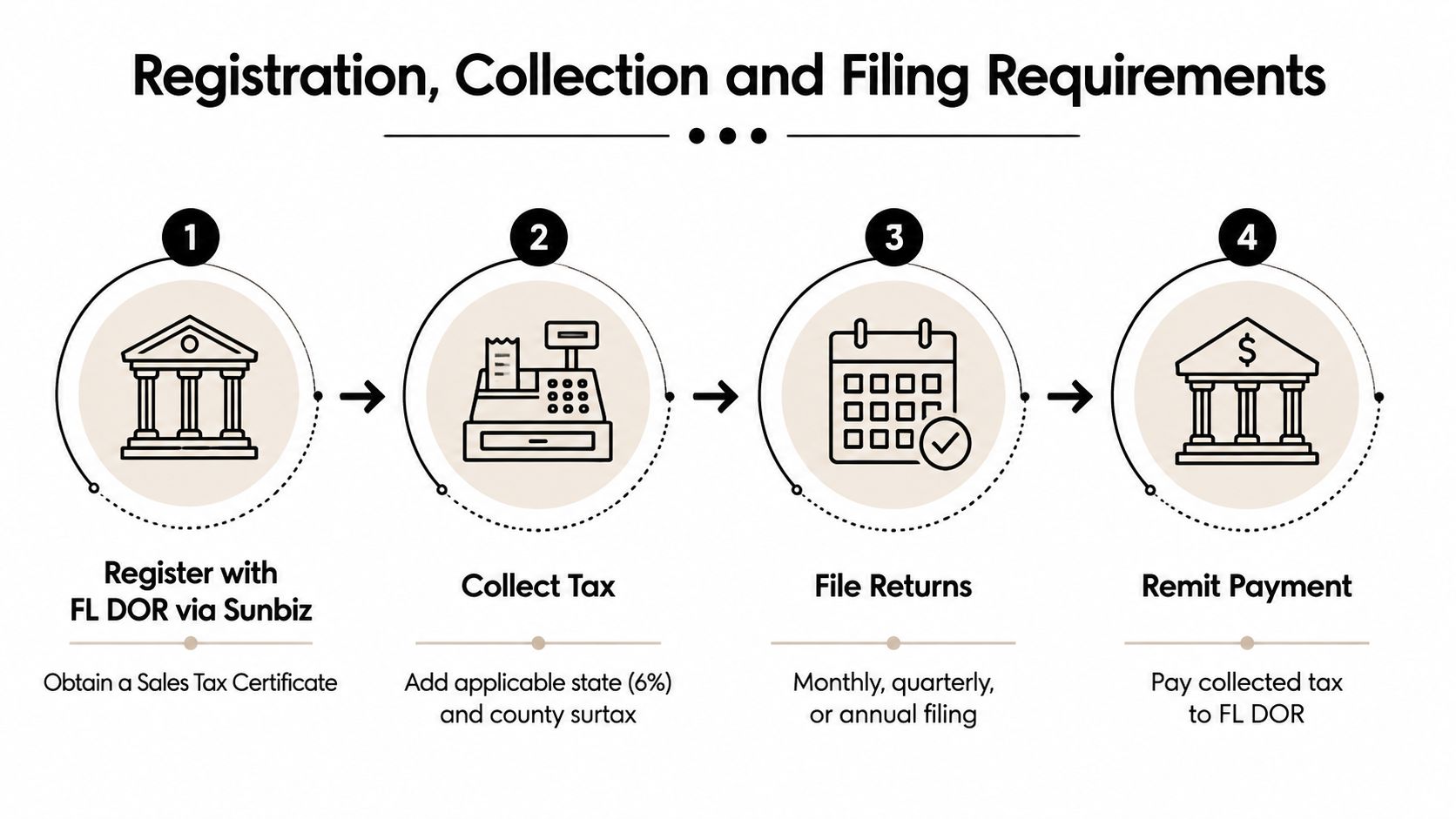
Your filing frequency is assigned by the state. It may be monthly, quarterly, or annual, depending on the business's tax circumstances. Use the filing schedule shown by the Department of Revenue, reconcile gross taxable sales, exemptions, surtax, and payments, and save the submitted return with the supporting report.
A business owner who needs senior financial oversight without adding a full-time executive may also benefit from hiring a part-time CFO for founders. The CFO's role isn't to replace tax counsel. It's to make sure tax liabilities, cash reserves, reporting, and operating decisions stay connected.
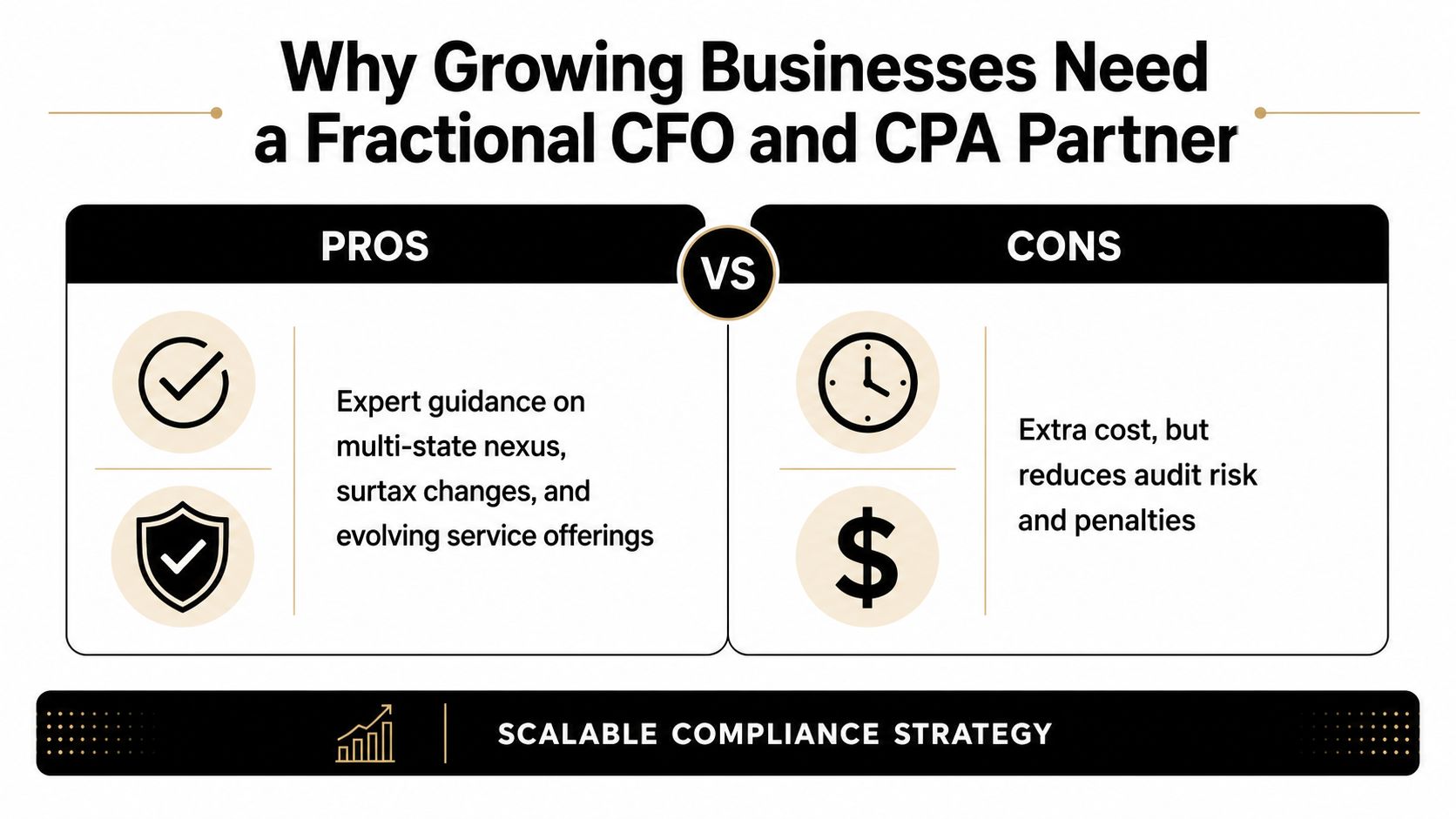
Why Growing Businesses Need a Fractional CFO and CPA Partner
A business can survive a simple sales tax process with an owner, a bookkeeper, and a calendar. Growth changes the equation. New service lines, remote customers, multiple counties, subcontractors, software platforms, and acquisitions create transactions that don't fit a single checkbox.
A fractional CFO watches the financial system around the tax return. That includes revenue classification, cash planning, customer concentration, margin analysis, and the liability created by tax collected or potentially owed. A CPA partner handles the technical interpretation, registration decisions, return review, exemption support, and communication when the Department of Revenue asks questions.
What each advisor should own
A fractional CFO should help you see the business before a deadline forces a decision:
- Revenue architecture: Identify taxable, exempt, product, and bundled revenue streams.
- Cash planning: Reserve collected tax and model obligations before payroll or expansion consumes cash.
- Process control: Assign responsibility for invoice review, certificates, reconciliations, and filing approval.
- Growth review: Evaluate new locations, customer markets, contracts, and service packages for tax exposure.
A CPA should challenge the legal and accounting assumptions:
- Taxability analysis: Review service descriptions against Florida statutes and administrative rules.
- Sourcing review: Examine remote delivery and primary benefit decisions.
- Documentation: Test resale certificates, exemption records, invoices, and contracts.
- Corrections: Help address discovered errors, amended filings, notices, or audit requests.
Why DIY stops working
Spreadsheets don't automatically know that a new service has become taxable. Invoicing software may calculate a rate, but it can't reliably decide where the primary benefit was consumed or whether a bundled contract should be separated. A bookkeeper can record what the sales team entered, but a CPA and CFO should question whether the original classification was right.
All companies don't need a full-time CFO. Growing companies do need someone who can guide financial decisions, monitor compliance, and explain what the numbers mean. A fractional model gives owners access to senior oversight while the business builds the scale to support a permanent executive role. A practical overview of this approach is available in the fractional CFO services for small businesses resource.
The return on professional support isn't limited to avoiding a penalty. It includes cleaner financial statements, better cash decisions, faster responses to notices, and fewer surprises when a lender, investor, or buyer reviews the books.
Your Sales Tax Compliance Checklist and Next Steps
Use this checklist before your next filing cycle, new contract, or service launch:
- Inventory services: List every service, package, add-on, product, and reimbursed charge.
- Check Florida law: Compare each taxable service against Chapter 212 and relevant Florida administrative rules.
- Review the primary benefit: Document where remote or bundled services are used and consumed.
- Register properly: Complete Form DR-1 before beginning taxable business operations.
- Configure accounting: Separate taxable and exempt revenue, sales tax payable, county surtax, and resale transactions.
- Source each sale: Record the customer, project, property, and service-use location.
- Collect certificates: Maintain valid resale certificates and exemption documents with customer files.
- Reconcile returns: Tie invoices, payments, taxable sales, exemptions, surtax, and the liability account together.
- Track deadlines: Follow the filing schedule assigned by the Florida Department of Revenue.
- Escalate exceptions: Ask a CPA to review unusual contracts, digital delivery, repair work, and multi-state activity.
Know when to stop handling it alone
Bring in professional help if your business has started serving customers in other states, bundles taxable and exempt services on one invoice, sells software or digital access, changes counties, acquires another company, or receives a Florida Department of Revenue audit notice. These situations need judgment and documentation, not a copied tax setting from an invoicing platform.
You should also schedule a review if you suspect the business failed to collect tax in the past. Waiting can leave the owner trying to reconstruct contracts, locations, exemptions, and customer invoices under pressure. The sales tax compliance services resource is a useful starting point for building a structured review and filing process.
Florida sales tax for services is manageable when your service catalog, contracts, accounting records, and filing process agree with one another. It becomes dangerous when the business relies on the phrase “most services are exempt” and never checks the exceptions.
Bookkeeping and Accounting of Florida Inc. helps businesses review service taxability, organize taxable and exempt revenue, manage Florida sales tax filing, and maintain reliable books for compliance decisions. Visit Bookkeeping and Accounting of Florida Inc. to schedule a consultation with a CPA or fractional CFO who can review your service catalog and build a practical workflow before errors accumulate.