
Friday night in Jacksonville, a business owner is trying to run payroll while wondering why the bank balance is lower than expected. Sales looked respectable, customers owe money, and yet payroll, rent, materials, and taxes are all due before those invoices turn into cash. That isn't a bookkeeping problem in the narrow sense. It's a business-control problem.
Thank you for reading this post, don't forget to subscribe!A bookkeeper should do more than enter transactions into QuickBooks. The right professional gives you reconciled accounts, dependable payroll records, current financial statements, a rolling cash forecast, and enough job or service-line detail to show where profit comes from. If you're asking, “How can a bookkeeper help my business?”, the practical answer is this: a bookkeeper turns financial activity into decisions before a small problem becomes an expensive surprise.
Why Owners Finally Call a Bookkeeper
A vendor refuses favorable terms, a loan application stalls because the financial statements do not tie out, or an IRS notice arrives while the owner is still tracing which account paid the bill. Those moments expose bookkeeping as a cash-flow and compliance survival system, not clerical cleanup.
Disorganized books create decision paralysis. During a slow Jacksonville summer, a contractor may hesitate to hire, buy equipment, or reduce overhead because nobody can say whether cash is tight for a week or margins have been deteriorating for months. The U.S. Small Business Administration reports that, among new employer establishments tracked from 1994 through 2022, 67.7% survived at least two years, 49.2% survived five years, 33.9% survived ten years, and 25.5% survived fifteen years. Those figures do not prove bookkeeping determines survival. They show why owners need reliable information during financially vulnerable years. SBA survival data and bookkeeping analysis
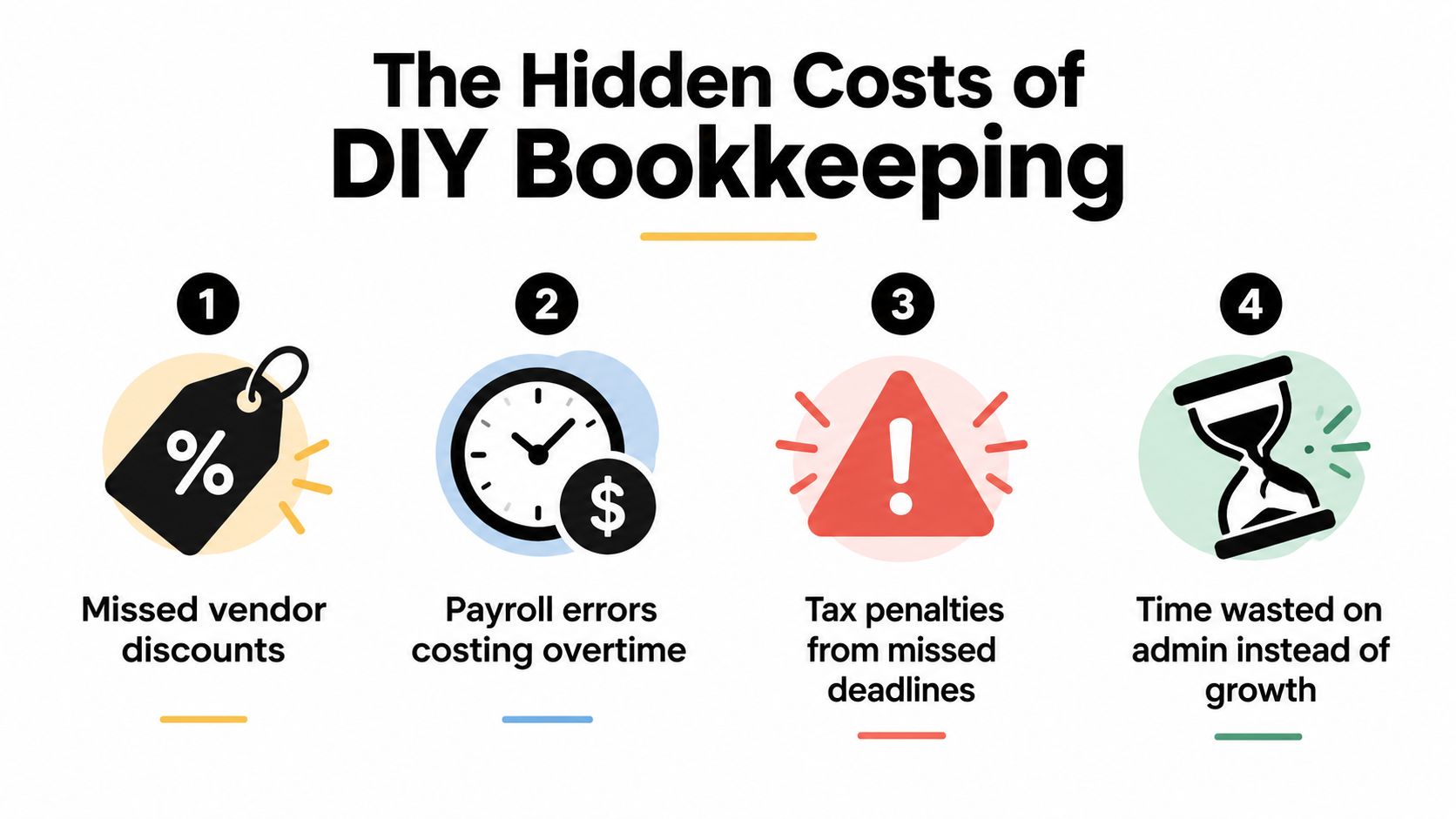
A truck-console full of receipts and transactions labeled “Miscellaneous” creates a bill that arrives later. Missed vendor discounts, payroll mistakes, tax penalties, denied financing, and wasted evenings all drain the same company account.
What the monthly process should produce
A qualified bookkeeper should install a repeatable financial rhythm:
- Reconciled accounts: Bank, credit-card, merchant, and loan accounts match the books, with discrepancies investigated instead of ignored.
- Clean payroll runs: Wages, withholdings, payroll liabilities, and payments tie out each period.
- Current financial statements: Your profit and loss statement, balance sheet, and cash-flow information arrive while decisions still matter.
- A rolling cash forecast: Weekly expectations for collections, payroll, taxes, debt payments, rent, and major purchases expose pressure early.
- Job-level profitability: Construction, HVAC, plumbing, medical, and other service businesses can see whether individual jobs or service lines earn their keep.
The owner decides whether to borrow, hire, reprice, or cut spending. The bookkeeper supplies dependable records, while fractional CFO guidance turns those records into choices about capacity, pricing, and timing. Use this guide to hiring a bookkeeper to evaluate qualifications, workflow, and communication before handing over the keys to the books.
For 2026 tax work, current payroll records, contractor documentation, expense support, and reconciled accounts give your CPA a usable file for applying the rules in effect. Clean records also reduce the scramble created by notices, filing deadlines, and questions about deductions.
The administrative burden is substantial. An NFIB survey found that 53% of small employers personally handled financial paperwork and recordkeeping, while 15% delegated it to an employee. Approximately 42% spent at least four hours per month on tax-compliance activities, including 12% who spent more than ten hours monthly. The IRS Taxpayer Advocate Service estimated that small businesses spend roughly 82 hours and $2,900 on tax compliance. Small-business bookkeeping and tax-compliance burden
That time belongs with customers, staff, and operations. A qualified bookkeeper protects the records, and the right fractional CFO helps turn them into decisions before a preventable surprise reaches the bank account.
Turning Accurate Books Into Cash You Can Use
A Jacksonville HVAC contractor can report $40,000 in October revenue and still miss payroll. The job may be finished while the general contractor's invoice keeps aging. A materials draw has already cleared the bank, and payroll arrives Friday. The profit and loss statement records the sale. Employees require collected cash.
That is why a qualified bookkeeper should manage accounts receivable as part of the operating rhythm, not file a report at month-end and disappear. Monday starts with a cash snapshot covering the bank balance, expected payments, upcoming obligations, and unusual transactions. Wednesday focuses on the accounts-receivable aging report, especially slow-paying builders, disputed invoices, and completed work that was never billed. Friday previews payroll, vendor payments, tax obligations, and the following week's cash position.
A rolling 13-week cash forecast gives the owner time to act. It will not predict every deposit or expense, but it exposes pressure before the bank account does. The business can accelerate collections, delay a purchase, revise payment terms, draw on a line of credit, or speak with a lender while choices remain available.
Practical rule: Profit shows whether the work is worthwhile. Cash forecasting shows whether the business can survive the timing.
Late invoices deserve immediate attention. Research on U.S. small businesses found that 56% had outstanding invoices in early 2025, with affected businesses averaging $17,500 owed. 47% reported invoices more than 30 days overdue, and businesses with heavier overdue-invoice exposure were more than 1.4 times as likely to report cash-flow problems. Small-business late-payment findings
Reports that trigger action
A bookkeeper should connect every report to a decision the owner can make:
- Cash-flow statement: Shows whether operations generate or consume cash after collections, purchases, debt payments, and payroll.
- Accounts-receivable aging: Identifies customers who need a reminder, a call, revised terms, or a collections decision.
- Accounts-payable aging: Separates urgent obligations from bills that can be scheduled without damaging supplier relationships.
- Job-cost variance report: Compares estimated labor, materials, and subcontractor costs with actual results.
- Gross margin by service line: Shows whether maintenance agreements, installations, emergency calls, or other offerings are carrying the business.
For a contractor working through Jacksonville's storm season, these reports may show that emergency calls are profitable while routine installations are underpriced because labor hours were underestimated. The owner can correct the estimate instead of blaming the weather. A medical practice with uneven insurance reimbursements can use the same review to see whether payroll commitments arrive before payer collections.
| Day | Bookkeeper Task | Owner Decision It Supports |
|---|---|---|
| Monday | Prepare cash snapshot and update the 13-week forecast | Decide whether upcoming obligations require collection action, spending control, or financing |
| Wednesday | Review accounts-receivable aging and unbilled work | Contact slow-paying customers and accelerate invoices |
| Friday | Preview payroll, payables, tax obligations, and bank activity | Approve payments, protect payroll cash, and schedule nonessential spending |
| Month-end | Reconcile accounts and review job-cost and margin reports | Reprice services, adjust staffing, and address unprofitable work |
Owners who need this discipline can evaluate monthly bookkeeping services that include recurring reconciliations, reporting, and financial review. For 2026 tax work, the same records help keep tax obligations visible alongside payroll, vendor payments, and collections. A bookkeeper maintains the schedule, while fractional CFO guidance helps decide which pressure deserves action first.
The goal is knowing what cash is free, what is committed, and what must happen before Friday.
What Clean, Audit-Ready Books Actually Look Like
The IRS expects business books to summarize transactions and show gross income, deductions, and credits. Supporting evidence can include sales slips, paid bills, invoices, receipts, deposit slips, and canceled checks. The IRS also explains that good records help a business monitor progress, prepare financial statements, identify income sources, track deductible expenses, prepare returns, and support reported items. IRS recordkeeping requirements
Clean books begin with the chart of accounts. A Jacksonville healthcare practice shouldn't post every deposit to “Revenue” and every payment to “Expense.” Patient service revenue, insurance reimbursements, lab fees, medical supplies, provider compensation, rent, software, and merchant fees should be visible in separate, meaningful categories. A practice owner can then distinguish clinical performance from ancillary services and see whether reimbursement delays, staffing costs, or lab expenses are affecting cash.
The same discipline applies to construction and trades. Each project needs identifiable labor, materials, subcontractors, permits, equipment, and change-order activity. A dedicated loan account should separate principal from interest. Merchant processor fees should be recorded separately rather than reducing sales invisibly. “Miscellaneous” should be an exception awaiting review, not a permanent filing cabinet.
The difference between tidy and defensible
Messy bookkeeping usually has three symptoms: personal and business transactions are mixed, categories are vague, and supporting documents are missing. That combination makes tax preparation slower, financing harder, and an audit more uncomfortable than it needs to be.
An audit-ready system reconciles bank and credit-card accounts, classifies revenue and deductible expenses consistently, preserves invoices and receipts, and links material balances to supporting documents. The bookkeeper should complete a monthly close with a bank reconciliation, receivables and payables review, payroll tie-out, and exception report. Management reports should explain meaningful variances instead of merely exporting raw accounting data.
| Category | Messy Version | Audit-Ready Version |
|---|---|---|
| Revenue | One broad income account for every service | Separate patient, project, product, or service-line revenue |
| Contractor payments | Unsupported transfers labeled “labor” | Vendor file, tax information, invoices, classification review, and payment history |
| Loans | One account for the entire payment | Principal and interest tracked separately with the loan balance reconciled |
| Merchant fees | Net deposits recorded as sales | Gross sales recorded with processing fees shown separately |
| Personal spending | Owner purchases mixed into business expenses | Owner draws or reimbursements documented and separated |
| Receipts | Paper documents scattered across vehicles and email | Indexed electronic records linked to transactions |
| Project costs | Materials and labor posted to general expense | Costs assigned to jobs for margin and variance analysis |
When records have already deteriorated, a business may need a structured bookkeeping clean-up service comparison before ongoing monthly bookkeeping can work properly. Cleanup isn't a cosmetic exercise. It establishes opening balances, corrects classifications, identifies missing support, and gives the next reporting period a trustworthy starting point.
The result is practical. A lender receives coherent statements. A tax preparer gets organized documentation. A business can issue required information returns from reliable vendor records. Sales-tax reporting becomes less painful. If the IRS asks how a deduction was calculated, the owner can retrieve the evidence instead of beginning a weekend archaeological dig.
Payroll, 1099s, and the 2026 Compliance Reset
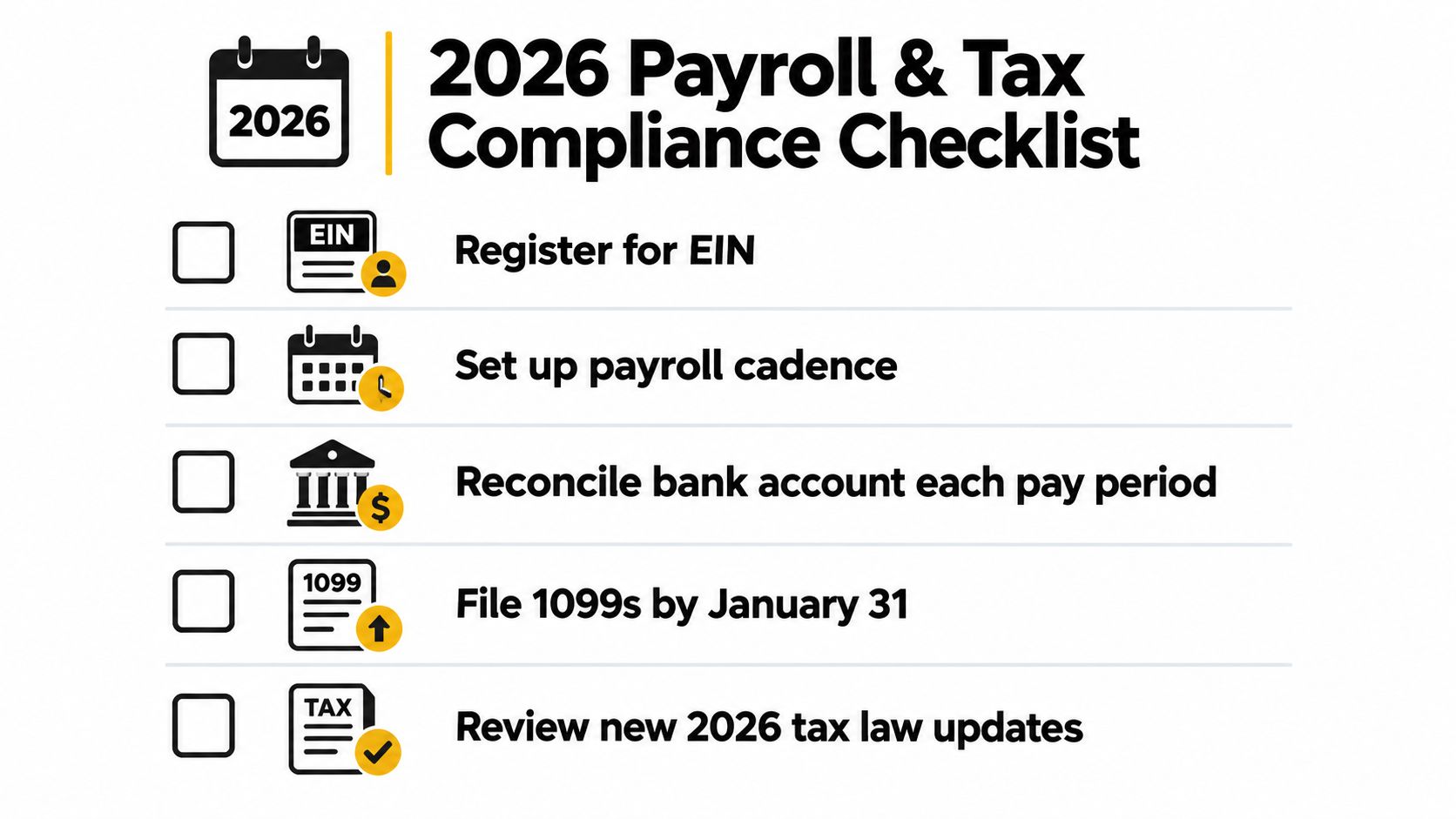
Payroll compliance begins before the first paycheck. A business needs an employer identification number, a documented payroll cadence, accurate worker records, properly configured withholdings, and a reconciliation process that matches payroll reports to the bank and general ledger.
A bookkeeper can own the recurring workflow. That includes reviewing employee and contractor classifications, processing payroll, tracking payroll liabilities, reconciling each pay period, monitoring deposits, matching filed returns to the ledger, and preserving payment confirmations. The owner should approve payroll and remain involved in hiring and classification decisions, but the system shouldn't depend on memory and a calendar notification.
Beginning with payments made after December 31, 2025, the federal reporting threshold for certain business payments rises from $600 to $2,000 under the One Big Beautiful Bill Act. For calendar year 2026, businesses generally won't need to issue Forms 1099-NEC or 1099-MISC for qualifying payments below $2,000 to a recipient, and the same amount applies to related backup-withholding rules. For calendar years after 2026, the threshold will be adjusted for inflation. IRS explanation of the business tax provisions
That change doesn't eliminate vendor recordkeeping. A bookkeeper still needs current vendor tax information, payment totals, worker classifications, and year-end reporting controls. Applying an outdated $600 rule is poor compliance. Assuming the new threshold means no records are required is worse.
Payroll records need a retention system
The IRS requires employment-tax records to remain available for inspection for at least four years after the tax becomes due or is paid, whichever is later. Electronic systems must index, preserve, retrieve, and reproduce records in legible form. IRS Publication 583 recordkeeping guidance
A sound digital audit trail keeps payroll registers, employee tax forms, filings, wage calculations, payment confirmations, and reconciliations together. Asset invoices and depreciation support need their own retention logic because the relevant property record may remain important after the original purchase.
Payroll deposits also require monitoring. Deposit frequency depends on the employer's prior-period liability, and an accumulated $100,000 liability during a deposit period can trigger next-business-day payment requirements. Employers must track wage payments, withholdings, deposits, quarterly employment-tax returns, and supporting documentation. IRS employment-tax recordkeeping guidance
For owners who want a broader perspective on how payroll connects with personnel administration, this HR and payroll integration UK guide for offers useful process context, although Jacksonville businesses still need U.S. payroll and tax procedures.
The 2026 self-employment-tax limit also matters to sole proprietors, partners, and other owners with taxable self-employment income. For 2026, the maximum amount of net self-employment earnings subject to the Social Security portion is $184,500, separate from the Medicare component. Timely books let the owner and tax professional distinguish revenue, deductible expenses, distributions, guaranteed payments, and taxable profit when estimated payments are reviewed. IRS Publication 334
The practical recommendation is simple. Don't wait for tax season to discover that payroll liabilities, vendor files, and owner payments were never reconciled. Use a recurring checklist and a qualified bookkeeper who knows what must be filed, what must be retained, and what needs a CPA's judgment.
For owners who want the mechanics of recording payroll activity explained, the payroll accounting entries guide is a useful reference.
Where a Bookkeeper Pays Off Most by Industry
A generic bookkeeping package is rarely enough for a business with specialized revenue, compliance, or cost structures. The right bookkeeper understands how money moves through the industry, then builds the chart of accounts and reporting around that reality.
A Jacksonville construction company needs job costing, work-in-progress tracking, change-order control, subcontractor documentation, and billing that ties to project progress. If labor hours and materials are posted to broad expense accounts, the owner may see revenue without seeing which projects are consuming the margin. A bookkeeper can compare estimated and actual job costs before the next bid repeats the same mistake.
Healthcare practices face a different problem. Patient revenue, insurance reimbursements, lab fees, provider compensation, credentialing payments, and contracted providers need separate treatment. Clear records support payroll, contractor reporting, cash forecasting, and financial conversations about adding staff or opening another location.
Retail and e-commerce businesses need transaction flows that match the sales platform. Shopify deposits, payment processor fees, refunds, shipping, inventory purchases, and cost of goods sold must reconcile to QuickBooks or another accounting system. Businesses selling across state lines may also need sales-tax nexus tracking and reporting processes that don't rely on whichever platform category appeared in the bank feed.
Nonprofits need fund accounting, restricted-versus-unrestricted tracking, grant expense documentation, and reporting that supports Form 990 preparation and audits. Treating restricted funds like ordinary operating cash is not a harmless shortcut.
| Industry | Key Bookkeeping Deliverables |
|---|---|
| Construction and trades | Job costing, work-in-progress tracking, project billing, subcontractor records, payroll, and margin-by-job reporting |
| Healthcare | Patient and insurance revenue separation, lab and clinical expense tracking, provider compensation, payroll, and contractor reporting |
| Retail and e-commerce | Shopify-to-accounting reconciliation, inventory valuation, refunds, processor fees, cost-of-goods-sold review, and sales-tax tracking |
| Nonprofit organizations | Fund accounting, restricted-fund controls, grant documentation, Form 990 preparation support, and audit-ready reporting |
The best system reflects the owner's actual decisions. A contractor needs to know whether to accept a project. A clinic needs to know whether collections support another provider. A retailer needs reliable inventory and margin information. A nonprofit needs to prove that restricted money was used correctly. Bookkeeping becomes valuable when it answers those questions without requiring the owner to reconstruct the business from bank statements.
AI in the Books Without Losing Control
AI doesn't replace a bookkeeper. It replaces some repetitive keystrokes, which is useful, but hardly the same thing.
QuickBooks AutoCategorize, Xero's coding tools, and bank-feed rules can match transactions, extract receipt information, flag duplicates, and post recurring entries. They can't reliably determine why a vendor invoice belongs to a specific construction job instead of office supplies. They won't independently resolve whether a worker should receive a W-2 rather than a 1099. They can't read a contract and decide whether construction retainage is earned revenue or deferred revenue.
Research covering more than 34,000 small and midsize business owners across the United States, Canada, the United Kingdom, and Australia found that bookkeeping is among the leading business tasks where U.S. companies report using AI. The same research describes adoption as a range of embedded software features and standalone tools, not fully autonomous bookkeeping. Separate small-business research found that 19% used AI weekly specifically for bookkeeping, while about 30% planned to increase usage within six months. AI impact research for small and midsize businesses
Decision rule: Let AI move the paper. Let the bookkeeper decide what the paper means.
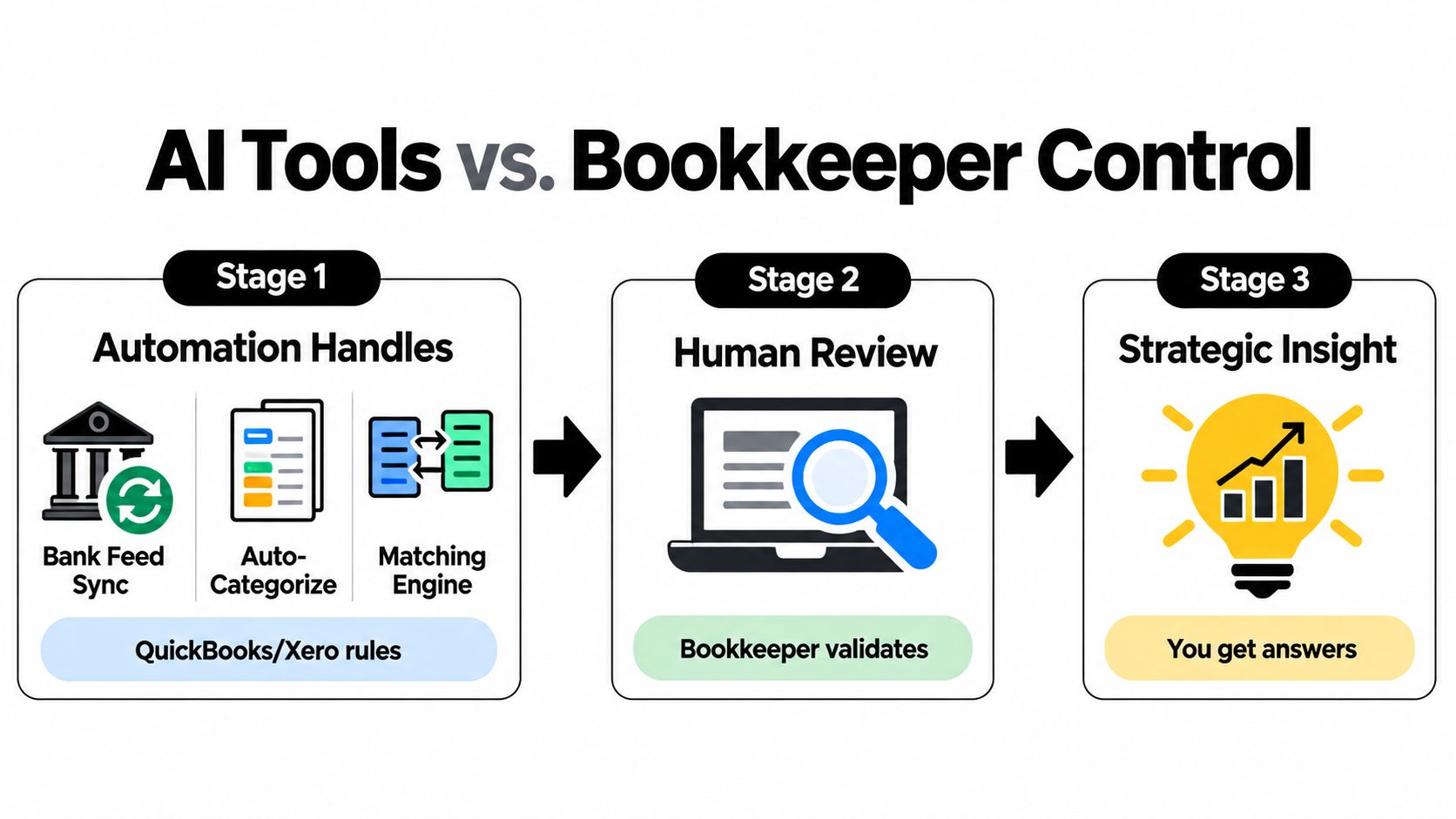
A controlled workflow has three stages:
- Automation handles the mechanical work. Bank feeds sync, receipts are extracted, routine transactions are matched, and duplicate entries are flagged.
- The bookkeeper reviews exceptions. Unusual transactions, new vendors, large purchases, payroll entries, job coding, and account reconciliations receive human review.
- The owner receives useful answers. Reports explain cash pressure, margin changes, overdue receivables, and decisions that need approval.
AI can make errors faster and harder to notice. A wrong rule can misclassify an entire stream of transactions, contaminate job-cost reports, obscure deductions, and create an inaccurate tax package. Protect credentials, limit access, document the chart of accounts, and require a reviewed month-end close.
Owners evaluating technology for adjacent business tasks may find an AI legal assistant for business owners useful, but legal and financial tools serve different functions. Neither should replace qualified review of accounting records.
From Bookkeeper to Fractional CFO and When to Make the Call
A bookkeeper keeps the records clean, reconciles the bank, manages recurring financial workflows, supports payroll and reporting, and produces information the business can trust. A fractional CFO uses that information to model pricing, forecast hiring, evaluate equipment purchases, negotiate with lenders, plan tax moves, and decide which opportunities the business can afford.
Every company may not need a full-time CFO. Every growing company needs someone capable of providing CFO-level guidance before a major decision. A Jacksonville contractor bidding a $2 million project needs more than a clean bank reconciliation. The owner needs a cash model showing labor timing, materials, retainage, bonding, financing, and the effect on existing work. A healthcare practice opening a second location needs a startup budget, staffing model, reimbursement assumptions, and break-even analysis. A nonprofit approaching an audit needs fund controls, documentation, and a plan for reporting obligations.
Five signs the business needs help
- Unreconciled accounts older than 60 days: Nobody can trust the reported cash or liabilities.
- Surprise tax bills: Estimated payments and taxable profit aren't being monitored together.
- No 13-week cash forecast: The owner is operating from today's bank balance.
- More than 20 hours per month spent in QuickBooks: The owner is acting as an unpaid accounting clerk.
- A delayed decision because the numbers aren't ready: The business is losing time because reporting is not useful.
The handoff should be practical. A bookkeeper establishes accurate records and dependable reporting. A fractional CFO then interprets the information, models scenarios, and gives the owner a clear recommendation. Those roles work together. Strategy built on unreconciled books is just expensive guessing with better formatting.
For a Jacksonville small or midsize business, start with a one-hour diagnostic. Provide the last three bank statements and the current profit and loss statement. A qualified bookkeeping and fractional CFO team should identify missing controls, cash leaks, reporting weaknesses, and the decisions that need attention over the next 90 days.
Bookkeeping and Accounting of Florida Inc. provides bookkeeping, payroll, tax preparation, audits, QuickBooks support, healthcare and nonprofit accounting, and fractional CFO guidance for Jacksonville and Northeast Florida businesses. Visit Bookkeeping and Accounting of Florida Inc. to schedule a financial diagnostic and turn your books into a practical cash-flow and compliance system.