
Let’s be honest—the phrase “financial projections” can make even the most seasoned business owner’s eyes glaze over. But treating them as a chore is a massive mistake.
Think of projections as your business’s GPS. They guide you through growth, help you secure loans, and let you make smart decisions instead of reactive ones. Many businesses don’t fail because of bad ideas; they fail because of cash flow surprises that a good forecast would have seen coming a mile away.

This isn’t just about making up numbers. It’s about strategic budgeting and forecasting that forces you to connect your operational plans directly to your financial reality. It’s about asking the hard questions before they become expensive problems.
A well-crafted financial forecast is more than just a set of numbers; it's a declaration of your company's ambition and a practical guide for achieving it. It’s what separates businesses that react from businesses that lead.
Without this forward-looking map, you’re operating in the dark. You’re making decisions based on gut feelings, and that’s a recipe for costly errors. At its core, a financial projection is built from interconnected statements that tell the complete story of your business's financial health—past, present, and future.
Core Components of a Financial Projection
| Statement | What It Shows | Key Question It Answers |
|---|---|---|
| Pro Forma Income Statement | Your projected revenue, costs, and resulting profit or loss over a specific period. | "Are we going to be profitable?" |
| Pro Forma Balance Sheet | A snapshot of your company's projected assets, liabilities, and equity at a future point in time. | "What will we own and what will we owe?" |
| Pro Forma Cash Flow Statement | The movement of cash from operations, investing, and financing activities. | "Will we have enough cash to pay our bills?" |
Understanding how these three pieces fit together is the first step toward building a forecast you can actually rely on to run your business.
Don't Forget About Taxes (The IRS Won't)
One of the biggest holes we see in DIY projections is compliance. Tax laws are constantly in flux. The tax law changes scheduled for 2026 will directly affect deductions, tax rates, and your company's overall liability. What worked last year might get you a nasty letter from the IRS this year. Most small businesses do not know what all is required to stay compliant, and frankly, they shouldn’t have to.
But ignoring these changes in your forecast is like planning a road trip without checking for road closures. It leads to:
- Understated tax bills that create a sudden cash crunch.
- Inaccurate net income numbers that hide your true profitability.
- Missed planning opportunities that leave cash on the table.
You Don't Have to Do This Alone
Every business needs financial strategy, but not every business can afford a full-time CFO. This is where the right kind of expert guidance becomes a game-changer. All companies need a fractional CFO and someone to guide their business.
A fractional CFO gives you access to that high-level expertise without the six-figure salary. They don't just build the projections for you; they help you understand what the numbers are telling you. They need us to help them stay compliant. Our business accounting services are designed to do just that—turn your financial data from a confusing mess into your most powerful strategic weapon.
Curious what that level of support actually looks like? You can learn more about the strategic role a fractional CFO plays by reading our article on what a CFO does in a company.
Ultimately, this is about taking control. It’s about making proactive decisions, heading off challenges, and seizing opportunities with confidence. Let's stop thinking "I have to do this" and start thinking "I need this to win."
Gathering Your Financial Building Blocks
You can't predict your company's future by staring into a crystal ball. Solid financial projections are built on one thing: a deep understanding of your past. Think of it as your financial foundation. If you build on messy, inaccurate data, the whole forecast will come crashing down.
Before you even think about projecting, you need to do a detailed financial analysis of where you've been. This isn't just about pulling numbers; it's about finding the story behind them. This is how you build forecasts based on reality, not wishful thinking.
Start with Your Core Financials
The backbone of any good projection is your historical data. Your accounting software, like QuickBooks, is where this gold is buried. You’ll want to pull at least three years of clean, accurate reports to see credible patterns.
Your go-to documents are:
- Income Statements (P&L): These show your revenue, costs, and profits. Looking at a few years' worth helps you spot trends in sales growth and see where your expenses are creeping up.
- Balance Sheets: This is a snapshot of your assets, liabilities, and equity. It tells you what your company owns and owes, revealing its financial health at a single point in time.
- Statements of Cash Flows: Frankly, this might be the most important report of them all. It shows exactly how cash moves in and out of your business. A profitable company can still go broke if its cash flow is a mess.
Let's say your P&Ls from the last three years show a steady 10% annual sales growth. That's a real, historical trend you can use as a starting point for your revenue assumptions. It’s far more reliable than just picking a number out of thin air.
Look Beyond the Numbers
Your accounting software doesn't tell the whole story. The best projections also lean on operational data—the stuff that explains why the numbers look the way they do. Without this context, you're just guessing.
Garbage in, garbage out. The quality of your financial projections is a direct reflection of the quality of the data you start with. Clean, comprehensive data is non-negotiable.
Don't forget to dig into this non-financial info:
- Sales Records & CRM Data: What's your sales pipeline look like? Your conversion rates? Your average deal size? This data lets you build much more specific revenue forecasts.
- Customer Contracts: Are your clients on 30-day or 60-day payment terms? Do they pay upfront? The answer dramatically changes your cash flow projections.
- Industry Benchmarks: How do your margins stack up against your competitors? This is a crucial reality check for your assumptions.
Looking at your profit and loss statements next to this kind of operational data gives you a much richer, more accurate picture.
Why You Shouldn't Do This Alone
Let’s be honest. Gathering, cleaning, and making sense of all this data is a huge time sink, and it’s painfully easy to make mistakes. Your time is better spent running your business, not getting lost in spreadsheets.
This is where bringing in a professional pays for itself. A good CPA or fractional CFO doesn't just pull reports. They vet the data, find miscategorized expenses that are skewing your margins, and spot outdated assumptions that could get you into trouble. For instance, with major tax law changes on the horizon for 2026, building a forecast that ignores them is a recipe for a nasty surprise from the IRS.
Our business accounting services are designed to manage this whole process for you. We gather the right data, make sure it’s squeaky clean, and build a rock-solid foundation for projections that actually help you make smart decisions. It gives you the confidence and peace of mind to focus on what you're best at: growing your business.
Building a Realistic Revenue and Expense Forecast
Now that you have clean historicals, it’s time for the real work: turning your business strategy into numbers you can actually count on. This isn't about wishful thinking or plugging numbers into a template. It’s about building a revenue and expense forecast that serves as a real-world roadmap.
Most business owners get excited and jump right into forecasting revenue. I get it. But a more disciplined approach starts with your expenses. This forces an immediate reality check by grounding your forecast in what you know you have to spend, which then shows you the revenue you must generate just to keep the lights on.
Deconstructing Your Expenses
You can’t forecast what you don’t understand. Lumping all your costs into one big pile is a rookie mistake that hides serious problems and opportunities. The key is to split your spending into three buckets.
- Fixed Costs: These are your predictable, non-negotiable expenses. Think monthly office rent, salaried payroll, insurance premiums, and software subscriptions. They don't change whether you sell one widget or a thousand.
- Variable Costs: These costs are directly tied to your sales. For a construction company, it’s the lumber and hourly labor for a specific job. For a retailer, it’s the cost of the inventory you sell. More sales automatically mean higher variable costs.
- Semi-Variable Costs: This is the hybrid category. These costs have a fixed base but go up with activity. The classic example is a salesperson’s compensation—a fixed base salary plus a variable commission that depends on how much they sell.
Why does this matter so much? Because when you see the numbers clearly, you can manage them. We've seen U.S. small businesses reduce overall expenses by as much as 15% just by getting this part right. A Jacksonville business might have a fixed rent of $5,000 a month, but its variable material costs could swing wildly between 25-35% of revenue. You can't control what you don't track.
Some of the best guidance on making realistic projections for your business hammers home this "expenses first" method for a reason—it works.
Projecting Your Revenue with Real-World Data
Once your expense baseline is set, you can build a much smarter revenue forecast. Forget just adding 8% to last year's number and calling it a day. Is that even realistic? You need to build a forecast based on assumptions you can actually defend to a lender, an investor, or even just yourself.
A construction firm needs to look at its signed contracts and the probability of winning the bids it has out. A healthcare practice should be analyzing patient volume, insurance reimbursement rates, and whether its doctors have the capacity to see more people.
Your revenue forecast should be a story you can tell with confidence, backed by data. It should answer the question: "Where is this money actually going to come from?"
This is also where compliance trips up countless businesses. For instance, major federal tax law changes are set to hit in 2026. These will affect everything from individual tax rates to corporate deductions, hitting your bottom line directly. A forecast that ignores these shifts isn't just a bad guess; it's a financial time bomb.
Why You Need an Expert Guide for Your Forecast
Every company, big or small, needs someone to guide their business financially. That's exactly what a fractional CFO does. They bring an outsider’s perspective and deep industry knowledge that turns your forecast from a spreadsheet exercise into a real strategic weapon.
Imagine you run a construction company. A fractional CFO knows the headaches of job costing. They’ll factor in the very real impact of supply chain issues on your timelines and the volatility of local material costs. For a healthcare practice, they can model revenue based on changing insurance regulations—the kind of detail that keeps you compliant and profitable.
A fractional CFO doesn't just check your math. They challenge your assumptions, pressure-test your logic, and ensure your financial projections are aligned with your operational reality.
Let’s be blunt: most small business owners do not know what all is required to stay fully compliant. The landscape of tax laws, reporting standards, and industry regulations is a minefield that’s constantly changing. Trying to navigate it alone while running your business is a recipe for disaster.
This is where our business accounting services become your lifeline. You need us to help you stay compliant. We don't just help you build a forecast; we act as your strategic partner. We make sure your numbers are right, your assumptions are solid, and your business stays on the right side of the law so you can focus on what you do best—growing your business with confidence.
Assembling Your Pro Forma Financial Statements
Alright, you’ve wrestled with your assumptions and have a solid foundation for revenue and expenses. Now it’s time to put those numbers to work.
This is where we build the three pro forma statements that tell your financial story: the Income Statement, the Balance Sheet, and the Statement of Cash Flows. These aren't just separate reports; they're a tightly connected system where numbers from one flow directly into the next.
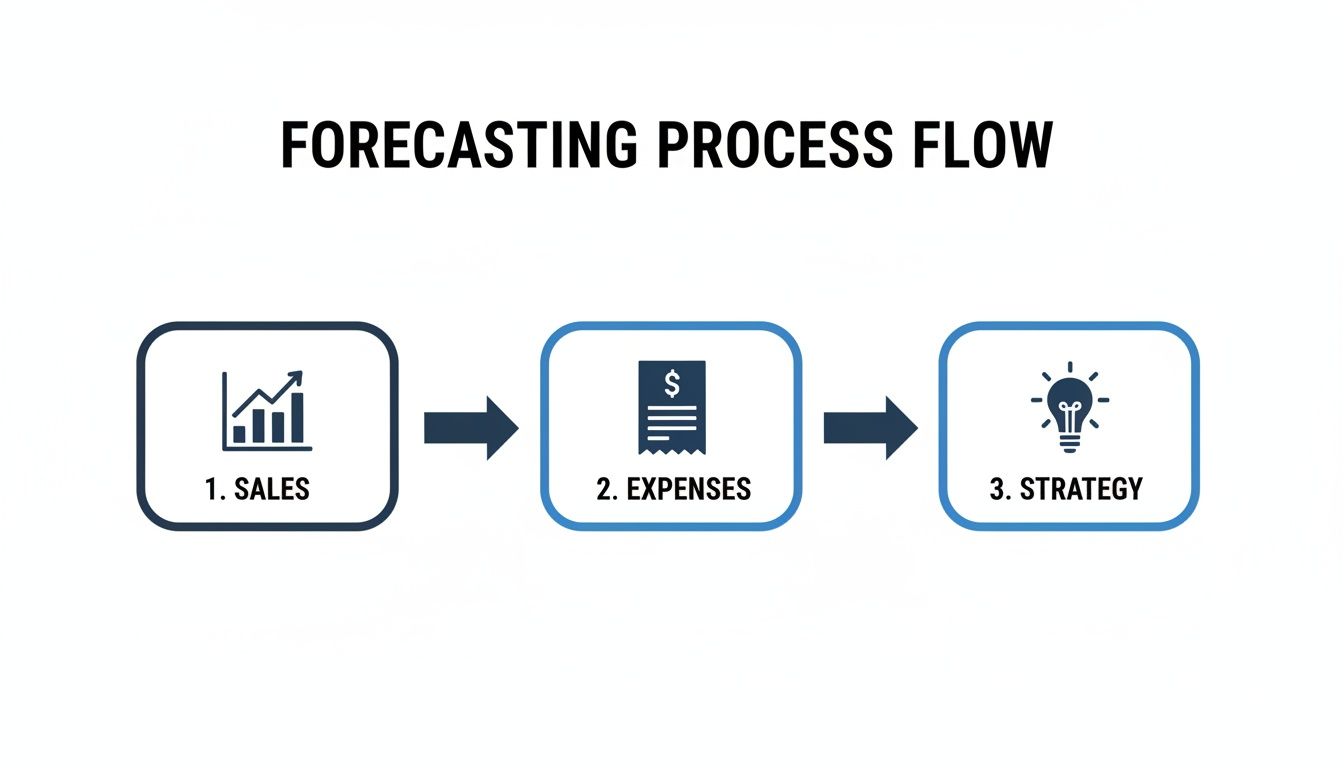
Think of it like this: your profit (from the Income Statement) updates your company’s value (on the Balance Sheet) and is the starting point for figuring out your actual cash position (on the Statement of Cash Flows).
If one number is off, it throws the whole model out of whack. This is why getting the connections right is make-or-break for building projections you can actually trust.
The Statement of Cash Flows: Where Most Businesses Go Wrong
If there's one place where we see business owners get into trouble, it’s with the Statement of Cash Flows. This is the true stress test of your business’s health.
It’s entirely possible to be profitable on paper but go bankrupt because you have no cash to pay your bills. This gap between profit and cash is a silent killer.
Sales do not equal cash in the bank. This is the single most important lesson in financial forecasting. Your income statement can look fantastic while your bank account is empty—a classic sign of poor cash flow management.
Let’s look at a real-world scenario.
Example: A Retailer's Cash Crunch
Imagine a retailer lands a huge sale for $100,000 in March. That looks amazing on the Income Statement.
But their payment terms are Net 45. They won’t see a dime of that cash until mid-May.
- March: The Income Statement proudly shows $100,000 in revenue.
- April: The retailer still has to pay its bills. That’s $25,000 for rent and payroll, plus $50,000 for the inventory they just sold.
- The Problem: The business is now out $75,000 in cash before that big check arrives. If they don’t have enough cash reserves, they’re staring down a crisis.
This is an incredibly common story. Add in payroll taxes, credit card fees, and other costs, and you see how quickly a cash gap becomes a chasm. To really get a handle on this, check out our guide on understanding the Statement of Cash Flows.
The Compliance Minefield: Tax Law Changes
Another huge blind spot in DIY projections is failing to account for ever-changing tax laws. Your tax bill directly hits your net income and, you guessed it, your cash flow. A forecast built on outdated tax rules is worthless.
For instance, there are significant tax law changes coming in 2026 that will impact deductions and tax rates for many businesses. If your three-year projection doesn’t model these changes, your forecasted net income for 2026 will be wrong. Guaranteed.
Most owners don't have the time to track these legislative shifts. They don't know what's required to stay compliant, and that ignorance can lead to painful surprises from the IRS.
You Need an Expert on Your Side
Every business deserves senior-level financial guidance. You need a partner who can look beyond the spreadsheet and provide strategic direction. That’s exactly what a fractional CFO does.
When we assemble financial statements, we don’t just plug in numbers. We:
- Ensure the three core statements are properly connected and balanced.
- Stress-test your cash flow against real-world scenarios like the one above.
- Incorporate upcoming tax law changes so your projections are both compliant and realistic.
Our business accounting services are designed to be that guide. We help you stay compliant because we know what’s required. We build accurate, defensible pro forma statements that become a tool for smart decisions, not just a document to file away. Let us handle the complexity so you can run your business.
Stress-Testing Your Projections with Scenario Analysis
Look, a single financial projection is just a shot in the dark. A well-intentioned guess, maybe, but still a guess. Resilient businesses aren’t built on a single, fragile plan. They’re built to withstand a few punches.
That's where scenario analysis comes in. It’s how you stress-test your forecast against reality. Instead of crossing your fingers and hoping for the best, you’ll build models for the best-case, worst-case, and most-likely outcomes.
This isn't about getting out a crystal ball. It’s about building agility into your business strategy so you’re not caught flat-footed.
What happens to your cash flow if a major client pays 30 days late? What if material costs for your construction job suddenly jump 20%? Or for a healthcare clinic, what if a new regulation causes a 15% dip in patient visits?
Answering these questions before they happen is the difference between panic and having a plan.
Building Your Key Scenarios
The idea is to see how your business holds up when you tweak the important variables—the "drivers" of your revenue and costs. For most businesses, this boils down to three core scenarios.
- Best-Case Scenario: This is your sunny-day forecast. What if you land that huge contract you’ve been chasing? What if your new marketing blitz actually doubles your leads? It’s optimistic, but it has to be rooted in reality.
- Worst-Case Scenario: Time to play devil’s advocate. What happens if you lose your biggest customer tomorrow? What if a recession hits and sales crater by 30%? This isn’t about scaring yourself; it’s about finding your financial breaking point so you know where the cliff edge is.
- Moderate-Case Scenario: This is your most probable reality, built on current trends and solid, defensible assumptions. It often becomes the baseline you measure everything against.
Advanced modeling can make forecasts more accurate, which is a lifesaver for small businesses in volatile markets. For example, a construction firm might pencil in 15% growth in a best-case scenario but only 5% in a worst-case where supply chain issues drive up material costs. You can learn more about these forecasting techniques on Entrepreneur.com.
Why This Is Fractional CFO Territory
Honestly, this is where most business owners get stuck. Running these "what-if" models isn't just about plugging a few different numbers into a spreadsheet and calling it a day.
You have to understand how a drop in sales impacts inventory, which then affects your cash, which then impacts your ability to pay your loans. It's all connected. This is exactly where a fractional CFO earns their keep.
A single projection tells you where you want to go. Scenario analysis gives you a map for all the detours, roadblocks, and shortcuts you might encounter along the way.
A good fractional CFO doesn’t just build the scenarios. They help you build the contingency plans that go with them. They help answer the critical question: "Okay, so what do we do when this happens?"
Stay Compliant and Sidestep Risk
You’re an expert in your field, not in the dizzying maze of financial compliance. Most business owners don't know what they don't know, and that ignorance creates massive—and totally avoidable—risk.
Think about the upcoming tax law changes. They're going to directly hit your bottom line and your cash flow, but they are almost always forgotten in a DIY projection.
Our business accounting services are designed to be your guide. We make it our business to know what’s required so you don’t have to. A fractional CFO is your strategic partner, running the sophisticated models and building the plans to navigate whatever comes your way. They make sure your financial projections are more than just a document—they're a powerful tool you can use to secure financing and run your business with real confidence.
Your Top Questions About Financial Projections, Answered
Even with a solid guide, building financial projections can feel like you’re trying to predict the future. And in a way, you are. Business owners run into the same roadblocks all the time, so let's clear up a few of the most common questions I hear.
How Often Should I Update My Financial Projections?
Think of your projections as a living document, not something you create once and shove in a drawer. If you’re in your first year or things are changing fast, you need to be looking at them monthly. Compare them to what actually happened.
This is how you spot a small problem before it becomes a business-ending one.
Once your business finds its rhythm and stabilizes, a quarterly review usually works just fine. But always—always—revisit them after a major event. This could be anything from landing a big round of funding, launching a new service, or getting hit with a sudden market shift. Regular check-ins keep your projections from becoming irrelevant fiction.
I'm a New Business with No History. How Do I Even Start?
Projecting for a startup feels like guessing, but it doesn't have to be. You don't have past performance, so you have to lean hard on solid market research and assumptions you can actually defend. This is where most new founders get stuck.
You need to focus your energy on three things:
- Market Analysis: Dig into your target market. Who are your customers? How many are there? What will they realistically pay?
- Competitor Benchmarking: Look at what your competitors are doing. What are their prices? How much are they likely spending on marketing and operations? This gives you a sanity check for your own numbers.
- Bottom-Up Forecasting: Don't just pull a revenue number out of thin air. Build it from the ground up. How many sales calls can one person make? What’s a realistic conversion rate? That's your starting point.
For a startup, projections aren't just a spreadsheet exercise. They are proof to investors and banks that you have a credible plan to actually make money.
What Are the Biggest Projection Mistakes You See?
The most common mistake is a classic for a reason: wildly optimistic revenue forecasts paired with ridiculously low expense estimates. It’s the "best-case scenario" trap, and it almost always leads to a cash flow crisis when reality inevitably sets in.
Another killer mistake is confusing profit with cash. Your income statement might show you’re profitable, but if your clients pay you in 60 or 90 days, you can still run out of cash to make payroll next week. Profit doesn't pay the bills; cash does.
Finally, a huge one is ignoring things you can't control, like tax law changes. For instance, major shifts in tax deductions and rates are on the horizon for 2026. If your projections ignore this, your net income forecast will be wrong, and you'll be hit with a surprise tax bill that drains your cash. Navigating these changes is a massive challenge most small businesses aren't ready for on their own.
You need a partner who has seen these pitfalls a hundred times and knows how to steer you around them. At Bookkeeping and Accounting of Florida Inc., our fractional CFO and business accounting services are built for this. We don’t just build your projections; we make sure they’re realistic, compliant, and a tool you can actually use to grow.
Let us help you stay compliant and build a financial roadmap you can trust.
Get Your Free Consultation and Take Control of Your Financial Future