
For most small business owners, the word "payroll" brings on a cold sweat. It feels like a mountain of red tape and ever-changing tax laws designed to trip you up, and honestly, it sometimes is. Getting how to set up payroll for small business wrong can lead to seriously painful IRS penalties, especially since most small businesses do not know what all is required to stay compliant.
But think of it this way: getting payroll right from day one is like pouring a solid foundation for your business. It’s not just about paying people; it's about building a compliant, stable company that can grow without the constant fear of an audit triggered by a simple mistake.
First Things First: Get Your Business Registered
Before you can legally pay a single person, you need to get on the government's radar as an employer. Don't skip this. These are your non-negotiable first steps.
You've got two top priorities right out of the gate:
- Federal Employer Identification Number (EIN): You absolutely cannot hire anyone without an EIN. This nine-digit number is your business's federal tax ID—think of it as a Social Security Number for your company. You can get one for free directly from the IRS website, and it only takes a few minutes.
- Florida Reemployment Tax Account: Here in Florida, you must register with the Department of Revenue to handle state unemployment taxes. This is mandatory the moment you have employees. Your tax rate will depend on your industry and payroll history.
Forgetting these registrations is a rookie mistake that stops your payroll process dead in its tracks. You'll need these numbers for everything that comes next.
The Big One: W-2 Employee vs. 1099 Contractor
This is where so many businesses get into hot water. Misclassifying a worker is one of the costliest mistakes you can make, and the IRS doesn't have much of a sense of humor about it. Get it wrong, and you're looking at back taxes, interest, and hefty fines.
The core difference really boils down to one thing: control.
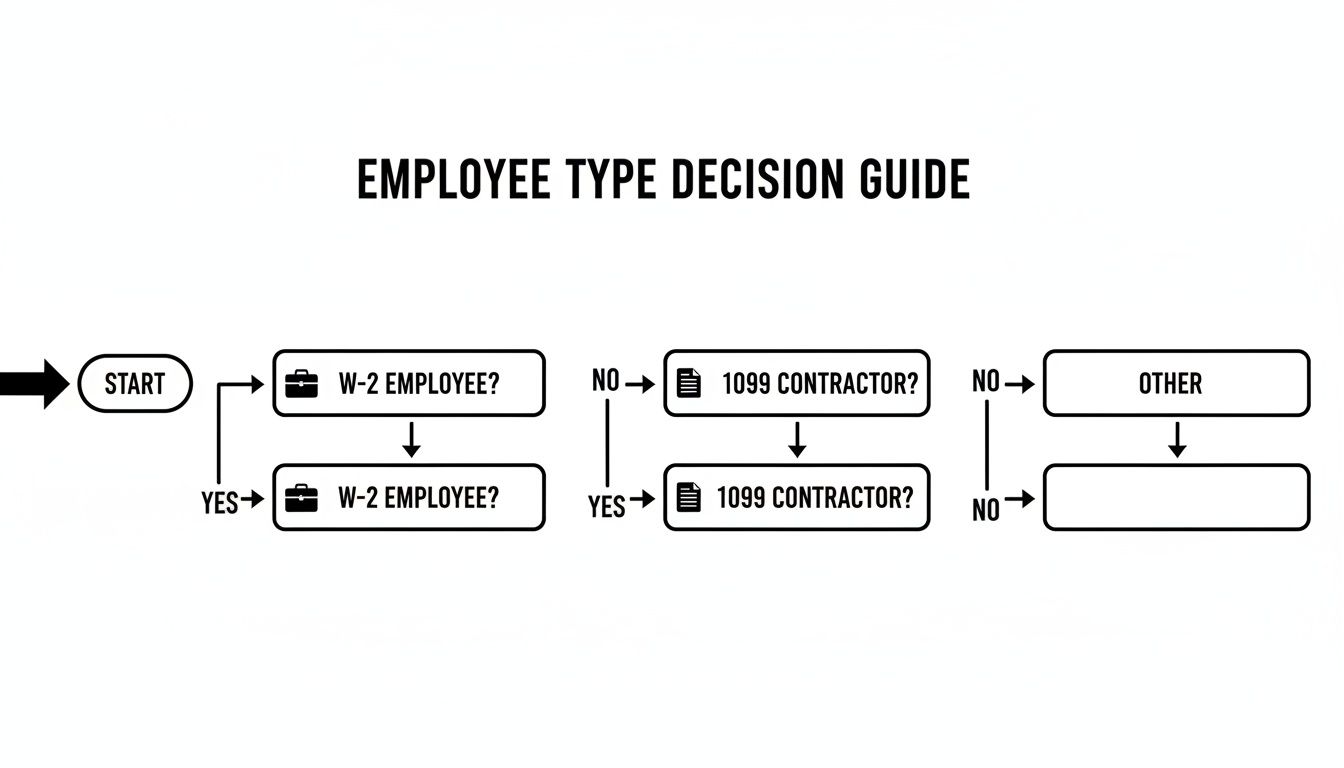
If you dictate the how, when, and where of the work, you've almost certainly got a W-2 employee on your hands.
The IRS gets specific, looking at behavioral control, financial control, and the nature of your relationship. For example, a Jacksonville construction company that gives a carpenter tools, sets his 8-to-5 schedule, and supervises his work has an employee. But a healthcare practice that brings in a specialist for a one-off project—who sets their own hours, uses their own methods, and sends an invoice—is dealing with a 1099 contractor.
Staying compliant is a moving target. Tax laws change constantly. What was fine last year might get you a penalty notice this year. This is exactly why having an expert in your corner isn't a luxury—it's a necessity.
Most business owners just don't have the bandwidth to keep up. That's why firms like Bookkeeping and Accounting of Florida Inc. exist. We take this mess off your plate and make sure you're set up correctly from the very beginning, helping you stay compliant because we know what's required.
Choosing the Right Payroll System for Your Business
Okay, you've got your registrations handled. Now comes the big decision: how will you actually run your payroll? This choice is about more than just software; it directly impacts your time, compliance risk, and overall sanity.
You really have three paths: tackling it manually, using payroll software, or outsourcing the whole shebang.
Let's get one thing out of the way: manual payroll with spreadsheets is a terrible idea. It might seem like a way to save a few bucks, but it's a high-stakes gamble. Tax law changes happen all the time, and one tiny miscalculation can trigger penalties that make the cost of professional help look like a bargain.
Frankly, most small businesses simply do not know what all is required, making DIY a house of cards. You need a system or a partner who knows the rules so you don't have to.
Payroll System Comparison for Small Businesses
To help you decide, let's break down the pros and cons of each approach. Think about where your business is now and where you want it to be in a year.
| Factor | Manual Payroll | Payroll Software (e.g., QuickBooks) | Outsourced Service (CPA/Payroll Firm) |
|---|---|---|---|
| Cost | Lowest upfront cost | Moderate subscription fees | Highest cost, but fixed and predictable |
| Compliance Risk | Extremely high; all on you | Low; software handles updates & calcs | Near zero; liability is transferred |
| Time Commitment | Very high; endless calculations | Low; automated data entry and filings | Minimal; a few minutes per pay run |
| Scalability | Poor; breaks with more employees | Good; easily scales with your team | Excellent; handles any complexity |
The right choice depends on your budget, your comfort with technology, and how much you value your time. For most, the high risk of manual payroll makes it a non-starter.
The Power of Integrated Payroll Software
For many small businesses, software like QuickBooks Payroll is the perfect middle ground. It gives you control without the manual headaches. As Certified QuickBooks ProAdvisors, we've seen it turn payroll from a dreaded chore into a smooth business function.
The real magic is the direct integration with your accounting. When payroll and bookkeeping talk to each other:
- Labor costs are automatically posted, giving you a real-time view of your profitability.
- Tax liabilities are calculated and tracked, so you're never surprised when a deposit is due.
- Year-end reporting becomes ridiculously simple because all the data is in one place.
To manage all your HR and payroll tasks in one place, you could also look into dedicated employee management software for small business. For more on software, check out our guide on the best accounting software for small businesses.
Outsourcing for Ultimate Peace of Mind
The third option? Hand it all over to a full-service provider like us. This is the "done-for-you" route. We handle everything—calculations, tax deposits, quarterly filings, and year-end W-2s.
This isn't just about offloading a task; it's about transferring the risk. You get guaranteed compliance and an expert watching your back.
All companies, regardless of size, need a fractional CFO and someone to guide their business. We don't just process your payroll—we help you understand the numbers, plan for cash flow, and make strategic decisions based on accurate labor data.
Choosing a partner isn't about finding a data entry clerk. They need us to help them stay compliant since most small businesses do not know what all is required, freeing you to focus on running your business.
Setting Your Payroll Schedule
Once your system is picked, you have to decide how often to pay people. This is your payroll schedule, and it affects both your workload and your team's budget. The usual suspects are weekly, biweekly (every two weeks), semi-monthly (twice a month), and monthly.
It's interesting to note that 49% of small businesses operate with just one to four workers, so efficiency is everything. Payroll trends from Patriot Software show that 43% of U.S. private businesses pay their employees biweekly, and for good reason.
A biweekly schedule usually hits the sweet spot. It's frequent enough to keep employees happy but simple enough for you, requiring just 26 payroll runs a year. Weekly payroll doubles the work, while monthly can be tough on hourly staff. The best choice comes down to your cash flow, industry norms, and any state laws you have to follow.
Getting the Numbers Right: How to Calculate Paychecks and Withhold Taxes

Let's get to the heart of it. Payroll is all about one thing: paying your people correctly and on time. Every single time. This is where the numbers get real, and it’s where most business owners stumble. Get this wrong, and you don’t just have unhappy employees—you have the IRS knocking on your door.
It all starts with gross pay. For your hourly folks, it’s simple enough: hours worked multiplied by their pay rate. For salaried employees, you’ll divide their annual salary by the number of pay periods in the year.
But the complications start almost immediately. What about overtime? The Fair Labor Standards Act (FLSA) is not a suggestion. It mandates that you pay non-exempt employees 1.5 times their regular rate for any hours they work over 40 in a week. Forgetting this isn’t an “oops”—it’s a major compliance breach.
The Fun Part: Tax Withholdings
Once you have gross pay figured out, you have to play tax collector. This is a legal requirement, not an optional one. It’s also the part that causes the most headaches, because tax laws are constantly changing, and manual calculations become outdated almost overnight.
You are responsible for withholding these key taxes from every paycheck:
- Federal Income Tax: The amount depends on the employee’s Form W-4 and the current IRS tax tables.
- FICA Taxes: This is a two-part tax for Social Security (6.2%) and Medicare (1.45%) that you deduct.
I can’t stress this enough: always use the most current version of the W-4. Using an old form will almost guarantee inaccurate withholding, which creates a tax mess for your employee and a liability headache for you. This is also tied to properly classifying your workers—a topic we cover in our guide on the differences between 1099 and W-2 workers.
Don’t Forget Your Share: Employer Taxes
Your employees aren’t the only ones paying taxes. As the employer, you have your own bill to pay. These are costs you need to budget for on top of gross wages.
Your employer tax obligations include:
- Matching FICA Contributions: You must pay an amount equal to the Social Security and Medicare taxes you withheld from your employee. Yes, you pay it too.
- Federal Unemployment Tax (FUTA): This is a federal tax you pay, currently 6% on the first $7,000 of each employee's wages.
- Florida Reemployment Tax (SUTA): Here in Florida, you also pay state unemployment tax on the first $7,000 of wages. The state assigns you a rate based on your industry and history.
Most business owners have no idea how much goes into staying compliant. Juggling federal tax tables, FICA limits, FUTA credits, and Florida's specific SUTA rules is a full-time job in itself. Trying to do this manually is like trying to juggle flaming swords. Why would you?
This is why automating your payroll isn’t a luxury; it’s a necessity. A single miscalculation or a missed deposit deadline can trigger penalties that cost far more than the software or service that would have prevented it.
Turning a Headache into a Strategic Tool
This is where a real financial partner proves their worth. Every business, no matter its size, needs a fractional CFO and an expert guiding the financial ship. At Bookkeeping and Accounting of Florida Inc., we don’t just “do payroll”—we turn it into a powerful business intelligence tool.
Of course, we help you stay compliant. We’re the ones obsessing over tax law changes so you don’t have to. But more importantly, we use that payroll data to model your cash flow, analyze labor costs, and give you the insights you need to make smarter, more profitable decisions.
We take a compliance nightmare and transform it into a clear view of your company’s financial health, giving you the peace of mind to focus on what you do best: growing your business.
Managing Tax Deposits and Filing Critical Reports
So you’ve withheld taxes from your employees' paychecks. Congratulations, you've completed step one. Now for the hard part: getting that money to the government on time and filing perfect reports.
This is where the payroll dream turns into a nightmare for a shocking number of small businesses. We’ve seen it time and time again—simple mistakes that lead to absolutely brutal penalties.
Let’s talk about your IRS deposit schedule. You don't get to choose between monthly and semi-weekly; the IRS assigns it based on your tax liability from a “lookback period.” Get it wrong and miss a deposit by a single day, and you can expect a nasty letter with penalties attached.
The Never-Ending Cycle of Payroll Tax Forms
Once the money is sent, you have to tell the government what you did. These forms are your official record, and they are not optional. Getting this right is a huge part of how to set up payroll for small business compliance.
Here's the gauntlet of reports you'll be running:
- Form 941 (Employer's Quarterly Federal Tax Return): Every three months, you’ll file this to report all wages, tips, and the federal income, Social Security, and Medicare taxes you’ve handled.
- Form 940 (Employer's Annual Federal Unemployment Tax Return): This one’s for your FUTA tax liability. You file it once a year, but you might have to make deposits all year long. Fun, right?
- Forms W-2 and W-3: At year-end, every employee gets a W-2, and the Social Security Administration gets a copy of everything, bundled with a Form W-3 summary.
- Form RT-6 (Florida's Employer's Quarterly Report): Don’t forget the state. This is how you report and pay Florida’s reemployment (unemployment) tax to the Department of Revenue every quarter.
Keeping all those deadlines straight while trying to run your actual business is a recipe for disaster. If you're feeling overwhelmed, check out our guide on how a payroll calendar can save you in fees.
The High Cost of Getting It Wrong (And Why You Need a Partner)
Don’t just take our word for it. The numbers are grim: a staggering 24% of small businesses have been hit with payroll penalties. Most of these stem from trying to manage it all by hand or just not keeping up with constant tax law changes. It's no wonder that payroll processing is the second most delegated task at 31%—smart owners know a minefield when they see one. You can dig into more of these stats in recent industry studies.
This is where having a real financial partner isn't a luxury; it's a necessity. The truth is, most small businesses do not know what all is required for total compliance. You need someone who does more than just fill in boxes on a form.
We don't just fill out your 941s and W-2s. We provide guaranteed compliance and the peace of mind that comes from knowing you will never dread a notice from the IRS or the Florida Department of Revenue.
At Bookkeeping and Accounting of Florida Inc., we're not just a service provider—we act as your fractional CFO and strategic guide. We know that tax law changes don't wait for you to catch up, so we make it our job to stay ahead.
We handle your tax deposits, guarantee every report is filed flawlessly, and turn one of your biggest business liabilities into a smooth, worry-free process. This frees you up to do what you're actually supposed to be doing: growing your business with confidence.
Understanding What Payroll Really Costs You
Most business owners think of payroll as just another expense—a boring, administrative chore you have to get through. But that’s a rookie mistake. Thinking of payroll as just a cost center is like thinking of your best salesperson as just an expense. It’s the engine, not just the fuel bill.
When you handle payroll right, it stops being a liability and starts becoming a strategic weapon. To get there, you need to be honest about the total investment. It’s not just the software subscription. It’s the hours you waste, the mistakes you make, and the mental energy you burn trying to keep up with every little tax law change.
The Real Price Tag on Payroll
Let’s talk numbers. If you don't budget for payroll properly, the costs will sneak up on you. A typical online payroll service will hit you with a base monthly fee plus a per-employee charge. Think that’s no big deal? A small team of ten can easily run you over $7,200 a year, just for the software.
Recent data shows that while 25% of small businesses somehow keep this under $100 a month, a much larger group—37%—are spending between $101 and $500. You can dig into more of the gritty details on what businesses are actually paying by reviewing recent cost data.
Now, compare that to the alternative: hiring someone to do it in-house. The average salary for a payroll specialist is $64,865. Suddenly, using smart software with an expert guide doesn't seem so expensive, does it?
Beyond the Paycheck: The Landmines You Don't See
This is where having a true financial partner—not just a data entry clerk—makes all the difference. We handle the critical tasks that business owners almost always forget, because frankly, you have a business to run. These aren't just details; they're compliance tripwires.
- New-Hire Reporting: Did you know most states, including Florida, demand you report every new employee within 20 days of their start date? Miss it, and you’re paying fines.
- Benefits Deductions: Mess up the calculations for health insurance or 401(k) contributions, and you're in hot water with both your employees and the government.
- Workers' Compensation: Calculating premiums based on bad payroll data is a recipe for disaster. It leaves you exposed to massive liability if someone gets hurt.
Most owners have no idea these requirements even exist until a penalty notice shows up. It’s a full-time job keeping track of it all, and one slip-up can cost you thousands. This is exactly why all companies need a fractional CFO—someone who lives and breathes this stuff so you don’t have to.
Anyone can push a button to run payroll. A true partner helps you understand what the numbers are telling you about your business, turning a headache into a roadmap.
From Chore to Strategy
This is the mental shift that separates businesses that just get by from those that dominate. When an expert team like Bookkeeping and Accounting of Florida Inc. manages your payroll, it’s no longer an expense. It’s a goldmine of business intelligence.
We use your payroll data to give you insights you can actually act on. We're not just moving money around. We’re analyzing your labor costs against your revenue, forecasting your cash flow needs around payroll dates, and spotting trends in overtime that are silently eating into your profits.
Yes, you need us to help you stay compliant. But the real win is in the guidance. We help you read the story your numbers are telling, turning a routine task into a powerful tool for building a resilient, profitable, and successful business.
Burning Questions About Small Business Payroll
You’ve got a business to run. The last thing you want is to get bogged down in payroll questions, but let’s be honest—the list of what you don’t know feels endless. Getting it wrong is expensive, so let’s clear up a few of the biggest questions we hear from entrepreneurs just like you.
How Often Should I Pay My Team?
Most businesses land on a biweekly schedule. In fact, 43% of private U.S. companies run payroll every two weeks. It’s a solid middle ground that keeps your administrative work manageable while giving your employees a predictable paycheck.
Weekly payroll is an option, especially in trades like construction, but it literally doubles your processing time. Your final choice really comes down to your cash flow, state requirements, and what your team expects.
What Happens If I Mess Up?
Payroll mistakes are a nightmare. A small error can kill team morale. A tax error? That brings the IRS and state agencies to your door with penalties ranging from 2% to 15% of what you owe.
One of the costliest blunders is misclassifying an employee as an independent contractor. That single mistake can leave you on the hook for back taxes, benefits, and overtime you never even knew you owed. This is exactly why you can't afford to "wing it."
Trying to keep up with ever-changing tax laws on your own is a recipe for expensive penalties. Most small businesses simply don't know what they don't know.
Can I Just Do Payroll Myself?
Technically, yes. Should you? Probably not. DIY payroll is a massive gamble. The process is a time-suck, the rules are constantly shifting, and the stakes are incredibly high. With 24% of small businesses getting hit with penalties for payroll mistakes, the risk is very real.
Outsourcing isn't just about saving a few hours. It’s about transferring that risk and liability to experts who live and breathe this stuff. They need us to help them stay compliant. It turns a stressful chore into a non-issue so you can get back to work.
What Payroll Records Do I Absolutely Have to Keep?
Both the IRS and the Fair Labor Standards Act (FLSA) are crystal clear: you must keep detailed payroll records for at least four years. There's no getting around it.
At a minimum, your records need to show:
- Employee details (name, SSN, address)
- Hours worked each day and week
- Calculations for gross pay
- A complete list of all deductions
- The final net pay and payment dates
You'll also need to hang on to copies of all your tax filings—Forms 941, 940, W-2s, and Florida's RT-6. Using an integrated system like QuickBooks, especially when it's managed by a certified ProAdvisor, is the smartest way to make sure this data is automatically captured, stored securely, and ready for an audit at a moment's notice.
Staying compliant is a full-time job in itself. You need a partner who can handle the complexities of payroll so you can focus on what you do best. The team at Bookkeeping and Accounting of Florida Inc. provides the expert oversight that gives you peace of mind. Learn how our payroll and fractional CFO services can protect and guide your business.