

Your stockroom is talking to you. Most owners just do not like what it says.
It says cash is sitting on a shelf too long. It says somebody reordered the wrong item. It says your team sold something that was not available. It says tax season is going to be a mess because nobody can explain what was on hand at year-end or what it cost.
That is the core issue with inventory. It is not a “warehouse problem.” It is a cash flow, profit, and compliance problem.
If you want to know how to track inventory for small business the right way, stop thinking about clipboards and start thinking about control. You need a system that tells you what you own, what it costs, where it went, and how it affects your books. If that system does not connect to accounting, it is half a system.
For Florida businesses, especially construction, healthcare, retail, and trades, inventory mistakes do not stay small for long. They bleed into job costing, payroll allocation, tax reporting, loan packages, and year-end cleanup bills. That is why owners need more than software. They need bookkeeping discipline, CPA oversight, and, in many cases, a fractional CFO who can turn inventory data into decisions.
Your Inventory Is a Ticking Time Bomb or a Goldmine
Monday morning. A contractor in Tampa sends a crew to a job site, and the material that should be on the truck is still sitting in the warehouse. By noon, the supplier is rushing an order at a higher price, the crew is burning payroll while waiting, and the bookkeeper has no clean way to tie that mess back to the job. A medical practice can get itself into a similar bind fast. Duplicate supply orders, expired items, and year-end counts nobody trusts.
That is what weak inventory control looks like in real life. It eats cash, distorts profit, and creates tax and reporting problems that show up later, usually at the worst time.

Owners usually spot the symptom first. Stockouts. Overstock. Shrinking margins. Angry staff. Then they try to fix it with more buying, more spreadsheets, or one heroic physical count. None of that solves the underlying issue. You need inventory records that connect to accounting, purchasing, and how the business operates.
For Florida businesses, that connection matters even more. In construction, materials have to flow into job costing or your project profitability report is fiction. In healthcare, supplies need tighter control because expiration, usage, and documentation are part of staying operational and audit-ready. If inventory never makes it into your books correctly, your cost of goods sold calculation is off, and so are your financial statements.
What inventory chaos looks like in practice
It usually looks routine, which is why owners miss it.
- A retail shop has product in two storage areas, but staff checks only one and reorders items already on hand.
- A clinic buys the same supplies twice because nobody trusts the quantities in the system.
- A contractor sends materials to a job site, but the usage never gets assigned to that project.
- An e-commerce seller updates quantities later, after the sales are already booked.
Those are control failures, not minor clerical mistakes.
A useful inventory asset has three jobs. It must be traceable, valued correctly, and turned into profitable sales before it becomes obsolete, expired, damaged, or stolen. If any one of those breaks, cash gets trapped on the shelf.
The upside is just as real. Clean inventory control gives you better purchasing, cleaner margins, tighter job estimates, fewer write-downs, and financials your banker and CPA can trust. Good operators follow the best practices for inventory management, then tie those practices to bookkeeping discipline and management review. That is how inventory stops being a slow leak and starts acting like a profit tool.
This distinction separates inventory as a ticking time bomb from inventory as a goldmine.
Choosing Your Inventory Method and Getting Organized
Before you start scanning barcodes or counting shelves, make one decision carefully. Choose the method that fits your business and your tax reporting. If you guess here, you create headaches later in Cost of Goods Sold, financial statements, and compliance.
Perpetual versus periodic
A periodic system updates inventory at intervals. Maybe monthly. Maybe year-end. Maybe “whenever somebody counts it.” Cheap to start. Expensive to trust.
A perpetual system updates inventory every time you buy, sell, transfer, or use an item. That is the system most growing businesses need. It is especially important if you run multiple locations, sell online, use a POS, or need current profit numbers.
For construction and trades, perpetual tracking matters because materials do not just sit in one room. They move to trucks, job sites, and project bins. For healthcare, it matters because expiration dates and lot control are not optional details.
FIFO usually makes the most practical sense
For many small businesses, FIFO or first-in, first-out is the clean operational choice. The older inventory gets used or sold first. If you handle perishables, dated supplies, or products that can go obsolete, FIFO is common sense.
A weighted-average approach can make sense in some operations with lots of similar units purchased at varying costs. But if your team cannot explain the method, it is the wrong setup for your business.
The tax point is straightforward. Your inventory method affects COGS, and COGS affects taxable income. If you want a plain-English breakdown of that connection, review this guide on how to calculate cost of goods sold.
Inventory Valuation Method Comparison
| Method | How It Works | Best For | Tax Implication |
|---|---|---|---|
| Periodic | Inventory updates happen at set intervals after physical counts | Very small operations with simple stock and low transaction volume | COGS is often less timely, which increases cleanup work and can weaken reporting |
| Perpetual | Every purchase, sale, use, or transfer updates stock records | Growing businesses, multi-location sellers, clinics, contractors, e-commerce | Provides cleaner ongoing COGS and stronger year-end support |
| FIFO | Older units are assumed sold or used first | Retail, healthcare, food-related items, dated supplies | Often aligns better with physical flow and easier audit support |
| Weighted average | Costs are blended across similar units | Businesses with many interchangeable items at changing purchase prices | Can smooth cost swings but requires consistent setup and review |
Get your SKU structure under control
If your item names look like this, you have a problem:
“Blue shirt”
“Blue shirt new”
“Blue shirt final”
“Blue shirt online”
That is not a system. That is a cry for help.
Build a SKU structure your team can follow without interpretation. Keep it consistent across purchasing, storage, sales, and accounting. Include meaningful product categories, units of measure, vendor naming, and location logic.
Try this approach:
- Use one naming convention: Pick one format for every item and stick with it.
- Separate raw materials from finished goods: This matters for manufacturers, contractors, and makers.
- Tag inventory by category: Retail stock, medical supplies, job materials, spare parts.
- Add location logic: Warehouse, van, clinic room, job site, online stock.
For a practical outside reference, these best practices for inventory management do a solid job reinforcing the importance of labeling, storage discipline, and process consistency.
Match the method to the business
A Jacksonville construction company should not use the same approach as a boutique retailer or healthcare clinic.
- Construction and trades: Track materials by project when possible. If lumber, fixtures, or paint get used, that usage should hit the correct job cost.
- Healthcare: Use FIFO logic and track lot, serial, and expiration data where needed.
- Retail and e-commerce: Use perpetual tracking with item-level counts synced to sales channels.
- Non-profits: Keep inventory organized for reporting and internal control, even if purchasing is grant-driven or irregular.
Key takeaway: The right inventory method is the one your team can follow consistently, your accountant can defend, and your financial statements can rely on.
Implementing a Painless Inventory Count Process
Friday at 4:30, your crew is tired, a delivery just came in, and someone is guessing how many boxes are still on the shelf. That guess ends up in your books, your margins, and sometimes your tax return. Bad count habits are expensive.
A good count process does not need to be painful. It needs rules, ownership, and enough discipline to survive a busy week.

Do one clean physical count first
Your first count sets the baseline for everything after it. If that baseline is sloppy, every job cost report, gross margin report, and year-end inventory value is suspect.
Pick a time with the least movement possible. For a retailer, that may be after close. For a contractor, it may be before trucks leave in the morning. For a clinic, it may be outside patient hours. If items must keep moving, assign one person to log every receipt, sale, transfer, and usage during the count. One person. Not five.
Clean up the item list before anyone touches a scanner or clipboard.
- remove duplicate items
- fix units of measure
- confirm SKUs and descriptions
- pull out damaged, obsolete, expired, and returned items
- separate stock held for a specific job or patient use from general inventory
That last point matters more than owners think. In construction, materials sitting in the warehouse may belong to a specific project and should tie back to job costing. In healthcare, expired or restricted supplies cannot sit in the same bucket as usable stock and pretend to be an asset. Accountants and auditors notice. So does the IRS when inventory values get inflated.
Set up the count so people make fewer mistakes
Count teams should be simple. One person counts. One person records. A supervisor spot-checks high-value or high-risk items.
Do not let staff “fix it later.” Write down partial boxes, open containers, damaged units, and item mismatches right there in the aisle. Sticky notes are not a control system. They are how shrinkage turns into mystery.
Use count sheets or mobile forms organized by area, not by memory. Shelf A1 should be counted with Shelf A1. Truck 3 should be counted with Truck 3. Exam Room 2 should be counted with Exam Room 2. If your team has to wander around hunting for items, your process is already broken.
If you need help tightening the accounting side after the count, these QuickBooks inventory and bookkeeping tips can help you avoid posting adjustments that create bigger messes later.
Shift to cycle counts instead of one giant annual scramble
After the baseline count, stop treating inventory like a once-a-year punishment. Use cycle counts.
ABC counting works because it puts your effort where the money is. Your high-value, fast-moving, theft-prone, or compliance-sensitive items get checked often. The low-risk items get checked on a slower schedule.
A practical setup looks like this:
- A items: count weekly
- B items: count monthly
- C items: count quarterly or on a set rotating schedule
For Florida contractors, A items often include copper, fixtures, tools, and other materials that disappear fast and hit job profitability hard when they are misused. For healthcare practices, A items may include high-cost supplies, controlled items, and products with expiration concerns. This is not just about shelf accuracy. It affects margins, billing, internal controls, and whether your financial statements hold up under scrutiny.
Barcode scanning pays for itself
Barcode scanning is no longer fancy. It is basic control.
Cin7’s inventory management guide for small businesses reports that barcode systems reduce human error in counts by 75% to 90% compared to spreadsheets. Businesses that put them in place also report fewer stockouts and lower inventory costs. Analysts at Cin7 also found that project failure is often tied to staff adoption, with 25% of implementation failures linked to poor uptake.
So buy the scanners, then train the staff properly.
If you are not ready for full software on day one, there are workable bridge solutions. This walkthrough on automating AWD inventory tracking in Google Sheets is useful for businesses trying to reduce manual spreadsheet work while building toward a stronger system.
Write the process down. Receiving steps. Picking steps. Transfers. Adjustments. Who approves write-offs. Who investigates variances. Hardware without procedures is just expensive clutter.
Keep the routine boring
Boring is good. Boring means repeatable. Repeatable means accurate.
- Count A items weekly
- Review B items on a regular monthly rhythm
- Check C items less often, but do check them
- Investigate variances quickly
- Approve write-offs and adjustments with documentation
Do not shrug off count differences. They usually point to a real problem. Theft. Damage. Bad receiving. Wrong units. Duplicate SKUs. Materials charged to the wrong job. Supplies walking out the back door. Find the cause, fix the process, and post the adjustment with backup. That is how you keep inventory from wrecking your books.
Connecting Inventory to QuickBooks for Real-Time Clarity
You walk into the office on a Tuesday morning, glance at QuickBooks, and the profit looks fine. Then a job runs short on materials, a nurse manager says supplies disappeared, or your crew billed items to the wrong customer. Suddenly that “profit” was fiction.
That is what happens when inventory sits in one system and accounting lives somewhere else. Your books lag behind reality. In Florida businesses, especially construction and healthcare, that gap causes more than operational headaches. It wrecks job costing, distorts margins, and creates tax reporting problems you do not want to explain later.
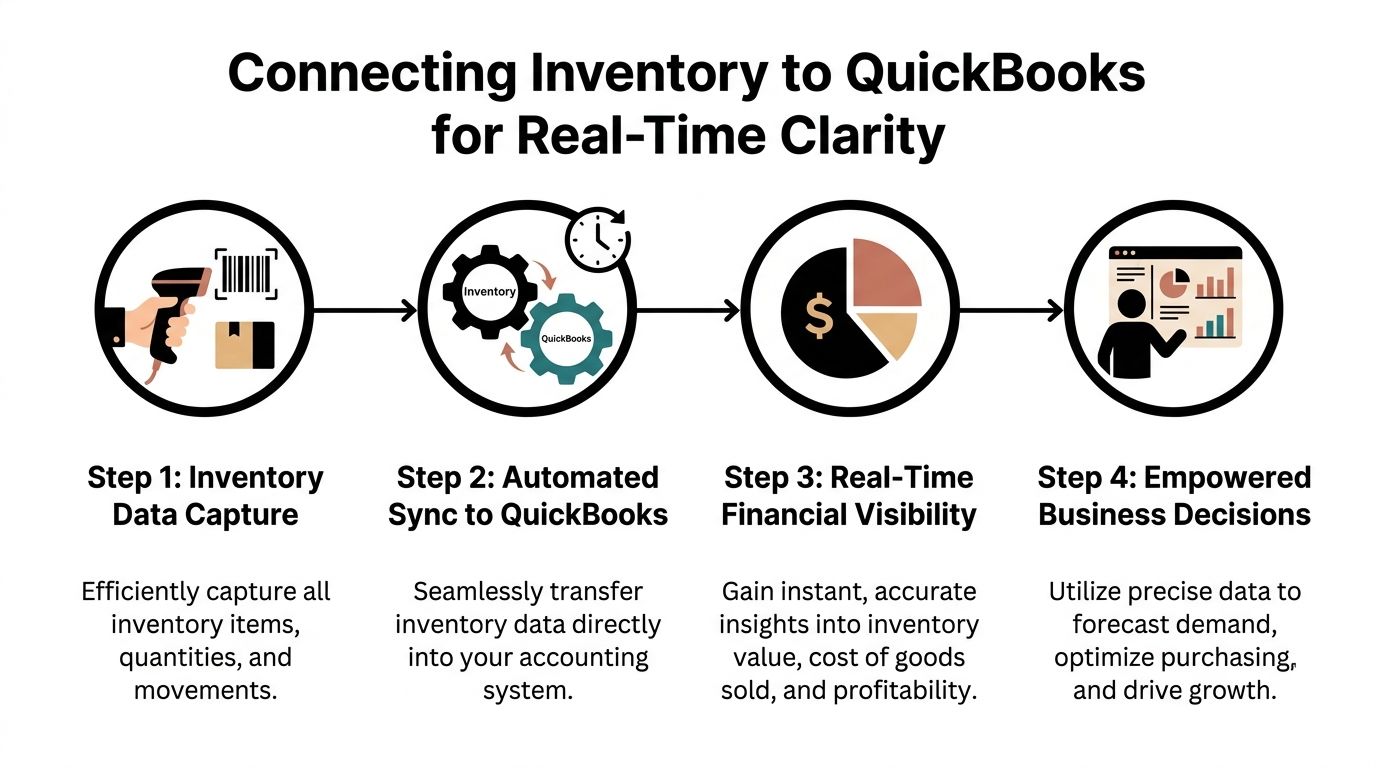
QuickBooks should be your financial control center, not a storage closet for old numbers. If inventory transactions do not hit correctly, your balance sheet is wrong, your cost of goods sold is wrong, and your monthly decisions are based on bad information.
What QuickBooks should handle
Set it up to do the basics well:
- create inventory part items
- assign opening quantities and values from your physical count
- record purchases accurately
- sync sales activity
- adjust inventory with documentation
- flow item cost into COGS cleanly
Done right, each purchase increases inventory assets, each sale relieves inventory, and each adjustment leaves a trail. That is the difference between clean reporting and month-end guesswork.
For contractors, the setup also needs to support materials charged to the correct job. For healthcare businesses, supply usage has to land in the right department or service line. If it does not, you will misread profitability and underprice the work that is already eating your cash.
The setup order that saves headaches
Start with the item file.
Clean up item names, SKUs, units of measure, categories, and vendor records before you import anything. If you load messy data into QuickBooks, you just create a faster mess.
Then load opening balances from a real physical count. No guessing. No rounded estimates. A bad starting quantity poisons every reorder point, valuation report, and gross margin report that follows.
Next, connect the systems that create inventory activity. That may be Shopify, Square, a field invoicing app, or a practice management platform. Manual entry creates duplicate sales, missed adjustments, and timing problems. Those errors love to hide until month-end, right when you are trying to figure out whether you made money.
Finally, require approval for write-downs, spoilage, shrinkage, and job transfers. Inventory adjustments need a reason, support, and a name attached to them. If nobody owns the adjustment process, inventory becomes the company junk drawer.
If you want a cleaner setup, this guide to QuickBooks tips and tricks for cleaner books and reporting is a solid starting point.
Where owners get burned
QuickBooks can keep inventory and accounting aligned. It can also help you produce bad reports with great confidence.
I see the same mistakes over and over:
- Wrong item types: tracked products set up as non-inventory items
- Bad opening entries: one lump-sum journal entry with no item-level support
- Duplicate posting: POS summaries entered manually while item-level sales also sync in
- Inconsistent purchasing: some items entered through bills, others through checks or journal entries
- No location discipline: inventory exists on paper, but nobody can say which truck, warehouse, or office has it
Those are not minor bookkeeping quirks. They change gross profit, distort taxable income, and make it harder to defend your numbers if a lender, buyer, or tax preparer starts asking questions.
Bookkeeping and Accounting of Florida Inc. provides bookkeeping, QuickBooks organization, and fractional CFO support for Florida companies that need cleaner reporting and inventory-linked financials.
Key takeaway: If inventory is not tied to QuickBooks correctly, your P&L is not a management tool. It is decoration.
Once the setup is right, owners stop buying on instinct alone. They can see which products earn their shelf space, which jobs are bleeding materials, and whether margin problems came from pricing, vendor costs, or waste. That is real-time clarity. And yes, it is worth the effort because bad inventory data is expensive, but clean inventory data helps you price better, buy smarter, and stay compliant.
Using Inventory KPIs to Drive Profitable Decisions
Clean inventory records change the questions you ask.
You stop staring at quantity on hand and start looking for margin leaks, cash traps, and pricing mistakes. That is how inventory turns from a bookkeeping chore into a profit tool.

Start with turnover, then ask why
Inventory turnover measures how fast you sell through stock and replace it. The number matters, but the reason behind the number matters more.
Slow turnover usually means cash is sitting on a shelf, in a truck, or in a supply room doing nothing useful. In a Florida construction company, that can mean materials bought for the wrong phase of a job. In a healthcare practice, it can mean supplies aging toward expiration while cash gets tighter. Fast turnover can be good, but if stockouts are rising, you are not running lean. You are leaving revenue on the table.
Look at turnover by item category, location, and job type. One blended companywide number can hide a mess.
Ask these questions:
- Which items sell steadily and still tie up too much cash?
- Which items move slowly because pricing is wrong, not because demand disappeared?
- Which branch, truck, or site keeps too much inventory “just in case”?
- Which materials belong in job costing instead of a generic inventory bucket?
ABC analysis helps you manage attention
ABC analysis is simple and useful. A items deserve tight control because they drive most of the dollars. B items need regular review. C items are where clutter, old habits, and bad purchasing decisions go to hide.
Owners often count everything with the same intensity. That wastes time and misses the core problem. Your highest-value items need tighter reorder rules, cleaner vendor planning, and more frequent review. Your low-value items need a blunt question. Should you still stock them at all?
This matters even more in industries with project costing or regulated supplies. A construction firm should know which materials belong to a specific job and whether that usage matches the estimate. A healthcare business should know which high-cost items need tighter rotation and expiration control. Generic inventory advice rarely covers that. It should.
Reorder points need math, not mood
Too many purchases happen because somebody got nervous.
Set reorder points from actual usage, vendor lead time, and the cost of carrying extra stock. Then review them. Demand changes. Vendors slip. Seasonality hits Florida businesses harder than many owners admit, especially in tourism, storm prep, and construction cycles.
Economic order quantity can help if you carry enough volume to justify the work. If your operation is smaller, a simpler min-max system tied to real purchasing patterns often works better. The point is the same. Reordering should follow a rule, not a hunch.
Watch a short KPI list that leads to action
A useful dashboard does not need twenty metrics. It needs a handful that tell you what to fix.
- Inventory turnover: Shows whether stock is moving or collecting dust.
- Days on hand: Shows how long cash sits in inventory before it comes back.
- Stockout frequency: Shows where poor planning is costing sales or delaying jobs.
- Shrinkage: Shows theft, damage, spoilage, and process breakdowns.
- Dead stock and obsolete items: Shows what should be cleared, written down, or stopped.
- Gross margin by item, service line, or job: Shows which products and projects deserve more capital.
If you want a broader owner-level dashboard, review these KPIs for small business owners that stop guessing and start measuring.
Good KPI review changes decisions fast
A bookkeeper records transactions. A fractional CFO asks better questions.
Why is one product selling well but producing weak margin? Why does one service line keep chewing through supplies faster than expected? Why does one project manager always run over materials budget? Why are bulk buys saving pennies while choking cash flow for weeks?
Those questions lead to better decisions. You may raise prices on items with strong demand and weak margins. You may cut a slow mover that looks harmless but drains working capital. You may shift materials into tighter job-cost tracking so overruns show up before the job is finished. You may renegotiate vendor terms because lead times are forcing bad buying behavior.
That is how profitable inventory management works. You track the numbers, connect them to operations, and use them to protect margin, taxable income, and cash.
The Compliance Trap Why Professional Guidance Is Not Optional
A lot of inventory advice online stops at scanners, spreadsheets, and shelf labels. That is fine until the IRS, your lender, your auditor, or your own year-end tax return asks harder questions.
Inventory is an accounting issue. It is a tax issue. In some industries, it is also a regulatory issue.
IRS rules are not optional
The IRS expects businesses with inventory to track it in a way that supports accurate costing and reporting. Publication 334 is part of that discussion. You need records that support what you bought, what you sold, what remains, and how you valued it.
If your inventory numbers are weak, your COGS is weak. If COGS is weak, taxable income is wrong. If taxable income is wrong, the cleanup bill tends to arrive at the worst possible time.
Tax law changes and filing requirements also do not stand still. Thresholds, reporting expectations, and treatment details can shift. That is why “we’ll figure it out at year-end” is such an expensive habit.
Construction and healthcare need specialized controls
Generic inventory advice falls apart in specialized industries.
In construction, manual inventory tracking often contributes to significant cost overruns on projects. In healthcare, poor expiration tracking leads 40% of small practices to report over $10,000 in annual losses from waste alone (SOS Inventory on inventory obsolescence and specialized risks).
For construction companies, the issue is not just quantity on hand. It is whether materials are allocated to the correct job, whether waste is visible, whether project profitability is real, and whether payroll, subcontractor costs, and materials tell the same story.
For healthcare practices and clinics, expiration and lot tracking matter because supplies can become unusable while still sitting on the books as assets. That distorts both operational planning and financial reporting.
Software alone will not keep you compliant
Software helps. It does not make judgment calls.
A CPA or experienced accounting team helps you answer questions like:
- Should this be inventory, supplies, or a job cost input?
- Is your valuation method consistent?
- Are write-downs documented properly?
- Are damaged or obsolete items still inflating the balance sheet?
- Do your books support tax filings, lender requests, and audits?
- Does your QuickBooks setup match how your business operates?
That is why most growing businesses need more than a monthly reconciler. They need a guide who understands compliance, industry nuance, and internal controls.
Key takeaway: Inventory errors rarely stay in the inventory system. They spill into taxes, loans, bids, margins, and credibility.
The hidden cost of doing it yourself
Owners often say they cannot justify professional help yet. I understand the instinct. But the math points the other way.
You can spend your time fixing item files, tracing adjustments, sorting year-end counts, rebuilding COGS, and answering accountant questions after the damage is done. Or you can build the system correctly, keep it compliant, and use the data to run the business.
One path feels cheaper. It is not.
Your Inventory Action Plan and When to Call for Backup
If you want a practical answer to how to track inventory for small business, do this in order and do not skip steps because the software promised magic.
Your action list
- Choose the right method: Use a system your team can follow and your accountant can defend.
- Standardize SKUs and categories: Fix naming, units, vendor records, and locations.
- Run an opening physical count: Clean the item file first, then count what is there.
- Move to cycle counting: Count high-value items more often and stop relying only on annual pain.
- Use barcode scanning where it fits: It reduces manual mistakes and speeds up daily work.
- Connect inventory to QuickBooks: Sales, purchases, and adjustments should hit the books correctly.
- Track a short KPI set: Turnover, stockouts, shrinkage, dead stock, and margin by item or category.
- Review compliance regularly: Inventory valuation, COGS, write-downs, and support documents need oversight.
Know when you are the bottleneck
A lot of owners understand the steps and do not get it done. That is normal.
You are running operations, dealing with customers, managing staff, and trying to grow. Inventory setup takes focused time. Ongoing discipline takes process ownership. Interpreting the numbers takes financial judgment.
That is where outside help earns its keep.
A bookkeeping team keeps the records clean. A CPA keeps the reporting compliant. A fractional CFO turns inventory data into decisions about purchasing, pricing, cash flow, and growth. All three matter. Businesses that skip one of those wind up paying for it somewhere else.
My blunt advice
If your inventory touches more than one location, more than one sales channel, project costing, healthcare supplies, or year-end tax complexity, stop trying to improvise your way through it.
Build the system once. Build it correctly. Review it regularly. Get professional eyes on it before bad habits harden into expensive errors.
That is how inventory becomes a control system instead of a recurring surprise.
Bookkeeping and Accounting of Florida Inc. helps Northeast Florida businesses connect inventory, bookkeeping, tax compliance, QuickBooks setup, job costing, and fractional CFO guidance into one workable financial system. If your shelves, job sites, clinic supplies, or product lines are driving confusion in your books, this is the kind of problem a professional accounting team should fix before it gets more expensive.