
A Jacksonville owner usually doesn't start with bad intentions. They start with a spreadsheet, a payroll provider, a box of old W-2s, and the belief that keeping everything “somewhere” is good enough. That approach works until an auditor asks for the exact time record behind an overtime calculation, the tax deposit confirmation supporting a quarterly return, or the approval showing when an employee's pay rate changed.
Thank you for reading this post, don't forget to subscribe!Payroll record keeping requirements in Florida aren't one retention number. Federal wage rules, IRS employment tax rules, privacy obligations, leave documentation, and industry-specific records can overlap. A clean payroll system protects more than compliance. It gives owners reliable numbers for cash-flow decisions, hiring, job costing, financing, and growth.
The Jacksonville Business Owner Who Almost Lost Everything
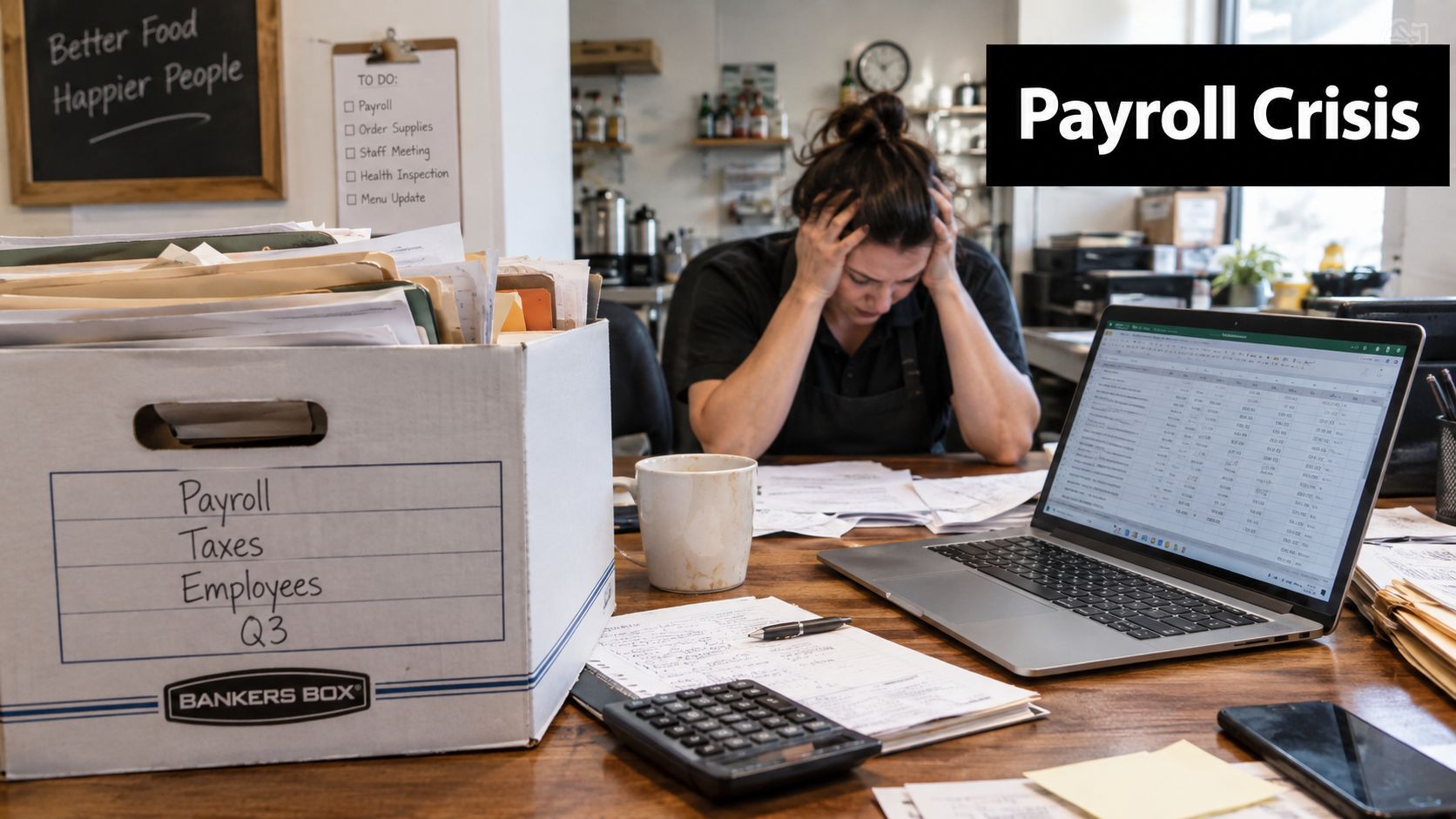
The restaurant sat off a busy Jacksonville corridor, with lunch traffic, delivery orders, and a staff that changed constantly. The owner ran payroll from a spreadsheet, kept old W-2s in a banker box, and calculated overtime by memory when the week got hectic. Time cards lived in a drawer until someone needed to enter the totals, then disappeared into recycling.
The problem surfaced when a Department of Labor investigator arrived and asked for time cards from 2021. The owner opened the drawer, checked the filing cabinet, and called the former manager. Nothing turned up. The records had been recycled, overwritten, or never created in a usable form.
The audit problem wasn't the missing box. It was the missing system.
The investigator didn't need a dramatic confession. The absence of time cards, wage-rate history, schedules, and supporting payroll reports created the problem by itself. The owner had to reconstruct years of payroll in a short window, contact former employees, compare bank withdrawals with old schedules, and explain overtime calculations that nobody could prove.
That scramble is common among small businesses that treat payroll recordkeeping as filing instead of infrastructure. A payroll file must preserve who worked, when they worked, what rate applied, how overtime was calculated, what taxes were withheld, when deposits were made, and who approved changes.
If an audit notice has already arrived, start with a disciplined document-gathering process. This audit preparation guide for business owners can help organize the first response, but prevention is cheaper and calmer.
The rest of the solution comes down to four disciplines:
- Classify records: Separate timekeeping, tax, employee, leave, and compensation documents.
- Apply the right clock: Match each document to the rule that governs its retention.
- Protect access: Use permissions, secure backups, and audit trails for sensitive data.
- Reconcile regularly: Tie payroll reports to the general ledger, bank activity, and filed tax returns.
A Jacksonville business doesn't need a perfect archive to become compliant. It needs a repeatable process that makes missing records difficult and questionable entries visible.
What Federal Payroll Recordkeeping Actually Requires
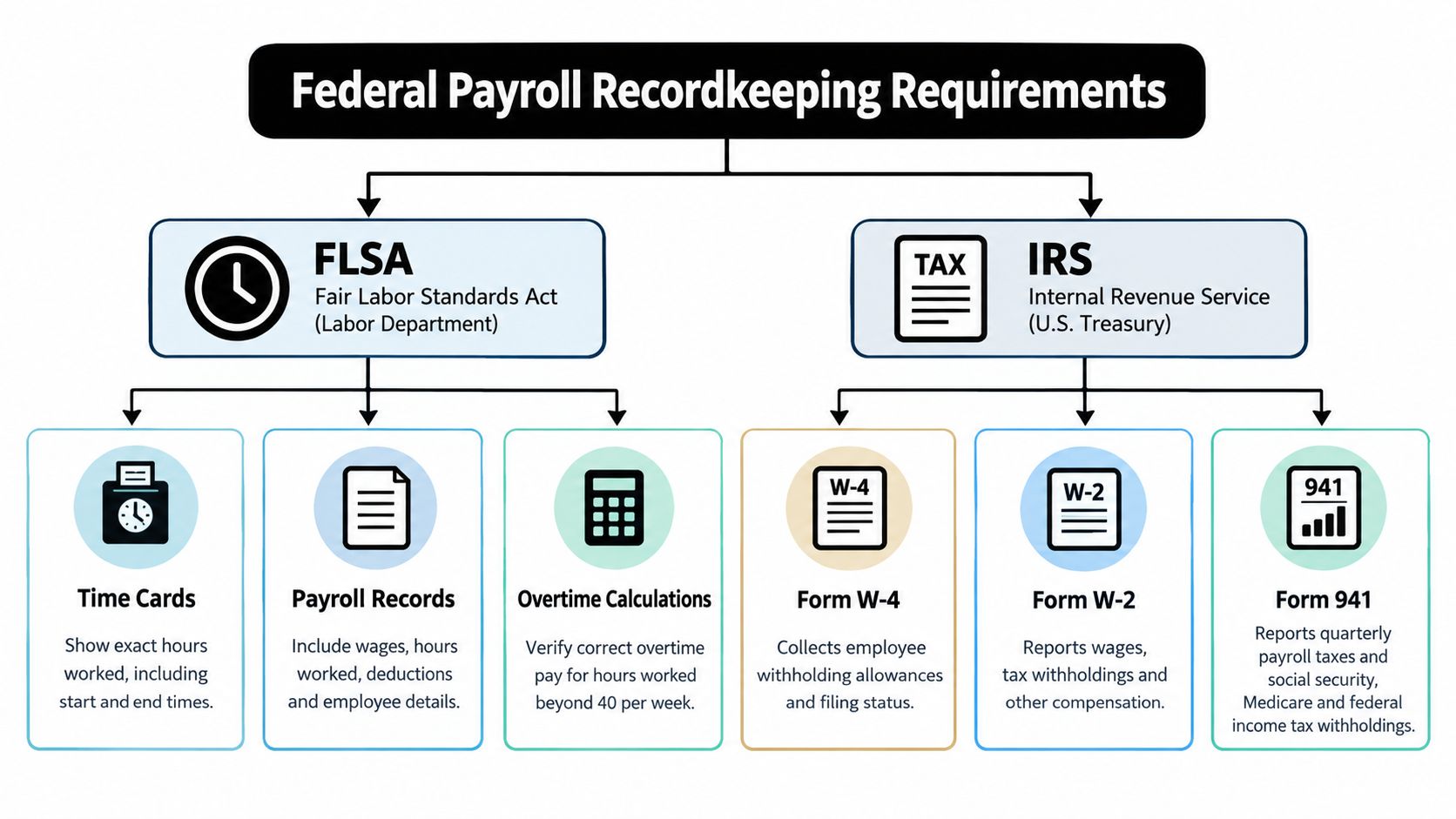
The federal baseline comes from two places that owners routinely confuse. The Fair Labor Standards Act, or FLSA, focuses on wages, hours, and employment records. The IRS focuses on employment taxes, filings, deposits, and the evidence supporting those filings.
The FLSA side of the file
The FLSA requires employers to preserve payroll records for at least three years, while records used to compute wages, including time cards, work schedules, and wage-rate tables, generally must be kept for two years. The U.S. Equal Employment Opportunity Commission's recordkeeping requirements provide federal context for employer record retention, while the detailed FLSA requirements apply in Jacksonville just as they apply elsewhere in the United States.
In practice, someone must record hours worked, identify the applicable pay rate, document overtime, and preserve the source data. That information should not exist only in a manager's text messages or an editable spreadsheet with no history.
The IRS side of the file
The IRS requires employment tax records for at least four years after the tax becomes due or is paid, whichever is later. Required evidence can include the employer identification number, wage and pension payment amounts and dates, reported tips, employee names and Social Security numbers, Forms W-4, tax deposit dates, EFTPS acknowledgment numbers, filed returns, and support for credits claimed. The IRS employment tax recordkeeping guidance identifies these records and the retention rule.
Your operating procedure should answer basic questions without relying on memory:
- Who records time? Assign responsibility to managers or employees and document approvals.
- Where is the source data stored? Use a controlled payroll or timekeeping system, not scattered personal files.
- Who reviews payroll? Require a second-person check for hours, rates, deductions, and tax liabilities.
- How are changes approved? Preserve written authorization for new rates, bonuses, deductions, and terminations.
- How does payroll reach the books? Reconcile payroll reports to bank activity and general-ledger entries.
A business that handles payroll, banking, and accounting through disconnected tools should also review this guide to financial controls compliance for broader control principles. Payroll is one part of the control environment, but it touches cash, tax liabilities, employee data, and financial reporting.
For a practical explanation of the business processes behind these rules, review this resource on what payroll compliance involves. The core point is simple. “Federal” doesn't mean optional for Florida employers.
Why the Two, Three, and Four Year Clocks All Run at Once
Payroll records do not share one universal expiration date. A time card, payroll register, and tax return from the same pay period can follow different retention clocks, so deleting the folder when the shortest period ends creates an audit gap.
The FLSA generally separates records used to calculate wages from broader payroll records. Time cards and wage computation materials generally belong in the two-year category, while broader payroll records generally remain available for three years. The IRS uses a different standard, requiring employment tax records for four years after the later relevant due or payment date.
That mismatch matters in practice. A time card may reach the end of its shorter wage-computation period while the payroll register and tax support for that same year remain subject to the IRS rule. Keep the related records together unless you have a documented reason to separate them.
| Document Type | FLSA Requirement | IRS Standard | IRS Underreporting Case | Safe Holding Period |
|---|---|---|---|---|
| Time card or schedule | Generally 2 years | May support tax records | Longer review can apply when relevant | Keep with related payroll support |
| Payroll register | At least 3 years | At least 4 years for employment tax records | Longer period may apply | At least 4 years |
| Form W-2 support | Related payroll record | At least 4 years for employment tax records | Longer period may apply | At least 4 years |
| Form 941 worksheet | Related payroll record | At least 4 years after the later due or payment date | Longer period may apply | At least 4 years |
The IRS rule is clear in a Form 941 example for the first quarter of 2026. The return is due April 30, 2026. Under the four-year rule, the related payroll tax records would need to remain available until at least April 30, 2030, if the later relevant date is April 30, 2026. The Form 941 retention example explains how the period runs from the applicable due date or payment date.
Florida does not replace federal payroll duties with a looser standard. Businesses operating across jurisdictions must account for every rule that applies to their records. Use the longest applicable retention period as the operating policy, classify records by type, and stop scheduled destruction whenever an audit, dispute, investigation, or legal hold exists.
The practical recommendation is simple: retain the complete payroll archive for at least the longest applicable period, then have a fractional CFO review the policy and exceptions. That extra oversight keeps a convenient deletion schedule from becoming a costly records problem.
The Documents That Must Live in Every Payroll File
A payroll file should answer a skeptical outsider's questions without requiring the owner to recreate history. Build the file when the employee is hired, update it when pay or status changes, and close it carefully when employment ends.
Build the employee file in working order
Start with the Form W-4, which documents federal withholding instructions. Florida doesn't impose a state individual income tax withholding form, but employers still need records related to Florida reemployment tax and unemployment reporting. Keep the Form I-9 and any E-Verify confirmation in a restricted location rather than giving every payroll user access to identity documents.
The written offer letter or pay-rate change approval proves what the employee was promised and when the rate became effective. That document matters when the payroll register shows a different amount from an earlier period.
Add the operational records next:
- Time and attendance records: Prove hours worked, schedules, meal periods where applicable, and overtime inputs.
- Pay registers: Show gross wages, deductions, employer taxes, payment dates, and net pay.
- Payroll journal entries: Connect payroll activity to expense, liability, and cash accounts.
- Direct deposit authorizations: Establish the employee's chosen payment method and account instructions.
- Garnishment orders: Support deductions and show that the business followed the controlling instruction.
- Leave records: Preserve vacation, sick leave, holiday, and other entitlement calculations.
- Termination paperwork: Record the final pay process, last day, deductions, and authorization trail.
Preserve payroll-adjacent evidence
Small businesses often keep the paycheck but lose the evidence behind it. Missing pay-rate notices, incomplete PTO ledgers, undocumented bonuses, and unapproved deductions can make an otherwise ordinary payroll period difficult to defend. New leave and pay-transparency expectations also make payroll-adjacent records more important, particularly when an employer must prove how leave, overtime, or worker entitlements were calculated.
A structured document system can help. LeaveWizard's employee document management system guide offers useful ideas for organizing employee records, permissions, and retrieval.
For storage, create one restricted subfolder per employee and a master payroll folder organized by year. Keep tax returns, deposit confirmations, payroll registers, reconciliation reports, and agency correspondence in the annual folder. Use electronic records management practices that provide secure backups, role-based access, searchable files, and an audit trail.
Why Most Small Businesses Need a Fractional CFO for Payroll
Payroll becomes a management-control problem before many owners recognize it. Once a Florida company has a growing workforce, multiple locations, multiple states, or complex compensation, one person shouldn't be the only individual entering hours, approving raises, releasing payments, and posting the accounting entries.
A fractional CFO owns the architecture around payroll. That includes selecting the payroll vendor, defining approval rules, connecting payroll to bookkeeping, reviewing tax liabilities, testing access controls, and coordinating the response when an agency asks questions. The CFO doesn't replace the payroll processor. The CFO makes sure the processor, timekeeping system, bank account, and accounting file agree.
Three failure patterns
Personal bank account payroll creates a control and documentation problem. Owner funds become mixed with employee payments, tax deposits, and business expenses. Even when the owner intends to fix the books later, the trail becomes difficult to verify.
A disconnected QuickBooks file produces two versions of the truth. The payroll provider reports one set of wages and liabilities, while the general ledger carries another. The owner may not notice until a bank reconciliation, tax return, or year-end review exposes the difference.
Unapproved wage changes leave the business unable to prove who authorized a new rate, bonus, commission, or deduction. That gap can contribute to FLSA back-pay exposure when the recorded rate doesn't match the rate used to calculate wages.
The IRS also expects supporting evidence for employment tax filings, including deposit dates, acknowledgment records, returns, and wage information. Missing support can create tax problems even when the total tax paid was correct.
| Risk | Typical Cost | Fractional CFO Cost |
|---|---|---|
| Missing time and wage records | Back-pay exposure, penalties, investigation expense | A planned advisory engagement |
| Incorrect payroll tax setup | Corrections, interest, penalties, management time | Ongoing review and controls |
| Disconnected books and payroll | Rework, unreliable financial statements, filing risk | Monthly reconciliation and close oversight |
| Unauthorized pay changes | Wage disputes and weak audit defense | Approval workflow and documented review |
The exact cost of a mistake depends on the facts, the employees involved, the period under review, and the agency's findings. A fractional CFO costs a fraction of the disruption caused by a serious payroll failure, while giving the owner a senior guide without adding a full-time executive to the payroll.
Setting Up QuickBooks Payroll to Stay Compliant
QuickBooks Payroll can support a sound recordkeeping process, but software doesn't fix incomplete setup. Treat every field as part of the audit trail.
Start with company settings
Enter the federal EIN, Florida reemployment tax account number, and applicable state unemployment insurance rate. Confirm the legal business name, filing address, pay schedules, and tax filing frequency before processing the first run.
Then configure each employee record using the source documents:
- Withholding data: Enter information from the employee's Form W-4 and retain the form in the employee file.
- Pay basis: Record hourly, salary, commission, bonus, or other compensation terms.
- Pay schedule: Match the system schedule to the actual workweek and pay dates.
- Payment method: Enter direct deposit instructions only after receiving written authorization.
- Employee status: Record hire, leave, rate-change, and termination dates consistently.
QuickBooks Payroll reports can generate wage detail, payroll liability balances, payroll summaries, and journal entries. The wage detail should support the payroll register and hours-to-wages review. The liability report should be reconciled to tax deposits and unpaid obligations. The quarterly summary should agree with the applicable filed employment tax returns.
Don't let the software become a sealed box. Export reports into a controlled archive, preserve the underlying approvals, and document corrections instead of overwriting the original record.
At month-end, a fractional CFO should review the payroll register, general-ledger posting, bank withdrawals, tax liabilities, benefits, retirement payments, and outstanding payroll items. The clean handoff is a package, not a screenshot. It should show what payroll calculated, what the business paid, what the books recorded, and what remains due.
From Clean Payroll Records to a Business You Can Actually Scale
Clean payroll records do more than satisfy an auditor. They give banks, sureties, investors, buyers, and potential partners confidence that labor costs and tax liabilities are real, complete, and understandable.
A construction company needs dependable payroll data for job costing, workers' compensation reviews, and prevailing-wage documentation where applicable. A healthcare practice needs controlled access to sensitive employee information and reliable labor-cost reporting. A nonprofit needs payroll records that reconcile to restricted funding, grant budgets, and financial reporting. The same discipline serves each organization, but the supporting documents differ.
Payroll becomes a management asset
A complete payroll archive helps answer questions that affect growth:
- Which projects are absorbing more labor than expected?
- What will the next hiring decision do to cash flow?
- Are overtime trends caused by scheduling, staffing, or pricing?
- Can the business support a loan, bonding request, acquisition review, or partner buy-in?
- Do payroll taxes, benefits, leave balances, and retirement payments agree with the books?
Emerging requirements also expand the evidence employers may need to preserve. UK guidance illustrates the direction of travel, with payroll records, holiday pay records, leave calculations, overtime, and worker entitlements becoming closely connected in compliance reviews. The Xero overview of payroll records discusses this broader recordkeeping focus, including the projection that UK holiday pay records will require six-year retention beginning April 6, 2026.
A payroll archive is a financial dataset. Treat it with the same care you give the general ledger.
Bookkeeping and Accounting of Florida Inc. works with Jacksonville and Northeast Florida businesses on bookkeeping, payroll, tax preparation, audits, QuickBooks setup, and fractional CFO services. The firm can validate employee information, review hours and overtime, calculate wages and deductions, record employer taxes, process payments, and post payroll to the correct general-ledger accounts.
Audit your current employee files, time records, payroll registers, tax returns, deposit confirmations, leave records, and approval documents against the layered federal and Florida rules. Then have a fractional CFO build a retention schedule, access policy, reconciliation process, and legal-hold procedure that will still work after the current tax season ends.
If your payroll records are scattered, incomplete, or disconnected from QuickBooks, contact Bookkeeping and Accounting of Florida Inc. for payroll bookkeeping, compliance support, and fractional CFO guidance. Ask the team to review your current payroll file structure and build a system that keeps records accurate, retrievable, and ready for the next audit.