
An IRS notice arrives on a Tuesday morning. Then your workers' compensation auditor asks for payroll by trade classification, and a project manager wants certified payroll records for a JEA job. You open the office drawer and find a shoebox of 1099s, handwritten timecards, and a QuickBooks file that shows revenue but can't tell you which jobs paid for the labor.
Thank you for reading this post, don't forget to subscribe!That situation is common among Jacksonville trades businesses. It's also avoidable. Payroll services for contractors should function as a compliance system, job-costing system, and management reporting system, not merely a way to send direct deposits. The right setup keeps W-2s, 1099-NECs, certified payroll reports, workers' compensation records, tax filings, and job allocations connected from the first day a worker is onboarded.
When a Shoebox of Receipts Becomes a Compliance Problem
The first warning usually isn't a dramatic investigation. It's a mismatch. A W-2 doesn't agree with the payroll ledger, a 1099-NEC doesn't match the vendor file, or Florida unemployment charges reflect workers the owner thought were subcontractors. Sometimes the trigger is a request for certified payroll records on a JEA or City of Jacksonville project. Sometimes it's a Compliance Safety and Health Officer, or CSHO, asking questions at a job site while the office can't produce a clean time record.
Roofers, welders, electricians, plumbers, and other trades also carry workers' compensation classifications that cannot be treated as generic office payroll. A worker paid under the wrong class code can distort premiums and create trouble during an audit. The owner may have paid everyone on time and still lack the records needed to prove that the pay was correct.
Practical rule: If your payroll cannot show who worked, where they worked, what trade they performed, what rate applied, and how the cost reached the job ledger, it isn't audit-ready payroll.
Contractor payroll produces much more than checks. It must support W-2 preparation, 1099-NEC reporting, certified payroll reports, workers' compensation audits, tax deposits, and job-cost allocations. The IRS requires employers to retain payroll records for at least four years, and misclassification can lead to back taxes, penalties, and unpaid overtime claims. The IRS recordkeeping and payroll guidance summarized for small businesses makes the point clearly: payroll documentation has to survive beyond payday.
Three problems keep showing up
Misclassification is the first. A finish carpenter might receive a 1099 while working under the contractor's schedule, using company tools, and performing the core work of the business. That arrangement deserves review before the first payment, not after a worker files a claim.
Prevailing-wage gaps are the second. Public work connected to Davis-Bacon requirements, JEA, or the City of Jacksonville can require wage and fringe calculations that ordinary payroll software doesn't understand.
Missing job-cost data is the third. If labor, payroll taxes, workers' compensation burden, and fringe costs don't flow into QuickBooks by project and cost code, busy jobs can look profitable until year-end. Owners then discover that the work generated sales but not margin.
Start by organizing the underlying records, including receipts, timecards, vendor documents, and payroll support. This guide to organizing receipts for taxes is useful, but receipts are only one part of the system. Contractor payroll needs connected records that explain the full labor transaction.
What Contractor Payroll Services Actually Include
A concrete subcontractor and a residential remodeler don't need the same payroll setup. The concrete sub may work on public projects with prevailing-wage classifications, weekly certified reports, and fringe-benefit allocations. The remodeler may need strong time tracking, workers' compensation coding, subcontractor documentation, and job-cost reporting across residential phases.
Both need accurate payment processing. Only a contractor-specific workflow reliably connects that payment to the compliance and accounting records behind it.
The core workflow
Register the business correctly. A provider should help maintain Florida registrations and support employees working across state lines, including crews that cross into Georgia or South Carolina.
Onboard each worker by status and trade. Employees need the appropriate employment records. Independent contractors generally provide Form W-9, are paid as business expenses rather than through payroll, and may receive Form 1099-NEC when reporting requirements apply. The IRS guidance on forms and taxes for independent contractors explains the distinction.
Capture time by job and wage type. Daily time should identify the project, phase, cost code, trade, regular hours, overtime, and any prevailing-wage category.
Process the right payment record. That can mean W-2 payroll, contractor accounts payable, garnishments, benefits, workers' compensation integration, and job-level allocations.
Prepare the required filings. The workflow may include W-2s, 1099-NECs, Form 1096, state filings, new-hire reporting to Florida's state directory, and certified payroll reports using the required agency format.
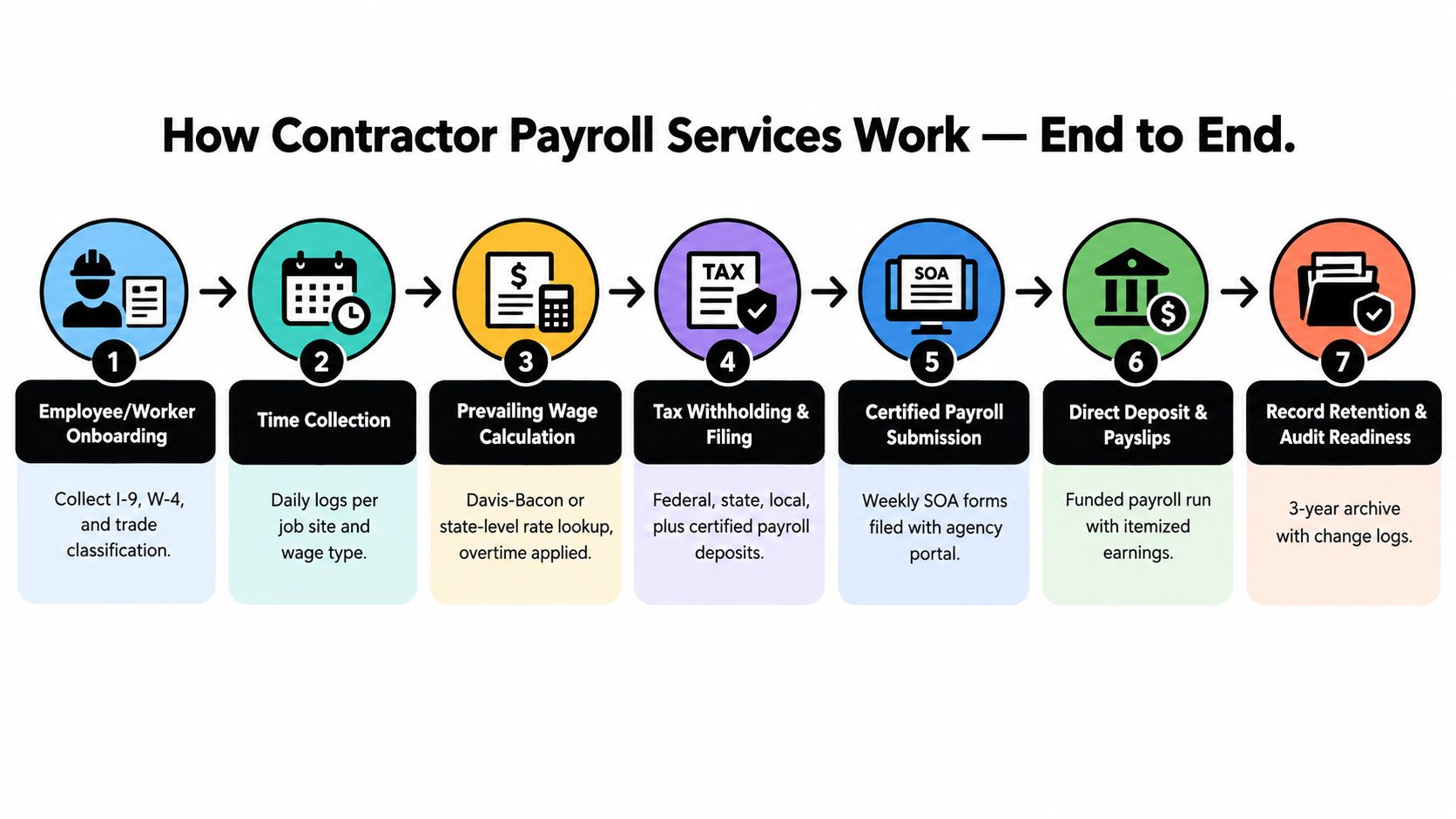
A general payroll app may calculate gross-to-net wages and issue direct deposit. That's the baseline. A contractor payroll service adds trade classifications, job and cost-code tracking, certified payroll generation, prevailing-wage fringe calculations, fringe-benefit plan setup, workers' compensation class codes, and audit support.
If your business performs federal work, a govcon software resource can help with broader government-contracting operations, but it doesn't replace a payroll workflow that understands your labor records. For the accounting side, review the basics of payroll processing before choosing a provider.
Worker Classification and the Real Cost of Getting It Wrong
Classification starts with the facts, not the label on the invoice. Calling someone a subcontractor doesn't make that person an independent contractor. The IRS analysis centers on behavioral control, financial control, and the relationship between the worker and the business.
Consider a Jacksonville finish carpenter. You provide the truck, supply the tools, set the schedule, direct the daily work, and require the carpenter to perform the same core service your company sells to customers. Those facts point toward employee treatment, even if the worker sends invoices and prefers a 1099.
Apply the three factors before payment
Behavioral control asks who directs how the work gets done. A worker following your detailed process, schedule, supervision, and training looks different from an independent business deciding its own methods.
Financial control examines investment, opportunity for profit, unreimbursed expenses, and whether the worker serves other customers. A true independent business generally bears more business risk and controls more of its commercial activity.
Relationship type considers written agreements, benefits, permanency, and whether the work is central to your business. A long-term worker doing your primary trade deserves closer review than a specialist hired for a defined outside service.
Construction businesses also need to consider Florida construction-industry rules and the economic-realities approach used by federal agencies. A classification decision that passes a casual office review can still fail when regulators examine control, dependence, permanence, and the actual working relationship.
| Cost Item | 1099 Independent Contractor | W-2 Employee |
|---|---|---|
| Payment channel | Accounts payable or contractor payment workflow | Payroll processing |
| Federal withholding | Generally no federal income tax, Social Security, or Medicare withholding | Gross-to-net withholding applies |
| Onboarding record | Form W-9 and vendor documentation | Employee onboarding and payroll records |
| Year-end reporting | Form 1099-NEC when reportable | Form W-2 |
| Main control | Vendor master data and payment tracking | Time, wage, tax, benefit, and employment records |
| Major exposure | Misclassification and information-return errors | Overtime, withholding, unemployment, and workers' compensation errors |
The IRS notes that incorrect or late information returns can create filing penalties, while independent contractors generally use Schedule C to calculate business earnings subject to self-employment tax. IRS Publication 334 is a useful reference for that reporting framework.
The cost of a wrong decision can include back wages, overtime, unpaid FICA and FUTA, workers' compensation premium recovery, interest, penalties, and class-action exposure. A contractor who treats classification as a paperwork shortcut can spend far more defending the decision than reviewing it correctly before the first check. Owners who want a legal perspective should understand their worker status before the payment process becomes evidence against them.
Certified Payroll and Prevailing Wage for Construction and Trades
Certified payroll is not regular payroll with a different report attached. On Davis-Bacon work and public projects for JEA or the City of Jacksonville, the payroll system must preserve the connection between worker, trade, hours, wage rate, fringe amount, project, and weekly submission.
Federally funded or federally assisted contracts over $2,000 can trigger prevailing-wage requirements under the Davis-Bacon framework, as summarized by Miter's payroll compliance guidance. Northeast Florida contractors need the same discipline when a bid package or local contract requires prevailing-wage reporting, even when the project isn't federally funded.
Four layers belong in every run
The base rate must match the worker's classification and the contract or wage determination. A plumber, laborer, electrician, and operating engineer cannot be grouped under one convenient rate.
The fringe rate must be captured separately. If the contractor provides qualifying benefits, the payroll record should show how those benefits satisfy the obligation. If not, the required fringe amount may need to be paid as wages.
The fringe-benefit plan documentation must support the calculation. Payroll should connect the worker's benefit enrollment, contribution, or cash-in-lieu treatment to the certified report.
The apprenticeship ratio must be checked against the applicable registered program and project requirements. A worker's apprentice status doesn't automatically justify any ratio or wage treatment.
A Northeast Florida example makes the problem obvious. If a JEA lift-station upgrade specifies a plumber's base wage and a separate fringe amount, the payroll service should calculate regular and overtime treatment, record the fringe allocation, identify the project and classification, and generate the weekly Statement of Compliance. Generic software may issue the paycheck while omitting the evidence that proves compliance.
| Layer | Contractor Payroll Service | Generic Small-Business Payroll |
|---|---|---|
| Wage classification | Matches trade and project requirements | Usually relies on a standard pay rate |
| Fringe amount | Calculates, allocates, and documents the fringe | Often absent or manually entered |
| Apprentices | Tracks status and required ratios | Rarely connected to project rules |
| Weekly report | Produces WH-347 or required agency export | May require spreadsheets |
| Job costing | Posts labor and burden to project codes | Often posts only aggregate payroll |
| Audit trail | Retains source time, edits, approvals, and submissions | Depends on manual recordkeeping |
Missing or incomplete certified payroll can breach contract requirements in public-work bid packages. It isn't merely a late administrative task. Before reviewing workers' compensation exposure, contractors can also find workers comp rates by trade and risk classification.
Off-the-shelf payroll platforms usually fail here because they process paychecks, not prevailing-wage evidence.
Job Costing and QuickBooks Integration That Owners Can Trust
Payroll sitting in its own silo is a check-writing tool. A contractor needs each labor transaction to reach QuickBooks Online or Desktop with a job, phase, class, and cost code, or the financial statements won't explain what happened in the field.
The data flow should begin with time entry. A worker records hours against a project and phase, the supervisor approves the entry, payroll applies the correct wage and burden, and the accounting integration posts the result to the appropriate job. Labor taxes, workers' compensation, benefits, and prevailing-wage fringe amounts should remain visible instead of disappearing into overhead.
What a usable posting looks like
Suppose a three-person crew works on one residential remodel. The accounting file should distinguish each person's base labor, payroll tax burden, workers' compensation allocation, and any applicable benefit or fringe cost. The exact amounts depend on the payroll run and insurance classifications, but the structure should look like this:
| Line Item | Amount | Job/Class | QBO Item |
|---|---|---|---|
| Crew base wages | Payroll-run amount | Remodel project and labor phase | Direct labor |
| Employer payroll taxes | Payroll-run amount | Same project, labor burden class | Payroll tax burden |
| Workers' compensation burden | Payroll-run amount | Trade-specific project class | Workers' compensation |
| Benefits or fringe | Payroll-run amount | Employee and project allocation | Benefits or fringe |
| Indirect supervision | Payroll-run amount | Overhead class | Indirect labor |
“Payroll-run amount” is deliberate. A fabricated allocation is worse than no allocation because it gives the owner false confidence. Your bookkeeper should be able to trace every amount back to approved time, the payroll register, and the accounting entry.
QuickBooks class tracking matters because it separates departments, locations, or operating segments. Item-level mapping matters because it identifies the type of labor or burden. Neither setting helps if the integration posts one lump sum with no project detail.
Watch for three symptoms:
- Every job looks profitable. Direct labor may be sitting in overhead or failing to post.
- Indirect labor never moves. Supervisors may be coded as general expense even when they work on specific jobs.
- Work in process won't reconcile. Payroll postings may not match the schedule of values or the project ledger.
A contractor-focused accounting team should test the integration with a complete payroll run, not a demo employee. Use the QuickBooks construction job costing guide to review the accounting structure before accepting a payroll sync.
Pricing Models and Where Contractors Quietly Overpay
Contractor payroll pricing usually falls into three models, and none should be judged by the advertised base fee alone. A flat-fee plan can look attractive for a small operation, but it may exclude certified payroll, multi-state filings, job costing, workers' compensation support, and year-end cleanup.
Per-employee pricing is easier to forecast when the workforce is stable. It becomes expensive when crews turn over, workers change classifications, projects require additional reports, or the provider charges separately for every compliance feature. Hybrid bundles may combine core payroll and filings while placing limits on states, runs, forms, or certified reports.
Compare the bill you'll actually pay
| Cost Line | Flat-Fee | Per-Employee | Hybrid Bundle |
|---|---|---|---|
| Base payroll processing | Predictable | Lower base, scales with headcount | Included up to stated limits |
| Employee turnover | May be included or restricted | Can increase the bill quickly | Depends on the bundle rules |
| 1099-NEC and 1096 work | Often an add-on | Frequently priced per form | May be included only for a capped volume |
| Certified payroll | Commonly excluded | Usually an add-on | May be included at a limited level |
| Multi-state filings | Often separate | Per-state charges may apply | Verify included jurisdictions |
| Job-cost integration | May require another module | Often sold separately | Check whether burden allocation is included |
| Off-cycle or rush payroll | Can carry a separate fee | Can carry a separate fee | Read the exception schedule |
| Year-end reconciliation | Rarely included | May be billed separately | May be included only with an annual renewal |
The owner's time is the hidden cost. Re-keying time from a spreadsheet into payroll, then re-keying payroll into QuickBooks, creates opportunities for errors and makes month-end close slower. The accountant's cleanup time and the year-end scramble across W-2s, 1099-NECs, workers' compensation records, and certified payroll archives can exceed the subscription itself.
Ask for a written fee schedule that covers employee changes, contractor forms, state registrations, certified reports, amended filings, off-cycle checks, year-end processing, and accounting integration. Don't accept “full service” until the provider defines what happens when a crew crosses a state line or a public project adds a new wage determination.
The right model is the one that prices the compliance work your company performs. Cheap payroll that leaves job costing and certified reporting to the owner is not cheap.
Red Flags and Common Mistakes When Choosing a Payroll Provider
Payroll vendors can sell compliance theater with polished dashboards and vague promises. A contractor should challenge the provider before handing over employee records, bank information, and tax responsibilities.
| Red Flag | Question to Ask Verbatim |
|---|---|
| Marketing never mentions certified payroll | “Show me a sample WH-347 you generated last quarter.” |
| The provider says it handles taxes but cannot explain Davis-Bacon rates | “How do you document the wage determination and fringe calculation for each project?” |
| No subcontractor W-9 tracking module | “Where do you store W-9s, and how do you flag missing or outdated vendor records?” |
| Timekeeping is spreadsheet-only | “Can I see the edit history, approval trail, and original time entry for a payroll record?” |
| Workers' compensation is classified generically | “Which trade class code will you apply to each worker and project?” |
| No multi-state capability | “How will you handle an employee who works in Florida, Georgia, and South Carolina during the same period?” |
| Sync posts gross payroll without job detail | “Which cost codes did this payroll post to in QuickBooks?” |
| The quote hides per-run or per-form fees | “Give me the total annual fee schedule, including every filing, amendment, and year-end charge.” |
The red flags matter because contractor payroll errors rarely stay inside payroll. A missing W-9 affects information reporting. A generic workers' compensation code affects an audit. A gross-only accounting sync affects bids, margins, and work-in-process reporting. A weak certified payroll process can affect the contractor's standing on public work.
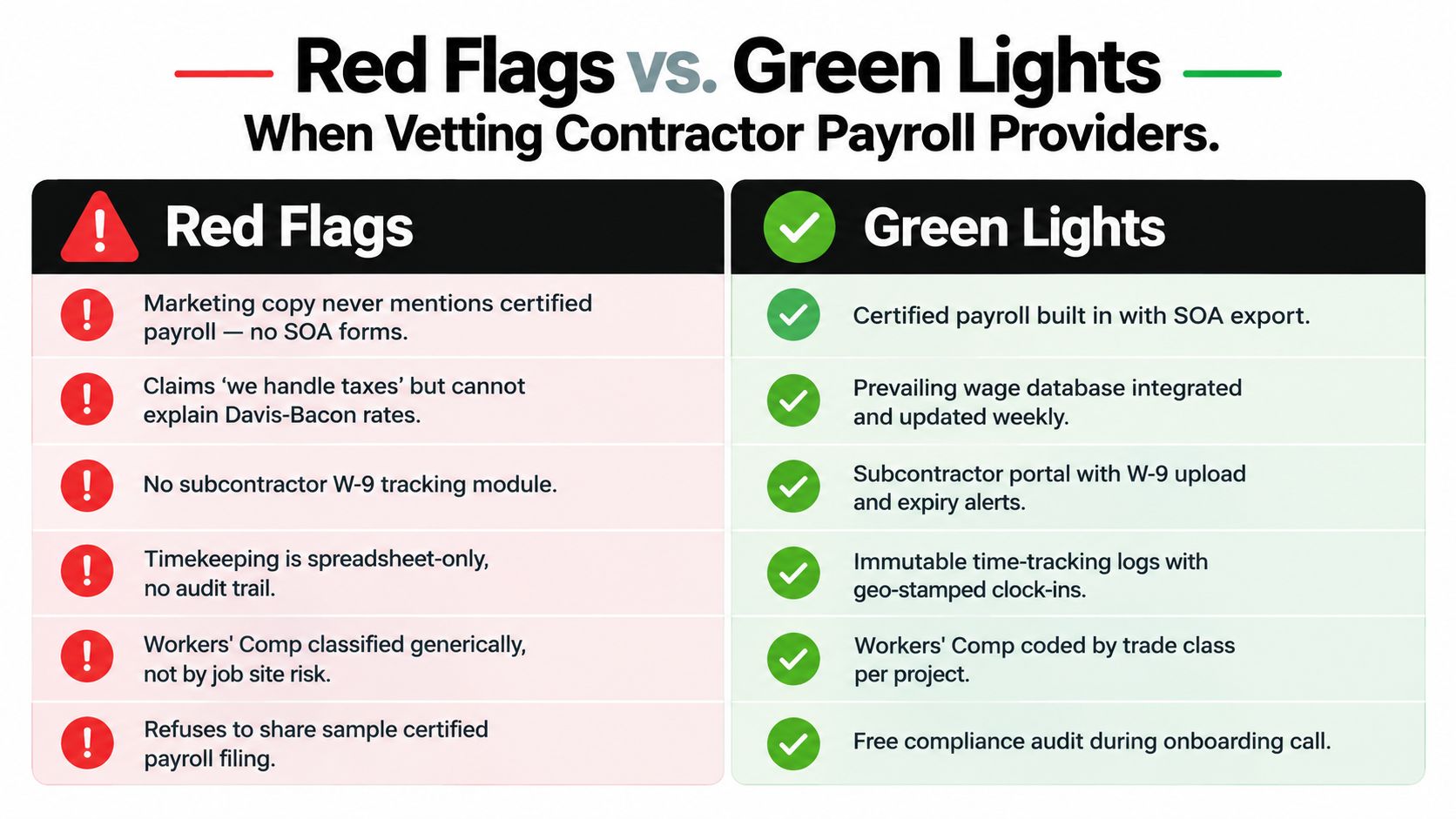
A credible provider should discuss Davis-Bacon fringe rates, JEA prevailing wage, City of Jacksonville bid requirements, Florida workers' compensation classifications, multi-state filings, and the accounting treatment of payroll-related purchases and sales-tax issues. If the sales representative only discusses direct deposit and a mobile app, you're not interviewing a contractor payroll partner.
The lowest quote commonly excludes the job-level reporting that protects the owner's margin. Ask for a live walkthrough using your actual trades, projects, and cost codes.
A Practical Checklist and Why a Fractional CFO Ties It Together
Use this checklist before changing payroll providers or bidding another public project:
- Document each worker's employee or independent-contractor classification.
- Collect and file subcontractor W-9 forms.
- Confirm the certified payroll format required by the agency.
- Pull and date the prevailing-wage rates used for each project.
- Match workers' compensation class codes to each trade and job site.
- Verify timekeeping by project, phase, wage type, and cost code.
- Confirm the provider can export WH-347 or the agency's required report.
- Map federal, Florida, and other state tax registrations.
- Record the federal deposit schedule assigned through the IRS lookback process.
- Write down the overtime approval and calculation policy.
- Connect payroll burden to QuickBooks job and class tracking.
- Reconcile payroll, job costs, and work in process on a scheduled basis.
- Review benefit and fringe documentation before certified payroll submission.
- Request a complete fee schedule, including forms, states, amendments, and off-cycle runs.
- Schedule a management review of labor burden, cash flow, and project margin.
Federal payroll deposits follow an IRS lookback process. When employment tax liability in that period is $50,000 or less, the employer is assigned a monthly deposit schedule, with deposits due by the 15th of the following month. This summary of federal payroll deposit schedules shows why deposit timing belongs in the operating calendar, not in someone's memory.
A vendor that answers every checklist item clearly is worth evaluating. A vendor that avoids the questions has already shown you the limits of its service.
A Jacksonville fractional CFO ties the system together because payroll data drives labor burden, certified payroll records support public-project administration and bonding conversations, and job costing informs bids. Small businesses need someone who can guide those decisions without adding a full-time executive salary. Bookkeeping and Accounting of Florida Inc. provides bookkeeping, payroll processing, tax support, certified payroll documentation, QuickBooks guidance, and fractional CFO services for businesses in Jacksonville and Northeast Florida.
The goal isn't to buy another payroll subscription. It's to build a record that tells you what you owe, whom you owe it to, which job consumed the labor, and whether the work produced a margin worth repeating.
Bookkeeping and Accounting of Florida Inc. can set up contractor payroll, connect labor and burden to QuickBooks job costing, prepare W-2 and 1099 filings, and support certified payroll for government work. Visit Bookkeeping and Accounting of Florida Inc. to request a contractor payroll compliance review and a practical checklist for your next payroll or public-project bid.