
You can run a clean payroll all month and still get blindsided by the IRS. That's what happens when a business owner treats payroll like a routine task and never checks the payroll tax deposit schedule attached to it. One missed deadline, one holiday shift, one payroll that pushed liability over the edge, and now the owner is staring at penalties instead of cash flow.
Thank you for reading this post, don't forget to subscribe!I see this constantly with Jacksonville businesses. The payroll gets processed, the wages go out, and everyone assumes the tax side is automatic. It isn't. The IRS ties your deposit timing to your own filed returns and your own liability history, and that schedule can change the moment your business grows, adds locations, or starts paying people across state lines.
Why Payroll Tax Deposit Schedules Catch Small Businesses Off Guard
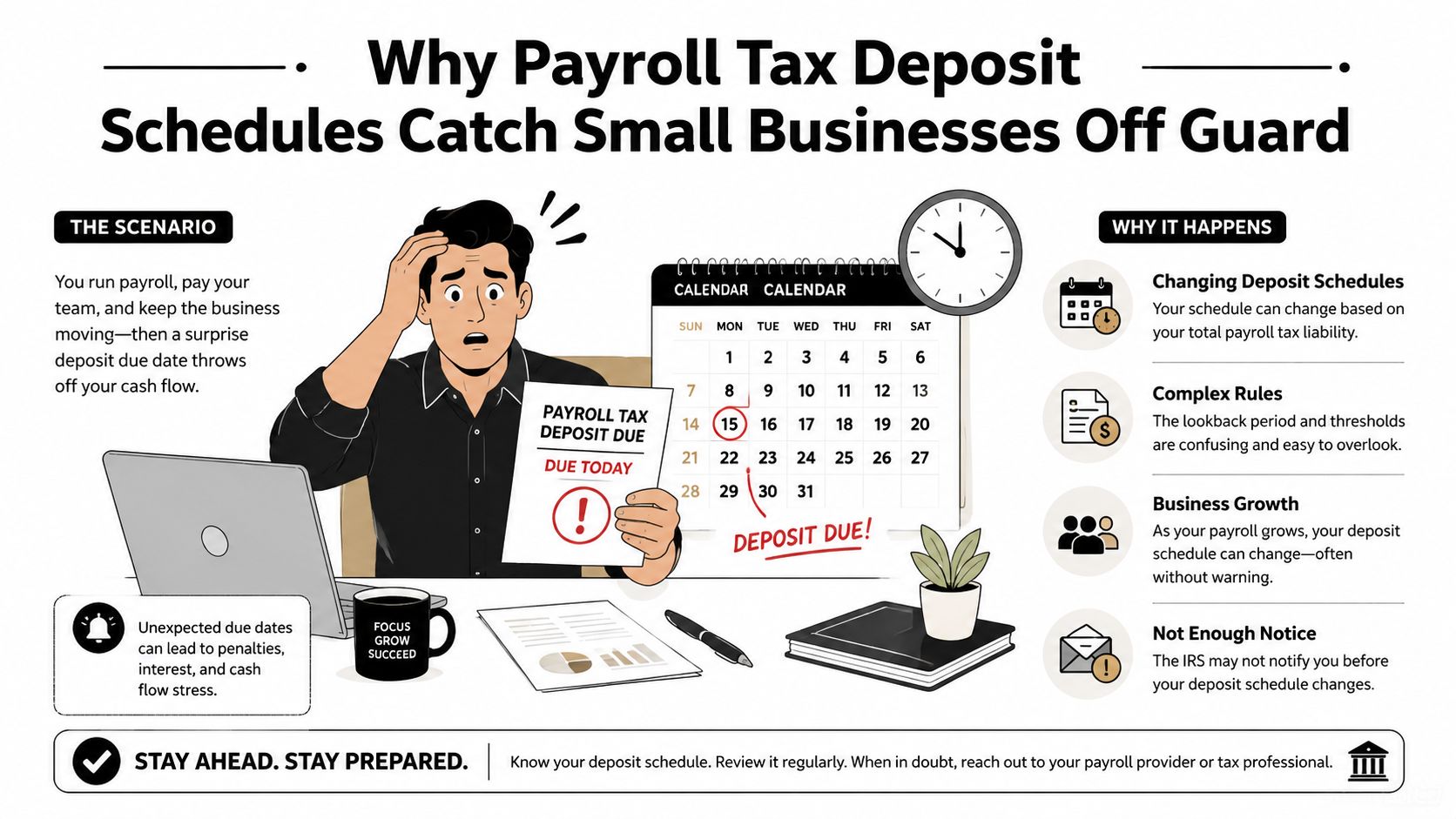
A Jacksonville owner calls in because the IRS says a deposit is late. The payroll ran on time, the taxes were withheld, and the money was sitting in the operating account. The problem was simple and brutal, the owner didn't know the deposit cadence had changed, so the business missed the deadline.
That story plays out in construction shops, clinics, retail stores, and nonprofits all over Northeast Florida. Owners know when employees get paid. They don't always know when the federal government expects its share. The IRS doesn't care whether you were busy, understaffed, or “almost done” with the books.
Practical rule: if you can't say your current deposit schedule out loud, you're already exposed.
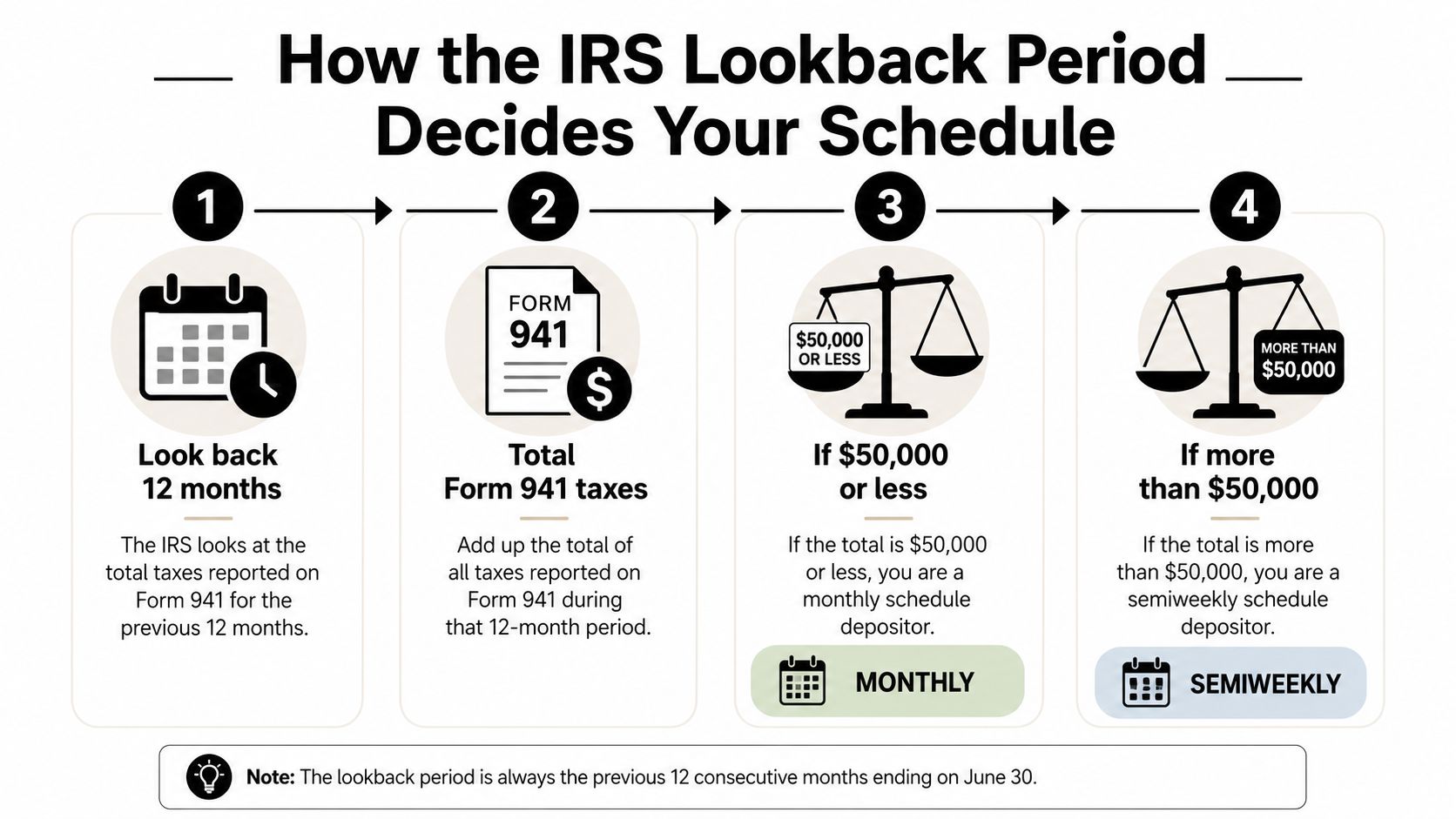
The IRS uses a 12-month lookback period to assign the schedule, and that window runs from July 1 of the second preceding year through June 30 of the prior year. That means your 2026 deposit rhythm was determined by earlier payroll history, not by your current workload or payroll frequency. The trap is that business owners often think payroll software has this handled, when the software only processes payroll, it does not make judgment calls about federal compliance.
If you want a cleaner operating rhythm, the right employee-management stack helps, especially when you're trying to keep people records, scheduling, and payroll aligned. A useful starting point is how Pebb supports small teams, because payroll problems usually start as people-management problems.
How the IRS Lookback Period Decides Your Schedule
The IRS does not let you choose between monthly and semiweekly. It looks at what you already reported, totals the employment taxes on Form 941 for the four quarters in the lookback window, and assigns the schedule from that result. The dividing line is simple, $50,000 or less generally means monthly depositor, and more than $50,000 generally means semiweekly depositor. That rule is the core of federal payroll tax deposit compliance in the United States, and the IRS says each employer has to determine its own schedule from filed returns rather than from payroll frequency alone. See the IRS's deposit guidance for the underlying framework in depositing and reporting employment taxes.
Read the schedule from your returns, not your payroll cycle
Two businesses can have the same headcount and land on different schedules. One may have lower liabilities because wages are steadier. Another may cross the threshold because it pays bonuses, commissions, or higher taxable wages. Headcount is irrelevant here. Liability is what matters.
A practical way to check your own status is to pull the four quarters in the lookback period and total the employment taxes reported on your filed Forms 941. If the number lands at or below the federal threshold, you're monthly. If it's over, you're semiweekly. That's the part owners usually want to skip, and that's exactly why they get surprised.
The IRS schedule comes from filed returns, not from how often you run payroll.
A good practical accounting resource for owners who want the bookkeeping side explained clearly is this practical accounting guide. It's useful because payroll compliance breaks down fastest when the books aren't current.
Monthly Versus Semiweekly Deposit Timing Explained
Monthly and semiweekly sound like administrative labels. In real life, they're cash-flow instructions. Monthly depositors have one recurring federal deadline, while semiweekly depositors live with a tighter calendar that tracks payday more closely. One schedule is easier to manage. The other demands discipline every single pay run.
Monthly schedule
If you're a monthly depositor, taxes for a month are generally due by the 15th day of the following month. So January liabilities are due by February 15. If the 15th falls on a Saturday, Sunday, or legal holiday in the District of Columbia, the deposit moves to the next business day. The IRS explains that rule in its tax topic on monthly employment tax deposits.
Semiweekly schedule
Semiweekly depositors don't get to lump everything into one monthly payment. Payroll timing drives the deposit date, and the schedule is tighter by design. Wages paid on Wednesday, Thursday, or Friday generally require a deposit by the following Wednesday. Wages paid on Saturday, Sunday, Monday, or Tuesday generally require a deposit by the following Friday. If that deadline falls on a weekend or holiday, the due date shifts to the next business day.
| Schedule | Lookback Threshold | Deposit Deadline | Example |
|---|---|---|---|
| Monthly | $50,000 or less | 15th day of the following month | January liabilities due by February 15 |
| Semiweekly | More than $50,000 | Wednesday or Friday, depending on payday | A Friday payroll is generally deposited by the following Wednesday |
If you're trying to keep the calendar straight, a payroll calendar matters more than most owners realize. This internal resource on how a payroll calendar can save you in fees is worth keeping nearby if you're still managing deposits manually.
Setting Up EFTPS and Making Your First Deposits
Once you know your schedule, the money still has to move correctly. Federal payroll deposits run through EFTPS, the Electronic Federal Tax Payment System. That means you're not stuffing a check in the mail and hoping for the best. You're scheduling an electronic transfer and keeping proof that the payment cleared.
The enrollment process is usually where slow systems expose bad habits. The PIN still comes by mail, so businesses that want instant setup get annoyed fast. That delay is exactly why I tell owners not to wait until the first deposit is due to figure out access.
Get the mechanics right before payday hits
You should connect EFTPS to the same workflow that produces payroll, not to some separate “we'll do this later” process. If your payroll software or bookkeeper generates the liabilities, the deposit should be reviewed and scheduled from the same records. Reconcile every EFTPS confirmation number to the payroll register so one deposit doesn't get lost in the shuffle.
Here's the operational truth most owners miss. A payroll system can calculate wages. It can even calculate taxes. It still won't protect you if nobody confirms the deposit went out on time.
Direct rule: if you can't match the deposit confirmation to the payroll register, your controls are weak.
For owners who want to understand the payroll workflow itself, this internal overview of basic payroll processing gives the right context before you start wiring deposit steps into your monthly routine.
The $100,000 Mid-Year Threshold Most Guides Skip
This is the emergency rule that catches growing businesses flat-footed. If accumulated payroll tax liability reaches $100,000 or more, the employer has to make a deposit by the next business day and then continue under the semiweekly system. The IRS spells that out in Publication 1932.
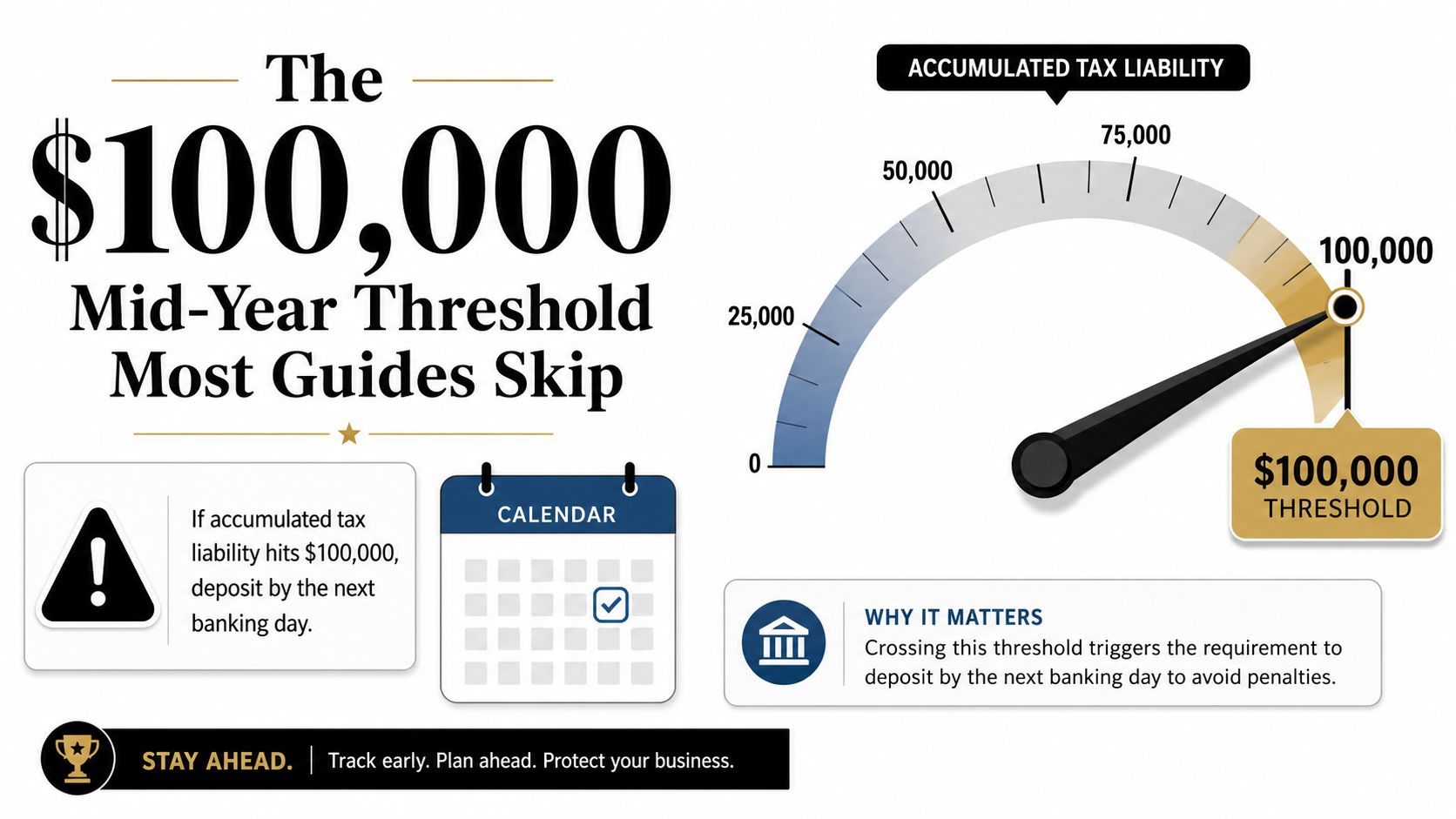
That rule matters because it changes the game immediately. A business can think it's comfortably on a regular payroll rhythm, then a bonus run, seasonal surge, or strong month pushes liability into next-day territory. Fast-growing small businesses, seasonal employers, construction firms with heavy bonus payrolls, and healthcare practices that pay retention bonuses all feel this pressure first.
The fix is not guessing harder. The fix is monitoring liability in real time. I want owners looking at payroll tax accumulation inside payroll software, in weekly bookkeeping reviews, or through alerts that fire before the threshold is crossed. If you wait until the due date to discover the number, you're already behind.
Build a threshold alert habit
- Review liabilities weekly: don't wait for month-end books if payroll is running fast.
- Track totals in the payroll system: the liability screen should be part of your regular review.
- Use a second set of eyes: a bookkeeper or fractional CFO should confirm whether the balance is approaching the cliff.
- Treat bonuses carefully: one off-cycle payroll can change the timing immediately.
A bookkeeping team earns its keep here, because the business owner usually doesn't have time to watch liability accumulation every day. A fractional CFO does.
Coordinating Federal and State Deposit Calendars
Federal timing is only half the job. If you pay employees in more than one state, or even have one employee working remotely elsewhere, you need to reconcile more than one schedule. The federal rule tells you when to deposit to the IRS. State agencies can use different thresholds, different timing logic, and different filing calendars.
California is the clearest example of how messy this gets. The state's EDD maintains its own deposit timing and thresholds for state PIT/SDI deposits, and those rules can differ from the federal schedule. The result is reconciliation work for multi-state employers, especially in healthcare, construction, and remote-first organizations.
Florida business owners sometimes assume the local angle is simple because Florida doesn't have a state income tax. That assumption is dangerous. Once you hire across state lines, the other state's withholding rules still matter, and your federal schedule doesn't solve those obligations for you.
Centralize the calendar or pay for confusion later
The cleanest setup is one payroll platform, one review process, and one accounting team that understands both federal and state remittance timing. That matters most when employees work irregular schedules, cross weekends, or sit in different states with different remittance rules. The more complex your workforce gets, the more a piecemeal approach falls apart.
Multi-state payroll is not just payroll. It's calendar management, tax compliance, and cash-flow control wrapped together.
If you want a practical comparison on payroll support for small teams, Stewart Accounting Services payroll advice is a useful reference point for how smaller organizations think about payroll administration.
Why Most Small Businesses Outsource This and a Practical Checklist
Most owners don't need another IRS deadline to memorize. They need someone to own the calendar, watch the liability, handle the transfers, and keep the state filings aligned. That's why a fractional CFO or outsourced accounting team makes sense for so many small businesses. It turns a compliance burden into a managed process.
Bookkeeping and Accounting of Florida Inc. fits that model because the firm handles bookkeeping, payroll, tax preparation, and fractional CFO services under one roof. That matters when the deposit schedule, the cash flow forecast, and the state filings all need to line up at once. The published payroll tax specialists page is the kind of service description owners should look for when they want the payroll tax side handled without becoming payroll experts themselves.
What to do this week
- Verify your current schedule: confirm whether you're monthly, semiweekly, or newly at next-business-day risk.
- Check EFTPS access: make sure the account is active and the login works.
- Set a liability alert: use software, bookkeeping, or both.
- Reconcile state filings: especially if you have employees outside Florida.
- Hand off the calendar if needed: if this already feels like too much, it probably is.
I'm opinionated about this because I've watched too many owners try to “keep up” with payroll taxes and fail. A good fractional CFO doesn't just report numbers, they keep the business compliant before the deadline turns into a problem. Bookkeeping and Accounting of Florida Inc. offers that kind of support for owners who want the payroll tax deposit schedule managed correctly instead of reactively.
If you're tired of chasing payroll deadlines, Bookkeeping and Accounting of Florida Inc. can help you manage payroll tax deposits, state filing coordination, and the bookkeeping controls that keep those deadlines from slipping. Visit Bookkeeping and Accounting of Florida Inc. to get support from a Jacksonville CPA team that understands compliance, cash flow, and what small businesses need to stay on track.