

You close a sale. The invoice goes out. Then the good feeling lasts about five minutes.
After that, the questions start. Do you charge Florida sales tax? What if the customer is in Georgia, Texas, or California? What if you're selling a service, a piece of equipment, a bundled job, or a mix of all three? If you guess wrong, you don't just create paperwork. You create liability.
Small business owners in Jacksonville run into this every day. Healthcare practices sell items alongside services. Construction companies move materials, labor, and equipment across job sites. Remote teams work from different states. Owners assume their CPA can fix it at year end. Sometimes they can. Often, the problem started months earlier.
Sales tax is one of those business issues that looks shallow until you step in it. Then it feels like a swamp. A proper sales tax consultation helps you find solid ground before the state does it for you.
That One Sale That Keeps You Up at Night
A Jacksonville company lands a nice out-of-state customer. Maybe it's a clinic shipping equipment to another state. Maybe it's a construction supplier sending materials to a project outside Florida. Maybe it's a consultant billing a client with team members spread across state lines. The payment is great. The tax question is not.
That uneasy feeling is justified. The rules move constantly, and they don't care that you're busy running payroll, chasing receivables, and trying to keep margins intact.

The complexity isn't in your head. In 2024 alone, there were 588 sales tax rate changes across the U.S. Since 2014, an average of 610 new or updated sales and use taxes have emerged annually, according to Vertex's 2024 sales tax changes report.
That's not background noise. That's a compliance minefield.
If you operate in more than one state, sell online, use marketplaces, hire remote workers, or bill mixed revenue streams, one transaction can raise several questions at once. Which state has nexus? Is the item taxable? Did the marketplace collect it? Are you tracking gross sales correctly? Is this even a sales tax issue, or a use tax issue waiting to bite you later?
You don't get in trouble because the sale was big. You get in trouble because nobody stopped to ask how the sale should be taxed.
That's why owners who read about the sales tax mistake that costs U.S. businesses thousands usually recognize themselves fast. They didn't ignore taxes. They assumed the rules were simpler than they are.
A sales tax consultation isn't overkill. It's what you do when one sale turns into a pattern, and that pattern turns into exposure.
What a Sales Tax Consultation Is and Is Not
A common perception of "sales tax consultation" is that it means somebody logs in, files a return, and moves on. That's compliance work. Necessary, yes. But that's not the main value.
A real sales tax consultation is a diagnostic. It looks at how your business operates, where your revenue comes from, how your invoices are structured, where your people work, and what tax obligations you've created without realizing it.
What it is
It's a fractional CFO lens applied to sales tax. Not bookkeeping. Not data entry. Not year-end cleanup.
It's a strategic review that asks questions like these:
- Where have you created nexus: Not just where you're headquartered, but where sales activity, remote staff, inventory, projects, or marketplace sales may have triggered obligations.
- What exactly are you selling: A product, a service, a bundled job, equipment, software access, or a taxable and exempt mix.
- How are you documenting exemptions: If your files are thin, your "exempt sale" may not hold up when reviewed.
- Whether your systems match reality: QuickBooks, POS, invoices, marketplace reports, and tax returns often tell slightly different stories. That's where trouble starts.
What it is not
It is not a magic form. It is not something only giant e-commerce sellers need. And it is not something you push off until you get a notice in the mail.
A lot of owners also confuse a sales tax consultation with ordinary bookkeeping. A good bookkeeper records transactions properly. That's valuable. But specialized tax analysis asks a different set of questions. It interprets taxability, sourcing, nexus, and documentation risk.
Practical rule: If your business is growing, changing, adding states, adding service lines, or hiring remote staff, you need judgment, not just transaction coding.
Why this matters to every company
Every company needs someone looking around corners. That's the role many owners expect from a fractional CFO, and they're right to expect it. Sales tax is one of the places where high-level guidance pays for itself because it protects cash flow, margins, and management time.
When owners skip this step, they usually end up doing one of two bad things. They over-collect and make pricing messy, or they under-collect and accumulate a liability they didn't budget for. Neither is smart. A sales tax consultation helps you stop guessing.
Key Triggers That Demand a Consultation
Some business changes should trigger a sales tax review immediately. Not next quarter. Not after year end. Right away.

The threshold that catches owners off guard
Crossing state-specific economic nexus thresholds, commonly $100,000 in annual sales (like in Florida) or 200 transactions, legally obligates your business to register and collect sales tax. Ignoring this can lead to penalties up to 50% of the tax due, plus interest, as explained by the Sales Tax Institute's guidance on sales and use tax administration.
That means growth can create tax exposure even when you never opened an office in another state.
Business events that should trigger a call
You crossed Florida's economic nexus threshold
If your out-of-state business is selling into Florida and hits the threshold, you may need to register and collect. If you're a Florida business selling into other states, you need to watch each state's rule separately.You hired a remote employee in another state
Owners love remote flexibility until it creates tax presence. One employee working elsewhere can change the analysis.You expanded into services or bundled offerings
A business that used to sell products only might now sell consulting, installation, maintenance, or subscriptions. Taxability gets murky fast.You started selling through a marketplace
Amazon, Etsy, Walmart, and similar platforms may collect in some situations, but that doesn't mean your entire compliance problem disappeared.You perform work across state lines
This is common in construction, trades, consulting, and healthcare support services. The minute your people or equipment cross borders, your tax map changes.You received a letter from a tax authority
At that point, you're late. Get advice before you answer casually.
If you're trying to get your head around threshold concepts more broadly, Receipt Router's VAT threshold guide is a useful plain-English comparison point because it shows how crossing revenue thresholds can create filing duties you didn't plan for.
Here's a quick explainer that helps many owners understand the basics before they sit down with an advisor:
Why these triggers matter
None of these events feels dramatic when it happens. That's the problem. Tax exposure usually enters through ordinary business growth. You get a new client, add a worker, launch a service line, or open a marketplace account. Then six months later you're operating in rules you never reviewed.
Sales tax isn't something you "clean up later" without consequences. It needs attention when the business changes.
Inside Your Consultation What We Uncover
A good consultation doesn't start with forms. It starts with a map of your business. We look at where revenue comes from, how transactions move through your books, what your invoices say, and which states may already expect you to be registered.
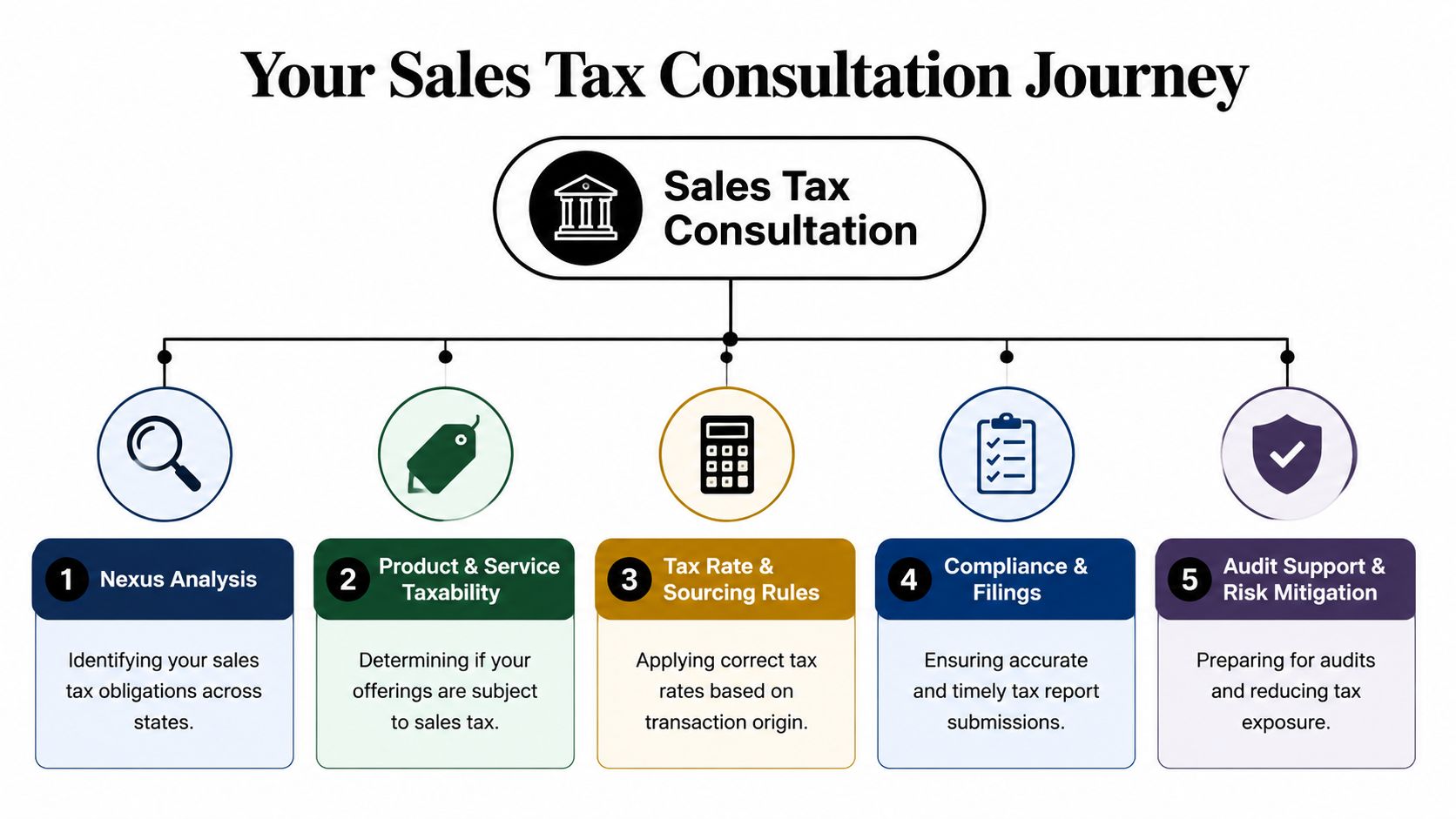
Nexus analysis
This is the first hard question. Where are you liable?
That answer can involve sales volume, transaction count, remote employees, project work, stored inventory, or marketplace activity. A company may think it only has Florida exposure when it has obligations elsewhere because sales climbed, a team member relocated, or a job was performed out of state.
Product and service taxability
Many businesses often find themselves blindsided. Owners assume something is either obviously taxable or obviously exempt. Real life is messier.
A medical practice might provide exempt services but also sell taxable equipment. A contractor might invoice labor, materials, rentals, and change orders in ways that alter treatment. A service business may bundle software access, reports, and support. Each element matters.
Expert taxability reviews and reconciliation processes regularly find that businesses are over or under-reporting by 15-30% on average. Proper validation of exemption certificates is critical, as undocumented exempt sales are a primary trigger for audit penalties, according to Texas Tax Group's guide to selecting a sales tax consultant.
If your exemption file is a shoebox, a random folder, or a promise that "the customer said they're exempt," you're exposed.
Reconciliation and document review
This part is less glamorous and more important. We compare what your systems say against what you filed or should have filed.
That usually means reviewing items such as:
- Sales reports by channel: Direct invoices, POS sales, marketplace transactions, and manual entries.
- Exemption support: Resale certificates, nonprofit documentation, and customer records.
- Use tax exposure: Purchases where tax wasn't paid properly, especially equipment and business purchases.
- Return consistency: Whether collections, remittances, and general ledger activity align.
If you're buried in PDFs, invoices, and scattered statements, tools that automate financial document processing can make the review faster and cleaner before your consultation even starts.
Marketplace and audit readiness
Marketplace rules create false confidence. Owners think the platform collected everything, so they're covered. Sometimes yes. Often partly. Rarely fully.
The consultation also tests whether your records could survive scrutiny. Audit readiness means your files support your tax treatment. It means your gross sales numbers reconcile. It means exempt transactions are documented and taxable ones are coded correctly.
That is the difference between a manageable review and a painful one.
Nexus Traps for Florida Service and Construction Businesses
The internet is full of sales tax advice for product sellers. That's useful, but it leaves a giant hole for Florida companies that sell services, manage jobs, or operate with remote teams.
Most sales tax guides focus on product e-commerce, but the significant complexity for many Florida businesses lies in service-based and remote work nexus. Determining your obligation when providing services across state lines or having remote employees is a major compliance gap that requires specialized analysis, as noted by Weaver's sales and use tax consulting overview.

Service businesses get into trouble quietly
A Jacksonville advisory firm may bill clients in several states and assume that because it sells expertise, not products, sales tax isn't a concern. That's not a safe assumption. The answer depends on the type of service, where it's delivered, where staff work, and whether another state sees enough activity to impose obligations.
Remote work makes that worse. One employee working from another state can create a physical connection that owners never planned for.
Construction companies face a different kind of mess
Construction is where ordinary accounting and sales tax collide hard. Materials, labor, rentals, subcontractors, equipment, and job location all matter. If a Florida contractor performs work in another state or moves equipment across state lines, the tax picture can shift quickly.
That's one reason construction firms need tight books and job-level visibility. If you're in that world, this guide on bookkeeping for construction companies is worth reading because tax errors often start with weak job costing and inconsistent records.
Healthcare and mixed operations need special attention
Healthcare businesses often assume they are broadly exempt. Some revenue may be. Some may not be. Selling equipment, supplies, or other taxable items alongside patient services creates a mixed-revenue problem that generic sales tax advice barely touches.
For practices trying to tighten operations overall, especially billing workflow and documentation, providers that specialize in Florida medical billing solutions can help clean up the front end. That's not a substitute for tax analysis, but it can improve the records that tax analysis depends on.
A service business can create sales tax risk without ever looking like a "sales tax business." That's why owners miss it.
How to Prepare for Your Consultation
Don't show up empty-handed and expect miracles. A strong sales tax consultation runs faster and produces better answers when your records are organized.
You don't need perfection. You need a clean starting point.
Bring the right information
| Document/Information | Why We Need It |
|---|---|
| Sales reports by state | To identify where revenue is being earned and where obligations may exist |
| QuickBooks access or exports | To compare recorded sales, tax collected, and account coding |
| Sample invoices | To review how products, services, labor, freight, and bundled items are described |
| Marketplace reports | To see what platforms collected and what still needs review |
| Exemption and resale certificates | To test whether exempt sales are actually supported |
| Prior sales tax returns | To compare filings against underlying activity |
| Purchase records for major equipment and expenses | To identify possible use tax issues |
| Entity and registration information | To confirm where the business is already registered and filing |
Think through these questions before the meeting
A productive consultation usually starts with management, not paperwork. Come in ready to answer:
- Where are you growing next: New states, new service lines, new customer types.
- What worries you most: A notice, marketplace confusion, exemption records, remote employees, or mixed revenue.
- What changed recently: New staff, new locations, new projects, or a new e-commerce channel.
- What system are you relying on: QuickBooks, a POS, spreadsheets, TaxJar, Avalara, or a patchwork of all of them.
Clean records lower the cost of finding the truth. Messy records make every answer slower and more expensive.
If your receipts, invoices, and support documents are all over the place, start with a simple system like the one described in this article on how to organize receipts for taxes. You don't need fancy binders. You need consistency.
Expect a fixed-fee mindset, not endless drift
A worthwhile consultation should feel like an investment in risk control, not a meter running while you explain your business. Ask for a defined scope. Ask what will be reviewed. Ask what deliverables you'll receive. If the engagement is vague, the results usually are too.
Your Path to Compliance and Peace of Mind
Sales tax gets dangerous when a business has mixed revenue, changing operations, and weak documentation. That's especially true in healthcare, construction, nonprofits, and service businesses that don't fit the neat online examples owners usually find.
For businesses with mixed revenue, such as a medical clinic selling both exempt services and taxable equipment, managing sales tax is a significant challenge. Specialized guidance is needed to handle documentation for exempt transactions and avoid compliance risks, as discussed in Avalara's explanation of sales tax compliance service needs.
You can try to manage all of this yourself. Plenty of owners do. It's usually a mistake. Running your company is already a full-time job. Trying to also interpret nexus, taxability, exemptions, use tax, and filing obligations across multiple moving rules is how good businesses wander into avoidable trouble.
The better move is simple. Get the issue reviewed before it turns into a notice, an audit question, or a balance you didn't plan to pay. Peace of mind in sales tax doesn't come from hoping you're fine. It comes from knowing where you stand, what needs fixing, and how to stay compliant going forward.
Frequently Asked Questions About Sales Tax Services
What's the difference between my bookkeeper handling this and a specialized sales tax consultation
Your bookkeeper records what happened. A sales tax specialist evaluates whether it was taxed correctly in the first place.
Those are different jobs. Bookkeeping keeps the books current. A sales tax consultation looks at nexus, taxability, sourcing, exemption support, and whether your filings match your operations. If you sell across states, have mixed revenue, or use marketplaces, that distinction matters.
Is a sales tax consultation a one-time project or an ongoing service
It can be either.
Many businesses start with a one-time diagnostic. That gives them a clear picture of exposure, registrations, cleanup needs, and process changes. After that, some owners only need periodic reviews when the business changes. Others need ongoing help with compliance, filings, exemption management, and higher-level oversight. That's where regular accounting support and fractional CFO guidance become valuable.
My business is small. Can I really afford this
The better question is whether you can afford guessing.
Small businesses often assume they're too small to draw attention. That's risky thinking. A single threshold issue, missing exemption file, or incorrectly taxed revenue stream can cost a lot more than a professional review. Even if your operation is lean, your tax obligations may not be simple.
What if I only sell services
That does not automatically keep you out of trouble. Service businesses often have the murkiest nexus and taxability issues, especially when they work across state lines or use remote staff. If your answer to "where are my people working and where are my clients located?" is complicated, get it reviewed.
Do I need this if I already use software
Software helps. Software is not judgment.
TaxJar, Avalara, QuickBooks, and similar tools can support compliance, but they rely on setup, taxability choices, mapping, and clean underlying data. If those inputs are wrong, the automation helps you be wrong faster.
If you're done guessing and want a clear answer, talk with Bookkeeping and Accounting of Florida Inc.. They're a Jacksonville CPA firm that helps Florida businesses clean up their books, stay compliant, and get the kind of practical oversight most owners only realize they need after a problem shows up. For growing companies that need more than basic bookkeeping, their team also provides fractional CFO support, tax guidance, and industry-specific help for healthcare, construction, retail, and nonprofits.