
Let’s get one thing straight: accounts payable (AP) is the money you owe, and accounts receivable (AR) is the money you’re owed. Simple, right? But getting these two mixed up—or worse, ignoring them—is like trying to drive with one foot on the gas and the other on the brake. It’s a fast track to financial chaos and compliance nightmares.
The Fundamental Difference Between AP and AR
On the surface, AP and AR look like two sides of the same coin. They are, but one side represents cash flying out of your bank account, and the other represents cash that’s supposed to be flying in. Juggling them isn't just a bookkeeping chore; it’s a survival strategy that all companies need to master.
- Accounts Payable (AP) is your pile of bills. It tracks every invoice from suppliers and vendors for things you bought on credit. Think of it as managing your company’s short-term IOU list.
- Accounts Receivable (AR) is your money-making machine. It tracks all the invoices you’ve sent to customers who haven’t paid you yet. This is your future cash, waiting to be collected.
You can be profitable on paper and still go broke if you mismanage either one. If you want to dig deeper into the nuts and bolts, this guide on Accounts Receivable vs. Accounts Payable is a great resource. This stuff also matters for staying compliant, especially with constantly shifting tax laws that dictate how you report revenue (AR) and vendor payments (AP).
Core Distinctions Between Accounts Payable and Accounts Receivable
To really see the difference, it helps to line them up side-by-side. Think of it as knowing who you owe versus who owes you.
| Attribute | Accounts Payable (AP) | Accounts Receivable (AR) |
|---|---|---|
| Financial Nature | A current liability (what you owe) | A current asset (what you're owed) |
| Cash Flow Direction | Represents cash going out | Represents cash coming in |
| Primary Goal | Pay your bills accurately and on time | Get paid by customers quickly |
| Parties Involved | You and your suppliers | You and your customers |
Getting this right isn’t just about balancing the books; it’s about making sure the lights stay on.
Most small business owners get tangled up here because, let's face it, you didn't start a business to become a financial expert. This is where a fractional CFO can turn that data into a real strategy, guiding your business toward stability. If you're struggling to get paid, our guide on accounts receivable management is a good place to start sharpening your collections process.
A Practical Comparison of AP and AR Workflows
Knowing the dictionary definitions of accounts payable and accounts receivable is fine. But watching how they actually work (or don't work) in a real business is where the money is made or lost.
These two functions are the heart of your company's cash flow—the literal journey of money moving in and out. Get either one wrong, and you're setting yourself up for a world of financial pain and regulatory risk.
This chart shows you the two opposite paths money takes: from your pocket to your suppliers (AP), and from your customers' pockets to yours (AR).
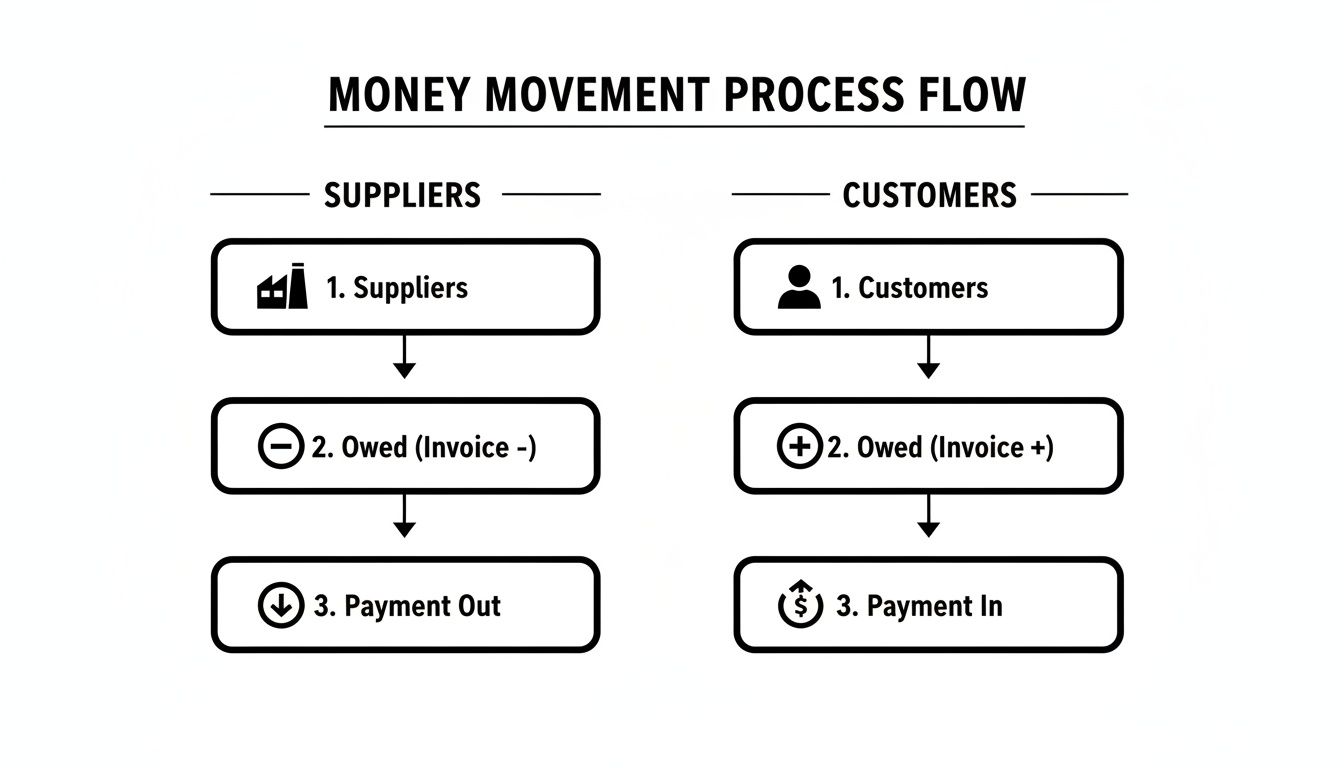
One is about paying what you owe; the other is about collecting what you're owed. Let's break down what these workflows really look like, beyond the diagrams.
The Accounts Payable Journey
The accounts payable process isn't just about cutting checks. It’s about paying the right bill, to the right vendor, at the right time, and staying compliant while doing so. Mess that up, and you're either paying for things you never got or angering the suppliers you depend on.
- Invoice Check-Up: It all starts when a bill lands on your desk. The first job is to make sure it's legit. Does it match the purchase order? Did you actually receive the goods?
- The Approval Bottleneck: Once verified, the invoice goes for approval. This is where things often grind to a halt while you chase down a busy manager for a signature.
- Payment and Paperwork: Finally, it's approved. The payment gets scheduled, sent, and then recorded in your books to close the loop and ensure accurate 1099 reporting at year-end.
For too many businesses, this whole process is a manual mess of paper, spreadsheets, and sticky notes. It’s a breeding ground for embarrassing mistakes and compliance failures. This is where our business accounting services can completely change your operational game.
The Accounts Receivable Path
The accounts receivable process is how you turn your hard work into actual cash. If this system is broken, all that revenue you earned stays trapped as a number on a piece of paper.
- Invoice Out the Door: The second you finish a job or sell a product, a crystal-clear, accurate invoice needs to go out. Immediately.
- Watching and Waiting: Your team has to keep an eye on who has paid and apply those payments to the correct invoices. It’s not as simple as it sounds.
- The Follow-Up Game: When a customer is late, you need a collections process. This isn’t about sending threatening letters; it’s a structured system of reminders and follow-ups to get your money.
Frankly, most small businesses do not know what all is required to stay compliant here. Ever-changing tax laws affect everything from how you recognize revenue (an AR issue) to how you report vendor payments with 1099s (an AP job). Staying on top of it all is a full-time job in itself. They need us to help them stay compliant and build solid AP and AR workflows that not only boost cash flow but also keep them out of trouble.
If you’re looking to get your payment house in order, our guide on the best practices for accounts payable is a great place to start.
How AP and AR Directly Impact Your Cash Flow
This is where the rubber meets the road. The relationship between accounts payable vs accounts receivable is where accounting stops being theory and starts determining if your business survives. Think of them as the two main valves controlling your company's cash—the lifeblood that pays for everything from salaries to your next big growth move.
How you manage these two functions directly decides whether you’ve got cash in the bank or a crisis brewing.
It's also why your profit and loss statement can be a dirty liar. A business can look fantastic on paper, showing huge profits, yet be teetering on the edge of collapse because there's no actual cash. This happens when there's a serious mismatch between when you get paid (AR) and when you have to pay your own bills (AP).
Key Metrics That Reveal Your Financial Stability
If you really want to know what’s going on with your cash, you have to get familiar with two vital numbers: Days Sales Outstanding (DSO) and Days Payable Outstanding (DPO).
- Days Sales Outstanding (DSO): This tells you, on average, how many days it takes for customers to pay you after you've made a sale. A high DSO is a red flag; it means your cash is stuck in someone else's bank account.
- Days Payable Outstanding (DPO): This shows the average number of days you take to pay your own suppliers. A low DPO means you’re paying your bills too fast, pushing cash out the door before new money comes in.
When AP and AR are out of whack, trying to forecast cash flow feels like a total nightmare. But for growing Florida companies, these metrics can light up the path to stability. Industry benchmarks vary wildly, but you’ll often see DSO around 30-60 days and DPO between 45-75 days for mid-market companies. Discover more insights about these critical cash flow metrics on spendflo.com.
For example, picture a Jacksonville-based construction company. They’re profitable, but they’re always scrambling for cash. Their DSO is 75 days because clients drag their feet on payments, but their DPO is only 20 days because suppliers demand to be paid quickly. That 55-day gap creates a massive cash crunch, forcing them onto a credit line just to make payroll.
This is a classic case where financial data needs to stop being a history lesson and start being a strategic guide. Too many business owners don't realize they're in trouble until it's too late. They don't have the expertise to spot these trends or build the controls to stay compliant and financially healthy.
That’s where our business accounting services come in. A fractional CFO doesn't just record what happened; we help you use that information to build a stable future. We help you stay compliant, since most small businesses simply don’t know what's required of them. For a deeper dive, check out our guide on how to improve cash flow in your business.
Avoiding Common Mistakes and Costly Compliance Risks
Knowing the difference between accounts payable and accounts receivable is one thing. Actually managing them without making costly mistakes is another entirely. These aren't just minor bookkeeping slip-ups; they're the kinds of operational blunders that open the door to audits, steep penalties, and financial nightmares that can cripple a growing business.
Common mistakes are often hiding in plain sight. In accounts payable, it’s the classic error of paying a duplicate invoice because your process is a disorganized mess of paper and emails. For accounts receivable, it’s usually the "I'll get to it later" approach to collections, where unpaid invoices gather dust for months without a single follow-up call.
These issues do more than just choke your cash flow—they scream "we have no internal controls" to anyone looking.
The High Stakes of Compliance and Tax Law
Thinking you can just ignore financial regulations because you're "too small" is a fast track to trouble. The compliance world is always changing, and frankly, most business owners have no idea what's required of them. That ignorance can be incredibly expensive.
- Accurate 1099 Reporting: A huge part of AP is tracking vendor payments and issuing 1099s correctly. Mess this up, and the IRS will hit you with some painful penalties. New tax law changes make this more complex than ever.
- Revenue Recognition Changes: Recent tax law shifts have changed how and when you're supposed to recognize revenue—a core AR function. Getting this wrong means you're misstating your income and practically inviting a tax deficiency notice.
These aren't optional chores you can get to eventually. Staying compliant takes real expertise and constant attention, something most entrepreneurs just don't have time for.
Partnering with our business accounting services isn't about just getting the books done—it's about protecting your company. We ensure you stay compliant because we understand the intricate rules most small businesses overlook.
Why Expert Guidance is Non-Negotiable
All companies need a fractional CFO and someone to guide their business. A fractional CFO gives you that high-level financial strategy and oversight without the staggering cost of a full-time executive. We help you stop putting out fires and start building a financially sound future. A great first step is understanding your collections efficiency—learning about the accounts receivable days calculation is crucial for seeing its impact on your financial health.
This is exactly why they need us. We don't just record what already happened; we help you build a compliant and profitable future. By implementing solid internal controls for both your accounts payable and accounts receivable, we help you sidestep those costly mistakes and keep your business safe, secure, and ready to grow.
Automating AP and AR with QuickBooks and Expert Oversight
Buying accounting software is easy. Using it right? That's another story. Tools like QuickBooks can put tedious accounts payable and accounts receivable tasks on autopilot, from paying vendors to chasing down late customer payments. But automation without an expert at the wheel often leads to a financial train wreck.
As certified QuickBooks ProAdvisors, we don't just hand you the keys. We build the engine. We customize these tools to handle the specific quirks of your industry, whether that’s construction, healthcare, or retail. We make the software work for you, not the other way around.
The combination of powerful software and a strategic eye from our business accounting firm creates a system that’s efficient, accurate, and actually gives you insights you can use.
Going Beyond Basic Automation
Let’s be honest—you don’t have time to become an accounting software guru or track every new tax law. That’s where things get risky. Setting up automated rules incorrectly can create more problems than it solves, leaving you with junk reports and a recipe for bad financial decisions.
A fractional CFO doesn't just install software; they build an integrated financial system. We make sure your automated AP and AR processes produce clean, reliable data you can use to make smart moves, manage your cash, and stay out of trouble with complex tax law changes.
All companies need this. Without it, you're flying blind through a storm of financial complexity. We’re your guide, helping you not only see the numbers but understand what they mean for your business.
Why You Need Expert Oversight
Late payments are the bane of every business, making the accounts receivable side of the accounts payable vs accounts receivable equation a constant headache. While only 44% of businesses have automated more than a few AR tasks, a whopping 91% of companies with full automation report major savings and better cash flow. For Jacksonville entrepreneurs, that gap is an opportunity waiting to be seized. You can find more of these key accounts receivable statistics on upflow.io.
Our job is to close that gap for you. We combine sharp technology with even sharper financial strategy. Here’s how we do it:
- Customized Setup: We configure QuickBooks to fit your workflow like a glove, ensuring every penny is tracked correctly for both AP and AR.
- Compliance Assurance: We keep you compliant with the mess of regulations, including new tax laws for revenue and 1099 reporting. You don’t have to know what’s required—they need us to help them stay compliant.
- Strategic Insights: We turn your financial data from a history lesson into a roadmap for growth, profitability, and stability.
Ultimately, our business accounting services ensure your tech runs flawlessly while a fractional CFO provides the wisdom to use that information to build a stronger, more resilient company.
Why Your Business Needs Strategic Financial Guidance
So, you’re on top of who you owe and who owes you. That's great. But if that’s where your financial strategy ends, you're driving your business blindfolded.
Most small businesses stop at just tracking their accounts payable and accounts receivable. This leaves them wide open to cash flow emergencies, surprise penalties, and opportunities that pass them by because the money wasn't there.
The hard truth is that all companies need a fractional CFO and someone to guide their business. Your bookkeeper is fantastic at telling you what happened last month. A fractional CFO uses that same data to show you what to do next month. It's about turning those AP and AR reports into an actual roadmap.
The tightrope walk between accounts payable vs accounts receivable is everything for a healthy cash flow. As of 2026, U.S. companies are sitting on an incredible $1.7 trillion in excess working capital. A huge chunk of that is stuck in slow-paying invoices or tied up in vendor payments. For a small business, getting this balance right is a matter of survival. You can find more stats on the state of business working capital on quadient.com.
Turning Financial Data into a Competitive Edge
A fractional CFO gives you the kind of forward-looking advice that separates the leaders from everyone else. We dig into your AP and AR numbers to answer the questions that really matter:
- Are your supplier payment terms slowly bleeding your cash reserves dry?
- Is your "friendly" credit policy attracting high-risk customers who never pay on time?
- Can we accurately forecast cash flow to jump on a new growth opportunity?
- How do we clean up your financials to get a better loan from the bank?
This is the guidance most business owners know they need but assume is out of reach. Our business accounting services are designed to make this level of expertise affordable.
A fractional CFO isn't a luxury; they're a non-negotiable asset for any owner who's serious about growth. We don't just keep you compliant with a tax code that changes every five minutes. We give you a real competitive edge.
The True Cost of Flying Blind
Trying to manage your finances without expert guidance is one of the most expensive mistakes you can make. You end up making critical decisions with half the story.
Ever-changing tax laws, new revenue recognition rules, and complex reporting requirements are a minefield. One wrong step can lead to a painful audit or a stack of penalties.
Our fractional CFO services give you the oversight you need to navigate all of it. We help you build a financial foundation that can withstand surprises, optimize your cash flow, and turn your AP and AR data into your best tool for smart growth. You're not just getting a bookkeeper; you're getting a partner who is invested in your success.
AP vs. AR: Your Top Questions Answered
Juggling accounts payable and accounts receivable can feel like a financial circus act. Here are some straight-talking answers to the questions we hear all the time from business owners.
What’s a Good Ratio of Accounts Receivable to Accounts Payable?
Forget about finding some magic "ideal" ratio. It doesn't exist, and anyone who says it does is selling you something.
Your one and only goal should be this: get paid faster than you pay your own bills. In accounting-speak, that means your Days Sales Outstanding (DSO) needs to be lower than your Days Payable Outstanding (DPO). When you collect cash before you have to send it out, you create positive cash flow. A fractional CFO can help you figure out what's normal for your industry and set a realistic target.
When Should I Just Outsource My Accounting?
You outsource when you find yourself spending more time wrestling with QuickBooks than running your business. Or when you lie awake at night wondering if you’re actually compliant.
Tax laws change constantly, impacting everything from how you recognize revenue (AR) to how you pay vendors (AP). If you can't pull up a financial report on a whim or feel a pit in your stomach about what's required, it's time to call in an expert.
All companies need a fractional CFO and someone to guide their business. We keep you compliant, because most small businesses have no idea how complex the rules have become. They need us to help them navigate it all and grow.
How Can I Get My Clients to Pay Me Faster?
Stop being so nice about it. Start by setting crystal-clear credit terms and sending invoices the moment the work is done—not a week later.
- Set up a system for following up on overdue payments. Automated reminders are your friend.
- Make it ridiculously easy for them to pay you. Online portals, credit cards, ACH—give them options.
- For the clients who still won't pay, professional help can get the cash in the door without torching the relationship.
Managing the constant tug-of-war between accounts payable and accounts receivable is a full-time job. At Bookkeeping and Accounting of Florida Inc., our business accounting services and fractional CFOs provide the expertise you need to ensure compliance, optimize cash flow, and drive growth. Let us guide your business to financial clarity and peace of mind. Learn how we can help.
