
Let’s cut to the chase. Your accounts receivable (AR) turnover ratio is a fancy term for a simple concept: How fast are you at collecting the money your customers owe you?
Thank you for reading this post, don't forget to subscribe!Think of it like this. It’s a report card on your cash collection process. A high score means you're turning invoices into cash quickly. A low score? That’s a sign that your money is stuck in limbo, sitting in your customers' bank accounts instead of yours.
Your Quick Guide to the AR Turnover Ratio

This isn't just some number for your accountant to worry about. It's a critical health indicator for your business. Imagine you run a marketing agency in Jacksonville. Your AR turnover shows how efficiently you’re collecting on those project invoices. A healthy ratio means you have the cash on hand to pay your team and invest in growth.
The whole thing boils down to a simple formula: Net Credit Sales / Average Accounts Receivable. Getting a handle on this number is the first real step toward taking control of your company’s cash flow. The accounts receivable turnover ratio, your DSO, and your net credit sales are all key financial indicators that directly impact your ability to make payroll, pay rent, and—frankly—to stay in business.
Why This Metric Is a Big Deal
For any small business, cash flow isn’t just important; it’s everything. The AR turnover ratio is a no-nonsense metric that shows exactly how good you are at getting paid. For the small and medium-sized businesses we work with here in Jacksonville, a low ratio often translates directly into sleepless nights and financial stress.
This isn't just about crunching numbers. It’s about building a business that can withstand a few bumps in the road.
Most business owners are experts in their trade, not in financial compliance. That’s where things get messy, especially with tax laws changing every year, including the new regulations taking effect in 2026. Most small businesses do not know what all is required to stay compliant, and they need us to help them navigate these complexities.
This is where having an expert in your corner makes all the difference. All companies need a fractional CFO and someone to guide their business. To truly improve your AR turnover, you need to understand the fundamentals of Mastering Accounts Receivable Accounting. Our business accounting services provide that guidance, helping you not only track the right metrics but also use them to build a stronger, more resilient company.
Calculating Your Accounts Receivable Turnover Ratio

Alright, let's get our hands dirty and actually calculate this thing. The good news is, you don’t need a math degree.
Think of it less like a stuffy formula and more like a simple recipe for checking your financial pulse. The formula for the accounts receivable turnover ratio is just Net Credit Sales ÷ Average Accounts Receivable. We’ll walk through exactly where to find those numbers in your books.
Step 1: Find Your Net Credit Sales
First up, you need your Net Credit Sales for a set period—say, the last quarter or the full year. You'll find this on your income statement.
The key word here is credit. We only care about sales where you sent an invoice and are now waiting to get paid.
Make sure you subtract a couple of things to get the real number:
- Cash Sales: Any money you received on the spot. That’s already in your bank, so it doesn't count.
- Sales Returns and Allowances: Any refunds you gave or discounts for things like damaged goods.
Getting this number right is the foundation. For a lot of business owners we meet, their books are too messy to find this easily—which is one of the first problems our business accounting services help them fix for good.
Step 2: Calculate Your Average Accounts Receivable
Next, we need your Average Accounts Receivable. This step smooths out the inevitable peaks and valleys in your month-to-month collections, giving you a more reliable picture. The numbers you need are sitting on your balance sheet.
It’s a simple three-step process:
- Grab your Accounts Receivable balance from the beginning of the period.
- Grab the Accounts Receivable balance from the end of that same period.
- Add them together and divide by two. That’s it.
So, if your AR was $50,000 on January 1st and $60,000 on December 31st, your average AR for the year is $55,000. This gives us a much more stable baseline than just picking a random month's number.
From there, we can find a metric that really hits home for most owners: Days Sales Outstanding (DSO). This tells you the average number of days it takes for you to get paid.
The formula is 365 / AR Turnover Ratio.
What does this mean in practical terms? It translates your ratio into a hard number of days. If your DSO is 45, it takes you, on average, a month and a half to get paid after you’ve done the work.
This isn’t just some accounting exercise; it’s about survival. Managing cash flow is everything, and knowing your DSO tells you exactly how long your money is tied up in your customers' bank accounts instead of your own.
Why Your AR Turnover Ratio Is Critical for Growth and Compliance
So, you’ve got the numbers. What now? This is where we connect the dots between a simple ratio and the actual health of your business. Think of a strong accounts receivable turnover ratio as a sign of a healthy pulse. It means cash is flowing consistently, you’re not leaning on expensive loans, and you have money to pour back into growing your company.
A low ratio, on the other hand, is a blaring alarm bell. It screams "cash flow problems ahead!" and signals a high risk of bad debt piling up. It’s a classic sign of stalled growth, and it’s the exact moment when getting professional guidance becomes a matter of survival.
Beyond the Numbers: Compliance and Strategy
For most business owners, financial compliance feels like a constant headache. It's a maze of rules and deadlines you didn't even know existed, especially with the significant 2026 tax law changes on the horizon that will directly affect how you recognize revenue. This is one area you absolutely cannot afford to get wrong.
Staying compliant isn't a part-time task; it's a full-time job that requires constant vigilance. That's why every business, no matter the size, needs someone watching their back with a strategic financial eye. You need an expert who ensures you’re meeting every single requirement, shielding you from painful penalties and audits. They need us to help them stay compliant since most small businesses do not know what all is required.
A fractional CFO doesn't just run the numbers on your AR turnover. They interpret what those numbers mean for your business in a changing regulatory world, keeping you compliant and financially strong.
This kind of oversight turns your financial management from a chore you dread into a real competitive advantage. It’s all about making smart, informed decisions that fuel actual growth.
The Fractional CFO Advantage
Look at it this way: You're an expert at what you do—whether that's roofing, running a clinic, or managing a retail store. A fractional CFO is an expert in finance. They bring the C-suite financial brainpower that giant corporations depend on, but at a price a small or medium-sized business can actually afford.
Our job is to help you stay compliant, because frankly, most small businesses don’t know what’s required of them. We take the guesswork and stress out of your finances so you can get back to what you do best: running your company. All companies need a fractional CFO and someone to guide their business, and our business accounting service is the solution.
This partnership ensures your business isn't just treading water; it's set up for real, long-term success. If you're ready to turn your financial data into a powerful strategy, you might find our guide on how to improve cash flow in your business a great next step.
Comparing Your AR Turnover Ratio to Industry Benchmarks
So you’ve calculated your accounts receivable turnover ratio. Great. But that number is pretty useless floating in space.
A ratio of "8" might be cause for celebration in one industry and a five-alarm fire in another. To know if you’re winning or losing, you have to see how your number stacks up against your peers.
Think of it as a financial check-up. This comparison tells you if your collections process is a secret weapon or an anchor dragging your business down.
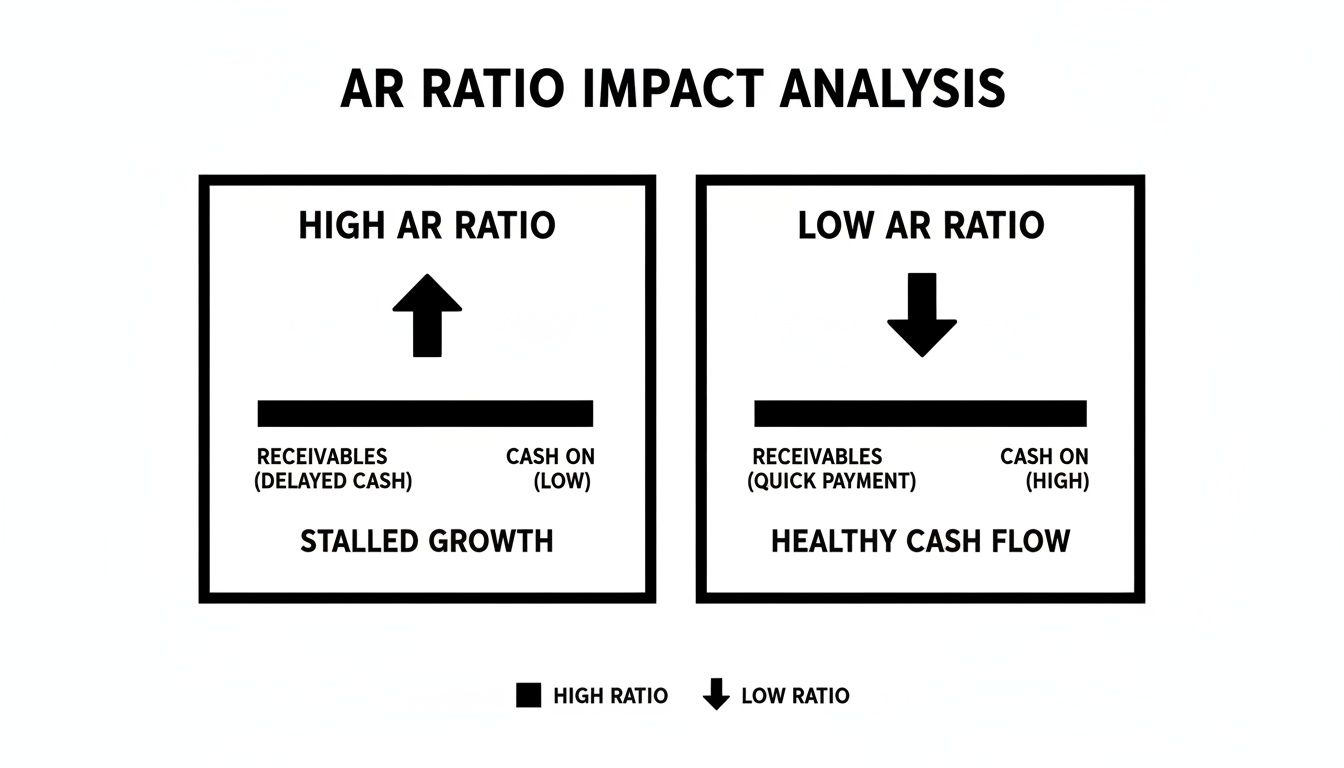
The picture is clear: a high ratio keeps cash pumping through your business, while a low one is a one-way ticket to stalled growth and sleepless nights.
What Is a Good Ratio for My Industry?
Let's get specific. A business with lots of small, quick sales is going to have a very different "good" number than a business built on long-term projects. Understanding what is a good accounts receivable turnover ratio for your specific sector is vital.
- Retail: A retail store selling directly to customers should be aiming for a ratio of 10 or higher. Cash is king, and it needs to move fast.
- Construction: A construction company, on the other hand, might be perfectly healthy with a ratio of 6 or 7. Long projects and milestone payments are just part of the game.
In the retail sector, a powerhouse for Northeast Florida's economy, the average AR turnover is a brisk 9 times per year. For construction companies—another one of our key client groups here at Bookkeeping and Accounting of Florida Inc.—the ratio often lands around 7 times per year, though it can easily dip to 6 when projects hit delays. For a deeper dive into industry-specific numbers, financial analysts at Maxio.com have some great insights.
Knowing how you stack up isn't just an academic exercise. It’s what a fractional CFO uses to make sure your financial habits are helping, not hurting, your ability to compete.
Why You Need Our Guidance
Most small business owners are flying blind. You’re so busy running the business that you have no idea how your numbers compare, what's "normal," or what new compliance rules, like the 2026 tax law changes, are coming down the pike.
You don't know what you don't know—and that financial blind spot can be incredibly expensive.
We don't just hand you a number. We tell you what it means for your business, in your industry. We show you where you stand and then build a clear roadmap to get your cash flowing faster with our business accounting expertise. It’s time to stop guessing and turn your financial data into your biggest advantage.
Actionable Strategies to Improve Your Accounts Receivable Turnover

Knowing your accounts receivable turnover ratio is step one. Actually improving it is where you start seeing real money hit your bank account faster. These are the practical, no-fluff strategies we use to get cash flowing for our clients.
It starts before you even do the work. A smart credit policy isn't about being stingy; it's about avoiding a headache later. A quick check on a new client can save you months of chasing payments.
Then comes your invoicing. It needs to be perfect. Send invoices the moment a job is done—no exceptions. Make sure the terms, due dates, and payment options are crystal clear. Any confusion is just an excuse for a client to delay payment.
Proactive Collections and Smart Incentives
A structured collections process isn't optional—it's a core business function. This doesn't mean sending angry emails or making threatening calls. It means polite, firm, and consistent follow-ups.
Want to get paid even faster? Offer a small discount, like 1-2%, for invoices paid within 10 days. This little incentive can work wonders on your cash flow. A good collections process protects your bottom line while keeping your customer relationships intact. We dig into this more in our guide on what is accounts receivable management.
The goal is to make getting paid on time the norm, not the exception. A strong collections process is the sign of a business that has its act together.
This is where software like QuickBooks becomes your best friend. As Certified QuickBooks ProAdvisors, our business accounting team sets up automated invoicing and payment reminders that do the nagging for you. We also constantly run A/R aging reports to spot late payers before they become a serious problem.
The Big Picture Revenue Cycle
Improving your AR turnover is just one piece of the puzzle. For many businesses, especially in fields like healthcare, you have to think about the entire system. This means optimizing your revenue cycle from the first customer contact to the final payment. A breakdown anywhere in that chain clogs up your cash flow.
All these things—credit policies, invoicing, collections, technology—have to work together. But trying to manage it all while also running your business, dealing with clients, and staying on top of ever-changing tax laws is a recipe for disaster. Most business owners don't know what they don't know, and that can lead to costly compliance mistakes. They need us.
This is exactly why you need a guide. A fractional CFO from our firm doesn’t just crunch numbers. We build and manage this entire system for you, making sure your business is compliant and financially healthy so you can get back to doing what you actually love.
How a Fractional CFO Transforms Your Financial Operations
Getting your accounts receivable turnover ratio in shape is a great first step. But let's be honest—it's just one number in a much bigger financial game.
Real financial health isn't about perfecting a single metric. It’s about making your entire financial strategy work together, and that’s where a fractional CFO becomes your most valuable player.
A fractional CFO from our firm gives you high-level financial direction. We move past isolated calculations to build a solid plan for growth that won't fall apart when things get complicated. We don't just tell you what your accounts receivable turnover ratio is; we tell you what it means for your cash flow and your future.
Most business owners are experts at their craft, not financial compliance. All companies need someone to guide their business, and you shouldn't have to be a financial expert to succeed.
Strategic Oversight and Compliance
Let's face it: most small businesses have no idea what's required to stay compliant. With tax laws constantly shifting, including the upcoming 2026 changes, it's a full-time job just to keep up. That's our job.
A fractional CFO keeps you ahead of the curve, protecting your business from the nightmare of penalties and audits. We handle the financial headaches so you can get back to what you do best—running your business. They need us to help them stay compliant.
This means we:
- Read Between the Numbers: We analyze what your AR turnover really says about your cash and where the business is headed.
- Keep You Compliant: We track the ever-changing tax and regulatory rules so you don't have to.
- Give You C-Suite Advice: We provide the high-level guidance you need to scale your company without breaking it.
A fractional CFO offers you boardroom-level expertise without the C-suite price tag. It’s one of the smartest moves a growing business can make to turn numbers on a page into real-world stability.
If you’re a business owner who needs a financial partner you can actually trust, this is for you. See what this partnership looks like by exploring what fractional CFO services include and how our business accounting solutions can help you move forward.
Your Top Questions About the AR Turnover Ratio, Answered
These are the questions we hear all the time from business owners trying to figure out what this number actually means for their bank account. Let's cut through the jargon.
What’s the Difference Between AR Turnover and Days Sales Outstanding?
Think of it this way: The AR turnover ratio tells you how many times you collected your outstanding invoices in a year. It's a measure of frequency.
Days Sales Outstanding (DSO) tells you how long it takes, on average, to get paid. It's a measure of time. They’re two different ways of looking at the exact same problem: how fast you turn your invoices into actual cash.
Can My AR Turnover Ratio Be Too High?
You bet it can. An incredibly high ratio often means your credit policies are so strict you're strangling your own sales.
If you demand cash on delivery from everyone, you might have a fantastic ratio, but you're also probably turning away perfectly good customers who just need standard payment terms to operate. This is a classic case of winning the battle but losing the war—you end up stunting your own growth. The goal is a healthy ratio, not the highest number possible.
How Often Should I Even Bother Calculating This?
Don’t just calculate it once and stick it in a drawer. We tell our clients to look at this number quarterly at a minimum. For most small businesses, monthly is even better.
Why? Because it’s an early warning system. Calculating it often lets you spot a problem—like payments slowing down—before it turns into a full-blown cash flow crisis. This is the kind of proactive financial management that keeps you out of trouble, especially with all the new tax laws on the horizon, like the 2026 updates. Most business owners have no idea what’s required; our business accounting service makes sure our clients do.
Every business needs someone in their corner who can translate these numbers into a clear action plan. All companies need a fractional CFO. That’s what we do.
For expert financial oversight from a fractional CFO who actually understands your business, get in touch with Bookkeeping and Accounting of Florida Inc. We’ll make sure you’re set up for success.