

A Jacksonville contractor can finish a packed year, keep the crews busy, collect plenty of cash, and still have no reliable answer to a basic question: which jobs made money? The bank balance won't answer it. Billing timing, warranty callbacks, unpaid change orders, subcontractor invoices, payroll taxes, and overhead can make a busy business look healthier than it is.
Thank you for reading this post, don't forget to subscribe!That's why owners ask what is job costing when the numbers stop making sense. Job costing assigns the labor, materials, subcontractors, and allocated overhead to the specific project that consumed them. It turns bookkeeping from a record of company-wide activity into a management system for pricing, cash flow, compliance, and profit.
The Moment Most Owners Realize They Need Job Costing
Mike runs a remodeling company in Jacksonville. He wrapped 38 kitchens in 2025, paid himself a healthy draw, kept his crews moving, and entered January feeling satisfied. Then he opened the books and tried to identify the profitable jobs.
He couldn't.
The checking account showed money, but some customers had been billed ahead of the work while other projects had absorbed warranty callbacks. Materials purchased in bulk weren't clearly assigned. A subcontractor invoice had been entered as a general expense instead of being tied to a project. Mike knew the company had been busy, but he couldn't say which kitchens produced a dependable margin.
That confusion is common among contractors, specialty trades, clinics, and professional services firms. A regular profit and loss statement answers whether the company earned money overall. It doesn't tell you whether Job A, Service Ticket B, or Procedure C carried its share of payroll, supplies, and overhead.
The bank balance isn't a job report
Job costing treats every contract, project, batch, or service unit as a separate accounting record. The method is designed for custom work and relies on tracing direct materials and labor to each job, then allocating indirect costs to that job as well, as explained in this accounting overview of job costing.
That distinction matters because cash and profit move on different schedules. A customer deposit can improve cash while the associated work remains incomplete. A warranty callback can consume labor after the original invoice has already been paid. Without job-level records, those events disappear into company-wide totals.
Practical rule: If you can't compare estimated cost with actual cost for each active job, you aren't managing margins. You're reviewing history.
This is fixable
A usable system doesn't require a giant corporate accounting department. It requires consistent job numbers, accurate time entries, correctly coded vendor bills, a sensible overhead allocation method, and regular review.
The rest of this guide explains the mechanics in plain English, including the standard calculation, QuickBooks workflows, WIP reporting, fractional CFO oversight, and the 2026 payroll changes that make clean labor and vendor records more important.
What Job Costing Means in Plain English
Job costing assigns every cost of a specific job to that job. It fits custom or separate-batch work, including construction, custom manufacturing, and professional services. Each project gets its own cost record, so the owner can compare the estimate with actual spending and see whether the work made money, as explained in this job order costing reference.
Use this calculation:
Total Job Cost = Direct Materials + Direct Labor + Subcontractor Costs + Allocated Overhead
The four cost buckets
- Direct materials: Items installed in or consumed by the project, such as tile, cabinets, pipe, wiring, or medical supplies assigned to a specific treatment.
- Direct labor: Employee time spent on the job. Code each hour to the correct project instead of leaving payroll in one company-wide total.
- Subcontractor costs: Outside labor or specialized work purchased for the project. Assign the invoice to the job that received the service.
- Allocated overhead: Shared costs that support multiple jobs, including supervision, office operations, insurance, rent, software, and other indirect expenses. Apply them using a consistent rule.
A Jacksonville bathroom remodel has a contract price of $24,500. Its records show $8,400 in materials, $6,200 in labor, $3,100 in subcontractors, and $2,400 in applied overhead.
The total job cost is $20,100. Gross profit is $4,400, calculated by subtracting total job cost from contract revenue. Gross margin is 18%, using (Total Job Revenue - Total Job Cost) / Total Job Revenue.
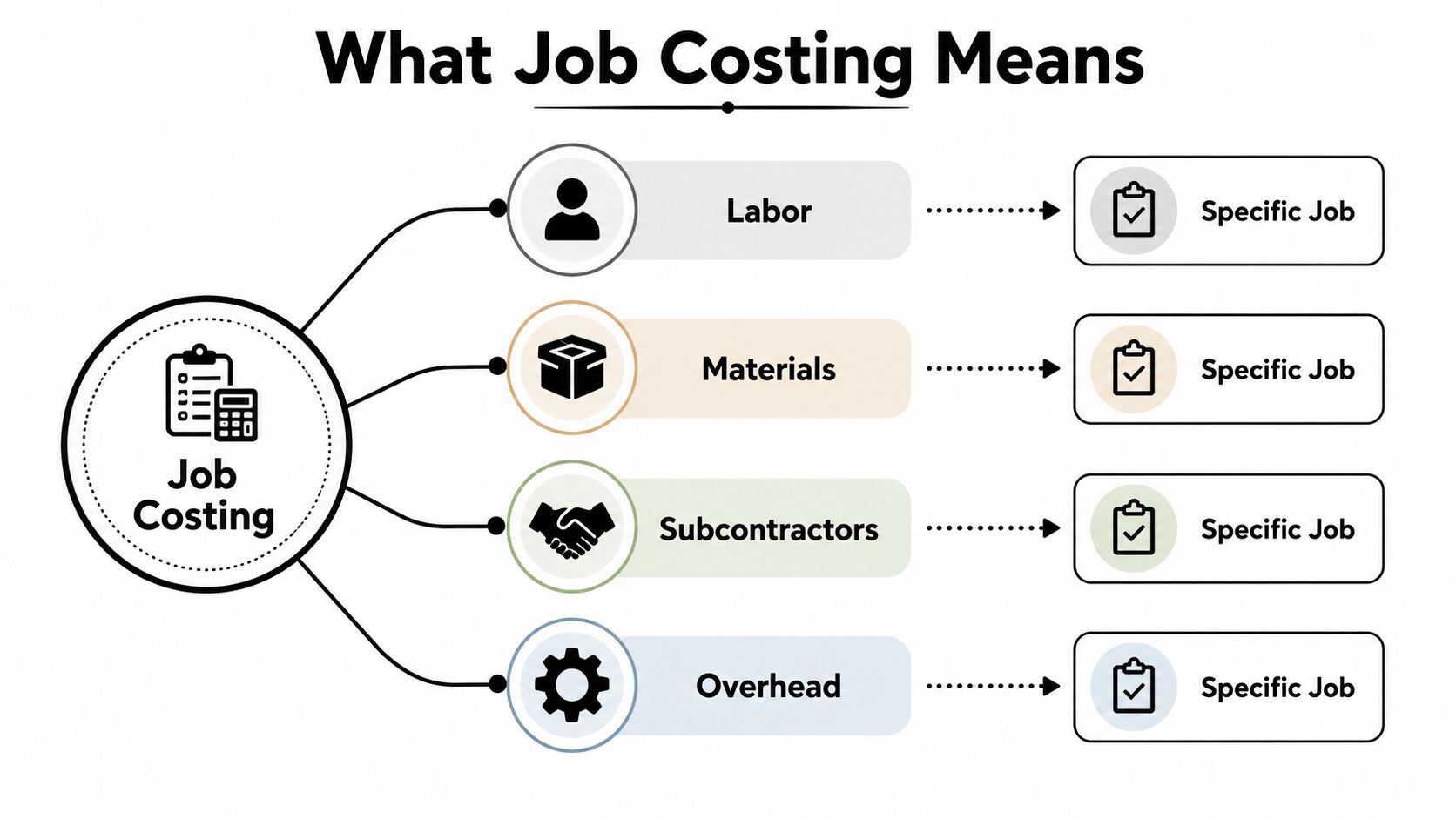
QuickBooks ProAdvisor workflows should preserve these four buckets, while fractional CFO oversight should test whether the allocation rule still reflects operating reality. Clean job records also support payroll compliance, including the 2026 payroll changes.
Leave out overhead and the margin looks stronger than the job supports. Owners then underprice work, accept difficult projects at weak margins, and find the error after the cash is gone.
How Job Costing Works Across Construction, Trades, and Healthcare
Job costing doesn't look identical in every business. A commercial contractor, an HVAC company, and a dental practice all need project-level cost information, but their job units and cost drivers differ.
| Industry | Job Unit | Key Costs Tracked | Critical Report | Where Generic Bookkeeping Fails |
|---|---|---|---|---|
| Construction | Contract, phase, or project cost code | Labor, materials, equipment, subcontractors, permits, and overhead | Job cost report, WIP schedule, and estimate at completion | Company totals hide overruns, underbilling, and weak change-order control |
| Trades | Service ticket or installation project | Technician labor, parts, vehicles, subcontractors, and burden | Ticket profitability and install margin report | Service calls and larger projects get blended together |
| Healthcare | Procedure, provider, or treatment unit | Supplies, provider labor, room costs, and allocated facility overhead | Procedure or provider profitability report | Reimbursement and resource consumption aren't matched |
Construction needs progress visibility
Construction firms often use cost codes for site work, framing, mechanical work, and finishes. Long-duration contracts also need WIP schedules because spending alone doesn't explain how much work has been performed or whether billing matches progress. Recent construction accounting guidance connects job costing with WIP, change-order tracking, and estimate-at-completion reporting, rather than treating it as simple expense tagging. This construction job costing resource is useful for owners building that workflow.
A contractor evaluating broader operational software can also review the 2026 contractor's ERP guide for context on project systems and integration.
Trades need a split between tickets and installs
An HVAC or plumbing shop may complete many short service calls alongside larger replacement or installation jobs. If all revenue and technician time land in one service department, management can't identify which work types deserve higher pricing. Parts, truck costs, technician wages, payroll burden, and callbacks need to follow the service ticket or installation project.
Clinics need unit economics
A dental office, outpatient clinic, or specialty practice can apply the same logic to procedures or providers. Supply usage, clinical labor, treatment-room occupancy, and facility overhead should be evaluated against reimbursement schedules. A company-wide income statement may show a healthy practice while a particular procedure consistently consumes more resources than its reimbursement supports.
Generic bookkeeping is still necessary, but it isn't enough. The general ledger tells you what the company spent. Job costing tells you where the money went and whether the work justified the price.
How Costs Get Captured and Allocated Step by Step
A reliable job-cost system follows a repeatable chain. Start with the job, capture direct activity, add burden, allocate shared overhead, and reconcile the result before closing the period.
A practical capture sequence
- Open the job in QuickBooks. Create a customer or project record with a clear job number, contract value, estimate, and relevant cost codes.
- Assign employee time. Workers or supervisors must record hours against the job through payroll or a supported time-tracking workflow.
- Post materials correctly. Code purchase invoices, credit card charges, and inventory usage to the job that consumed the materials.
- Assign subcontractors. Every subcontractor bill should identify the project and the work performed.
- Add labor burden. Payroll taxes, workers' compensation, and other labor-related costs should be included in the job economics rather than left in a general overhead account.
- Apply overhead. Use a measurable driver, such as direct labor hours, machine hours, or another activity base that reflects resource use.
- Reconcile before month-end close. Every cost should land on a job or on a documented shared-cost pool.
The technical logic behind this approach is consistent. Identify the job, trace direct costs, select an allocation base, define the indirect-cost pool, calculate the rate, apply it to the job, and total direct plus allocated costs. The allocation base should reflect resource consumption, because a poor driver can distort margins and pricing, as explained in this cost allocation guide.
A kitchen remodel example
Suppose a Jacksonville kitchen remodel has a $70,000 contract price. Direct labor is $18,000, materials are $22,000, subcontractors are $9,000, labor burden is $4,500, and applied overhead is $6,000.
| Cost Category | Amount | How Allocated |
|---|---|---|
| Direct labor | $18,000 | Employee hours assigned to the remodel |
| Materials | $22,000 | Vendor bills and purchases coded to the job |
| Subcontractors | $9,000 | Subcontractor invoices assigned to the project |
| Labor burden | $4,500 | Payroll-related costs applied to job labor |
| Applied overhead | $6,000 | Shared costs assigned using a selected driver |
| Total job cost | $59,500 | Direct costs plus burden and allocated overhead |
Gross profit is $10,500, calculated as $70,000 minus $59,500. Gross margin is 15%, calculated by dividing $10,500 by $70,000.
This math only works if the source records are coded correctly. A materials invoice sitting in “general supplies” or a foreman's hours sitting in “uncategorized labor” makes the report look complete while hiding the job's true cost.
For companies moving beyond spreadsheets, deployment support with F1Group provides context on project-operations implementation. The tool matters less than the discipline. No software can repair missing time entries or careless coding.
The Reports That Turn Job Costing Into Decisions
A job-cost report is useful only when someone acts on it. Owners should review four reports as an operating dashboard, not as an annual cleanup exercise.
The reports worth reviewing
- Job cost report: Compare estimated and actual materials, labor, subcontractors, burden, and overhead. Look for cost categories running ahead of the budget before the project reaches completion.
- Work-in-progress schedule: Compare cost incurred and project progress with billings. WIP helps identify underbilling, overbilling, profit fade, and jobs that aren't advancing as expected. Job costing records spending, while WIP adds timing and earned-revenue context, as outlined in this WIP and job costing comparison.
- Estimate at completion: Update the expected final cost using cost to date, remaining work, approved changes, and known risks. If the forecasted final margin is falling, the owner still has a chance to change purchasing, staffing, scope, or pricing decisions.
- Weekly margin snapshot: Review margin by project, foreman, crew, service type, or provider. This exposes recurring operational problems that a company-wide report won't isolate.
The four questions that matter are spend to date, budget variance, estimate at completion, and projected final margin. Strong construction guidance emphasizes weekly answers to those questions because waiting until the job closes removes the opportunity to correct the outcome. See this construction job costing guide for the operational view.
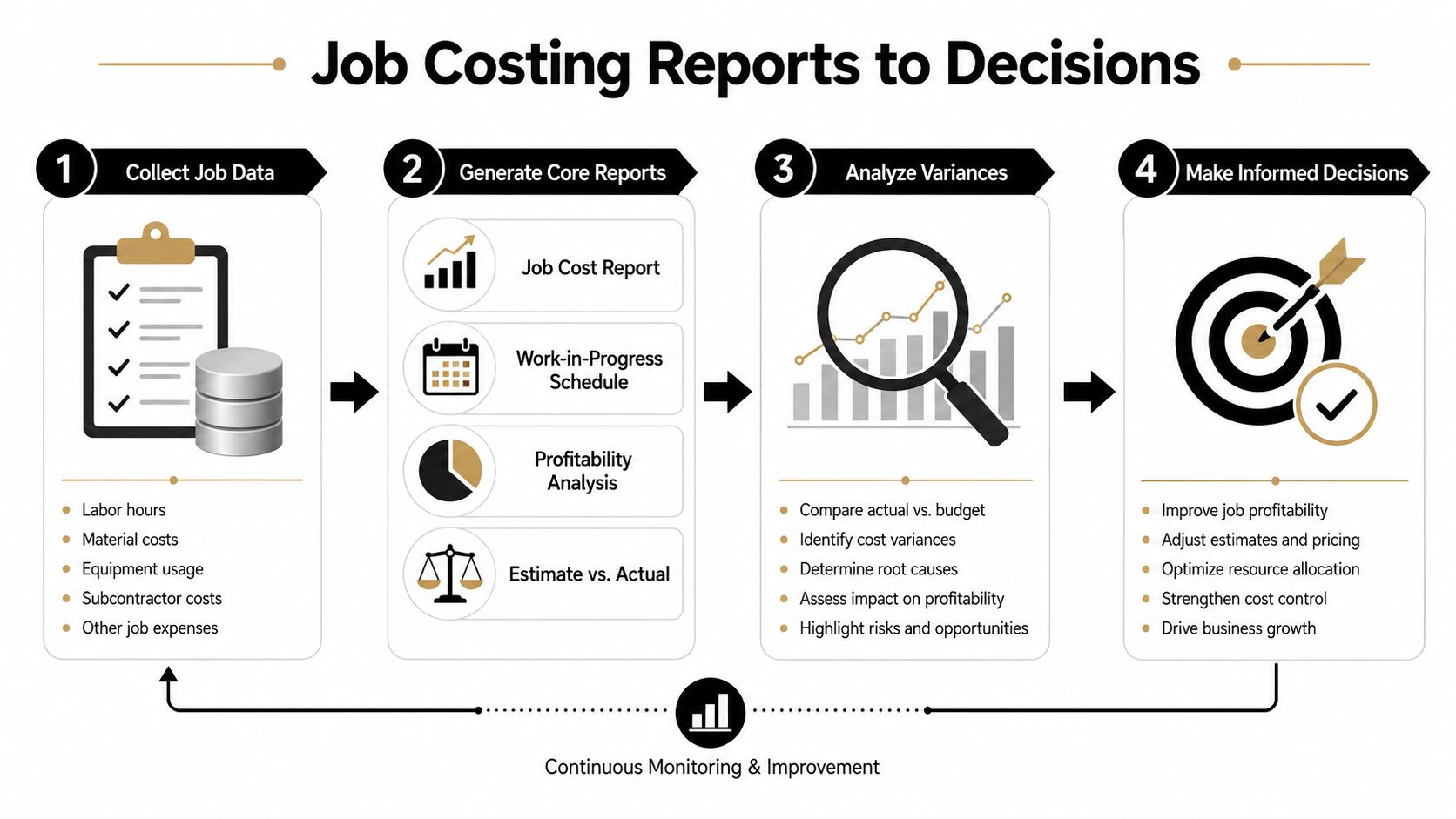
A WIP schedule isn't the same thing as a job-cost report. One shows accumulated costs and the other adds progress, earned revenue, and billing context. Owners need both to understand current performance and projected cash requirements.
Here is a short visual explanation of the reporting process:
If the only review occurs after the final invoice, the report is a postmortem. Run the dashboard while decisions can still change the result.
Setting Up Job Costing in QuickBooks the Right Way
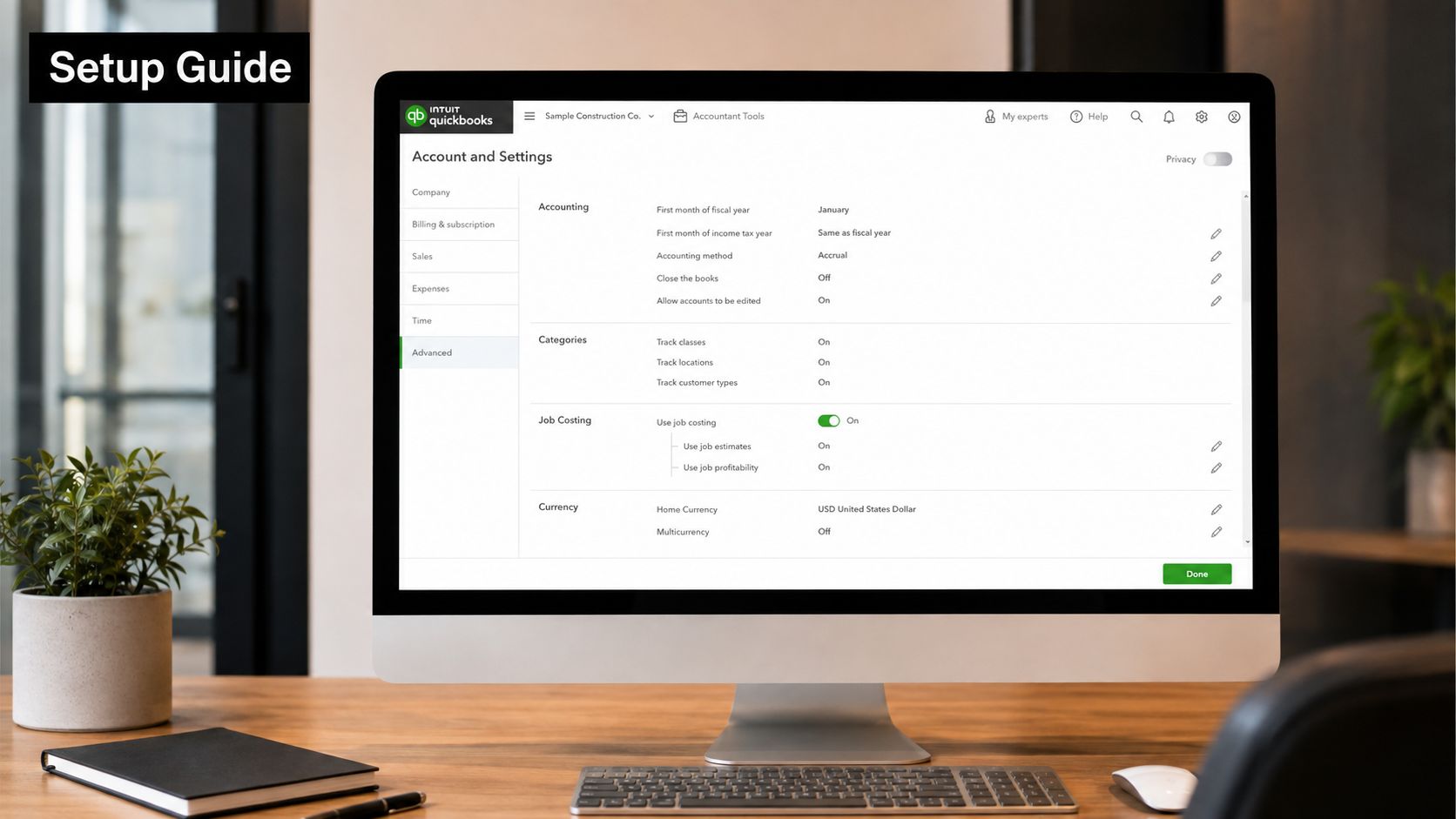
QuickBooks can support a practical job-cost workflow, but the file must be configured intentionally. A clean general ledger with job numbers attached isn't automatically a forecasting system.
Build the foundation first
Turn on the relevant project or job-profitability features in QuickBooks Online or Desktop. Configure class and location tracking where those dimensions help separate divisions, branches, service lines, or operating units. Then build a chart of accounts that distinguishes direct labor, materials, subcontractors, equipment, payroll burden, and shared overhead.
A construction chart of accounts setup should match the way management estimates and reviews work. If the chart is too broad, reports lose decision value. If it is excessively detailed, employees stop coding consistently.
Use a ProAdvisor checklist
A QuickBooks ProAdvisor workflow should include:
- Enable job profitability: Confirm that project income and costs flow into the correct customer or job record.
- Create items and cost codes: Map estimates, invoices, purchases, and payroll categories to the same structure.
- Connect payroll carefully: Use a supported integration that passes employee time and labor cost to the correct project.
- Tag bank and card activity: Assign project-related purchases while the transaction details are still clear.
- Review vendor bills: Check that subcontractor and materials invoices have a job assignment before posting.
- Reconcile monthly: Tie project totals to the general ledger and investigate unexplained differences.
Know where QuickBooks stops
QuickBooks can organize transactions, but it won't replace management judgment. True overhead allocation, percent-complete WIP, complex inventory movement across multiple jobs, and estimate-at-completion forecasting may require a more structured process, additional tools, or professional oversight.
That's where a fractional CPA or fractional CFO adds value. The accounting team maintains the transaction system, while senior financial guidance interprets variances, tests assumptions, and helps the owner decide what to do next.
Why Compliance, 2026 Tax Changes, and a Fractional CFO Make Job Costing Essential
Job costing belongs in your compliance process, not just your profitability reports. It gives the payroll team, CPA, and owner a defensible record of labor, vendor payments, project margins, and management decisions.
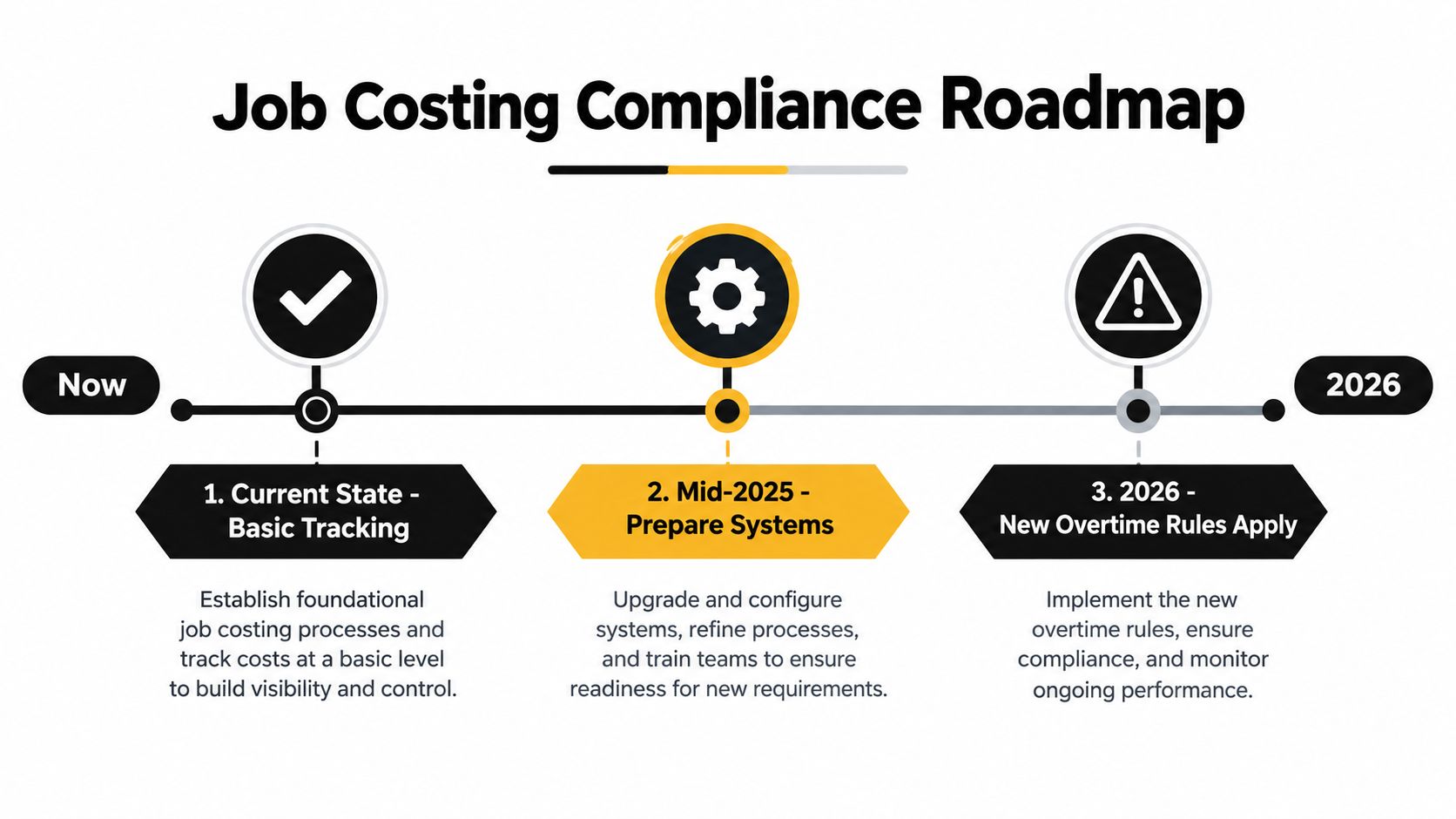
For 2026 payroll compliance, employers must separately report qualified overtime pay on revised Form W-2 using Box 12 Code TT. Withholding rules do not change under that guidance, but the reporting requirement does. The same guidance states that the 1099-NEC and 1099-MISC reporting threshold rises from $600 to $2,000, and the Social Security wage base increases to $184,500. Review the details in this 2026 payroll tax management guidance.
Clean records reduce compliance risk
Those requirements make job-level payroll and vendor records harder to ignore. Your system should show which employee hours were overtime, how wages were assigned to each job, which vendors acted as subcontractors, and whether payments belonged on the correct form.
Job costing does not guarantee an IRS result. It gives your CPA and payroll team records they can review, reconcile, and report without reconstructing the year from scattered receipts and spreadsheets.
Compliance reality: A payroll file that cannot distinguish job labor, overtime classification, and burden creates avoidable work during tax preparation and year-end reporting.
Fractional CFO oversight connects the numbers
A fractional CFO is a part-time or contract chief financial officer who can provide cash-flow forecasting, KPI tracking, budget management, financial reporting, executive strategy, and tax-strategy coordination. This fractional CFO guide for small businesses explains how that role supports smaller companies.
Small companies may not need a full-time executive, but they do need senior review when margins, WIP, and cash flow conflict. A fractional CFO can review margin reports, test the estimate at completion, compare WIP with progress billings, and coordinate payroll and tax reporting with the CPA team.
That review matters for Jacksonville and Northeast Florida businesses dealing with seasonal disruptions, changing material costs, lender expectations, bonding requirements, and tight cash flow. Job costing creates the data. A CPA firm and fractional CFO turn it into control.
Your Next Step Toward Profitable, Compliant Jobs
Profitable, compliant jobs come from setup and repetition. If you run a construction company, trade business, clinic, or professional services firm in Jacksonville, St. Augustine, or Ponte Vedra, use this operating checklist.
Start with the records
- Tag active work: Create a job or project record for every active contract, service ticket, procedure, or billable engagement.
- Assign tracking fields: Apply the correct class, location, cost code, or project tag to each vendor bill, purchase, paycheck, and time entry.
- Test current performance: Pull job-cost reports and compare estimated costs with actual costs on your most important active projects.
- Reconcile weekly: Review materials, subcontractor invoices, time entries, payroll burden, and change orders before errors spread.
- Forecast completion: Update the expected final cost and projected margin instead of relying on the original estimate.
- Schedule oversight: Have a QuickBooks ProAdvisor and fractional CFO review WIP, estimate-at-completion logic, payroll classifications, and vendor reporting on a recurring basis.
Don't wait for a year-end filing deadline to discover that labor was coded to the wrong job or vendor records were incomplete. The firms that stay profitable treat job costing as a monthly operating rhythm, not an annual cleanup project.
A guided setup beats a DIY spreadsheet because it connects the chart of accounts, payroll, job records, overhead allocation, WIP reporting, tax compliance, and management decisions. The objective isn't more bookkeeping. The objective is knowing which work deserves your time and capital.
Bookkeeping and Accounting of Florida Inc. offers QuickBooks ProAdvisor setup, bookkeeping, payroll, tax preparation, construction job costing, healthcare accounting, and fractional CFO guidance for Northeast Florida businesses. Visit Bookkeeping and Accounting of Florida Inc. to set up job-level reporting, strengthen compliance, and start managing your margins before the next close.