
Most small businesses need more than tax filing. They typically need compliant bookkeeping, tax planning, and ongoing financial guidance, especially when only about half of businesses reach their fifth anniversary and approximately one in three reach 10 years, according to the International Federation of Accountants' discussion of small-business survival.
Thank you for reading this post, don't forget to subscribe!You may be running payroll between customer calls, approving invoices from your phone, and promising yourself you'll organize the receipts this weekend. Then tax season arrives, a lender requests current financial statements, or the IRS asks you to substantiate a deduction. Suddenly, the question isn't just, “What does a CPA do for a small business?” It's whether your business has reliable information, defensible records, and someone who can explain what your numbers require you to do next.
A CPA can build and supervise the financial system behind your company, prepare and plan for taxes, review compliance obligations, produce useful reports, and serve as a fractional CFO who guides hiring, pricing, cash reserves, financing, and expansion. For a Jacksonville business, that combination can mean the difference between reacting to financial surprises and managing the business deliberately.
The Hidden Dangers of DIY Financial Management
The shoebox method usually starts innocently. Receipts land in a desk drawer, bank transactions remain uncategorized, personal and business purchases share one card, and the owner tells themselves everything can be sorted out before the tax deadline. By then, the receipts are faded, the memory behind each expense is gone, and nobody can confidently explain whether a payment was inventory, equipment, payroll, or an owner distribution.
The pressure increases when an IRS notice requests substantiation. The IRS says business records should show gross receipts, expenses, asset purchases, inventory, payroll, and other operating transactions, and those records support financial statements, tax returns, deductible expenses, and the taxpayer's ability to substantiate reported figures during an examination. The IRS recordkeeping guidance makes the practical point clear: a deduction is much easier to defend when the underlying records are complete and organized.

The risk is bigger than a messy tax return
Disorganized books can also affect decisions far earlier than filing season. A bank may question financial statements that don't reconcile. An owner may hire when cash is already tightening, underprice a profitable-looking service, or purchase equipment without understanding the effect on working capital. Software can record transactions, but it won't know whether the transaction was classified correctly or whether the resulting report answers the owner's actual question.
A CPA creates procedures that reduce those risks. That can include account reconciliation, transaction classification, separation of business and personal spending, receipt procedures, payroll documentation, and regular financial reporting. The IRS small-business recordkeeping guidance also explains that records must support income, expenses, credits, and asset information reported on tax returns.
Practical rule: If you can't explain a number in your financial statements, don't make a major business decision from it.
The trade-off is straightforward. DIY bookkeeping appears inexpensive, but the owner pays with time, delayed information, and avoidable uncertainty. Professional bookkeeping and CPA oversight cost money, yet they create an organized financial system that supports both compliance and management decisions. The right arrangement doesn't remove the owner from financial decisions. It gives the owner dependable information before those decisions become urgent.
Bookkeepers vs CPAs vs Fractional CFOs, What Is the Difference
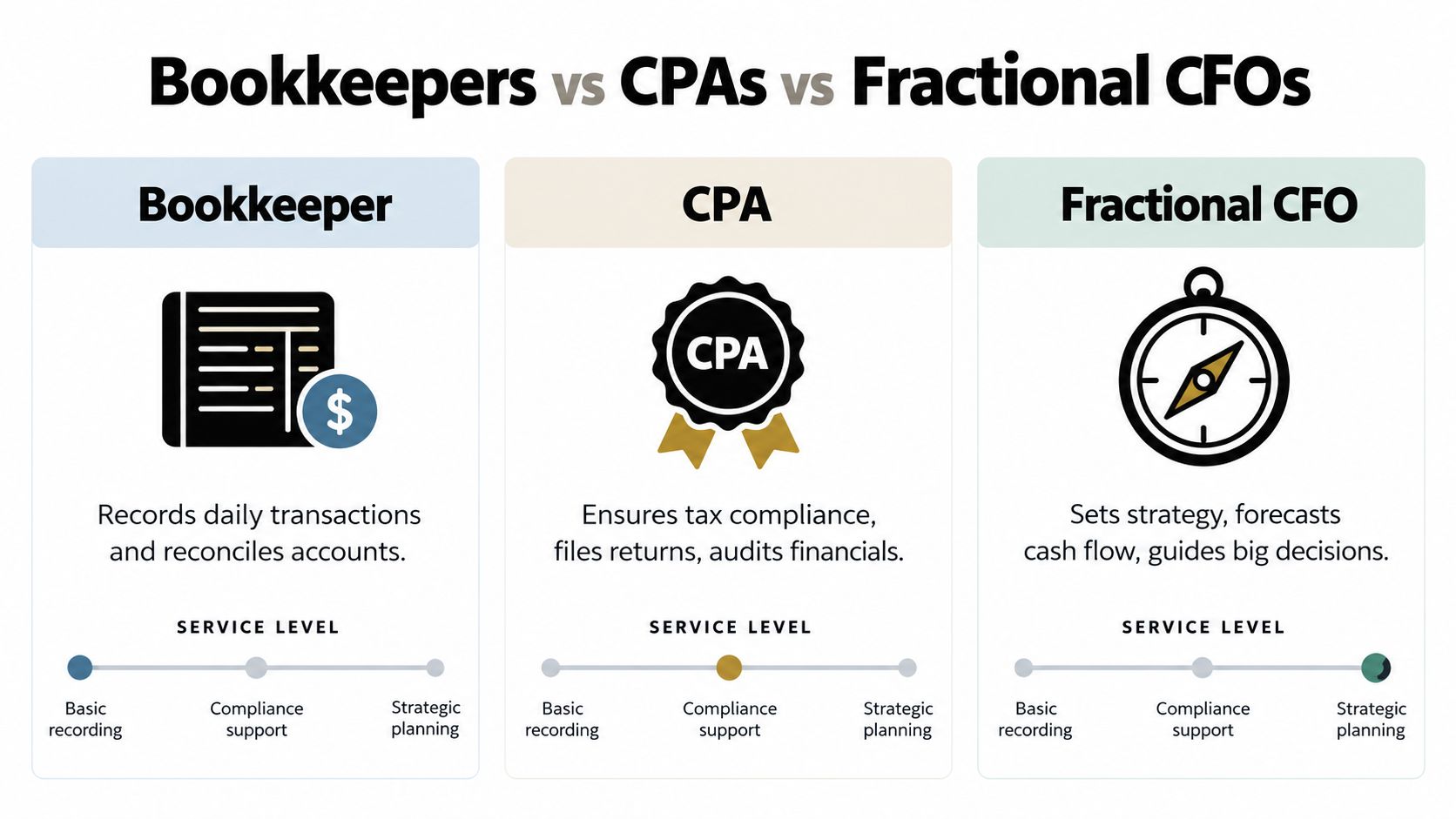
Business owners often use “bookkeeper,” “accountant,” “CPA,” and “fractional CFO” as if they describe the same service. They don't. Think of the roles as a financial operating team: the bookkeeper maintains the scoreboard, the CPA checks the rules and interprets the results, and the fractional CFO helps decide how to win the next quarter.
A bookkeeper records daily activity. That work includes categorizing income and expenses, reconciling bank and credit-card accounts, maintaining the general ledger, managing accounts payable and receivable, and preparing basic reports. The bookkeeper answers, “What happened?”
A CPA builds on that foundation. The CPA reviews the records, prepares tax returns, plans for tax obligations, analyzes financial statements, evaluates entity and owner-compensation questions, and helps the business meet compliance requirements. The CPA answers, “What does this mean, what must we report, and what should we plan for?”
A fractional CFO works farther ahead. This adviser uses reliable financial information to build cash forecasts, monitor key performance indicators, evaluate financing, model hiring, assess expansion, and help the owner decide whether the business can afford a proposed commitment. The fractional CFO answers, “What should we do next, and what could happen if we do it?”
Match the service to the problem
| Role | Primary responsibility | Best question to ask |
|---|---|---|
| Bookkeeper | Records transactions and reconciles accounts | Are the books current and accurate? |
| CPA | Handles tax compliance, planning, and financial interpretation | Are we reporting correctly and planning intelligently? |
| Fractional CFO | Forecasts, models, and guides strategic decisions | Can we afford this move, and how should we measure it? |
A small startup may begin with bookkeeping support and tax preparation. A growing contractor may need bookkeeping, a CPA, and job-level financial analysis. A healthcare practice with payroll, insurance receivables, and expansion plans may need all three functions coordinated.
You can review how these services work together through CPA and bookkeeping services for small businesses. The practical choice isn't always “bookkeeper versus CPA.” In many cases, the best structure uses a bookkeeper for consistent transaction work, a CPA for compliance and tax planning, and a fractional CFO for decisions that require forward-looking analysis.
Turning Raw Data into Actionable Financial Reports
A business owner can have every transaction entered and still lack a reliable view of cash. A customer invoice may be recorded, while the payment remains weeks away. Inventory, payroll, loan payments, and equipment purchases can also make a profitable month feel financially tight. A CPA turns those separate records into reports that support decisions.
That work starts with dependable inputs. Sales invoices, point-of-sale deposits, vendor bills, payroll records, loan statements, inventory activity, and asset purchases must reach the correct accounts and accounting period. The CPA may design or supervise the bookkeeping process, set monthly close procedures, reconcile accounts, and review classifications before using the reports.
The IRS recordkeeping requirements cover records such as receipts, expenses, assets, inventory, payroll, and operating transactions. These records support more than an annual tax return. They provide the foundation for income statements, balance sheets, cash-flow reports, tax positions, lender requests, and management decisions.
The accounting method changes the conversation
Cash accounting records activity when money changes hands. Accrual accounting records a transaction when the sale is completed, even if the customer pays later. The SBA explanation of financial statements and accounting highlights why this distinction matters. A balance sheet tracks assets, liabilities, and equity, while accrual accounting can show sales before cash arrives.
That timing matters to a contractor waiting on progress billing, a clinic waiting for insurance payments, a retailer holding inventory, or a business collecting retainers. A company can report a healthy profit while cash remains tied up in receivables, work in progress, debt service, purchasing, or payroll timing. The SBA's guidance on financial statements explains that records must support income, expenses, credits, and asset information reported on tax returns.
A CPA helps determine which reporting approach fits the business, then translates those reports into decisions about pricing, hiring, billing, and cash.
Reports that support decisions
Clean books become useful when the CPA connects them to action. A monthly reporting package might include:
- Income statement: Shows revenue, direct costs, operating expenses, and profitability over a defined period.
- Balance sheet: Shows what the business owns, owes, and has invested in the company.
- Cash-flow report: Explains how operating activity, financing, and purchases affected available cash.
- Receivables and payables aging: Identifies collection priorities and upcoming obligations.
- Margin analysis: Compares profitability by service line, job, location, or customer category when the accounting system captures the needed detail.
The analysis may show revenue rising while a service line loses margin, customers paying too slowly, or payroll timing creating a recurring cash squeeze. The owner can then adjust billing schedules, revise pricing, reduce waste, delay a purchase, or arrange financing while choices remain available.
The report is only half the service. The useful part is having someone translate it into a decision.
A polished profit-and-loss statement produced once a year is not financial management. Small businesses need timely records, consistent reconciliations, and regular discussion of profitability, liquidity, working capital, and financing needs. A CPA can provide that ongoing interpretation, giving the owner a clearer basis for protecting cash and choosing the next investment.
Why Every Growing Business Needs a Fractional CFO
A fractional CFO gives a small business access to senior financial guidance without requiring a full-time executive position. The role is especially useful when the owner has transactions recorded and returns filed but still can't answer practical questions such as, “Can we hire now?” “Which customers deserve collection attention?” or “What will cash look like after the equipment purchase?”
The need is common. The 2025 BILL report on the future of finance found that nearly two-thirds of businesses couldn't access their current cash position on demand, and for one in five, obtaining that information could take days or weeks. The same survey found that 50% of businesses viewed improved cash-flow management as necessary to compete. Those findings don't prove that fractional CFO support causes better outcomes, but they show why access to current financial information is a serious management issue.
What the engagement should produce
A fractional CFO should deliver more than broad advice. The scope should identify specific outputs and meeting rhythms, such as:
- A 13-week cash forecast: Maps expected collections, payroll, vendor payments, taxes, debt service, and planned purchases.
- A KPI dashboard: Tracks the operational measures that explain revenue, margin, utilization, collections, or project performance.
- A monthly management review: Turns the numbers into decisions, assigned actions, and follow-up questions.
- Decision models: Compares hiring, equipment, pricing, financing, entity, or expansion options using current business information.
For a Jacksonville contractor with uneven billing, the forecast can highlight a gap before payroll is due. For a healthcare practice, it can separate billed revenue from cash collected. For a seasonal retailer, it can support purchasing and reserve decisions before demand changes.
You can evaluate fractional CFO services for small businesses by asking what reports you'll receive, how often they'll be updated, who attends the review, and whether recommendations connect to your accounting records. More accounting work doesn't automatically create better insight. Multiple bank relationships, inconsistent coding, and software limitations can still hide the current cash position.
A CPA serving as fractional CFO can also connect strategy to compliance. Hiring affects payroll obligations. Capital purchases affect depreciation and tax planning. Entity structure affects reporting and owner decisions. The strongest arrangement keeps those questions in one conversation instead of leaving the owner to coordinate disconnected providers.
A short video can help illustrate how financial reporting and advisory support fit together:
Critical 2026 Tax Law Changes You Must Know
A contractor can show a profit on paper and still lack enough cash for the next tax payment. A practice can collect revenue without tracking the records needed to support deductions. These gaps often appear after year-end, when correcting them is harder or no longer possible. A CPA who reviews the books throughout the year can connect compliance work with cash planning and owner decisions.
The main updates
For 2026, the IRS identifies changes under the One Big Beautiful Bill Act affecting small-business reporting, self-employment tax, qualified business income, and loss limitations. The IRS Publication 334 for 2026 states that the maximum net self-employment earnings subject to the Social Security portion of self-employment tax is $184,500, while the 2026 business mileage rate is 72.5 cents per mile. It also identifies the permanent extension of the 20% qualified business income deduction for qualified active trades or businesses, with increased income thresholds for applying its limitations.
The publication also states that the excess-business-loss deduction disallowance is permanent, with its threshold indexed for inflation for tax years beginning after 2025. These rules make year-to-date profit tracking, accurate expense coding, mileage logs, entity classification, and owner-compensation analysis practical accounting requirements rather than year-end cleanup tasks.
| Topic | 2025 Threshold or Rule | 2026 Update |
|---|---|---|
| Self-employment tax | 2025 Social Security earnings limit: $176,100 | Maximum net self-employment earnings subject to the Social Security portion: $184,500 |
| Business mileage | 2025 business mileage rate: 78 cents per mile | 72.5 cents per mile |
| Qualified business income | 20% qualified business income deduction and prior limitation thresholds applied | 20% qualified business income deduction permanently extended for qualified active trades or businesses, with increased income thresholds for limitations |
| Excess business losses | Disallowance applied under the prior rule | Disallowance made permanent, with the threshold indexed for inflation for tax years beginning after 2025 |
| Business payment reporting | Base reporting threshold under section 6041(a): $600 | Threshold rises to $2,000 for payments made after December 31, 2025, with indexing for later calendar years |
All 2026 figures above are drawn from IRS Publication 334 for 2026 and IRS guidance for 2026 reporting.
Why bookkeeping still matters
The higher reporting threshold does not remove the need to track vendor payments. IRS guidance estimates that approximately 3.6 million taxpayers are affected, with about 98% classified as small entities with gross receipts under $40 million. A business still needs records showing who was paid, how much, when, and under which category.
The reporting change also creates a cash-flow checkpoint. A CPA can review vendor payments, identify missing documentation, monitor year-to-date results, plan estimated payments, and flag issues before a filing deadline. Those reviews can show whether a tax reserve is realistic or whether unpaid invoices and upcoming obligations are consuming available cash.
Compliance requires decisions and documentation captured throughout the year. A CPA working with the bookkeeping team can apply rules consistently and turn the records into advice, giving the owner a clearer view of both tax exposure and near-term cash needs.
Specialized Accounting for Complex Industries
Generic bookkeeping can record a transaction without understanding the operational question behind it. A healthcare clinic, construction company, retailer, and nonprofit may all receive deposits and pay vendors, but their revenue cycles, controls, reporting obligations, and risks differ sharply.
A medical practice may need to distinguish charges, insurance receivables, patient payments, contractual adjustments, payroll, and supply costs. The balance in the bank account doesn't explain whether billing delays or payer collections are constraining cash. A CPA familiar with healthcare accounting can help management connect financial reporting to collections, staffing, and practice growth.

Industry details change the accounting answer
Construction companies face a different problem. Job revenue, retainage, subcontractor payments, payroll, materials, equipment, and work in progress need to be assigned accurately enough to show whether each project is producing an acceptable margin. A company can appear profitable overall while a poorly estimated job absorbs cash and management time.
Nonprofits also need more than a basic income statement. Restricted funds, grant reporting, board oversight, program costs, and audit requirements call for records designed around the organization's obligations. A CPA can help establish documentation and reporting procedures that make those requirements visible before a grant report or audit becomes urgent.
Retailers and trades businesses have their own blind spots. Inventory, sales-tax records, deposits, vehicle use, purchasing, and seasonal cash cycles can all affect decisions. The most useful accounting system reflects how the business earns and spends money, rather than forcing every industry into the same chart of accounts.
Specialization matters when the financial statement must explain operations, not merely total transactions.
Ask a prospective accounting firm whether it has experience with your revenue model, payroll structure, reporting requirements, and financing relationships. Also ask who will review the work and how quickly you'll receive management reports. A local firm can be particularly useful when Jacksonville and Northeast Florida owners need responsive communication alongside technical accounting support.
Making the Smart Choice for Your Business Future
Handling financial management alone may work while transactions are simple and the owner has time to stay current. It becomes risky when the books fall behind, tax rules change, payroll grows, customers pay slowly, or the owner must make decisions without trustworthy reports.
A professional relationship should give you more than a completed return. It should provide clean bookkeeping, documented compliance procedures, tax planning, financial reporting, and access to guidance when the business is deciding whether to hire, borrow, purchase, expand, or restructure.
Use this guide to choosing an accounting firm to compare experience, communication, service scope, industry knowledge, and reporting deliverables. The right provider should explain what happens each month, what the CPA reviews, how tax planning is handled, and whether fractional CFO support is available when your decisions become more complex.
Don't wait for an IRS notice, a rejected loan application, or a cash shortage to expose the gaps. Schedule a financial review now, identify the records and reports your business lacks, and build a system that helps you stay compliant while planning the next move.
Bookkeeping and Accounting of Florida Inc. provides bookkeeping, payroll, tax preparation, compliance support, financial reporting, and fractional CFO guidance for growing businesses in Jacksonville and Northeast Florida. Visit Bookkeeping and Accounting of Florida Inc. to discuss the financial information, industry support, and ongoing accounting partnership your business needs.