
You're staring at the bank balance, the payroll report, and a month-end deadline that won't move. The numbers look close enough, but “close enough” doesn't tell you whether payroll taxes were posted correctly, a customer deposit is missing, or an owner draw was coded as wages. It only tells you that nobody has investigated yet.
Thank you for reading this post, don't forget to subscribe!Balance sheet reconciliation gives you that investigation. It connects the general ledger to bank statements, subledgers, loan schedules, payroll records, invoices, and other independent evidence. Done properly, it helps Jacksonville business owners close the books with numbers they can defend, use for tax filings, and rely on for decisions.
Why Reconciliation Matters Before Month End Even Begins
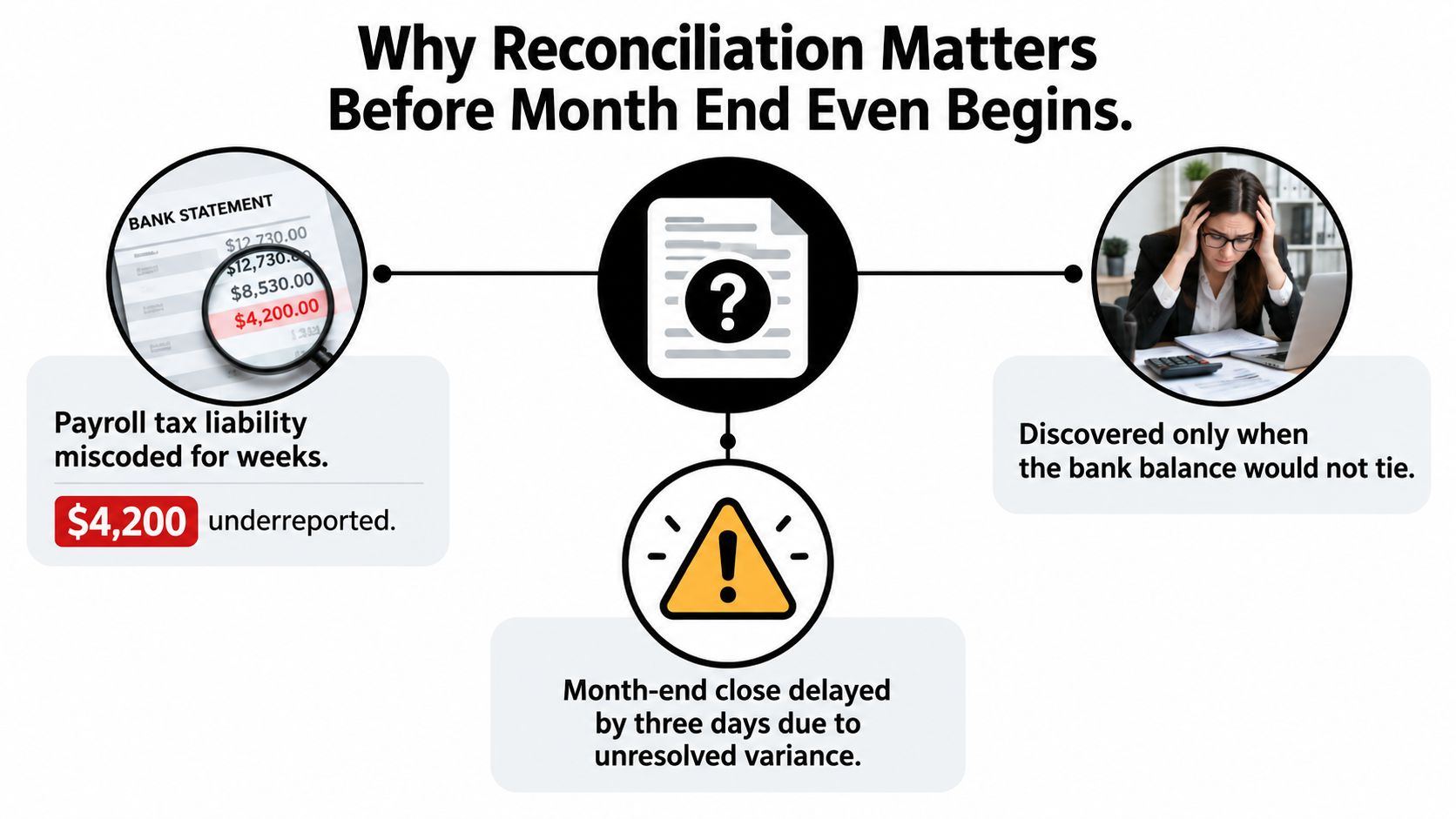
It's the last afternoon of the month. You're ready to review the profit and loss statement, but the cash account won't tie to the bank. After digging through payroll records, you find that a payroll tax liability was posted to the wrong account weeks ago. The bank balance is correct, the liability balance is not, and the close is now delayed while someone reconstructs the error.
That's exactly why reconciliation exists. Balance sheet reconciliation compares each general ledger balance with independent evidence, such as bank statements, accounts receivable listings, loan schedules, payroll registers, fixed-asset records, supporting invoices, and customer or vendor confirmations. The comparison tests whether the balance is complete, accurate, properly classified, supported, and recorded in the correct period.
A bank reconciliation might identify an outstanding check or deposit in transit. Those are timing differences. It might also reveal a duplicate payment, an omitted deposit, an unauthorized transaction, or a journal entry posted to the wrong account. The process separates legitimate timing from mistakes that require correction.
The control behind the numbers
The underlying logic is older than modern accounting software. Historical research identifies a 1211 Florentine ledger as early evidence of double-entry methods, with Luca Pacioli's 1494 publication becoming the first complete published synthesis of the principles modern reconciliation still applies (historical research on double-entry bookkeeping). Every recorded debit must have a corresponding credit, but that internal balance alone doesn't prove that the books reflect economic reality.
Reconciliation adds outside evidence. It asks whether the cash shown in QuickBooks agrees with the bank, whether payroll liabilities agree with payroll reports and tax deposits, and whether receivables agree with customer-level records. The same control principle has connected ledgers to real-world obligations for more than 800 years.
Practical rule: A clean reconciliation isn't one with no differences. It's one where every difference has an explanation, an owner, a deadline, and supporting evidence.
A reliable month-end close process checklist can organize the work, but a checklist won't replace judgment. Most reconciliation failures aren't arithmetic failures. They're supervision, classification, cutoff, documentation, and follow-up failures.
What Balance Sheet Reconciliation Actually Is
Think of the process like a pilot's pre-flight inspection. The pilot doesn't glance at one instrument and assume the aircraft is safe. Each critical system is checked against a separate indicator or required procedure before takeoff. Your accounting team should treat each balance sheet account the same way.
For every account, compare the general ledger balance with a second, independent source. Cash goes to a bank statement. Accounts receivable goes to the aging report and customer activity. Payroll liabilities go to the payroll register, tax deposits, and filed returns. Fixed assets go to the asset register, invoices, disposal records, and depreciation schedule.
Build a reconciliation file that proves the work
A useful reconciliation file should contain:
- Account identity: Name the account and period under review.
- Ledger balance: Record the ending general ledger balance.
- Source date: Identify the date of the bank statement, subledger, schedule, or confirmation.
- Reconciling items: List every difference rather than netting unexplained amounts.
- Aging: Show how long each item has remained open.
- Explanation: State whether the item is timing-related, an error, missing documentation, or a policy question.
- Support: Attach statements, invoices, payroll reports, confirmations, or other evidence.
- Sign-offs: Include preparer and reviewer approval dates.
- Escalation notes: Document who owns unresolved items and what happens next.
The categories matter because they determine the response. An outstanding check needs an expected clearance date. A duplicate posting needs a correcting journal entry. Missing support requires document retrieval. A policy issue may require a revised accounting treatment after CPA review.
Materiality also needs practical judgment. A small recurring difference can signal a broken process, especially when it affects cash, payroll taxes, sales tax, customer deposits, or another compliance liability. An amount doesn't become harmless just because it falls below a financial-statement threshold.
Balance sheet reconciliation isn't limited to cash. Accounts receivable, inventory, prepaid expenses, fixed assets, accounts payable, payroll liabilities, debt, deferred revenue, owner equity, intercompany balances, and retained earnings all need support appropriate to their nature. Rental businesses, for example, may need account schedules tied to leases, deposits, property expenses, and debt activity. A resource on managed bookkeeping for rental operators can help owners think through the records required for property-related accounts.
Account-by-Account Procedures That Catch Errors
A reconciliation catches errors only when the evidence matches the account's risk. A bank statement can support cash activity, but it cannot prove that customer balances are collectible. Each account needs a named owner, a review deadline, account-specific evidence, and a documented explanation for every unresolved item.
Start with cash and cards
For operating cash, compare the general ledger with the bank statement. Investigate outstanding checks, deposits in transit, bank fees, interest, duplicate entries, and missing deposits. Assign an expected clearance date to timing items. An old check or unexplained deposit should remain open only with a documented reason and owner.
Credit-card clearing accounts need the same discipline. Match the card statement to payment transfers, employee receipts, and ledger activity. Review duplicate transactions, unrecorded card payments, and purchases posted to the wrong expense or liability account. A clean-looking reconciliation is not enough if the support does not explain who made the purchase and how it was approved.
Test receivables and payables beyond the balance
Reconcile accounts receivable by comparing the general ledger with the customer aging. Then review credit memos, write-offs, disputed invoices, unapplied cash, and the allowance or bad-debt reserve. A matching total can still conceal a customer balance that needs correction or a reserve that no longer reflects collection risk. Set a materiality threshold for routine review, but require escalation for recurring differences or issues involving customer deposits and other liabilities.
For accounts payable, compare the ledger with the vendor aging and examine invoices received after period end. Search for duplicate vendor payments, unapplied credits, unpaid liabilities, and cutoff errors. Include corporate card liabilities in the review. A business can record the expense while omitting the related card liability or payment, leaving both the balance sheet and cash reporting wrong.
Treat payroll liabilities as a high-risk account
Reconcile payroll liabilities to the payroll register, tax deposit confirmations, payroll bank activity, and quarterly payroll returns. Check federal, state, local, benefit, retirement, and other deductions separately. A liability that rolls forward without agreement requires an owner, a correction deadline, and supporting evidence. Do not leave it in a suspense-style explanation that merely says it will be reviewed later.
The IRS requires businesses to retain employment-tax records for at least four years after filing the fourth-quarter return for the year (IRS Publication 334). Keep wage payments, employee information, Forms W-4, tax deposits, payroll returns, and supporting benefit or reimbursement documentation with the reconciliation file.
Finish with assets, accruals, and related-party balances
Tie fixed assets to the depreciation schedule, acquisition invoices, approval records, and disposal documentation. Reconcile accruals to invoices received after period end and documented estimates. For owner loans and intercompany accounts, confirm both sides independently. Each entity or related party should show the corresponding balance, cutoff, currency treatment, and required elimination.
| Account | What to Test | Common Reconciling Items | Source Document |
|---|---|---|---|
| Cash | Ledger to cleared bank activity | Outstanding checks, deposits in transit, missing fees | Bank statement |
| Credit cards | Statement, receipts, and payments | Unrecorded charges, duplicate posts, payment timing | Card statement |
| Accounts receivable | Customer detail to GL | Credit memos, disputes, unapplied cash | AR aging |
| Accounts payable | Vendor detail and cutoff | Duplicate payments, late invoices, vendor credits | AP aging |
| Payroll liabilities | Register to deposits and returns | Misclassified taxes, unpaid deductions, timing | Payroll register and tax confirmations |
| Fixed assets | Asset register to ledger | Missing additions, disposals, depreciation errors | Asset schedule and invoices |
| Accruals | Estimate to subsequent invoices | Unsupported estimates, cutoff issues | Invoices and accrual schedule |
| Intercompany or owner loans | Both sides of the balance | Cutoff differences, unexplained netting | Confirmations and agreements |
Automation can assist with repetitive matching across several systems. For teams evaluating Hinawi ERP reconciliation automation, require the system to preserve exceptions, explanations, approvals, and evidence. A match without an audit trail is not a completed control.
Use this guide to reconciling bank accounts for a bank-focused workflow, then apply its control logic to the rest of the balance sheet.
Vendor records need careful review because beginning with payments made after December 31, 2025, the federal information-reporting threshold for certain business payments increases from $600 to $2,000, with the same threshold applying to related backup-withholding rules (IRS employment-tax recordkeeping guidance). For calendar year 2026, assign ownership for vendor setup, payment categorization, and reporting review so the ledger distinguishes covered payments from those that do not require reporting.
The Monthly Reconciliation Cadence That Works
A missed reconciliation can leave an owner reviewing cash, payroll liabilities, and taxes after the reporting deadline has passed. Run the close from a calendar with named owners, due dates, materiality thresholds, and documented escalation rules. Memory is not a control.
Gather first, then lock the period
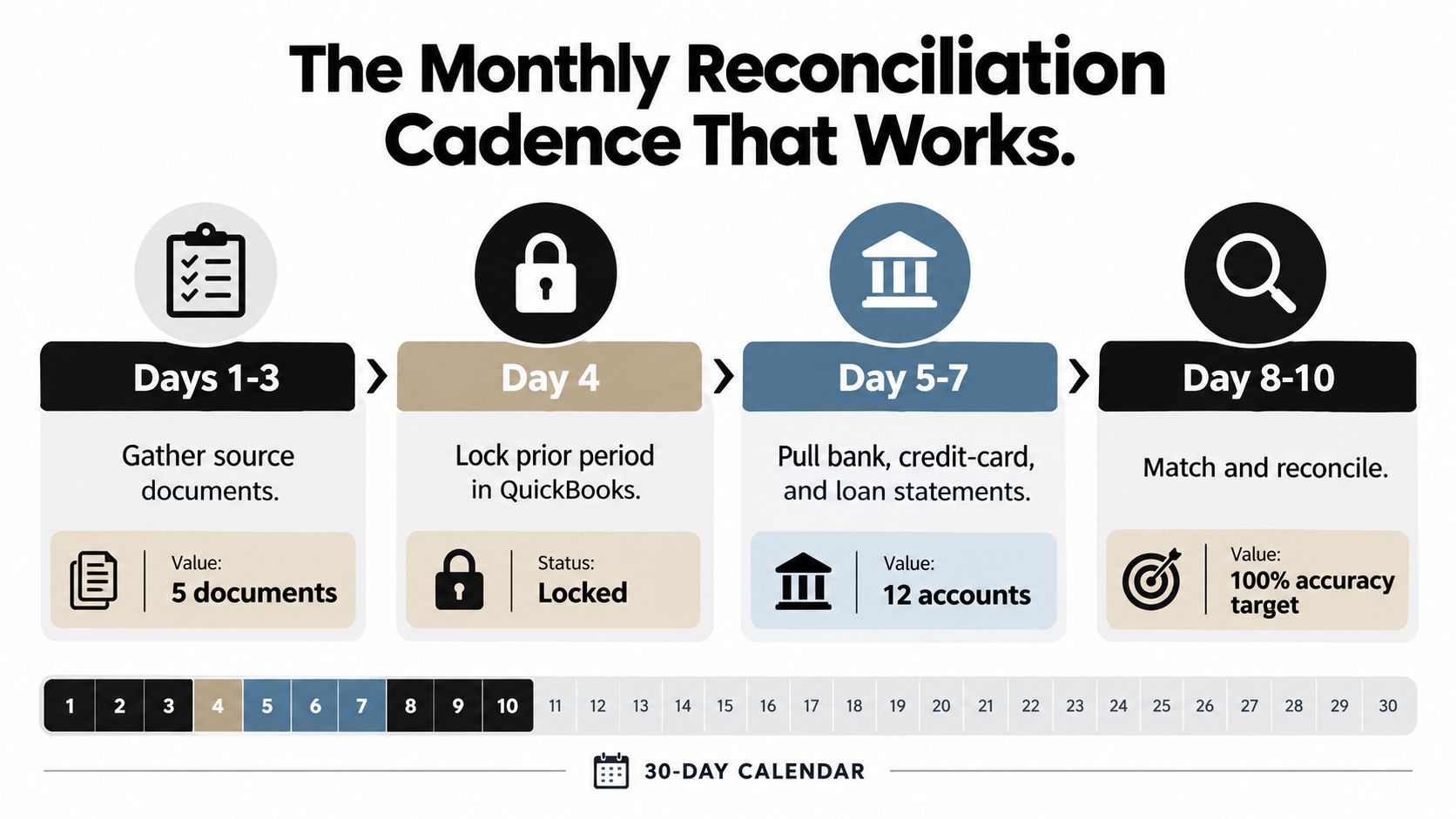
During days one through three, assign someone to collect bank, credit-card, loan, payroll, sales-tax, receivable, payable, and payment-processor reports. Pull the relevant QuickBooks reports, confirm that prior-period transactions are complete, establish the transaction cutoff, and lock the period. Record the preparer and the evidence used.
Days four through seven are for account-by-account reconciliation. Start with cash and payroll liabilities because errors there affect liquidity and compliance. Then reconcile credit-card clearing, accounts receivable, accounts payable, loans, fixed assets, accruals, owner accounts, and intercompany balances. Each account should have an owner, a reviewer, and a clear rule for what qualifies as an acceptable reconciling item.
Review exceptions before you report
Days eight through ten belong to management review, correction entries, and escalation. The reviewer should challenge unsupported explanations, inspect aged items, confirm that entries were posted to the proper period, and verify that the reconciliation agrees with the final ledger. Require a dated explanation and supporting document for every open difference.
From day eleven onward, complete reviewer sign-off, archive the close file, and issue management reporting. The archive should identify what was tested, who prepared it, who reviewed it, what remained open, and the owner and deadline for each resolution.
Escalate immediately when:
- Materiality is exceeded: A single reconciling item crosses the defined threshold.
- The item remains open: It survives two successive closes or reaches the organization's 30-day stale-item limit.
- Cash or compliance is affected: The item involves cash, payroll taxes, sales tax, debt covenants, or another filing obligation.
- Control failure is possible: The difference suggests unauthorized activity, missing approval, duplicate processing, or a broken system integration.
A dated reconciliation file preserves evidence behind payroll liabilities and deposits. Keep it with the supporting reports and approval record so an IRS review does not require rebuilding the close from scattered files.
Comparing Reconciliation Methods and Tools
The right reconciliation method is the one that gives each exception an owner, a deadline, a materiality threshold, and review evidence. A busy file full of matched transactions is not proof of control. For most small and midsize businesses, the practical choices are QuickBooks Online, third-party automation, and spreadsheets.
QuickBooks Online is the sensible starting point for many Jacksonville businesses. Bank feeds, reconciliation screens, rules, recurring journal entries, and account reports can support a disciplined monthly close. A certified QuickBooks ProAdvisor team can configure the file, clean up the chart of accounts, establish matching rules, and assign review responsibilities. The software handles routine matching. A reviewer still must examine unusual transactions, classifications, and exceptions, then retain the explanation and approval.
Third-party automation earns its place when a business has multiple bank feeds, payment processors, point-of-sale systems, payroll platforms, entities, or high transaction volume. Matching tools reduce repetitive handling and surface exceptions faster. They do not decide whether a correctly matched payment belongs to the wrong entity, accounting period, customer, or account. Set rules for those risks, assign an exception owner, and require evidence before closure.
Spreadsheets can work for a very small business or a first-time cleanup. Control them tightly. A file emailed between employees, unprotected formulas, supporting documents stored elsewhere, or unclear approval history turns a low software cost into a weak audit file.
| Approach | Time per Month | Audit Trail | Monthly Cost | Best Fit |
|---|---|---|---|---|
| QuickBooks Online tools | Moderate after setup | Good when notes and attachments are retained | Software and bookkeeping support | Small businesses with straightforward accounts |
| Third-party automation | Lower for repetitive matching | Strong if exceptions and approvals are preserved | Software integration and review | High-volume or multi-system businesses |
| Manual spreadsheets | High as accounts grow | Weak unless carefully controlled | Low software cost, high staff effort | Very small businesses and initial cleanups |
A 2025 survey found that 85% of finance professionals considered a fully documented electronic audit trail important to meeting financial goals, while only 30% had automated 75 to 100% of financial-recording tasks (Kani Payments reconciliation and reporting survey). Documentation remains the control. Automation supports it, but does not replace judgment, approval, or retained evidence.
For Jacksonville small businesses with one to twenty employees, start with a properly configured QuickBooks file and a written exception process. Add automation when transaction volume, payment integrations, or multi-entity requirements justify the cost and governance work. Bookkeeping and Accounting of Florida Inc. provides QuickBooks setup, monthly bookkeeping reconciliations, payroll support, tax preparation, and fractional CFO services within a broader accounting relationship.
Common Reconciling Items and Red Flags Worth Knowing
A $6,000 bank difference can be a timing issue, a duplicate payment, or an owner transaction posted to the wrong account. Your job is not to force the balance to zero. Assign an owner, set a clearance date, apply a materiality threshold, and retain evidence for every unresolved item.
Outstanding checks, deposits in transit, and credit-card charges posted near month end may clear normally. They become control failures when they remain open without explanation, exceed the approved review period, or appear unchanged at each close. Escalate items affecting cash, taxes, payroll, restricted funds, or related entities.
Watch for these red flags:
- Duplicate vendor payments: The same invoice, amount, or payment reference appears more than once.
- Wrong-period entries: Revenue, expenses, deposits, or liabilities fall into the wrong accounting period.
- Misclassified transactions: Owner draws appear as wages, wages appear as distributions, or capital purchases appear as ordinary expenses.
- Unremitted sales tax: Tax collected from customers remains in the liability account without matching remittance activity.
- Unexplained cash shortfalls: The ledger balance exceeds the amount supported by the bank or payment processor.
- Payroll mismatches: Tax deposits do not agree with the payroll register or filed returns.
- Stale customer deposits: Deposits remain uncleared beyond the business's defined review period.
- Intercompany imbalances: Due-to and due-from accounts do not agree or fail to eliminate properly.
- Restricted-fund misuse: Restricted cash appears to support ordinary operating expenses.
- Inherited exceptions: A prior reviewer left an item open without a current explanation or assigned owner.
Automation finds matches, not meaning
Automation can match transactions quickly, but it cannot decide whether a payment belongs to the correct account, period, entity, or tax category. As the Kani Payments survey cited earlier showed, manual intervention and poor integration drive a large share of reconciliation mistakes. Use automation for repetitive matching, then require documented human approval for exceptions.
Human review is required when:
- A transaction matches by amount but belongs to the wrong account.
- A payment is recorded in the wrong period or legal entity.
- A customer or vendor identity is ambiguous.
- A recurring exception points to a system mapping or policy problem.
Reviewer's test: Ask what the transaction is, which period owns it, whose balance it affects, and what evidence supports the conclusion.
Keep the exception list with the close file. Each unresolved item should show its owner, explanation, expected clearance date, and supporting document. Do not approve a reconciliation that hides a recurring control failure behind a tidy spreadsheet total.
When to Bring in a CPA or Fractional CFO
Most owners don't hire outside help because they love reconciliations. They hire it because they need the discipline, review, and financial judgment that reconciliations force into the business.
Bring in a CPA or fractional CFO when the books include multiple entities, related-party transactions, complex owner accounts, or a growing number of payment and payroll systems. The need is even clearer for healthcare practices managing patient-receivable adjustments and payroll liabilities, construction companies tracking retainage and job-cost transfers, and nonprofits handling restricted cash, grant receivables, or deferred revenue.
Outside guidance also matters before a loan, audit, sale, investor discussion, or major expansion. A lender doesn't need a collection of busy spreadsheets. The lender needs financial statements supported by reconciled balances, consistent classifications, and explanations management understands.
Connect the close to tax planning
The IRS doesn't require one specific bookkeeping method. It does require a method that clearly and accurately reflects gross income and expenses, with supporting records that substantiate income, deductions, and credits (IRS small-business recordkeeping guidance). Reconciliation helps connect bank activity, owner transactions, payroll, tax accounts, receivables, payables, and reported income before the return is prepared.
For 2026, the maximum amount of net self-employment earnings subject to the Social Security portion of self-employment tax is $184,500, and a self-employed person generally must pay self-employment tax and file Schedule SE when net earnings are $400 or more (IRS self-employment recordkeeping guidance). Those rules make the classification of owner draws, payroll, business expenses, and tax liabilities more than a bookkeeping detail.
A fractional CFO gives you senior financial guidance without full-time overhead. The engagement can include monthly close review, cash-flow planning, quarterly tax coordination, lender-ready reporting, budget oversight, and one accountable person who sees how the accounts connect.
Most small businesses don't know every record, deadline, or filing threshold they must manage. That isn't a character flaw. It's a reason to build a professional control system before a missed requirement becomes a penalty, cash problem, or emergency cleanup. If you need senior oversight without hiring a full-time executive, fractional CFO services for small business can connect reconciliation with planning and compliance.
Your 30-Day Reconciliation Action Plan
Start Monday with a defined owner and a close folder.
- Week one: Gather three months of bank, credit-card, and loan statements. Pull QuickBooks reports for cash, payroll liabilities, sales tax, accounts receivable, and accounts payable.
- Week two: Reconcile cash and payroll liabilities first. Then review credit-card clearing, receivables, payables, accruals, fixed assets, and owner or intercompany balances.
- Week three: Age every open item. Escalate anything older than 30 days, anything affecting cash or compliance, and anything that suggests a control failure. Attach support and document the resolution.
- Week four: Complete reviewer sign-off, archive source documents, lock the period, and brief the owner on findings and required corrective actions.
Your red-flag one-pager should include duplicate payments, unexplained cash differences, payroll deposit mismatches, stale deposits, intercompany imbalances, restricted-cash concerns, and unsupported journal entries. Your sign-off template should name the account, period, preparer, reviewer, source documents, open items, aging, and escalation decision.
Owning a business is hard enough. Your books shouldn't be the part that keeps you up at night.
Bookkeeping and Accounting of Florida Inc. offers monthly bookkeeping, balance sheet reconciliations, payroll and tax support, QuickBooks ProAdvisor services, and fractional CFO guidance for Jacksonville and Northeast Florida businesses. Visit Bookkeeping and Accounting of Florida Inc. to schedule a consultation and review your current close process with a CPA-led team.