
A Jacksonville owner opens the bank portal on a Monday morning and sees enough cash to cover payroll. The income statement looks profitable, but several customer invoices are overdue, a contractor payment is approaching, and payroll taxes still need to be funded. Without current, reconciled information, that owner isn't managing the business. They're guessing.
Thank you for reading this post, don't forget to subscribe!Monthly accounting reports replace that guesswork with a recurring view of revenue, expenses, assets, liabilities, cash, receivables, payables, and operational performance. They also create the documentation trail needed for tax reporting, payroll compliance, vendor information returns, and sound financial decisions. A bookkeeping file that gets cleaned up once a year isn't a financial system. It's a delayed explanation of what already happened.
Why Waiting for Year End is a Financial Trap
A Jacksonville construction company can look busy all year and still miss a critical tax obligation. Suppose the bookkeeper produces a report only at year-end. By the time the owner sees that subcontractor costs were misclassified, receivables were aging, or payroll records were incomplete, the business has spent months making decisions on unreliable information.
Waiting for annual financials leaves an owner flying blind for eleven months. Hiring, equipment purchases, distributions, pricing, borrowing, and tax planning all become harder when the latest dependable numbers describe a distant period.

Monthly reporting is not merely a tax convenience. It is a management-control system. A monthly income statement shows whether sales are producing an acceptable margin. The balance sheet shows what the company owns and owes. Cash reporting reveals whether profit has become usable money. Aged receivables show which customers are consuming working capital.
One survey reports that businesses with monthly financial reporting are 47% more likely to identify cash-flow problems early and take corrective action within 30 days. That finding is documented in QuickBooks small-business insights. The practical lesson is straightforward: owners who review financial information regularly have more time to respond.
Practical rule: If an owner can't explain current cash, unpaid invoices, upcoming tax obligations, and the reason for a material variance, the business needs better reporting and financial guidance.
Small businesses often underestimate compliance. Payroll records, vendor payments, sales activity, contractor documentation, account reconciliations, and tax-support schedules all require consistent attention. Professional bookkeeping and accounting turns those obligations into a monthly process instead of a year-end emergency.
The Five Essential Monthly Accounting Reports
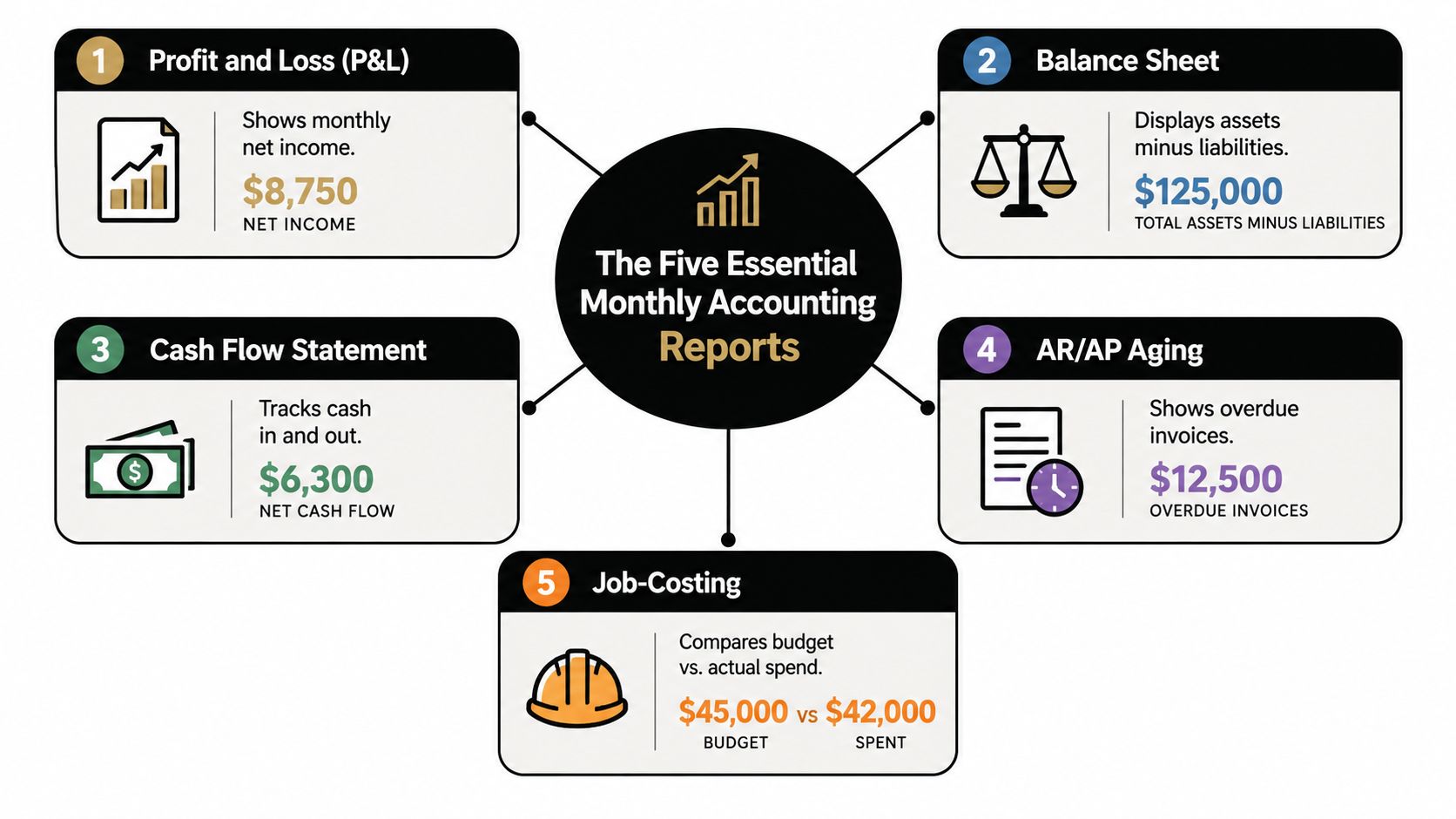
A useful reporting package contains more than a profit-and-loss statement. Each report answers a different question, and the five work together like instruments on a business dashboard.
Profit and loss
The P&L answers, “Did the company earn money during the period?” It organizes revenue, direct costs, operating expenses, and net income. Review gross margin, labor burden, recurring overhead, and actual results against budget or forecast.
The common mistake is treating net income as cash. Accrual accounting can recognize revenue before collection, so a profitable month may still leave the business short of funds.
Balance sheet
The balance sheet shows assets, liabilities, and equity at a specific date. The SBA describes the balance sheet as the foundation of financial management, because it helps owners understand resources, obligations, and future cash needs.
Look for unusual receivable balances, overdue liabilities, unexplained equity changes, and unreconciled cash. A balance sheet that isn't supported by reconciliations shouldn't guide major decisions.
Cash flow statement
The cash flow statement tracks money moving into and out of the business. It separates operating, investing, and financing activity, helping owners distinguish cash generated by operations from borrowing or asset sales.
For practical preparation guidance, owners can review Bizbe's resource on financial statement preparation. The internal cash-flow statement preparation guide also provides relevant context.
AR and AP aging
Accounts-receivable aging shows who owes the company and how long invoices have remained unpaid. Accounts-payable aging shows upcoming obligations and vendors that may need attention. Together, they explain why the P&L and bank balance may tell different stories.
Don't accept a total without reviewing the underlying customers, vendors, disputed balances, credits, and unapplied payments.
Job costing
Construction companies need job-level reporting, not just corporate totals. Job costing compares labor, materials, equipment, subcontractors, committed costs, and overhead against the approved budget. Estimate-to-complete changes should be visible before a project consumes its margin.
APQC benchmarking across 2,300 organizations reports a median monthly-close cycle of 6.4 days, while top-quartile organizations completed the close in 4.8 days or less, as documented by CFO.com's APQC benchmarking coverage. Speed matters, but only after reconciliations and review make the information trustworthy.
Monthly Close Checklist for Clean Financials
A clean close follows a calendar. It doesn't depend on someone remembering tasks after the month has already ended.
Gather and reconcile the source records
Start by recording all bank, credit-card, sales, expense, payroll, receivable, payable, and loan activity for the period. Reconcile bank and credit-card accounts to statements, then investigate every unexplained difference. Don't carry an old reconciling item forward without an owner and explanation.
Next, tie the accounts-receivable and accounts-payable subledgers to the general ledger. Review customer credits, unapplied cash, duplicate bills, unpaid invoices, and vendor statements. A clean ledger requires both transaction accuracy and correct period cut-off.
Post the adjustments
Accrue expenses incurred but not yet billed. Record payroll and employer-tax accruals, depreciation, prepaid-expense activity, inventory changes, work-in-progress adjustments, intercompany balances, and other period-specific entries.
For construction, that may include committed costs and estimated costs to complete. For organizations holding inventory, the close should address receiving timing, shrinkage, and count differences. Every adjustment needs support, a preparer, and an appropriate reviewer.
The month-end close process checklist can help owners organize these recurring responsibilities. The same discipline used to document streamline near miss reporting applies here: capture the issue, assign responsibility, record the resolution, and preserve the trail.
Review, explain, and retain
Compare actual results with the prior period, budget, and forecast. Require explanations for material variances, including the cause, responsible owner, and corrective action. Then review the P&L, balance sheet, cash-flow summary, aging schedules, and industry reports before issuing the package.
The IRS requires employers to retain employment-tax records for at least four years after filing the fourth-quarter return, including Forms W-2, W-4, and tax-deposit confirmations, according to IRS employment-tax recordkeeping guidance. Store reconciliations, payroll reports, receipts, returns, confirmations, and approval records in an organized system.
Mark reports as preliminary when information remains incomplete. A fast report with missing payroll accruals or unreconciled bank activity can mislead management more efficiently, which isn't an improvement.
Tax Law Changes and Compliance Requirements
Tax compliance is not a year-end event. It begins with how the business records transactions every month.
A significant federal information-reporting change applies to payments made during calendar year 2026. The statutory threshold under Internal Revenue Code section 6041 increases from $600 to $2,000, and the $2,000 threshold will be indexed for inflation after 2026, according to IRS guidance for the 2026 reporting change. Businesses still need complete vendor-payment records that identify the recipient, payment date, amount, and account classification.
The higher threshold doesn't eliminate the need for disciplined bookkeeping. A company must still distinguish contractor payments, professional services, repairs, rent, reimbursements, and other vendor categories. Monthly accounts-payable reviews make it easier to identify reportable payments and resolve missing taxpayer information before filing deadlines.
Employment-tax records require similar care. Payroll registers, withholding certificates, Forms W-2 and W-2c, tax-deposit confirmations, fringe-benefit records, and support for claimed credits should not be reconstructed from scattered email messages.
A monthly accounting report should also disclose what remains incomplete. That includes missing receipts, unbilled work, unreconciled accounts, payroll accruals, inventory estimates, and source data that hasn't been updated. Management needs to know whether the numbers are final, preliminary, or dependent on an unresolved assumption.
The following video provides additional context for businesses reviewing their tax and accounting processes.
Penalties and audit exposure are the obvious risks, but poor compliance also damages decision quality. Owners may overstate profit, underfund taxes, distribute cash that should remain in the business, or approve expansion without understanding their obligations. Professional accounting services give small businesses a structured way to stay compliant as rules and reporting requirements change.
Industry-Specific Reporting for Construction and Healthcare
A generic P&L rarely answers the question an industry owner needs to ask. Construction companies need project economics. Healthcare practices need revenue-cycle visibility. Retailers need margin and inventory control.

Construction
Consider a Jacksonville contractor with multiple active jobs. Corporate revenue might be rising while one project suffers from labor overruns, material price changes, delayed change orders, or underbilled work. A monthly job-cost report should separate earned revenue, billed revenue, committed costs, actual costs, estimate-to-complete changes, retainage, and gross-margin fade.
The owner can then ask a useful question: “Which job is consuming cash and why?” That question is more actionable than asking whether the company had a profitable month.
Healthcare
A clinic's financial report should connect accounting results to the revenue cycle. Track days in accounts receivable, payer mix, denial activity, provider productivity, collection trends, and outstanding claims alongside revenue and operating expenses.
A clinic can report strong production while cash collections weaken because claims are delayed or denied. Accounting and billing teams should investigate the source of the variance rather than assuming that higher patient volume equals healthier finances. Tools designed to reduce claim errors in clinics may support the operational side, while monthly accounting reports show the financial result.
Retail and nonprofits
Retail reporting should separate sales channels, gross margin, inventory movement, returns, discounts, and vendor obligations. Nonprofits need restricted-fund activity, grant reporting, liquidity, and unrestricted operating results shown clearly.
A peer-reviewed study of 154 companies found that 103 companies, or 62.05% of the sample, required management reports monthly, with a statistical test rejecting the view that reporting was required less often than monthly at p < 0.0001. The study is available through the peer-reviewed management-reporting research. The value isn't the format alone. Recurring reports give managers a chance to correct errors before they spread.
How Monthly Reports Drive Strategic Decisions
Monthly reporting becomes strategic when owners use statements to decide where to spend, hire, price, and control risk. A report is useful only when it changes an operating choice.
A P&L can show rising revenue while the balance sheet exposes faster growth in receivables. The cash-flow statement shows whether operations are funding the company, while the AR aging schedule identifies customers requiring collection attention. When the reports disagree, investigate the cause. The gap may reflect delayed billing, weak collections, unpaid obligations, or a classification error.
Hiring and capacity
Compare projected payroll, payroll taxes, benefits, and related overhead with recurring gross margin before adding staff. Monthly results cannot make the decision for you, but they can show whether sustainable operating performance supports the commitment. Include expected tax-law changes in the payroll and cash estimate, not after the hire is approved.
Pricing and profitability
Department, location, grant, provider, and job dimensions show where the business earns money. Construction owners can revise estimating assumptions when completed jobs repeatedly underperform. Healthcare owners can examine payer or service-line patterns. Retailers can reduce attention on products that occupy space without producing acceptable margin.
Cash and tax planning
The SBA's financial-management guidance identifies the balance sheet as a foundation for projecting cash flow and accounting for costs such as employees and supplies. Pair that view with aged receivables, upcoming payroll and tax obligations, and a 13-week cash forecast. A fractional CFO can connect those reports to changing tax requirements when the business lacks internal compliance expertise.
A profitable month can still be financially dangerous when customers have not paid and commitments are already due.
Show the report's confidence level. Approve major hiring or spending decisions from a finalized close. Use greater caution when results are preliminary and significant accounts remain unreconciled. That distinction keeps incomplete numbers from driving expensive decisions.
DIY Bookkeeping vs. Fractional CFO Services
DIY bookkeeping looks inexpensive until an owner counts the hidden cost. That cost includes time away from sales and operations, missed deductions, incorrect classifications, late reconciliations, incomplete payroll records, and decisions made from stale information.
| Decision factor | DIY bookkeeping | Fractional CFO support |
|---|---|---|
| Routine transaction entry | Works when volume and complexity are limited | Builds consistent workflows and reviews exceptions |
| Monthly close | Often delayed by competing priorities | Assigns ownership, deadlines, reconciliations, and review |
| Tax compliance | Owner must track changing requirements | Accounting professionals monitor records and reporting needs |
| Strategic planning | Usually based on bank balance and intuition | Uses forecasts, margins, cash needs, and scenario analysis |
| Industry reporting | Generic statements may hide operational problems | Adds job, payer, provider, grant, or location dimensions |
| Leadership access | Expertise may be unavailable when needed | Provides senior guidance without a full-time executive cost |
A fractional CFO doesn't replace every bookkeeping task. The role is to interpret reliable books, challenge assumptions, build forecasts, evaluate cash needs, support lender or tax conversations, and help the owner connect accounting data to business decisions.
Small companies often need that level of guidance before they can justify a full-time finance executive. They also need someone who understands that a construction job, medical practice, nonprofit, and retail store cannot use identical management reports.
Fractional CFO consulting services can be structured around the business's needs. That may include monthly reporting, cash forecasting, budgeting, financial controls, tax coordination, job-cost review, or management meetings.
Bookkeeping and Accounting of Florida Inc. provides bookkeeping, accounting, payroll, tax preparation, audit support, healthcare accounting, forensic audits, and fractional CFO services for businesses in Northeast Florida. Owners should evaluate any provider by asking who reconciles the accounts, who reviews the reports, how exceptions are documented, and whether the advisor understands the business model.
Next Steps to Professional Financial Guidance
Start by requesting the most recent P&L, balance sheet, cash-flow statement, AR and AP aging schedules, bank reconciliations, payroll records, and tax-support files. Don't settle for a report without a close date, comparison period, explanation of material variances, and list of unreconciled items.
Next, ask whether the books use the appropriate accounting method, whether job, department, location, grant, or provider dimensions are reliable, and whether vendor payments can be reviewed for information-reporting requirements. A professional assessment should identify both accounting errors and process weaknesses.
Owners in Jacksonville and Northeast Florida can use monthly accounting reports to improve cash planning, prepare for tax obligations, understand profitability, and make decisions with less uncertainty. Bookkeeping and Accounting of Florida Inc. has served the region for more than 20 years, supporting healthcare, construction, retail, nonprofit, and other small and midsize businesses with bookkeeping, payroll, tax, audit, and fractional CFO services.
A monthly report is valuable only when someone can explain what it means and what management should do next. If your current process produces statements but not confidence, it's time to bring in experienced financial guidance.
Bookkeeping and Accounting of Florida Inc. provides monthly bookkeeping, reconciled financial statements, payroll and tax support, industry-specific reporting, and fractional CFO guidance for Jacksonville-area businesses. Visit Bookkeeping and Accounting of Florida Inc. to schedule a consultation and turn your monthly accounting reports into a dependable system for compliance and better decisions.