
A Jacksonville clinic owner can start Monday with a full schedule, payroll waiting for approval, claims aging on the billing report, and a payer letter requesting records before the end of the week. Then a staff member mentions that a former employee may still have access to the electronic health record. Nothing about that morning feels like a single compliance task. It's finance, privacy, cybersecurity, payroll, vendors, and patient records arriving at the same time.
Thank you for reading this post, don't forget to subscribe!That's why compliance reporting in healthcare deserves more than an annual checklist. A practical system connects every report to an owner, a source record, a deadline, and evidence showing who reviewed it. This guide explains how small practices can build that system, prepare for audits, manage third-party risk, and use current tax information to make better business decisions.
When Compliance Paperwork Sneaks Up on Busy Practices
The clinic manager opens the payer letter while the owner is reviewing payroll. The letter asks for utilization information, supporting documentation, and a reconciliation to the practice's financial records. The billing system has one patient count, the EHR has another, and the spreadsheet prepared last quarter uses a different definition of a completed visit.
At the same time, the practice's payroll provider is asking for updated employee classifications. A laboratory vendor has sent a security notice. A patient has requested access to medical records. The owner's first reaction is familiar: “Who is handling this?”
That question matters because responsibility rarely sits in one department. Compliance reporting in healthcare can involve:
- Financial records: Revenue, payroll, accounts payable, accounts receivable, and payer reconciliations.
- Privacy and security records: Access logs, workforce training, risk assessments, incident notes, and corrective actions.
- Clinical and operational data: Encounters, utilization, patient identity, service availability, and quality measures.
- Vendor evidence: Business-associate agreements, investigation updates, system logs, and notification decisions.
- Tax documentation: Payroll filings, income-tax records, employment-tax support, and deadline tracking.
The U.S. Department of Health and Human Services' Office for Civil Rights, or OCR, had received more than 374,321 HIPAA complaints and initiated over 1,193 compliance reviews by October 31, 2024. OCR reported resolving 99% of those complaints and reviews, totaling 370,578 cases, while more than 31,191 cases resulted in required privacy changes, corrective action plans, or technical assistance. Enforcement outcomes included 152 settlements or civil monetary penalties totaling $144,878,972, and 2,419 matters referred to the U.S. Department of Justice. These figures appear in OCR's HIPAA enforcement highlights.
The practical lesson: Compliance isn't a folder you open once a year. It's an operating process that connects daily activity to defensible evidence.
A small practice doesn't need a complicated bureaucracy. It needs a reporting calendar, clean books, clear ownership, documented vendor communication, and a review habit that catches inconsistencies before an outside party does. The following framework is designed for physician groups, outpatient clinics, laboratories, and other healthcare businesses that need calm, repeatable controls without adding unnecessary administrative weight.
Understanding Healthcare Compliance Reporting Basics
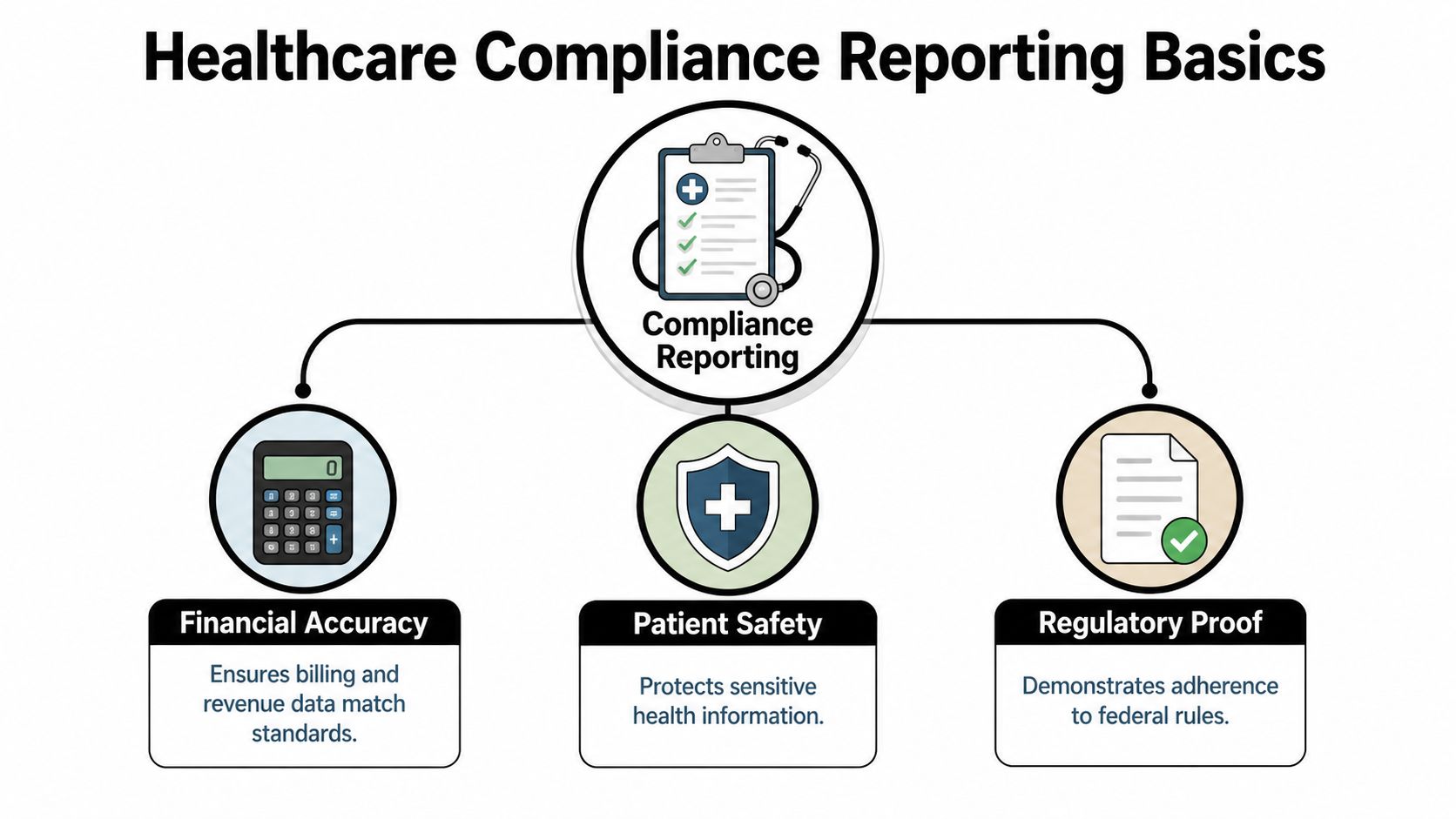
Think of compliance reporting as the practice's checkup chart. A medical chart records what happened to the patient, who provided care, and what follow-up is needed. A compliance file should record what the practice reported, which source produced the information, who reviewed it, and how the practice addressed exceptions.
The filing cabinet has three drawers:
- Internal records prove what happened inside the business. Examples include bank reconciliations, payroll registers, training logs, access reviews, vendor agreements, and general-ledger reports.
- Regulatory filings go to government agencies and demonstrate adherence to applicable requirements.
- Payer and contract reports support reimbursement, utilization review, plan reporting, and operational accountability.
Those drawers overlap. A payer report may rely on encounter data from the EHR and revenue information from QuickBooks. A payroll filing may support an employment-tax obligation while also helping document workforce classifications. A breach response may require access logs from an EHR vendor, patient records from the practice, and legal review of notification decisions.
Federal and Florida layers
Small businesses must meet federal, state, and local tax obligations, and requirements depend on the business structure and location. The U.S. Small Business Administration identifies income taxes and employment taxes as common state and local responsibilities and recommends documenting internal compliance activities because those records may be needed during a sale or legal action. Businesses with 50 or more employees also have Affordable Care Act reporting responsibilities concerning employer-provided health coverage, as explained by the U.S. Small Business Administration's business management guidance.
| Reporting Layer | What It Proves | Internal Record Needed |
|---|---|---|
| Federal healthcare | The practice followed applicable HIPAA, Medicare, Medicaid, and other federal requirements | Policies, training records, access reviews, incident files, and reconciliations |
| Florida and local business | The business addressed location-based tax, employment, licensing, and operational obligations | Payroll records, tax filings, licenses, payment confirmations, and deadline logs |
| Payer and contract | Services, utilization, eligibility, and financial information agree with contract expectations | Claims detail, encounter reports, payer correspondence, and source-to-report reconciliations |
For clinics that handle sensitive patient information, a resource such as filtered internet for clinics can support a broader conversation about web access and security controls. Your accounting records should sit alongside those technical safeguards, not apart from them.
Clean QuickBooks records matter because reviewers need to trace totals. Use consistent account names, separate personal and business spending, reconcile bank and credit-card activity, and retain documentation for unusual transactions. A healthcare financial management resource can help practice owners connect bookkeeping with reporting, cash flow, and operational decisions.
Essential Compliance Reports Every Provider Must Know
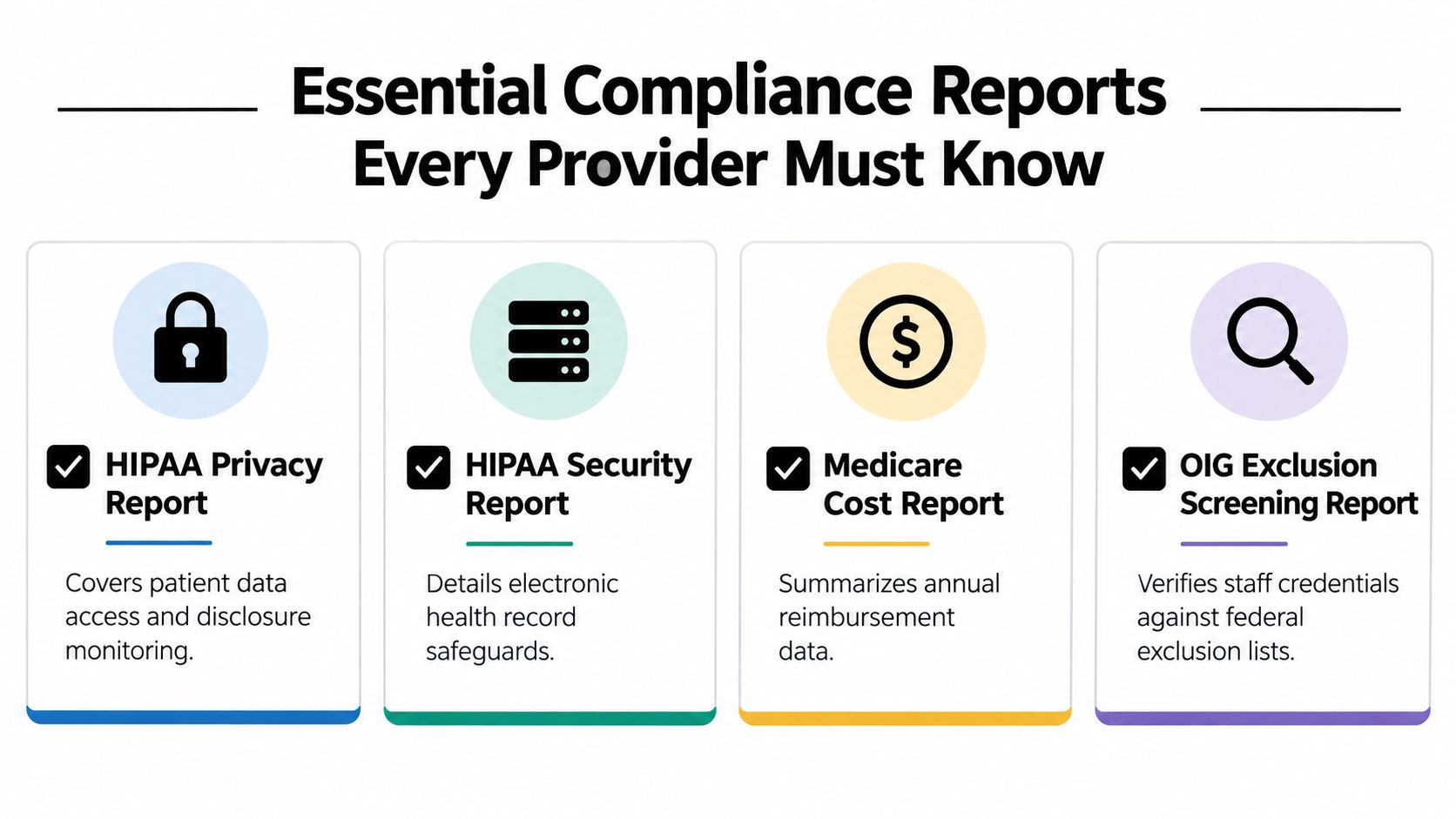
A useful report inventory starts with the question, “Who requires this, what triggers it, and what proves completion?” The answer may be a regulator, payer, employer-tax agency, patient, board, or business partner.
Privacy and security reporting
HIPAA privacy documentation should show how the practice handles patient access requests, permitted disclosures, minimum-necessary decisions, complaints, workforce training, and policy updates. Security documentation should support safeguards for electronic protected health information, including risk analysis, access management, incident response, and corrective action.
A practice should know where those records live and who updates them. “We have a policy” isn't enough if the practice can't show training completion, review dates, investigation notes, and evidence that access was removed when an employee left.
Breach notification records
When a breach involves protected health information, the Breach Notification Rule generally requires notice to affected patients and HHS without unreasonable delay and no later than 60 days after discovery. Breaches affecting fewer than 500 individuals generally must be reported to HHS annually. The CMS HIPAA basics guidance explains these obligations for covered entities and business associates.
The incident file should preserve the discovery date, affected systems, investigation steps, risk assessment, notification decision, communications, and corrective action. Don't let a vendor's investigation remain a verbal update. Put requests and responses in the incident register.
Medicare Advantage reporting
For Medicare Advantage organizations, 42 CFR §422.516(a) requires procedures to develop, compile, evaluate, and report operational cost, service utilization, service availability and accessibility, enrollee health-status developments where practical, fiscal soundness, and other CMS-required information. CMS may specify the frequency, format, deadline, and level of detail, including reporting at the contract or plan-benefit-package level.
Organizations must retain a complete reporting archive for 10 years and produce it to CMS on request. That makes common contract identifiers essential across accounting, enrollment, utilization, and quality systems. Before certification, reconcile reported totals to the general ledger or authoritative operational system, preserve submission confirmations, and document the reviewer's sign-off. The applicable CMS Part C reporting requirements provide the governing detail.
A practical audit trail should show the transformation from source record to submitted figure. A guide such as Beyond Surplus audit trail guide can help teams think through documentation and traceability.
Payroll, tax, and quality reports
Payroll reports support employment-tax filings, benefit records, wage classifications, and leave documentation. Quality and utilization reports depend on consistent clinical definitions, patient identity matching, and reliable encounter data. Assign each report a source system, preparer, reviewer, deadline, and retention location.
Real Breach Examples That Show Why Reporting Matters
A lower incident count doesn't automatically mean a safer practice. Leadership should ask how many records were exposed, how quickly the team detected the event, whether a vendor was involved, and whether access controls failed.
In calendar year 2024, OCR received 663 notifications concerning breaches of unsecured protected health information affecting at least 500 individuals. Those incidents affected approximately 242,908,056 people, and healthcare providers submitted 505 reports, or 76% of the total. Hacking and information-technology incidents affected approximately 241,582,022 individuals, or 99.45% of the total, while the largest hacking incident affected roughly 192 million people. The 2024 HHS breach report to Congress provides these figures.
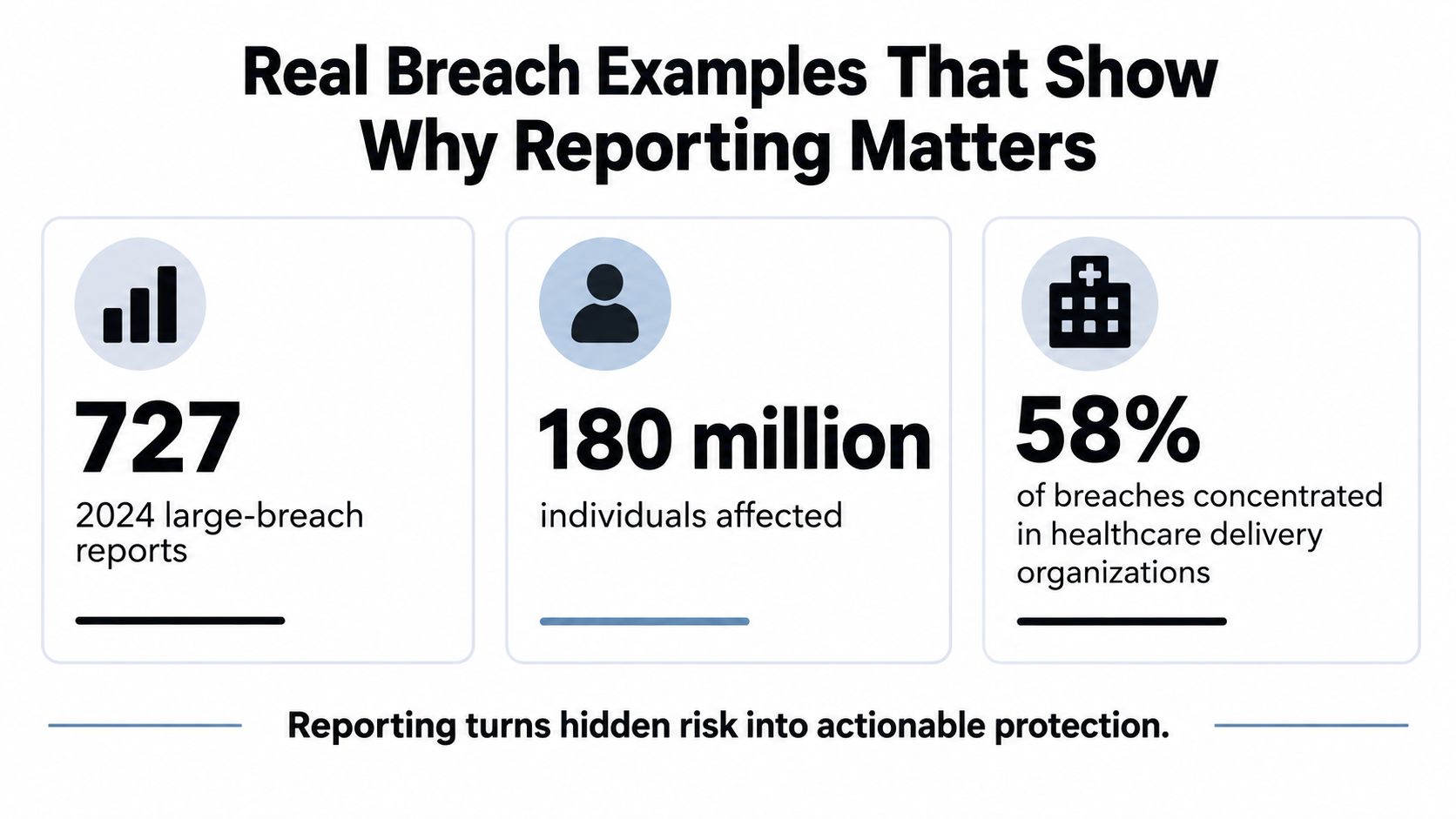
The total number of large-breach notifications was 9% lower than in 2023, yet the number of affected records remained exceptionally high. A clinic that celebrates fewer incidents while ignoring exposure size, delayed detection, or concentrated vendor risk can misread its own position.
Consider two common situations. In the first, a staff member sends a patient summary to the wrong recipient. The practice needs a documented review, a decision about whether the event is reportable, patient-impact analysis, and corrective action. In the second, a clearinghouse or EHR vendor identifies suspicious activity but provides incomplete logs. The clinic still needs to track the event, request evidence, assess its obligations, and document communications.
A useful dashboard should include:
- Time to detect: How quickly the practice learned about the event.
- Time to classify: How long it took to determine whether protected health information was involved.
- Time to notify: Whether required communications stayed within the applicable deadline.
- Vendor risk status: Whether business associates have current assessments and agreements.
- Access exceptions: Whether privileged access or terminated-user access remains unresolved.
- Severity: The number and type of records affected, not merely the incident count.
- Remediation status: Which corrective actions remain open and who owns them.
For technical safeguards and incident planning, practices may review cybersecurity solutions for healthcare alongside their accounting and compliance controls.
Common Pitfalls and Audit Ready Internal Controls
Most reporting failures don't begin with bad intentions. They begin with unclear ownership, inconsistent definitions, or records that exist in several places but don't agree.
A clinic may record a payment in the bank feed but fail to match it to the payer remittance. An owner may pay a personal expense from the business account and forget to classify it. A manager may use “visit completed” to calculate one quality measure and “claim submitted” to calculate another. Each issue creates reconciliation work and weakens the evidence behind the final report.

Build the control rhythm
Healthcare reporting increasingly depends on standardized, machine-readable clinical data. The Office of the National Coordinator identifies the United States Core Data for Interoperability, or USCDI, as a baseline set of standardized data elements that should be available for exchange across care settings. Consistent definitions help prevent denominator errors, duplicate records, and results that can't be reproduced.
Use a simple control sequence:
- Define the metric. Write down exactly what counts as a patient, encounter, service, disclosure, employee, or reportable event.
- Name the source. Identify the EHR field, billing report, payroll register, general-ledger account, or vendor record that supports the value.
- Validate the data. Check completeness, permitted values, duplicate patients, interface errors, and unusual changes before submission.
- Reconcile the result. Compare the report with the authoritative source population and investigate differences.
- Approve and retain. Record who reviewed the report, what exceptions were resolved, when it was submitted, and where the confirmation is stored.
Control rule: Every important reported number should trace back to an authoritative source record and a named reviewer.
Keep a reporting calendar that includes federal filings, payer deadlines, payroll tasks, employee training, access reviews, vendor assessments, and renewal dates. The calendar should show preparation time, not only the submission date.
A separate vendor register should identify each business associate, the data it handles, the agreement status, the responsible internal owner, open incidents, and evidence still outstanding. For a practical preparation aid, use an audit readiness checklist as a starting point, then adapt it to the practice's systems and contracts.
How a Florida CPA and Fractional CFO Keep You Compliant
DIY bookkeeping can work for a very small operation until the owner becomes the bookkeeper, payroll reviewer, billing analyst, compliance coordinator, and financial planner at the same time. At that point, the practice may have reports, but no one has verified that the reports agree.
A CPA and fractional CFO provide a different operating model. The CPA-focused work may include QuickBooks setup and cleanup, monthly bookkeeping, payroll support, tax preparation, financial reviews, audit support, forensic accounting, and healthcare reporting. Fractional CFO work adds cash-flow planning, budget-to-actual analysis, payer and contract review, dashboard design, and decisions about staffing, technology, and expansion.
DIY administration versus guided oversight
| Need | DIY approach | CPA and fractional CFO approach |
|---|---|---|
| Monthly close | Owner gathers statements when time allows | A recurring close process assigns preparation, review, and follow-up |
| Reporting deadlines | Deadlines live in email or memory | A shared calendar identifies due dates, inputs, reviewers, and confirmations |
| Vendor incidents | The practice waits for the vendor's update | A vendor register tracks detection, evidence, escalation, and notification decisions |
| Financial visibility | QuickBooks shows transactions but not always meaning | Clean classifications and management reports support decisions |
| Audit preparation | Staff search through folders after a request arrives | Evidence is retained as part of the normal reporting cycle |
A healthcare practice may depend on clearinghouses, laboratories, EHR providers, payroll processors, and other business associates. A vendor can create the triggering event, hold the relevant logs, and control the investigation timeline, while the healthcare provider remains responsible for patient and regulator communications. The healthcare breach report analysis notes that business associates accounted for 35.8% of large HIPAA breaches in 2025, while 76% of HIPAA enforcement actions included a penalty related to inadequate risk analysis.
That arrangement requires a responsibility matrix showing who detects, investigates, approves, notifies, reconciles, and retains evidence. Bookkeeping and Accounting of Florida Inc. provides bookkeeping, payroll, tax, healthcare accounting, audit support, and flexible fractional CFO consulting services for businesses that need senior financial guidance without full-time overhead.
Tax Law Changes and Your Next Compliant Steps
Tax planning and healthcare compliance reporting share the same foundation: current records, consistent classifications, documented review, and timely action. A practice can't make a reliable estimated-tax decision from outdated books, just as it can't certify a payer report from unreconciled encounter data.
IRS guidance sets the 2026 maximum net self-employment earnings subject to the Social Security portion of self-employment tax at $184,500. The same guidance states that the 20% qualified business income deduction for qualified active trades or businesses has been made permanent, while the income thresholds governing its limitations increased. These changes can affect owner compensation, estimated-tax calculations, entity-level planning, and year-end projections, as explained in IRS Publication 334.
Beginning in 2026, the federal paid family and medical leave tax credit expands to include qualifying paid-leave insurance premiums as well as wages paid during leave. Eligible employers may claim a general business credit ranging from 12.5% to 25% of qualifying wages for up to 12 weeks of leave per taxable year. Eligibility also expands to certain employees who have worked for the employer for six months and qualifying part-time employees who customarily work at least 20 hours per week, according to Treasury and IRS guidance.
Your next steps are straightforward:
- Review the chart of accounts and separate personal, clinical, payroll, and administrative activity.
- Build a compliance calendar with an owner and reviewer for every recurring report.
- Create a vendor incident register and require prompt evidence delivery under business-associate agreements.
- Map important metrics to source fields, reconcile totals, and retain submission confirmations.
- Schedule a tax projection using current financial statements rather than prior-year assumptions.
Bookkeeping and Accounting of Florida Inc. helps healthcare practices with clean bookkeeping, payroll, tax planning, audit preparation, healthcare reporting, internal controls, and fractional CFO guidance. Visit Bookkeeping and Accounting of Florida Inc. to schedule a conversation about turning your compliance reporting into a dependable monthly process.