
You finish a strong month of work, send the progress billings, and still can't answer the question your bank, bonding company, or tax preparer asks first: Which jobs made money? The checking account looks healthy because customers paid deposits, while unpaid retainage, unbilled change orders, subcontractor commitments, and an underestimated cost-to-complete figure remain hidden in the books.
Thank you for reading this post, don't forget to subscribe!That's why accounting for contractors is more than recording deposits and receipts. Your system must connect job costing, work in progress, payroll, subcontractor compliance, retainage, tax planning, and cash forecasting. The rules also keep changing. For 2026, the Form 1099 reporting threshold, fixed-asset deductions, interest limitations, and contract-accounting thresholds all deserve a deliberate bookkeeping response.
The Contractor Whose Books Almost Killed the Business
A residential remodeler with roughly $3 million in annual revenue won three large projects in the same season. The work was legitimate, the crews were busy, and the owner believed the company was growing. Materials arrived constantly, subcontractors submitted invoices, and personal purchases occasionally went onto the business card because the owner was moving between jobsites.
The accounting file told a different story. Every material invoice, subcontractor bill, equipment charge, and field reimbursement landed in one generic “Job Costs” account. No one could produce a reliable margin report by project. Retainage wasn't tracked separately, several subcontractors had no W-9 on file, and personal and business spending were mixed together. By tax time, the owner discovered a $180,000 tax bill, with no clean schedule showing which job generated the income or whether the cash was still needed to finish the work.
The company had even begun designing higher-end remodels for clients using resources such as browse Spanish Colonial house plans, but its own financial planning was far less organized than the projects it sold. The problem wasn't a lack of effort. It was a bookkeeping system that couldn't translate field activity into dependable financial information.
The warning signs were visible
- No dedicated accounts: Personal spending obscured operating cash and made owner draws difficult to classify.
- No vendor onboarding: Missing W-9 information created year-end 1099 cleanup and uncertainty about worker classification.
- No retainage schedule: Amounts withheld from progress payments looked like ordinary receivables instead of cash that might remain conditional.
- No job margin report: Management couldn't identify an underbid project before the final invoice.
- No monthly close: Errors remained buried until tax preparation, when corrective action was expensive and late.
A system built around a clean chart of accounts, monthly close, job costing, 1099 compliance, and fractional CPA or CFO review would have exposed the problem much earlier. The rest of this playbook turns those controls into an operating rhythm, so your books help you protect cash instead of merely documenting its disappearance.
Building the Bookkeeping Workflow Contractors Actually Need
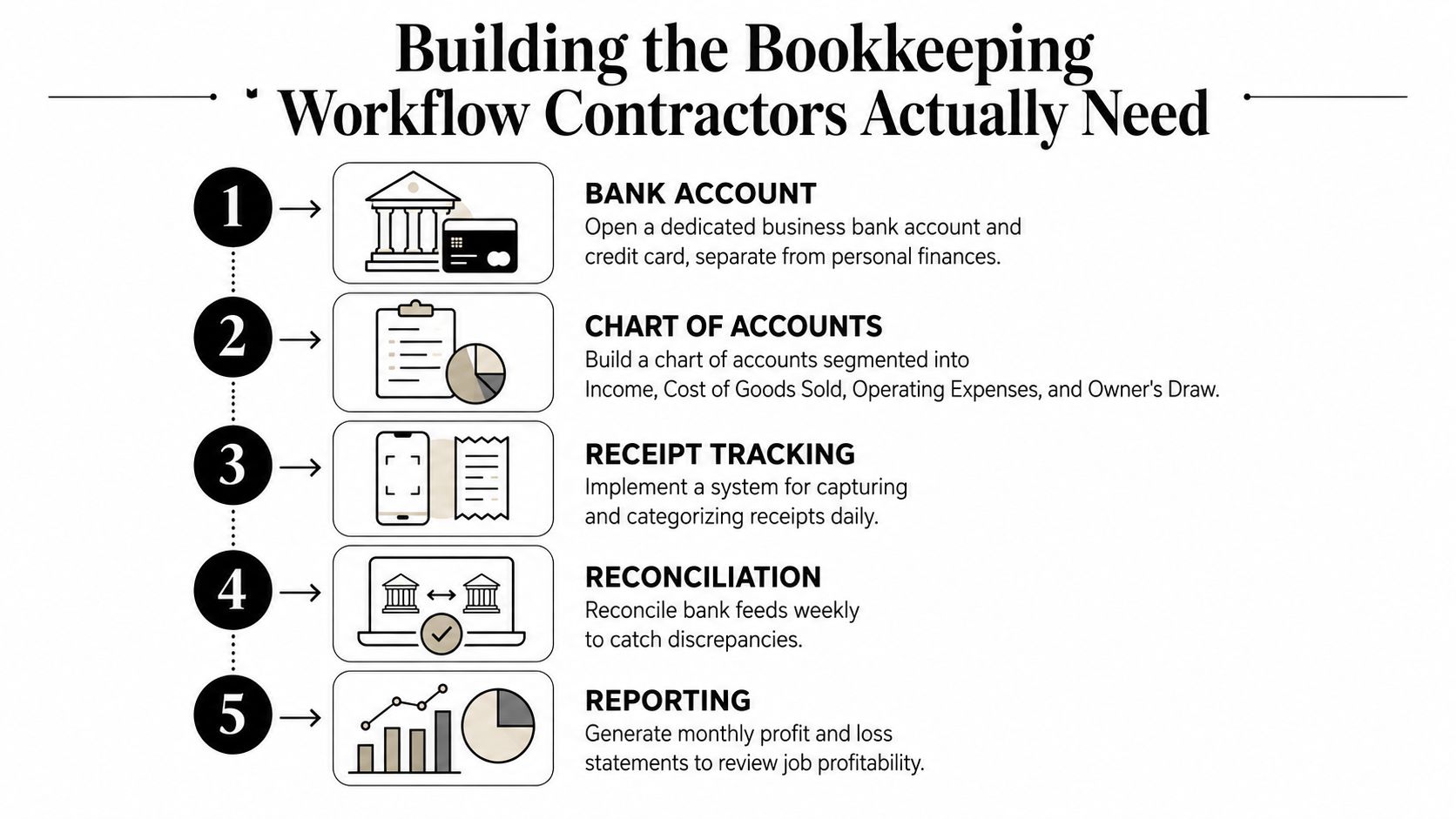
Start with separation. Open a dedicated business operating account and business credit card, then route every company transaction through them. Owner draws, shareholder distributions, and personal reimbursements need their own treatment. Mixing funds makes reconciliation slower and obscures the true cost of operating a job.
Build the accounting structure before adding transactions
Your chart of accounts should mirror how work is estimated and delivered:
- Income: Separate revenue by trade, service line, or contract type.
- Cost of Goods Sold: Use distinct accounts for materials, subcontractor labor, direct labor, and job-specific equipment.
- Operating Expenses: Keep insurance, office costs, vehicles, supervision, professional fees, and other overhead outside direct job costs.
- Equity and owner activity: Record owner draws or shareholder distributions separately from expenses.
Connect the bank feed to QuickBooks Online, but don't treat the feed as bookkeeping. Use a job-costing add-on when native project tracking isn't sufficient, capture receipts through Dext or Hubdoc, and run payroll through a system such as Gusto when it fits your workforce and tax setup.
Assign ownership to every recurring task
The owner shouldn't be the only person who knows where a receipt belongs. A bookkeeper can capture transactions and reconcile accounts, project managers can review job costs and committed spending, payroll staff can approve time and labor allocations, and the CPA or fractional CFO can review reports, tax estimates, and unusual balances.
Your monthly close should follow a fixed sequence:
- Reconcile bank and credit-card accounts, then investigate unmatched or duplicate transactions.
- Review the P&L by job, looking for material overruns, missing labor, unbilled change orders, and unusual gross-margin movement.
- Review accounts-receivable and accounts-payable aging, including disputed invoices and subcontractor balances.
- Check 1099 vendor balances, W-9 records, worker classifications, and payment coding.
- Confirm cash position, upcoming payroll, committed purchases, retainage collections, and tax obligations.
Use a practical rhythm: capture receipts daily, review job costs weekly, close the books monthly by the 10th, estimate taxes quarterly, and conduct an annual review with your CPA. The deadline matters less than assigning a person, a checklist, and an escalation path for every missed item.
Practical rule: If project managers don't review financial reports during the close, your accounting team is only reconciling transactions, not managing profitability.
Job Costing and Job Profitability From the Ground Up
A generic Job Costs account is not a job-costing system. It tells you what the company spent, but not whether the kitchen remodel, deck, or commercial tenant-improvement project earned the margin promised in the estimate.
Direct costs attach cleanly to a project. They include materials purchased for that job, subcontractor invoices, and direct labor hours recorded by employee and cost code. Indirect costs support several jobs or the company as a whole. Supervision, equipment depreciation, vehicles, insurance, and office overhead need a rational allocation method, such as hours worked, equipment usage, or revenue, depending on the cost.
Make every transaction answer three questions
When a bill, timecard, purchase, or reimbursement enters QuickBooks, it should identify:
- Which job: Use the customer, project, location, or job number.
- Which cost category: Apply a consistent cost code for materials, labor, subcontractors, equipment, or overhead.
- Which reporting dimension: Use classes or project fields consistently across estimates, invoices, bills, and payroll.
A useful job profitability report shows contract revenue, direct costs, allocated indirect costs, gross profit, and gross margin for each active project. Contractors who want a deeper setup reference can review this construction job costing guide, then adapt the structure to their trades and contracts.
The examples below use the requested internal management scenarios. They illustrate how a report can expose performance differences that disappear inside a company-wide P&L.
Job profitability example
| Job | Revenue | Direct Costs | Indirect Costs | Gross Profit | Gross Margin |
|---|---|---|---|---|---|
| Kitchen remodel | Not specified | Not specified | Not specified | Not specified | 32% |
| Deck build | Not specified | Not specified | Not specified | Not specified | 11% |
| Commercial TI job | Not specified | Not specified | Not specified | Not specified | -4% |
The kitchen remodel is producing a 32% margin, while the deck build is effectively near break-even at 11%. The commercial TI job is losing money at negative 4%. The report doesn't merely describe results. It directs action: verify the kitchen estimate, investigate deck labor and material assumptions, and stop treating the commercial job as healthy because billings continue.
The warning thresholds in this playbook are management rules, not universal accounting standards. A residential margin under 20% or a commercial margin under 12% deserves an immediate review of estimating, change orders, labor burden, and cost coding. Don't wait for closeout. By then, the margin is gone and the accounting file can only explain the loss.
Payroll, Subcontractors, and 1099 Compliance in 2026
A contractor can have accurate payroll calculations and still face an IRS problem. The common failures are misclassifying employees as subcontractors, paying vendors without proper records, and coding field labor outside the job that produced it. Set up worker classification, vendor files, payroll, and cash controls before the first payment.
The IRS classification review examines behavioral control, financial control, and the type of relationship. A worker can be a contractor under one arrangement and an employee under another. An invoice does not settle the question. Review who directs the work, how the worker handles financial matters, and whether the relationship operates like ongoing employment. This guide to classifying workers the right way can help determine whether someone belongs on Form W-2 or Form 1099-NEC.
Build the vendor file before the first payment
Collect a completed W-9 when a subcontractor enters the vendor list. Store taxpayer identification information securely, record the classification review, and assign each payment to service compensation or another appropriate category. Nonemployee compensation is reported separately from wages. Wages belong on Form W-2, not Form 1099-NEC. Use the IRS Form 1099-NEC guidance for independent contractors to establish the control process.
Run payroll weekly or biweekly based on the workforce and cash cycle. Assign labor hours to the correct project, allocate workers' compensation costs to the applicable job class, and include required union fringes. Posting all field labor to overhead can make a profitable job look weak and hide an unprofitable one, even when gross-to-net payroll is correct.
Track the 2026 reporting change carefully
For payments made in 2026, the Form 1099-NEC and Form 1099-MISC reporting threshold rises from $600 to $2,000, with inflation indexing beginning in 2027, according to this 2026 1099 threshold update. Keep collecting W-9s and tracking every vendor payment. Your system must identify vendors that cross the applicable threshold while preserving a complete payment history.
Reconcile Form 1099-K information when third-party platforms report receipts. The threshold reverted to $20,000 in gross payments and more than 200 transactions. Separate platform-reported receipts from contractor payables and ordinary card or network activity, then match payment type, vendor, tax form, and bank activity.
Build the filing calendar before year-end. Certain contractor-related forms carry a January 31 deadline, and some categories use $2,000 or more as a reporting level. If a subcontractor refuses a W-9, consult your tax professional about backup withholding, generally 24% under the applicable rules.
For practical guidance on compensating freelance workers, use a documented payment workflow and keep classification and reporting decisions inside your accounting controls.
Tax Law Changes That Reshape Contractor Accounting in 2026
The 2025 and 2026 tax-law reset changes how contractors should plan equipment purchases, interest expense, and year-end bookkeeping. The tax return is downstream from the books. If your fixed assets, debt, entity distributions, and project records aren't clean, your tax preparer can't reliably choose the most useful treatment.
The 2025 law retroactively restored 100% bonus depreciation for qualifying property placed in service from January 19, 2025, and increased the Section 179 deduction to $2.5 million with a $4 million phaseout, according to this 2025 year-end tax planning resource for contractors. The practical decision isn't “buy equipment for a deduction.” It's whether the asset supports production, whether cash can support the purchase, and whether the deduction matches the owner's tax position.
Compare the major fixed-asset choices
| Provision | 2026 Limit / Rate | Key Caveat |
|---|---|---|
| Bonus depreciation | 100% for qualifying property under the restored rule | Confirm the placed-in-service date, eligible property class, and recapture exposure on an early sale |
| Section 179 | $2.5 million deduction, with a $4 million phaseout | The limitation and phaseout require asset-level and business-level review |
| Business interest limitation | EBITDA-based calculation under the revised rule | Equipment debt can affect deductible interest and taxable income differently than book expense |
Don't assume you can stack every provision automatically on one asset. Record purchase date, placed-in-service date, business use, financing, and disposition history in the fixed-asset register. If a vehicle or equipment is sold early, review potential recapture before the transaction closes.
The revised business-interest rules use an EBITDA-based calculation, so heavy equipment debt deserves a forecast rather than a year-end surprise. Your bookkeeper should reconcile interest and principal separately, while the CPA models deductibility.
Contractors also need to coordinate pass-through entity deduction planning under Section 199A with reasonable S-corporation salary decisions. Payroll, shareholder distributions, profit, and entity-level tax elections should be reviewed together, not by separate people working from incomplete records.
Sales and use tax adds another trap. Out-of-state material purchases, contractor exemption certificates, and marketplace facilitator rules can create obligations that ordinary income-tax bookkeeping won't identify. Maintain purchase documentation by jurisdiction and ask your CPA to review the treatment before a large project closes. A broader guide to managing accounting risks can help owners connect accounting controls with operational risk.
QuickBooks Setup Tips and the Fractional CFO Advantage
QuickBooks Online or QuickBooks Desktop can serve as the general ledger for many contractors, but a default installation usually produces default reports. If every invoice uses one revenue account and every bill uses one expense account, the software will faithfully generate a report that isn't useful.
Configure QuickBooks around the work
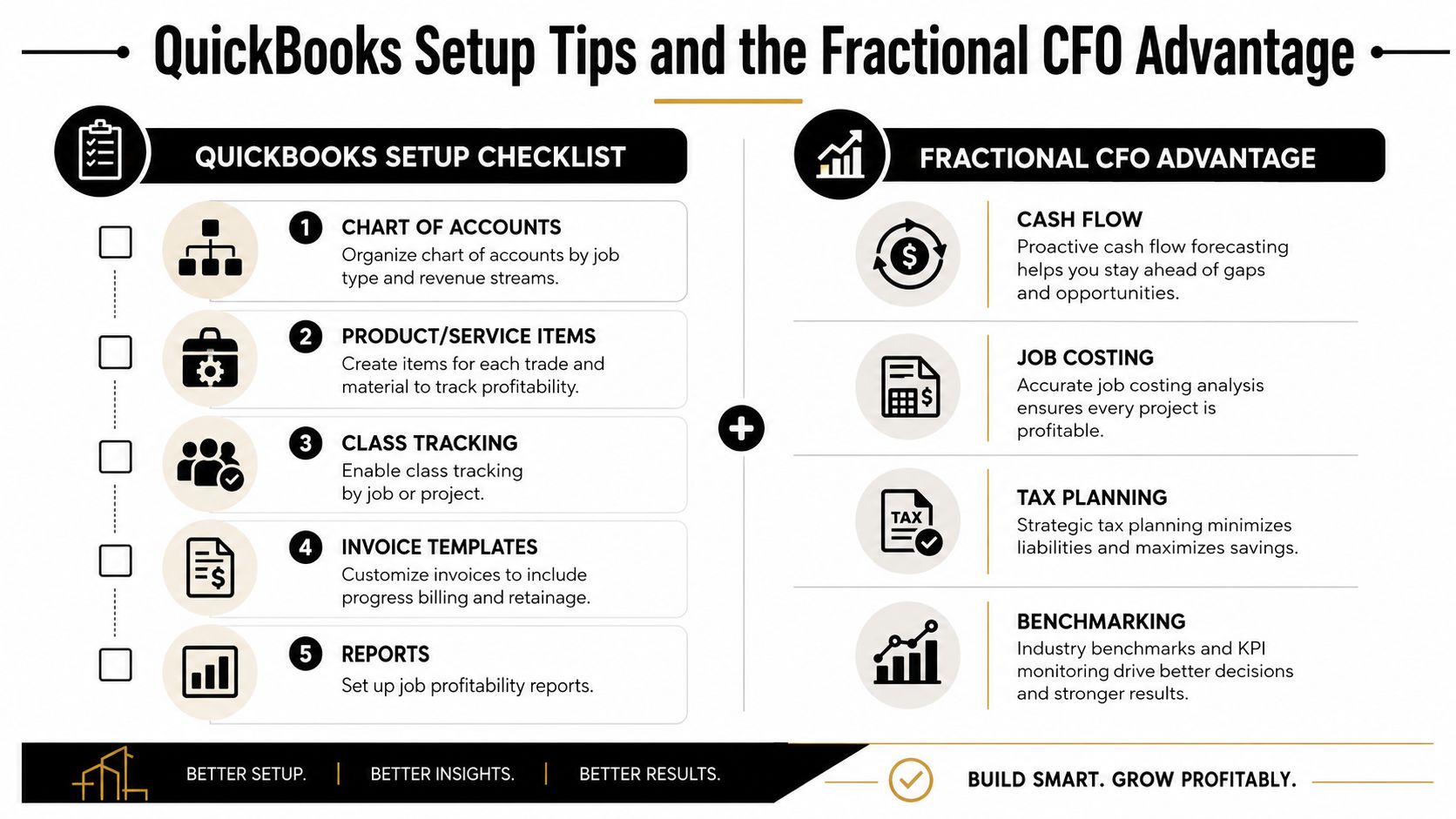
Separate revenue accounts by trade, service line, or job type. Build cost-of-goods-sold subaccounts for materials, direct labor, subcontractors, and equipment. Keep an indirect cost pool for overhead, then establish a consistent allocation policy so supervision, vehicles, insurance, and similar costs don't disappear into an unreviewed general account.
Enable class and location tracking only after deciding what each field means. For example, one field might identify the project and another might identify the division or trade. Apply the same logic to invoices, bills, credit-card charges, payroll, and credits. Create product and service items for recurring trades and materials, but don't let an item list become a substitute for project coding.
Contractors routinely hit three QuickBooks limitations: weak native retainage tracking, limited percentage-of-completion reporting, and cumbersome work-in-progress entries. A job-costing add-on such as JobCost or a construction-focused tool such as ConstructionIQ may improve the workflow, but software won't correct incomplete estimates or careless coding.
The missing role is financial judgment
A bookkeeper can post transactions. A fractional CFO can challenge the forecast behind them. That review should cover monthly close results, job-margin dashboards, cash forecasting, lender-ready financial statements, tax strategy coordination, and decisions about hiring, equipment, pricing, and debt.
Owner's test: If you only learn a job is losing money after the customer receives the final invoice, your business doesn't have financial control.
A fractional CFO isn't a luxury reserved for large companies. It's a practical layer of senior guidance without the overhead of a full-time executive. The value appears in avoided mistakes: an underbilled job identified before cash tightens, a purchase reviewed before the deduction decision, or a lender package prepared from reconciled financials rather than a spreadsheet assembled under pressure.
For a targeted cleanup before adding this layer, use this QuickBooks cleanup checklist. Bookkeeping and Accounting of Florida Inc. provides bookkeeping, payroll, tax preparation, QuickBooks setup, and fractional CFO services for companies that need accurate reporting and ongoing financial guidance. The firm is based in Jacksonville and serves growing businesses across Northeast Florida, including construction and trades companies.
Your Contractor Accounting Action Plan for This Quarter
Don't collect another folder of advice. Assign owners and produce deliverables. A 90-day contractor accounting plan should move from separation, to cleanup, to management reporting.
Days one through thirty
Week one: The owner opens a dedicated operating account and business credit card. Payroll or shareholder-distribution procedures segregate owner funds, and the bookkeeper activates real-time receipt capture.
Week two: The bookkeeper finalizes the chart of accounts, imports the vendor list, and configures QuickBooks classes, projects, customers, and job numbers. Project managers approve the cost-code structure before new transactions enter the system.
By day thirty: The accounting lead reconciles every prior month, cleans vendor records, confirms W-9 status, reviews worker classifications, and prepares any corrected information returns with the CPA.
Days thirty-one through ninety
- By day sixty: Produce a baseline WIP report, identify underbid or fading projects, document approved change orders, and review problem contracts with operations.
- By day ninety: Add KPI dashboards, formalize subcontractor onboarding, complete the 1099 calendar, and engage a fractional CFO for recurring monthly reviews.
- At every close: Reconcile the trial balance, review job margins, inspect AR and AP aging, verify retainage schedules, and update the cash forecast.
Your quarter should end with specific outputs: a clean trial balance, an accurate job-margin report, filed or corrected 1099s, a documented schedule of values and retainage, and a 13-week cash forecast. If an employee owns a task, name that person. If a project manager supplies an estimate, require a date and supporting detail. If the CPA reviews the file, schedule the review before the reporting deadline.
Most small businesses don't know every requirement that applies to payroll, subcontractors, information returns, retainage, WIP, sales tax, and year-end tax planning. That isn't a reason to operate reactively. It's a reason to put an accountable bookkeeping and fractional CFO process in place before the next tax bill or cash shortage exposes the gap.
Bookkeeping and Accounting of Florida Inc. helps contractors clean up QuickBooks, implement job costing, manage payroll and 1099 workflows, prepare tax filings, and review cash flow through fractional CFO support. Visit Bookkeeping and Accounting of Florida Inc. to schedule a conversation about building compliant, decision-ready accounting for your business.