
You're probably here because your “system” is a pile of receipts, a business checking account you only half use for business, and a spreadsheet you swear you'll clean up next weekend.
Thank you for reading this post, don't forget to subscribe!That's normal. It's also how small bookkeeping problems turn into tax messes, bad decisions, and expensive cleanup work.
If you're searching for bookkeeping for small business free, I get it. Early on, every dollar matters. Free tools can absolutely help you get organized. They can help you send invoices, track expenses, and stop guessing at whether you made money this month. But free bookkeeping is a bridge, not a forever plan. Use it to build discipline, not to avoid structure.
Good books do three jobs. They keep you compliant. They show whether the business is profitable. They give you numbers you can trust when it's time to hire, borrow, expand, or cut costs. If your records can't do those three things, you don't have bookkeeping. You have clutter.
Starting Your Books Without Starting a Fire
It usually starts on a Sunday night. You open your laptop, dump a stack of receipts on the table, and promise yourself you'll “get organized.” Twenty minutes later, your bank feed is full of mystery charges labeled “ACH,” “Stripe,” and “Amazon,” and you're guessing which ones were business, which ones were personal, and which ones you forgot entirely.
That is the appeal of bookkeeping for small business free. It gives you a place to start before the mess gets expensive. Good. Start there. Just don't confuse “free” with “safe.”
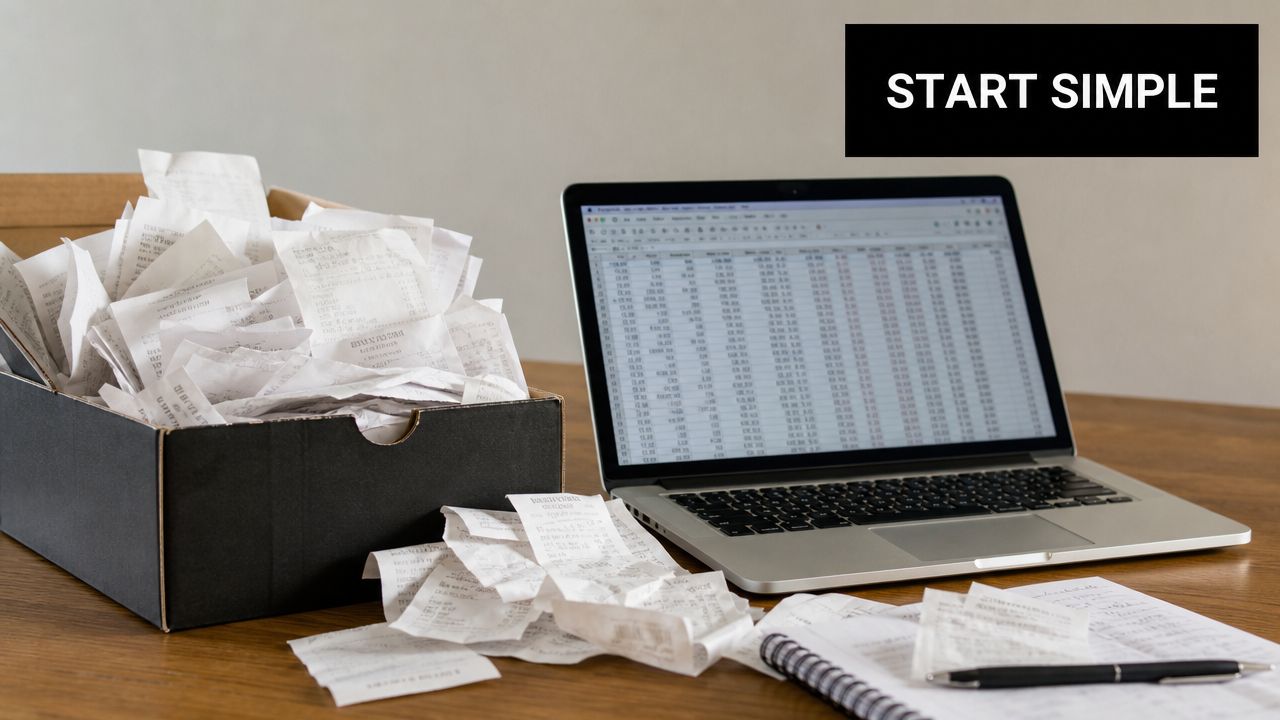
Here's the part new owners miss. Free bookkeeping tools save money only if your records stay accurate enough to support your tax return, explain your cash flow, and hold up when questions come up. If they don't, the savings disappear fast. You pay in missed deductions, late nights, amended filings, penalties, and cleanup bills for a professional to sort out six months of bad categories.
Cheap is not the target. Clean records are.
Practical rule: If you cannot explain where your money came from, where it went, and what you still owe, your bookkeeping system is failing.
A simple setup can work well at the beginning. Keep all transactions in one system. Use a basic chart of accounts that matches how your business earns and spends money. Follow one routine every week instead of “catching up” whenever panic hits. If you want outside reading, Toolradar has useful advice on small business bookkeeping for founders. If you use QuickBooks, this guide to setting up a chart of accounts in QuickBooks covers one of the least exciting tasks that prevents a lot of expensive mistakes.
Start with four priorities.
- Separation: Keep business activity out of personal accounts and cards.
- Traceability: Save receipts, invoices, and notes for anything that would look questionable to an outsider.
- Consistency: Record and categorize transactions on a fixed schedule.
- Review: Check your reports often enough to catch errors before they hit payroll, taxes, or cash flow.
Free tools are fine as a bridge. They are a bad hiding place. If the system cannot keep you compliant and show you a believable profit number, it is time to tighten it up or get help.
The Minimum Viable Bookkeeping Workflow
You don't need a finance degree to keep decent books. You need a routine. The process matters more than the app.
A practical workflow for small business bookkeeping starts with a dedicated business bank account, then choosing cash or accrual accounting, recording every transaction with the date, amount, and purpose, categorizing transactions into a chart of accounts, and reconciling accounts on a regular schedule. Major guides recommend weekly categorization and at least monthly reconciliation because it catches duplicated or missing entries before they distort financial statements and tax reporting, as outlined in Pilot's guide to bookkeeping basics for small businesses.
Start with the non-negotiables
If you're still swiping the same debit card for groceries and printer ink, stop. Open a dedicated business bank account. That one step makes every other bookkeeping task easier.
Then choose your accounting method:
Cash method
You record income when money hits the account and expenses when money leaves. Simple. Good for many very small businesses.Accrual method
You record income when earned and expenses when incurred. That gives a truer picture when invoices, bills, or project timing matter.
If you're not sure which method fits, that's one of the first places an accountant earns their keep. Picking casually can create cleanup later.
The weekly and monthly rhythm
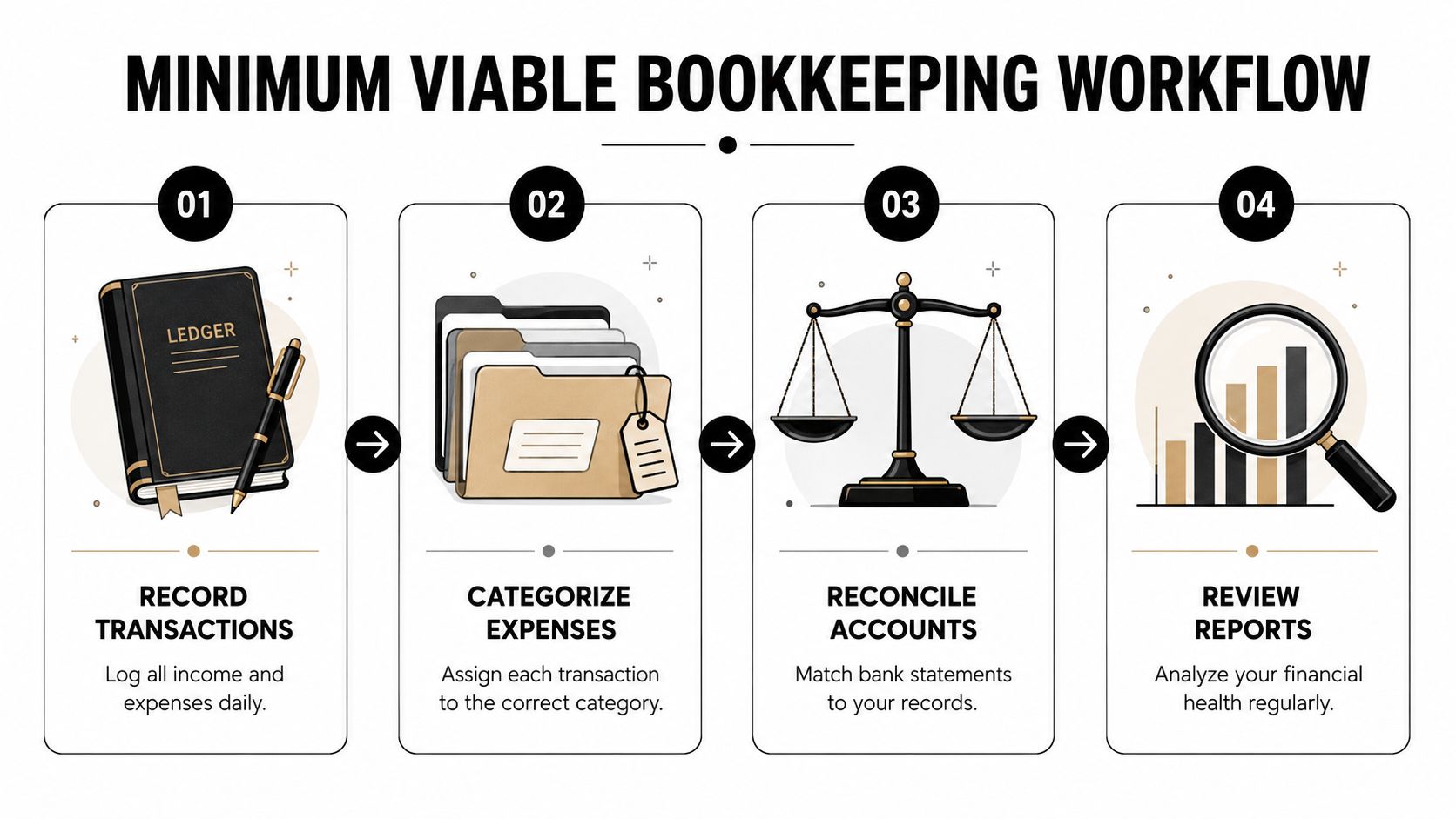
This is the minimum viable workflow I'd tell any owner to follow over coffee.
- Record every transaction: Enter income and expenses with enough detail that future-you knows what happened.
- Categorize weekly: Don't wait until quarter-end and try to remember whether that charge was software, supplies, meals, or subcontract labor.
- Reconcile monthly: Match your books to the bank and credit card statements.
- Review the reports: Look at your income statement, balance sheet, and cash flow with a skeptical eye.
That last point matters. Bookkeeping isn't just typing numbers into boxes. It should produce reports you can use.
If your monthly reports surprise you, your bookkeeping is late, wrong, or both.
For invoicing, use a tool that reduces manual chasing and keeps records organized. If your current setup is weak there, take a look at Chronoid's invoicing capabilities, especially if you want a cleaner billing trail without building your own process from scratch.
A lot of owners also need someone to keep the daily routine from slipping. That's where a service model can help. If you want to see what managed support looks like in practice, this overview of bookkeeping by day shows the type of recurring work that keeps books current instead of perpetually “almost done.”
Here's a simple gut check:
| Task | Frequency | Why it matters |
|---|---|---|
| Record income and expenses | Ongoing | Prevents forgotten transactions |
| Categorize activity | Weekly | Stops backlog and bad guesses |
| Reconcile bank and cards | Monthly | Catches missing or duplicate items |
| Review core reports | Monthly | Helps you spot profit and cash issues |
Before you move on, watch this. It's a good visual primer for owners who learn faster by seeing the workflow in action.
Choosing Your Free Bookkeeping Toolkit
Once your process exists, then you pick the tool. Not the other way around.
Most owners land in one of two camps. They either use a spreadsheet because it's familiar, or they use free accounting software because they want bank feeds, invoices, and basic reports without paying monthly right away. Both can work. Neither is magic.
Free accounting products have become a real entry point for small businesses. The U.S. Chamber of Commerce notes that free tools can include accounts receivable, invoicing, expense tracking, and bank reconciliation. It also notes that providers like Wave offer a “start for free” model, and that Xero says cloud-based bookkeeping can reduce manual errors by up to 90% through automation and bank syncing, as covered in the U.S. Chamber of Commerce guide to free accounting tools.
Spreadsheet versus free software
Spreadsheets are flexible. They're also fragile. One broken formula, one hidden row, one accidental overwrite, and your “books” turn into fiction.
Free software is usually better for owners who want structure. It forces categories, stores transactions in one place, and makes reconciliation less painful. But free tiers are still limited. Support can be thin. Payroll, advanced reporting, and industry-specific features often sit behind a paywall.
| Feature | Spreadsheet (DIY) | Free Software (e.g., Wave) |
|---|---|---|
| Setup | Fast if you keep it simple | Usually quick with guided setup |
| Data entry | Manual | Often partly automated |
| Error risk | High if formulas or tabs break | Lower for routine tasks |
| Invoicing | Manual templates | Usually built in |
| Bank reconciliation | Manual matching | Often included |
| Reporting | Basic, depends on your skill | Standard reports included |
| Scalability | Weak once volume grows | Better, but limited at higher complexity |
My blunt recommendation
Use a spreadsheet only if your business is tiny, your transactions are few, and you're disciplined enough to maintain it weekly. Otherwise, start with software.
Here's the catch. Software won't fix bad habits. If you dump transactions into Wave, Zoho Books, or another tool and never reconcile them, you still don't know your numbers. You've just outsourced the chaos to a cleaner interface.
For owners comparing systems beyond the free tier, this roundup of small business accounting tools is useful because it helps you think in terms of fit, not just price tag.
When free is fine
Free bookkeeping tools are perfectly reasonable when:
- Your transaction count is low: You can review everything without guessing.
- Your revenue model is simple: One or two service lines, no inventory, no complicated billing.
- You don't have payroll yet: Payroll complexity changes the game fast.
- You're using free as a temporary bridge: You already know you'll upgrade when the business grows.
That last one matters most. The right mindset is, “This works for now.” Not, “I hope this works forever.”
Common Pitfalls That Make Free Bookkeeping Costly
The danger isn't that DIY bookkeeping takes time. The danger is that it gives owners false confidence.
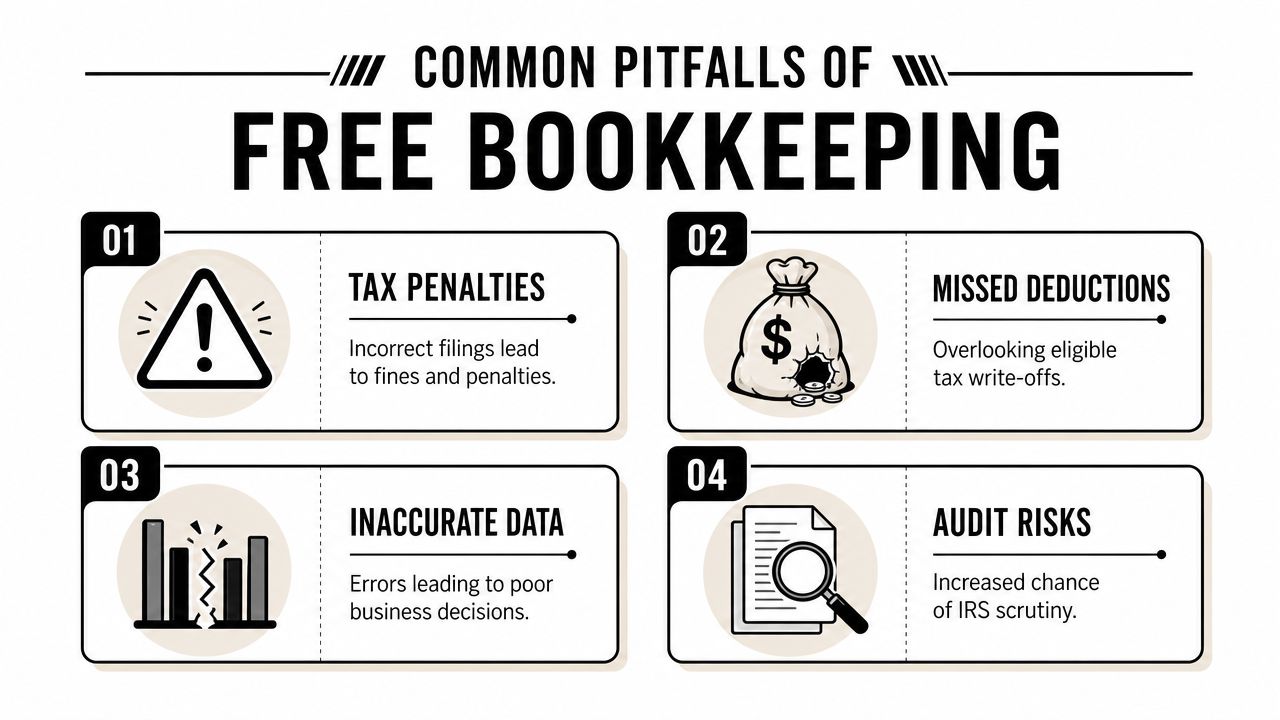
A messy set of books can still look organized on the surface. The categories seem reasonable. The bank balance roughly matches what you expected. Then tax time arrives, or a lender asks for statements, or payroll gets added, and the cracks show. That's when “free” starts billing you in penalties, missed deductions, and cleanup fees.
A monthly reconciliation cadence is the minimum benchmark recommended by major bookkeeping guides, and your reporting stack should end with a balance sheet, income statement, and cash flow statement. If you also handle inventory or payroll, monthly routines need to expand to include inventory updates, bad-debt write-offs, and payroll and tax-related records, because those areas commonly trigger misclassification and year-end cleanup, as explained in Wave's guide to small business bookkeeping.
The mistakes I see over and over
Some bookkeeping errors are common because owners are careless. Most happen because owners are busy.
Mixing personal and business spending
This muddies deductions, distorts profit, and makes every review slower.Misclassifying transactions
Meals aren't office supplies. Loan payments aren't pure expense. Owner draws aren't payroll. These distinctions matter.Skipping reconciliations
If you don't reconcile, you won't catch duplicates, missing entries, or bank errors promptly.Ignoring tax changes and filing requirements
Tax rules don't stand still. Filing thresholds, deadlines, payroll requirements, sales tax obligations, and documentation rules can shift. If no one is watching, you find out after the damage is done.
Clean books don't just help at tax time. They help before tax time, when there's still time to fix something.
Why this becomes a compliance issue
Owners often treat bookkeeping like admin work. It isn't. It's part of your control system.
If your payroll entries are wrong, your tax filings can be wrong. If your sales tax records are incomplete, you can underpay or overpay. If your income is posted to the wrong period, your financial statements stop being trustworthy. Then you make real business decisions off fake numbers. Hire too early. Spend too aggressively. Price too low.
That's why I'm opinionated here. If you've got employees, inventory, financing, or multiple revenue streams, free bookkeeping without oversight is a gamble.
Hidden costs nobody mentions
The software may be free. These aren't:
- Owner time: Hours spent guessing at old transactions.
- Cleanup work: Fixing months of errors all at once.
- Lost opportunities: Bad books can slow loans, investors, and major contracts.
- Stress: The kind that shows up every quarter and ruins a weekend.
The line between bookkeeping and business accounting matters here. Bookkeeping records history. Accounting interprets it. If nobody is helping you read the story, you're flying half blind.
Why Free Tools Fail Specialized Industries
Generic tools are fine for generic businesses. Once you step into a specialized industry, the wheels come off quickly.
A solo consultant with simple billing can often survive with a bare-bones setup for a while. A construction company can't. A medical practice shouldn't. A nonprofit that needs clean board reporting and grant tracking definitely can't.
Construction needs job costing, not just categories
Construction owners often think basic expense categories are enough. They aren't. You need to know whether each job is making money.
Free bookkeeping tools usually let you code transactions to broad buckets like materials, labor, rent, or fuel. That's not the same as job costing. If you can't tie labor, subcontractors, equipment, and materials to specific projects, you can't see which jobs are profitable and which ones are eating your margin.
Then payroll enters the picture. Certified payroll, subcontractor tracking, retention, progress billing, and change orders all create bookkeeping demands that generic free systems usually handle poorly or not at all.
A contractor can look busy, booked out, and still lose money job by job.
Healthcare needs clean records and careful coordination
Healthcare practices have a different problem. They live at the intersection of billing, payroll, compliance, and operational complexity.
A free tool may track bank transactions. Great. That still doesn't solve provider compensation issues, insurance payment timing, billing adjustments, or the need to keep the accounting side aligned with practice operations. If the bookkeeping system doesn't reflect how money moves through the practice, the reports become misleading fast.
Nonprofits need fund accounting discipline
Nonprofits aren't just small businesses with a mission statement. Their books need to distinguish between different funding uses, restrictions, and reporting obligations.
A generic setup may tell you cash balance and total expense. That's not enough when leadership needs to show how funds were used, what remains available, and whether restricted money stayed where it was supposed to stay. That requires a more specialized accounting structure and someone who understands nonprofit reporting logic.
Why industry knowledge matters
Specialized accounting earns its fee, not because the debits and credits are exotic, but because the business reality is.
For businesses in Northeast Florida that need more than generic software, one option is Bookkeeping and Accounting of Florida Inc., which provides bookkeeping, tax, payroll, audits, and fractional CFO support for industries including healthcare, construction, retail, and nonprofits. That's the kind of setup that makes sense when your business has rules and reporting needs a free tool was never built to handle.
When to Graduate and Hire a Professional
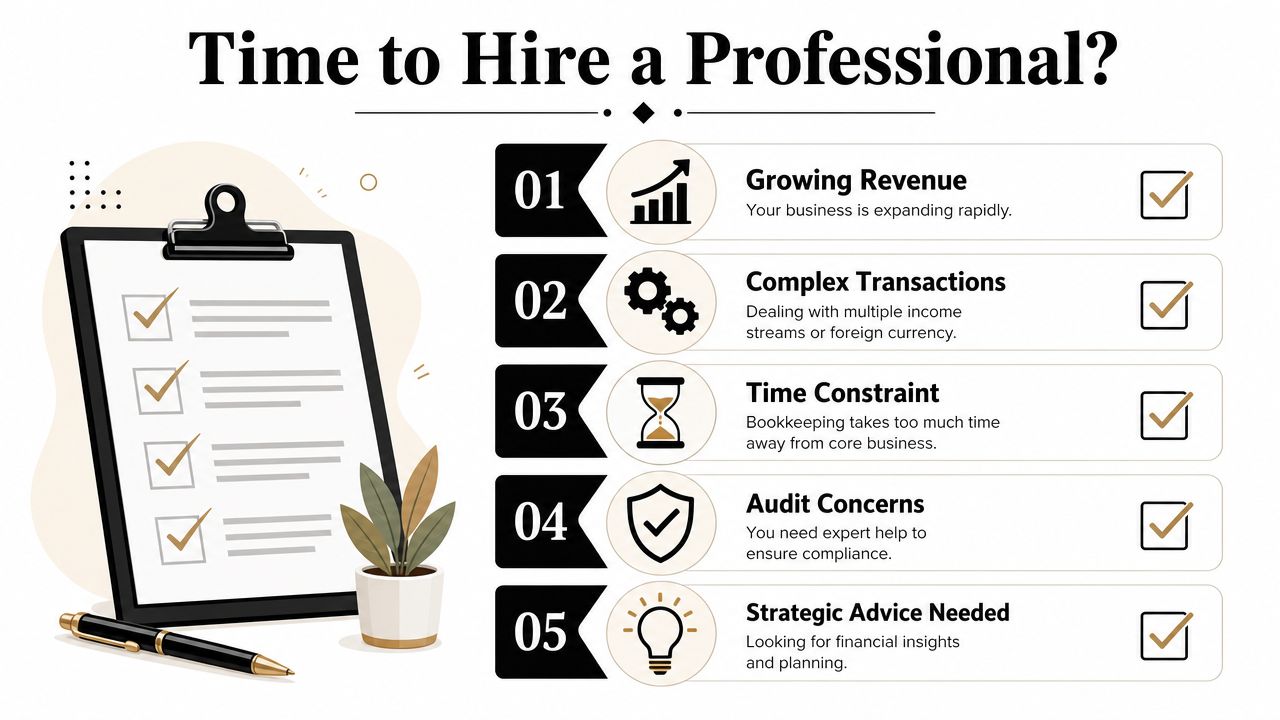
You start with a free spreadsheet, a bank feed, and good intentions. Six months later, payroll is due, sales tax is creeping up, a lender wants financials, and you are staring at numbers you do not trust. That is usually the moment free bookkeeping stops being free.
A basic system is fine while the business is simple. It becomes expensive the minute bad records start affecting taxes, payroll, cash flow, or financing. As noted earlier, many owners start out without much financial training. That is exactly why DIY bookkeeping should be a short-term bridge, not a long-term plan.
The signs are usually obvious
You have outgrown free bookkeeping if the books are slowing decisions or creating compliance risk.
- You are hiring people. Payroll tax filings, worker classification, reimbursements, and year-end forms leave plenty of room for mistakes.
- You need financing. Banks want clean profit and loss statements, balance sheets, and consistent records. They do not lend against guesswork.
- Revenue is climbing. Small coding mistakes turn into real money fast when volume goes up.
- You do not trust the numbers. If you hesitate before using your own reports, the system is already failing.
- Bookkeeping keeps eating owner time. Your job is to run the business, not spend Friday night fixing uncategorized transactions.
What professional help should actually do
A bookkeeper should keep records current and reconciled. An accountant should make sure those records hold up for taxes, reporting, and year-end cleanup. A fractional CFO should help you use those numbers to make decisions before a problem gets expensive.
That means more than posting transactions. You need someone who can catch margin problems, spot payroll creep, clean up balance sheet messes, and tell you whether your cash flow can support the next hire, location, or equipment purchase.
Hiring help is not an admission of failure. It is what adults do when the cost of being wrong gets higher than the cost of support.
If payroll is part of what is pushing you past DIY, take time to compare payroll solutions for small businesses before you bolt one onto a bookkeeping setup that is already straining.
My recommendation
Use free tools to build habits, not to run a growing company indefinitely.
Move to professional accounting when any of these become true:
| Trigger | Why it matters |
|---|---|
| Employees or contractors | Payroll filings, classification, and recordkeeping get harder fast |
| Multiple revenue streams | Reporting needs structure, not loose categories |
| Loan or investor prep | Financial statements need to be clean and consistent |
| Industry-specific requirements | Generic setups miss reporting and compliance details |
| Planning for growth | You need analysis and oversight, not just data entry |
A full-time CFO is overkill for many small businesses. Regular accounting support and fractional CFO services often hit the sweet spot. You get clean books, better decisions, and someone watching for compliance problems before they turn into penalties.
Free tools help you get started. Professional support helps you stay compliant, protect cash, and make decisions with numbers that mean something.
If your books are behind, messy, or too important to leave on autopilot, Bookkeeping and Accounting of Florida Inc. can help you get organized, stay compliant, and move beyond basic bookkeeping into reliable reporting, tax support, payroll coordination, and fractional CFO guidance. That is the difference between recording transactions and running the business with clear numbers.