

You searched ecommerce accountant near me because something feels off. Sales are coming in, money is moving, orders are shipping, and yet your books still look like a crime scene. Shopify says one thing. Amazon says another. Your bank account says something else entirely. Then your tax preparer asks for “clean numbers,” and suddenly everyone gets quiet.
I've seen this all over Jacksonville and Northeast Florida. A business starts online with a simple setup, then grows into a mess of marketplaces, payment processors, inventory headaches, sales tax exposure, and reporting nobody trusts. The owner isn't lazy. The owner is busy. There's a difference.
Most small business owners also don't know what compliance requires until a notice shows up or cash gets tight. That's normal. It's also expensive. If you run an ecommerce business, you need more than basic bookkeeping. You need clean accounting, tax guidance, and someone who can tell you what the numbers mean before they bite you.
Why Accountant Near Me Is the Wrong Search for Ecommerce
“Near me” sounds smart. For a plumber, sure. For a lunch spot, absolutely. For an ecommerce accountant, it's incomplete.
A local office in Jacksonville is nice. What matters more is whether that accountant understands how online businesses operate. If they don't know how Shopify payouts hit the bank, how Amazon fees distort revenue, how inventory affects margin, or how multi-state tax obligations creep up on you, their office being ten minutes away won't save you.

The scale of online retail tells you why specialization matters. The U.S. Census Bureau estimated first-quarter 2026 retail e-commerce sales at $326.7 billion, with e-commerce representing roughly 16.9% of total retail sales for that quarter, based on the same Census figures. That's a huge slice of commerce, and it's why so many firms now pitch ecommerce-specific bookkeeping, tax, and compliance services to sellers who need help with digital sales channels and related obligations, according to the U.S. Census Bureau retail e-commerce data.
What goes wrong with a generalist
Here's the pattern. A Jacksonville seller starts with QuickBooks Online, a basic bookkeeper, and a year-end tax return. Then they add Amazon, Walmart, POS sales, Stripe, maybe PayPal, maybe a 3PL, maybe wholesale on the side. Nobody reconciles the channels correctly. Inventory gets posted inconsistently. Sales tax gets treated like an afterthought.
That's when “my accountant is nearby” stops being useful.
Practical rule: If your accountant can't explain your payout reconciliation process in plain English, you don't have an ecommerce accountant. You have a tax preparer with a website.
A real ecommerce specialist doesn't just enter transactions. They help you understand margin, cash flow, and what each sales channel is doing to your business. If you're trying to get serious about achieving e-commerce profitability, you need financials built for decision-making, not just survival through tax season.
Jacksonville businesses need both local context and ecommerce depth
Northeast Florida businesses have the same ecommerce complexity as sellers anywhere else, but they also need an advisor who understands the regional business environment, local growth patterns, and how fast a small operation can turn into a multi-state compliance problem. That combination matters.
So yes, search locally if you want responsive service and a real relationship. Just don't stop at proximity. For ecommerce, specialty beats geography every time.
The Must-Have Skills for Your Ecommerce Accountant
Most firms that say they handle ecommerce mean they'll take your QuickBooks file and try not to ask too many questions. That's not enough. You need someone who can deal with the ugly parts of online retail without blinking.
Sales tax and compliance knowledge
Ecommerce creates tax obligations that don't care whether you meant to create them. If you sell across states, your accountant needs to understand nexus, registration, filings, and how automation tools fit into the process. If they shrug and say, “your software probably handles that,” keep walking.
If you want a plain-English primer on this area, navigating 2026 internet sales tax is a useful read before you talk to any firm. It'll help you ask better questions and spot vague answers faster.
Multi-channel reconciliation skills
In these critical tasks, amateurs often struggle. Your accountant needs to reconcile:
- Marketplace payouts: Amazon and Shopify don't deposit clean, simple revenue numbers. Fees, reserves, refunds, and timing differences all need to be sorted properly.
- Payment processors: Stripe, PayPal, and POS systems each have their own reporting quirks.
- Bank deposits: Deposits must match actual platform activity, not guesses pulled from summaries.
A solid process starts with consolidating sales, fees, inventory, and tax data into one accounting system, then reconciling payout reports to bank deposits, classifying marketplace fees and commissions, and only after that looking at margin and cash flow. That sequence matters because ecommerce books become unreliable fast when the data isn't normalized first, as outlined in this ecommerce accounting hiring and workflow guide.
Inventory and COGS competence
If your accountant doesn't understand inventory, they can't tell you whether you're making money. They can only tell you whether money moved.
One benchmark matters here. Ecommerce accounting specialists note that COGS above about 60% can leave too little margin to fund the business, and a financial literacy survey cited by the same expert source found 42% of small business owners started with limited or no financial literacy, which helps explain why so many owners miss margin and cash-flow problems until they hurt, according to this expert discussion on ecommerce accounting benchmarks.
High sales with weak margin is not a win. It's just a faster way to run out of cash.
Your accountant should also be able to explain inventory tracking clearly. If you need a practical reference point, this guide on how to track inventory for small business covers the basic discipline every seller needs.
Platform fluency and reporting discipline
Ask what they've worked with. You want someone comfortable with Shopify, Amazon Seller Central, Stripe, PayPal, QuickBooks Online, and ecommerce connectors. You also want reporting that goes beyond “here's your P&L.”
Look for this short checklist:
| What they should handle | Why it matters |
|---|---|
| Platform integrations | Reduces manual entry and bad data |
| Fee mapping | Shows true net revenue by channel |
| Inventory accounting | Keeps gross margin honest |
| Regular reconciliations | Prevents cleanup disasters |
| Decision-ready reports | Helps you act before problems grow |
If they can't show how they turn channel chaos into usable financials, they're not ready for an ecommerce business.
Finding Your Jacksonville Ecommerce Accounting Partner
Jacksonville business owners usually start the same way. They type ecommerce accountant near me, scan a map pack, and call the first firm with “tax” and “bookkeeping” on the homepage. That's efficient. It's also how people hire the wrong accountant.
The gap is simple. Many local firms market generic services, while ecommerce sellers need help with sales-tax nexus, inventory tracking, and multi-channel reconciliation. That difference is called out clearly in this discussion of ecommerce accounting versus general accounting firms. The local angle matters, but the workflow expertise matters more.
Where to look in Northeast Florida
Start local, but screen hard.
- Ask other ecommerce owners: Not your cousin with a service business. Ask someone who sells on Shopify, Amazon, Walmart, Etsy, or a mix.
- Check local business circles: Jacksonville networking groups, trade groups, and owner communities can point you to firms people use.
- Review the firm's website carefully: If the site only says bookkeeping, payroll, and tax prep, that tells you plenty.
A credible ecommerce accounting firm should talk specifically about platforms, inventory, sales tax, reconciliation, and reporting. If all the language sounds like it was written for any business with a checking account, move on.
What to inspect before you call
Pull up the website and look for proof of thought. Not fluff. Thought.
Use this filter:
- Industry language: Do they mention Amazon, Shopify, Stripe, fees, inventory, or marketplace reconciliation?
- Service depth: Do they discuss compliance, reporting, and advisory work, not just year-end taxes?
- Educational content: Are they writing about real ecommerce problems, or just repeating “we help small businesses” ten different ways?
- Clear next step: Can you easily schedule a call and explain your setup?
A practical starting point is this guide on how to find a good accountant. It helps narrow the field before you waste an afternoon on discovery calls with people who don't understand your business model.
If a firm can't show ecommerce competence before the first meeting, don't expect a miracle during the first meeting.
The Jacksonville angle that actually matters
A Jacksonville partner should understand local businesses, be accessible, and know Florida operations. Fine. But if your sales channels and tax footprint spread beyond Florida, you need someone who can handle that complexity without turning every question into a research project.
That's the standard. Not “close by.” Competent.
The Vetting Process Questions to Ask Before You Hire
Don't ask an ecommerce accountant whether they “work with online businesses.” Every firm says yes. Ask questions that force specifics. Generalists hate specifics.
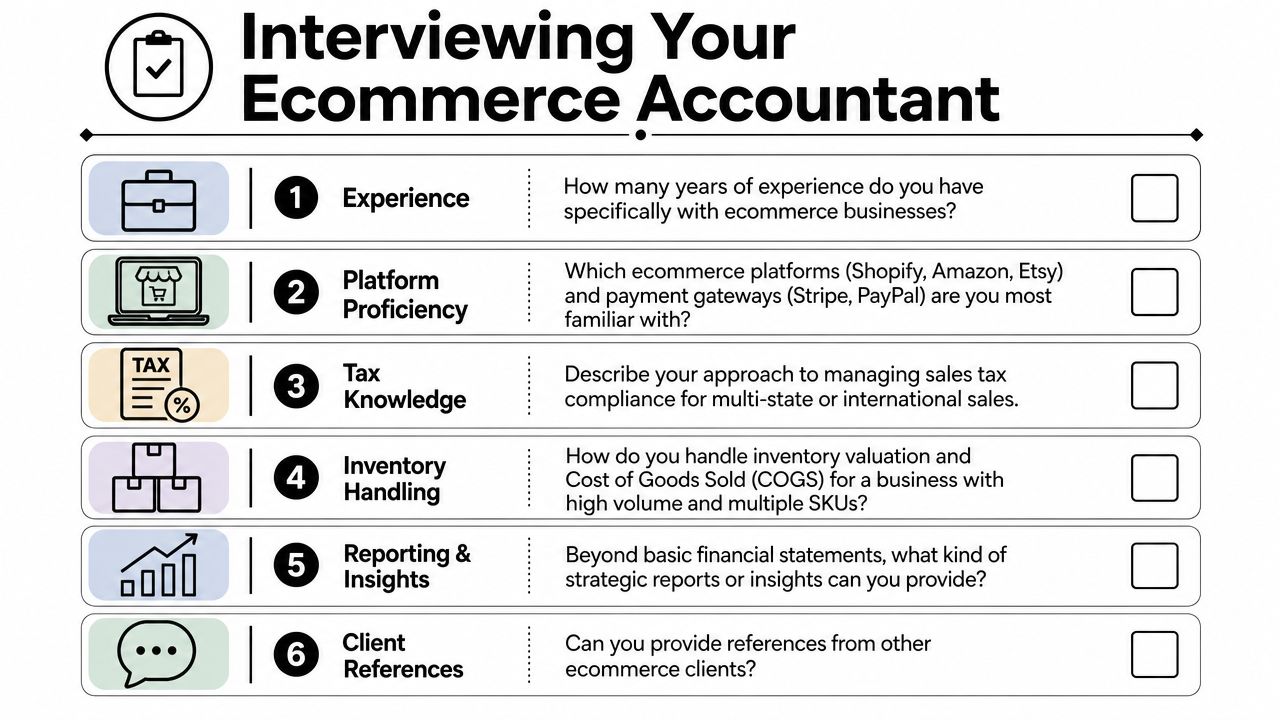
A structured hiring process matters here. Ecommerce accounting guides recommend checking whether the accountant has experience with comparable businesses and platforms, and they advise clients to have at least quarterly strategic meetings, reflecting how this work has shifted from basic record-keeping to specialized advisory support, as noted in A2X's guide to finding an ecommerce accountant.
Questions that expose weak answers
Ask these in the first conversation:
Which ecommerce platforms do you support regularly?
If they can't speak comfortably about Shopify, Amazon, Walmart Marketplace, POS systems, and payment processors, you've learned something useful.How do you reconcile payouts to bank deposits?
Not “do you reconcile.” How. The answer should include fees, reserves, refunds, timing, and clearing differences.How do you handle inventory and COGS?
Listen for whether they understand valuation, timing, and how inventory affects profitability.What's your process for sales tax compliance across states?
You want a workflow, not hand waving.What reports will I receive besides basic financial statements?
If all they offer is a P&L and balance sheet with no interpretation, that's bookkeeping, not guidance.How often do we meet?
Quarterly is the bare minimum for strategy. Monthly is often better when a business is changing fast.
What a solid answer sounds like
A strong firm answers directly, asks follow-up questions, and ties the answer back to your specific setup. A weak firm speaks in slogans.
Here's a quick comparison:
| Question | Weak answer | Strong answer |
|---|---|---|
| Platform experience | “We work with many businesses.” | “We handle specific ecommerce stacks and understand the reporting flow.” |
| Reconciliation | “QuickBooks does that.” | “We match platform activity, fees, and deposits to actual bank movement.” |
| Inventory | “We'll review that at year-end.” | “We track it routinely because margin depends on it.” |
| Meetings | “Reach out if needed.” | “We schedule regular reviews and come prepared.” |
A good accountant answers your question. A real ecommerce accountant also tells you what question you forgot to ask.
Ask about fit, not just competence
You're not hiring a magician. You're hiring a financial partner. Ask how they communicate, what information they need from you, how they handle cleanup, and who you'll work with after the sale call ends.
For Jacksonville businesses, this is where practical chemistry matters. If they're slow, vague, or allergic to detail in the first conversation, they won't get more organized after you sign engagement papers. People rarely improve under pressure.
Onboarding Your Accountant and Setting Up for Success
Once you hire an ecommerce accountant, don't dump a shoebox of passwords and hope for enlightenment. A good onboarding process is organized, controlled, and boring. Boring is good in accounting.
The first priority is access. Your accountant needs visibility into the systems that drive your business, not just the bank account at the end of the trail.
What to provide right away
Bring order to day one with a clean handoff:
- Accounting access: QuickBooks Online or your current accounting platform
- Sales channel access: Shopify, Amazon Seller Central, Walmart, Etsy, POS, or whatever you use
- Payment systems: Stripe, PayPal, merchant processors
- Banking and credit cards: Read-only access is usually enough to start
- Tax records: Prior returns, notices, prior sales tax filings, and entity documents
- Inventory information: SKU data, valuation method, and how you currently track stock
- Payroll details: If you have payroll, include provider access and filings
If your records are messy, say so. Cleanup is common. The problem isn't the mess. The problem is pretending there isn't one.
Set the operating rhythm early
You also need a communication cadence. Otherwise, the relationship becomes reactive and tax season becomes a blood sport.
A good onboarding plan usually includes:
- Kickoff meeting: Review your business model, channels, goals, and immediate risks
- Scope confirmation: Clarify what's included, what's not, and who handles what
- Close schedule: Agree on when books are reconciled and reports are delivered
- Review meetings: Monthly or quarterly, depending on complexity and growth
- Escalation path: Decide what happens when a notice arrives, cash tightens, or a system breaks
Clean books don't happen because software exists. They happen because someone owns the process every month.
The first ninety days should produce clarity
By the end of the initial onboarding period, you should know whether revenue is being recorded properly, whether payouts reconcile, whether inventory treatment makes sense, and whether your tax and compliance obligations are under control. You should also understand what information you'll get regularly and how to use it.
If none of that becomes clearer after onboarding, you didn't hire a specialist. You hired a monthly expense.
Beyond Bookkeeping The Case for a Fractional CFO
Bookkeeping keeps score. A fractional CFO helps you call better plays.
That distinction matters. Clean books are table stakes. Compliance is table stakes. Tax filings are table stakes. If you want to grow an ecommerce business without guessing, you need someone who can interpret the numbers, pressure-test decisions, and tell you when your plan is about to hit a wall.

Ecommerce-focused firms are moving in this direction for a reason. The more important issue isn't proximity. It's compliance readiness and growth-stage reporting. The trend is shifting from basic bookkeeping to outsourced CFO and advisory support, with firms bundling cash-flow reporting, tax planning, and exit-ready financials for modern sellers, as described by The Ecommerce Accountants.
What a fractional CFO actually does
A real fractional CFO helps you make decisions before the quarter is over. Not after.
That can include:
- Cash flow planning: So you know whether inventory purchases, ad spend, or hiring decisions are realistic
- Margin analysis: So you stop chasing revenue that doesn't produce usable profit
- Tax planning: Especially when tax law changes affect entity structure, deductions, payroll decisions, or state compliance
- Growth planning: New product launches, financing prep, lender reporting, and operational cleanup
- Exit readiness: Financials that make sense to buyers, lenders, and investors
If you run promotions late in the year, you also need someone who can connect campaign activity to financial consequences. Operational tools can help with review and dispute workflows too. For businesses tightening up peak-season performance, Disputely's Q4 campaign audit is a useful example of the kind of operational review that can sit alongside stronger financial oversight.
Why Jacksonville ecommerce businesses should care
Northeast Florida owners are used to doing a lot themselves. That's admirable right up until it becomes expensive. Most businesses don't need a full-time CFO. They do need senior financial guidance. That's where fractional support earns its keep.
One local option in this category is fractional CFO services from Bookkeeping and Accounting of Florida Inc., alongside its bookkeeping, tax, payroll, and accounting work. The point isn't to add fancy titles. The point is to give growing companies regular financial guidance without carrying full-time executive overhead.
The best ecommerce accountant near me might be in Jacksonville. It might be remote. That part is secondary. The key question is whether that person can keep you compliant, explain your numbers, and help you steer the business with some judgment instead of wishful thinking.
If they can't do that, they're doing data entry with a nicer invoice.
If your ecommerce business needs clean books, tax compliance, better reporting, and practical financial guidance, talk to Bookkeeping and Accounting of Florida Inc.. We help Jacksonville and Northeast Florida businesses get organized, stay compliant, and make decisions with numbers they can trust.