
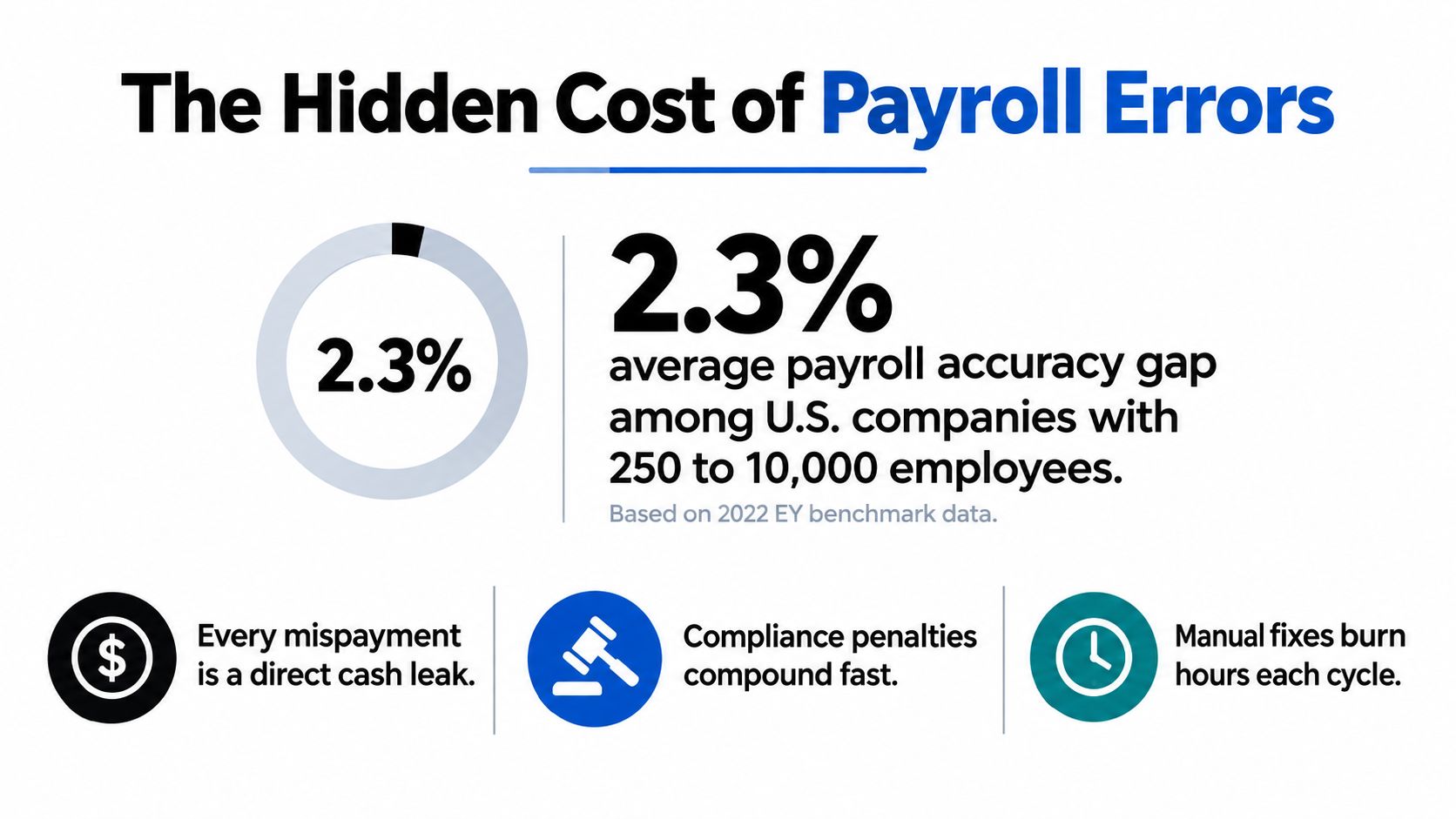
About 80% of payrolls run completely error-free for U.S. companies with 250 to 10,000 employees, according to a 2022 EY benchmark cited by NetSuite's payroll reconciliation guidance. That means roughly one in five payrolls contains an error, and the commonly cited correction cost is $291 per payroll error.
Thank you for reading this post, don't forget to subscribe!If you own a small business in Jacksonville, that statistic shouldn't make you shrug because your team is smaller. It should make you take payroll reconciliation seriously. A wrong hourly rate, missed overtime entry, duplicate payment, or incorrect tax setup can drain cash, frustrate employees, and create a filing problem that nobody notices until the books are already closed.
Payroll reconciliation isn't a spreadsheet exercise performed when someone remembers it. It's a financial control that connects timekeeping, HR records, payroll processing, bank activity, accounting entries, and tax filings. Here's how to reconcile payroll properly, and why a fractional CFO or experienced accounting partner can keep the process under control as tax requirements change.
The Hidden Cost of Payroll Errors
The 2022 EY benchmark is blunt. Average payroll accuracy for U.S. companies with 250 to 10,000 employees was about 80%, and the benchmark is cited alongside an average $291 correction cost per payroll error in NetSuite's explanation of payroll reconciliation. For a business owner, that is a control problem, not an abstract statistic. Every pay run needs documented review before money leaves the bank.
A business with 1,000 employees paid biweekly could face roughly 24 errors per pay period at a 1.2% error rate, or about 624 corrections per year, based on the practical example in the cited payroll-industry summary. A smaller Jacksonville company will see fewer incidents, but the risk remains familiar: one employee receives too much overtime, another misses a bonus, a terminated worker stays active, or a benefit deduction continues after enrollment changes.
Payroll leakage rarely announces itself
The correction is only the visible symptom. An incorrect deduction can alter a tax liability, benefits payable balance, and general ledger entry at the same time. Without record-to-record review, the mistake can carry into later pay periods, complicate filings, and become harder to unwind.
Common reconciliation findings include:
- Overpayments and underpayments: Approved wages, hours, overtime, commissions, or bonuses do not match what the employee received.
- Duplicate payments: A repeated direct deposit or manual check increases cash disbursements.
- Incorrect rates: The payroll salary or hourly rate differs from the approved employee record.
- Time-record problems: Missing or inaccurate hours distort gross pay and overtime.
- Benefits mismatches: Payroll deductions do not match current enrollment records.
- Inactive employees: A terminated employee remains on payroll.
- Tax errors: Withholding amounts disagree with the payroll register or filing records.
One payroll administrator and an aging spreadsheet create a control weakness, even when the administrator is trustworthy. Separate employee-record changes, pay-change approval, and payment release. An independent reviewer should confirm the final payroll.
Practical rule: Reconcile every pay cycle, investigate exceptions before the books close, and document who reviewed each result.
Payroll errors also weaken employee confidence. Survey data cited by HiBob's payroll accuracy research reports that 44% of employees noticed a payroll error at some point, while 42% said errors happen frequently. Reported problem areas include overtime, hours worked, pay rate, bonuses or commissions, and tax deductions. Employees do not view payroll as an accounting detail. They view it as proof that the company paid them correctly.
That control matters even more as 2026 tax-law changes create new filing and withholding risks. Payroll reconciliation must verify the underlying records before those changes reach returns or employee forms. A fractional CFO gives the owner an independent review, connects payroll controls to tax compliance, and helps decide when a discrepancy requires correction, documentation, or professional guidance.
The Four-Pass Reconciliation Workflow
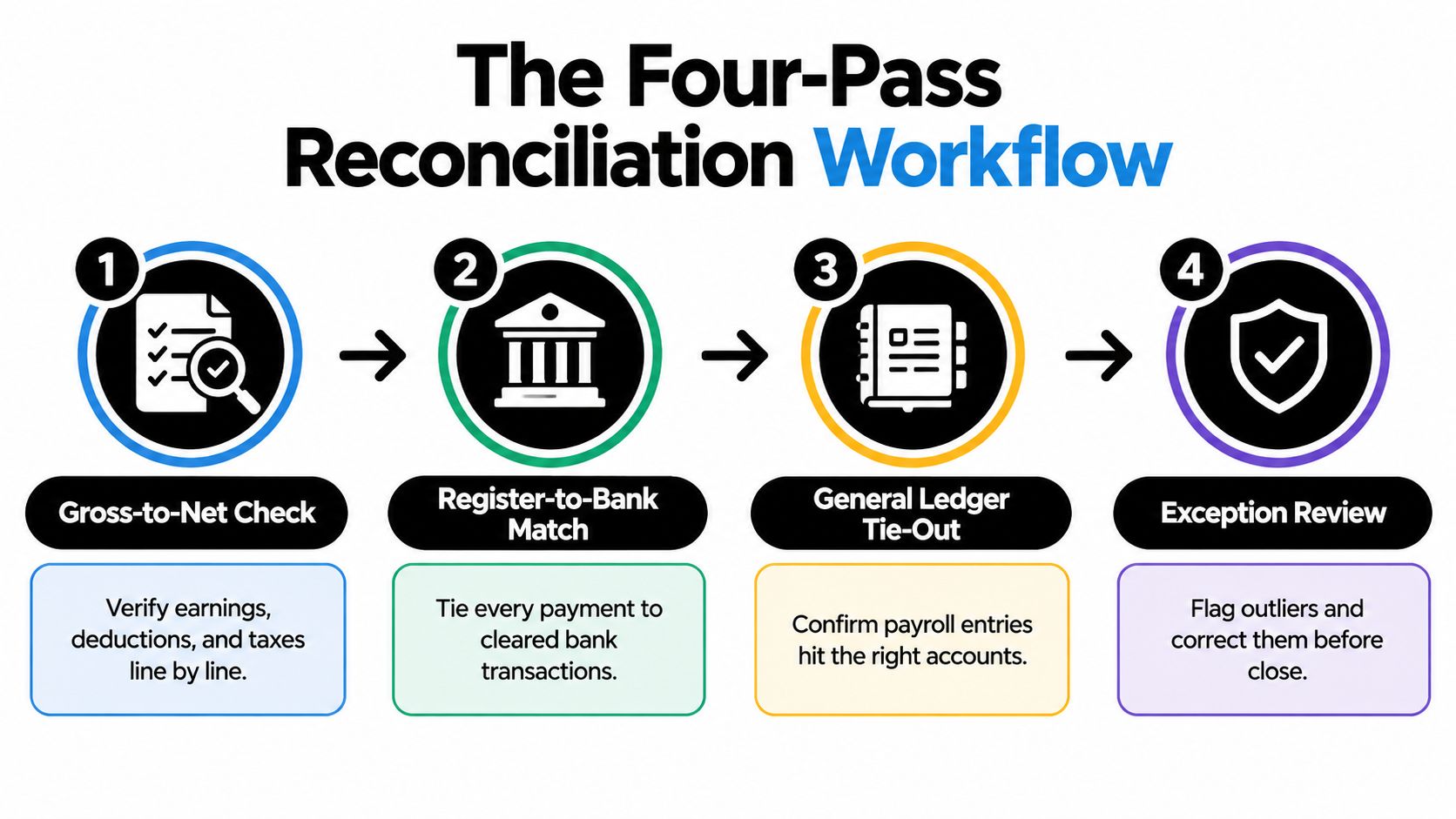
A clean payroll close follows four passes, in order: gross-to-net, payroll-to-general-ledger, payroll-to-bank, and payroll-to-tax-filing. Kurums' payroll reconciliation and controls guide identifies this sequence as a practical way to verify wages, deductions, liabilities, cash disbursements, and remittances.
Start with source records, not the bank statement. The bank can confirm what left the account, but it can't tell you whether an employee's overtime was approved or whether a benefit deduction matches enrollment.
Pass one, gross to net
Pull the payroll register, approved timesheets, employee change log, compensation approvals, bonus or commission support, and benefits enrollment report. Compare each employee's earnings and deductions to the source records.
Check:
- Base salary or hourly rate.
- Regular hours and overtime.
- Bonuses, commissions, allowances, and retroactive adjustments.
- Federal, state, and local withholding.
- Benefits, retirement, garnishments, and other deductions.
- Net pay.
Review unusual variances rather than accepting the payroll system's calculation without question. A sharp change may be legitimate, but it needs a documented explanation before approval.
Pass two, payroll to the general ledger
Next, compare payroll totals to the accounting system. Tie gross wages, employer payroll taxes, benefits, payroll liabilities, and cash clearing accounts to the correct general ledger accounts, departments, locations, and cost centers.
This pass catches coding errors that won't appear in the payroll register. A construction company might post field payroll to the wrong job, while a medical practice might classify administrative wages as clinical labor. The total payroll can look correct while management reports and job profitability are wrong.
Use a dated reconciliation file that shows the payroll period, register totals, GL totals, differences, explanation, correcting entry, and reviewer approval. If payroll data flows into QuickBooks, review the posting rather than assuming the integration worked.
For broader bank-control procedures, use this guide to reconciling bank accounts alongside your payroll close.
Pass three, payroll to the bank
Match the net payroll total and each payment batch to cleared bank transactions. Look for duplicate payments, rejected deposits, outstanding checks, unexpected withdrawals, and bank charges recorded outside payroll.
Don't treat a total match as enough. A duplicated payment can be offset by another missing payment and still leave the aggregate amount appearing reasonable. Tie payment files to actual cleared activity, then document any timing difference that remains open.
Automation can help with repetitive matching. If your accounting process has high transaction volume, automate transaction matching where the rules are stable, while retaining human review for exceptions and employee-master-file changes.
Pass four, payroll to tax filing
Finally, compare payroll tax liabilities to deposits and filed returns. Tie federal withholding, Social Security, Medicare, unemployment taxes, and applicable state or local liabilities to the relevant tax records.
The IRS payroll records guidance says employers should reconcile payroll records before filing Forms W-2 and W-3 by comparing federal income tax withheld, Social Security wages, Medicare wages, and employee Social Security and Medicare taxes, then documenting valid differences. That review should happen before year-end forms go out, not after an employee challenges a wage figure.
Use the following video as a visual supplement to the reconciliation process:
Identifying and Correcting Common Discrepancies
A reconciliation is valuable only when your team resolves exceptions correctly. Finding a mismatch and just changing the next payroll can create a second error, especially when taxes, benefits, or prior-period filings are involved.
Start by classifying the discrepancy. Was the source data wrong, was payroll configured incorrectly, did the payment fail, or did accounting post the transaction to the wrong account? The answer determines whether you need a payroll correction, a journal entry, a bank adjustment, a tax amendment, or several coordinated fixes.
The errors that deserve immediate attention
The most common discrepancies include overpayments, underpayments, duplicate payments, incorrect salaries or hourly rates, missing or incorrect time records, and terminated employees still on payroll, as summarized by Teamed's payroll accuracy guide. Benefits deductions, incorrect tax withholding, missed new hires, and unapproved one-time payments also deserve review.
A useful investigation sequence is:
- Confirm the source: Check the approved time record, employee status, compensation change, benefit election, or payment authorization.
- Measure the impact: Determine the effect on gross wages, employee deductions, employer liabilities, cash, and financial statements.
- Correct the root record: Update HR, timekeeping, benefits, or payroll setup before processing an adjustment.
- Recalculate affected taxes: Don't assume the original withholding remains correct after changing wages.
- Record the accounting effect: Post the correction to the right payroll expense, liability, receivable, or cash account.
- Document approval: Keep the original report, revised calculation, reason for correction, and reviewer sign-off together.
Journal entries need to follow the facts
Suppose payroll recorded an employee's wages and paid cash, but the company later determines that the employee was overpaid. The accounting response depends on whether the excess remains recoverable from the employee and whether related taxes have already been remitted.
A simplified entry to record a recoverable overpayment may debit an employee receivable and credit cash when the business recovers the excess directly. If the correction affects payroll liabilities, the entry may instead debit or credit the applicable payroll liability accounts and adjust wage expense according to the payroll provider's corrected calculation. Don't force a generic entry into a situation involving tax deposits or amended filings.
For an underpayment, the company generally needs a correcting payroll run or supplemental payment supported by the revised wage calculation. Accounting then records the additional wage expense, related employer liabilities, employee withholdings, and cash disbursement. A duplicate payment requires confirmation that the bank transaction is genuinely duplicated before you reverse cash and establish the appropriate receivable or recovery entry.
Preserve the audit trail
Never delete the original payroll record to make the reconciliation appear clean. Retain the original register, exception report, approval, correction calculation, amended payroll output, journal entry, and proof of payment or recovery.
Owners often need an accounting professional in such cases. Payroll software can calculate a correction, but it won't necessarily decide whether the related tax return, benefits invoice, job-cost report, or management financial statement also needs adjustment.
2026 Tax Compliance and Filing Requirements
Payroll reconciliation for 2026 must use current federal settings, not last year's assumptions. The IRS Publication 15 guidance sets Social Security tax at 6.2% for the employer and 6.2% for the employee, with a $184,500 wage base. Medicare tax remains 1.45% for each side, with no wage base limit.
Put those figures in the reconciliation checklist. Match the payroll register to the tax liability report, then match that report to deposits and filed returns. The software may hold the right configuration, but your review must test employee wages, taxable benefits, year-to-date limits, and the resulting liabilities. A small setup error can become a filing problem when 2026 changes affect withholding or deposit requirements.
Deposit rules create hard checkpoints
The IRS does not assign every employer the same deposit schedule. Use this payroll tax deposit schedule to review how monthly and semiweekly status is determined. Under IRS deposit guidance, an employer with a Form 941 liability less than $2,500 for the current or preceding quarter may pay with a timely filed return instead of making deposits. Liabilities of $2,500 or more generally require deposits, while a next-day deposit applies when employment tax liability reaches $100,000 on any day during a deposit period.
The lookback period determines the regular schedule. The 2026 employment-tax compliance calendar states that employers reporting $50,000 or less in taxes during the lookback period are monthly schedule depositors and must deposit employment taxes by the 15th day of the following month. Employers above $50,000 are semiweekly depositors.
Review the schedule throughout the year. Revenue growth, acquisitions, new locations, remote employees, bonuses, and other payroll changes can alter liabilities and increase filing risk. A business that waits until January may discover a missed deposit after penalties are already in motion.
Digital-asset compensation creates another reporting concern. Companies with employees or contractors connected to digital assets can consult Blockchain Jobs crypto reporting insights, but that resource does not replace payroll tax reconciliation or professional review.
For multi-state employers, document each employee's work location, withholding rules, registration status, and filing obligation. “Payroll total matches the bank” is not enough. Your records must support every return, and a fractional CFO can connect those records to the tax decisions required as 2026 rules change.
Why You Need a Fractional CFO for Payroll
Payroll reconciliation requires judgment across departments. Someone must review HR changes, validate time records, test payroll calculations, tie entries to the general ledger, monitor tax deposits, and decide when a correction requires professional tax guidance. Most small businesses don't have an internal person with enough time and specialized knowledge to own all of that.
The financial cost is material. A 2026 industry summary reports that nearly two-thirds of organizations lose at least 1% of total payroll spend each month to errors and inefficiencies; see the payroll reconciliation automation research. Treat that figure as a warning about process exposure, not as a promise that software alone will solve the problem.
What senior oversight changes
A fractional CFO gives the owner a finance leader without the cost of a full-time executive. The role should include control design, cash-flow oversight, payroll-to-GL review, tax-deposit monitoring, year-end reconciliation, and clear escalation when payroll data doesn't support a filing.
The right partner also separates responsibilities. Payroll staff can prepare the run, department leaders can approve time, and the CFO or accounting reviewer can examine exceptions and authorize release. That structure reduces dependence on one person and gives the owner a reliable record of what happened.
A firm such as Bookkeeping and Accounting of Florida Inc. can support bookkeeping, payroll tax considerations, QuickBooks consulting, year-end reconciliations, and fractional CFO guidance for businesses in Jacksonville and Northeast Florida. Owners who want peer discussion beyond their accounting team can also explore a CFO community for finance perspectives and operational questions.
Use a fractional CFO for small business when payroll has outgrown informal oversight, when you operate across locations, when tax deposits feel difficult to monitor, or when the owner is still the final reviewer of every payroll change. Payroll should support growth, not consume the owner's attention or expose the company to avoidable compliance problems.
Bookkeeping and Accounting of Florida Inc. provides payroll bookkeeping, payroll tax compliance support, QuickBooks assistance, year-end reconciliation, and fractional CFO guidance for Jacksonville and Northeast Florida businesses. Visit Bookkeeping and Accounting of Florida Inc. to schedule a consultation and replace payroll guesswork with a documented process, accurate books, and professional oversight.