
A Jacksonville business can look successful on the outside while its financial controls fall behind. Sales increase, new employees join the team, contractors send invoices, and personal and business purchases get mixed together. Then a payroll question, vendor dispute, tax notice, or cybersecurity incident exposes the weak spots. The owner is left searching through receipts and asking the uncomfortable question, “How did nobody catch this earlier?”
Thank you for reading this post, don't forget to subscribe!Internal audit services provide a practical answer before a small problem becomes an expensive one. An internal audit isn't a punishment or an accusation. It's a structured health check that shows where money, information, approvals, and compliance processes need stronger protection. For growing companies in Jacksonville and Northeast Florida, the right combination of business accounting, bookkeeping, tax planning, internal controls, and fractional CFO guidance can make compliance far less overwhelming.

Why Growing Businesses Cannot Ignore Internal Controls
A local contractor may have one person collecting deposits, entering bills, approving purchases, and reconciling the bank account. A medical practice may rely on billing reports that no one independently reviews. A retailer may know inventory is disappearing but lack a reliable process for identifying when and why. None of these owners necessarily intended to create risk. Growth moved faster than their procedures.
Small businesses often underestimate compliance because requirements are scattered across payroll, taxes, vendor reporting, industry rules, data security, insurance, and financial reporting. Owners are busy serving customers, managing employees, and making sales. They may assume that a bookkeeper or tax preparer will automatically detect every control weakness, but bookkeeping records transactions while internal audit evaluates whether the surrounding process is working properly.
Practical rule: Clean books tell you what happened. Strong internal controls help prevent the wrong thing from happening again.
Internal audit is prevention, not punishment
Most small businesses aren't legally required to conduct internal audits, but ISO-based guidance recommends planning audit frequency around process importance, organizational changes, and prior audit results. That means a clinic handling sensitive patient information needs a different schedule from a small service company with limited transaction complexity. An approach that considers specific risks is more useful than checking every process on an arbitrary rotation. ISO-based internal audit guidance supports that risk-sensitive approach.
An internal audit can identify missing approvals, weak password practices, duplicate vendor payments, unsupported expenses, inaccurate job costs, and gaps in tax documentation. Finding those issues early can protect cash flow, lender confidence, owner credibility, and future growth.
Why outside guidance helps
Most owners don't know every requirement that applies to their business, and they shouldn't have to become part-time auditors, tax attorneys, and cybersecurity specialists. A knowledgeable accounting partner can translate rules into daily procedures, assign responsibility, and explain which controls matter most.
The practical path is straightforward. First, understand what internal audit services do. Then identify your highest-risk processes, prepare for the audit, review the findings, and use accounting and fractional CFO support to turn recommendations into completed actions.
What Internal Audit Services Really Mean
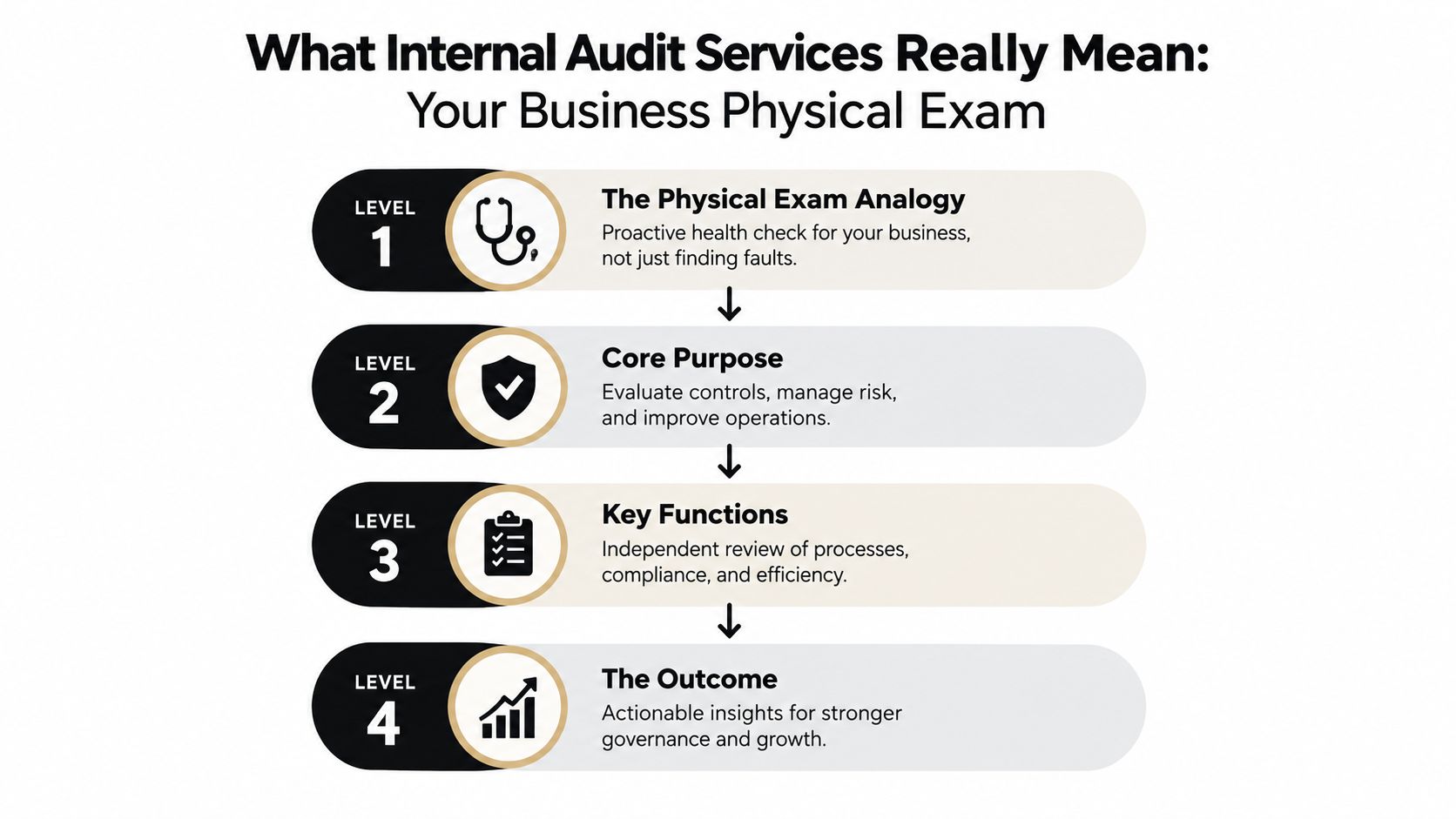
Think of an internal audit as a physical exam for the business. A physician doesn't wait for a serious illness before checking vital signs. In the same way, an auditor reviews the business before a control failure turns into a financial loss, compliance breach, or operational disruption.
The formal professional foundation developed over time. The Institute of Internal Auditors was created in 1941, and the IIA approved the Standards for the Professional Practice of Internal Auditing in 1978. Those standards aimed to unify internal auditing, improve practice, and create a consistent basis for evaluating audit operations. Canada also issued Standards for Internal Financial Audit in 1978 and Standards for Internal Audit in the Government of Canada in 1982, reflecting the shift from informal review work to structured assurance and governance services. Historical development of internal auditing
The four ideas owners need to understand
Assurance means receiving an objective assessment of whether controls and processes are working. An auditor may test invoices, payroll changes, user permissions, reconciliations, or revenue records.
Risk management means identifying what could prevent the business from meeting its goals. Risk may involve inaccurate financial reporting, fraud, data loss, regulatory noncompliance, or inefficient operations.
Governance means clarifying who makes decisions, who approves them, who reviews the results, and how leadership receives reliable information.
Improvement means the audit doesn't stop at “something went wrong.” A useful report explains the condition, likely cause, consequence, and corrective action.
Internal audit differs from several services that owners commonly confuse:
- Bookkeeping records transactions and maintains financial accounts.
- Business accounting interprets records, supports reporting, and helps management plan.
- An external audit provides an independent opinion for outside users of financial statements.
- A compliance review tests a defined requirement, policy, or regulation.
- An internal audit evaluates risk, governance, controls, and operational effectiveness for the organization itself.
Independence matters. The person testing a control shouldn't be the same person who designed or performed that control. A written audit charter can define authority, access to records, responsibilities, reporting lines, and expectations for objectivity. Owners who want a more detailed comparison can review internal audit versus external audit.
Typical Scopes Deliverables and Risk Based Focus
An internal audit doesn't have to examine every transaction or department. A strong engagement starts by asking a more useful question: where could a failure cause the greatest damage?
For a Jacksonville healthcare practice, that may mean billing accuracy, payer credits, payroll, HIPAA-related access controls, and patient-related financial data. For a construction company, the emphasis may shift to job costing, change orders, subcontractor payments, certified payroll, equipment, and retainage. A nonprofit may need attention on restricted funds, grant spending, board approvals, and donor reporting.
Common areas for an SMB audit
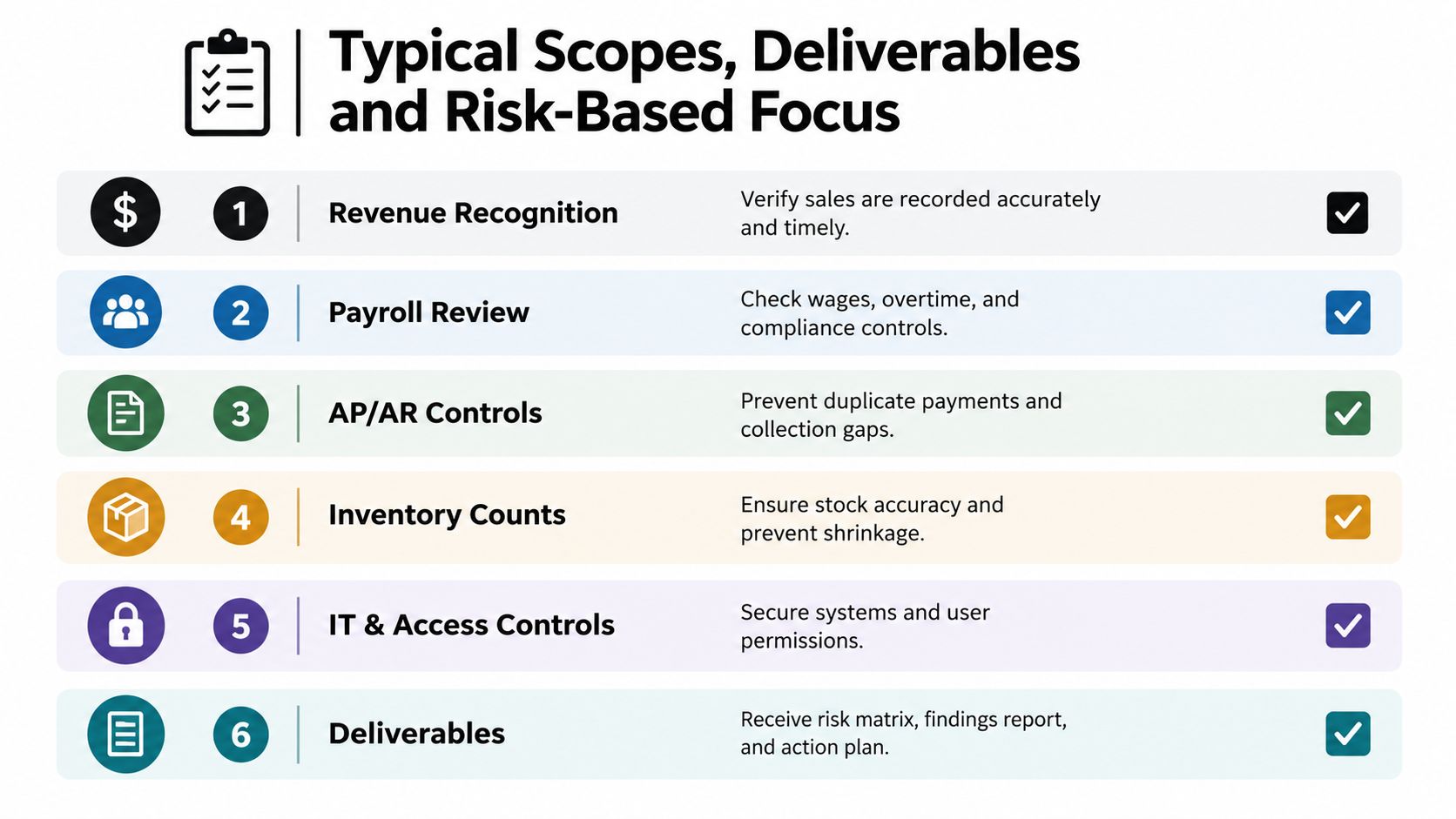
- Revenue recognition: Verify that sales are recorded accurately, in the right period, and with appropriate support.
- Payroll: Review employee setup, wage changes, overtime, timesheets, classifications, and approval controls.
- Accounts payable: Look for duplicate invoices, unauthorized vendors, missing approvals, and payments that don't match purchase documentation.
- Accounts receivable: Examine billing completeness, credit memos, collection follow-up, write-offs, and customer balances.
- Inventory: Compare records with physical counts and investigate shrinkage, obsolete stock, and receiving errors.
- Job costing: Trace labor, materials, subcontractors, and overhead to the correct project so management can see whether jobs are profitable.
- IT and cyber controls: Review user access, former employee access, backups, system changes, and sensitive information handling.
- Compliance: Test whether policies and required filings are supported by consistent processes and evidence.
A risk-based audit plan ranks inherent and residual risk rather than following a fixed rotation. The IIA's performance standards require the chief audit executive to use a documented, regularly refreshed risk assessment when setting priorities, while evaluating governance, risk management, and control processes through a systematic approach. IIA performance standards
That method is especially practical for smaller companies with limited audit hours. It directs attention toward processes such as revenue recognition, payroll, AP and AR, job costing, and regulated billing, where control failure could affect operations, compliance, financial reporting, or assets.
What you should receive
A professional engagement should produce useful working materials, not a thick binder that nobody opens again:
- Risk assessment: A documented view of major risks, existing controls, and priority areas.
- Audit scope and plan: Clear objectives, boundaries, procedures, timing, and responsible contacts.
- Workpapers: Evidence supporting the procedures performed and conclusions reached.
- Findings report: Plain-language descriptions of conditions, causes, consequences, and risk levels.
- Management action plan: Specific owners, deadlines, and corrective steps.
- Follow-up tracking: Confirmation that agreed improvements were implemented.
Internal audit is only one part of a broader protection strategy. Owners comparing controls with insurance planning may also find managing business risks with insurance useful because financial controls and insurance coverage address different parts of the same exposure.
For practical implementation ideas, review internal audit best practices, especially the importance of documenting evidence and assigning follow-up responsibility.
How the Internal Audit Process Works From Planning to Follow Up
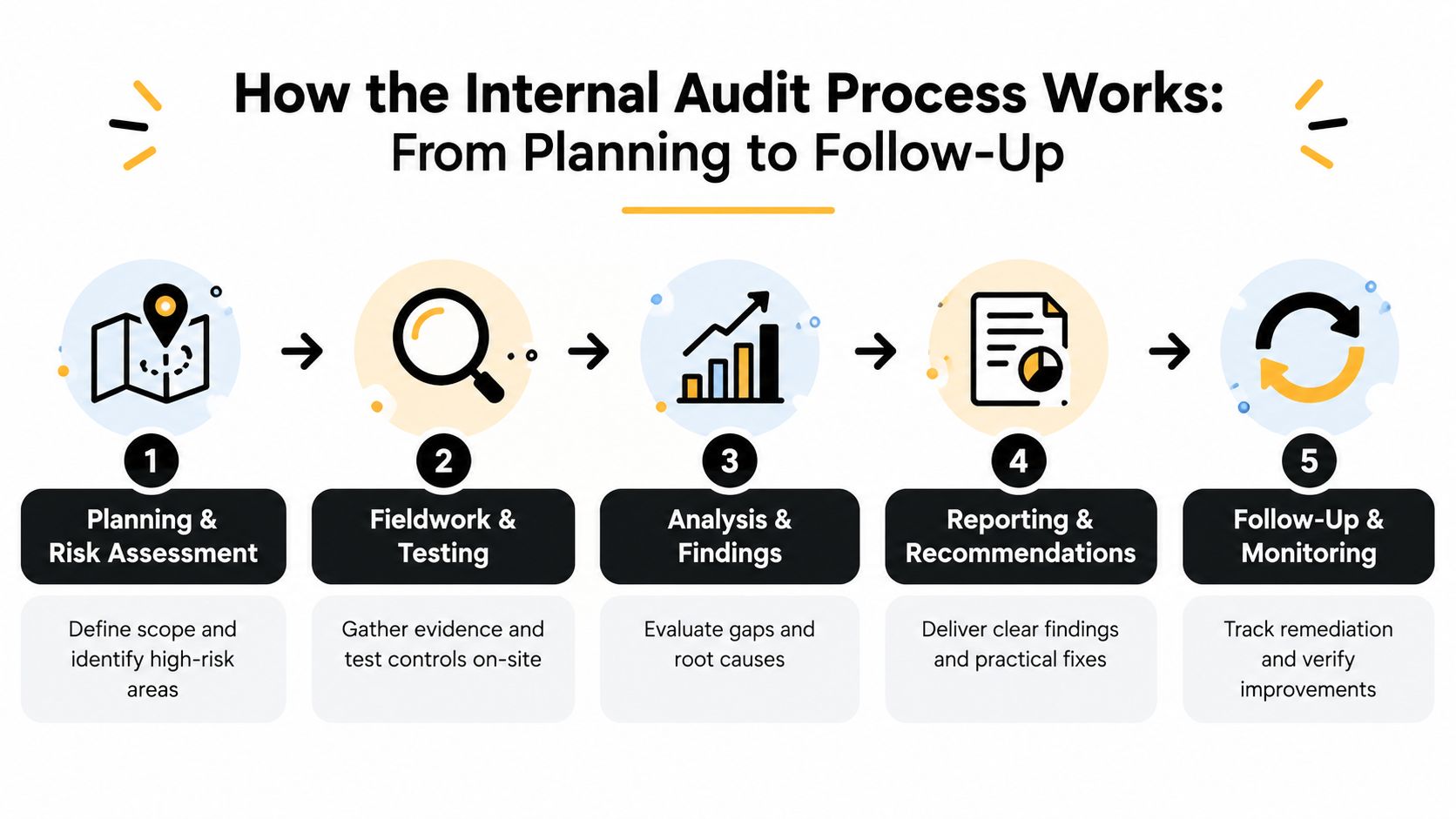
A well-run internal audit should feel organized, not mysterious. The team agrees on the purpose, requests relevant records, tests selected controls, discusses factual findings, and helps management track the response.
Step 1 starts with planning
The auditor meets with owners, managers, or an audit committee representative to understand the business, recent changes, known concerns, and objectives. The risk assessment then determines which processes deserve attention. The engagement might cover one segment of the business or a broader group of financial and operational data.
Useful preparation often includes:
- Current financial statements and general ledger detail
- Bank and credit card reconciliations
- Payroll reports and employee access lists
- Vendor and customer listings
- Written policies and approval procedures
- System access information
- Contracts, invoices, purchase orders, and supporting documents
- Prior audit findings or unresolved issues
The IIA's global benchmark research included more than 3,600 responses from 159 countries and territories, and reported that 51% of chief audit executives had five or fewer internal audit staff, while 71% had teams of 10 or fewer. IIA global internal audit research Those findings help explain why an SMB often uses a focused engagement instead of maintaining a large permanent department.
Steps 2 and 3 involve testing and analysis
During fieldwork, auditors perform walkthroughs, inspect documentation, select transactions, compare records, interview employees, and test whether controls operate as described. They may discover that a policy exists but isn't followed, or that employees follow a sensible process that management never documented.
The auditor then evaluates the gap and its root cause. A missing approval might result from unclear authority, a poorly configured accounting system, or a process that requires too many manual steps. The recommendation should address the cause, not merely tell someone to “be more careful.”
Steps 4 and 5 turn findings into action
The final report should explain what was tested, what the team found, why it matters, and what management agreed to do. Findings are often discussed with responsible managers before finalization so factual errors can be corrected and remediation can be realistic.
The engagement ends with follow-up, not the report. A control improvement isn't complete until someone verifies that the new approval, reconciliation, access review, or documentation process is operating as intended.
The IIA quality guidance emphasizes ongoing monitoring and periodic assessments through a quality assurance and improvement program, known as a QAIP. Useful indicators include workpaper completeness, on-time report issuance, remediation implementation, and whether control testing reflects the actual risk universe. IIA quality assurance services
Industry Specific Risks and 2026 Tax Law Changes to Watch
A one-size-fits-all internal audit misses the details that make a business vulnerable. A healthcare clinic doesn't manage risk like a roofing contractor, and a nonprofit doesn't track money like a retail store.
| Sector | Top Audit Focus | 2026 Tax and Compliance Trigger |
|---|---|---|
| Healthcare practices | Billing accuracy, payer reconciliations, payroll, patient data access, and HIPAA-related procedures | Updated bookkeeping and year-round documentation support tax reporting and sensitive-data controls |
| Construction and trades | Job costing, change orders, subcontractor payments, equipment, retainage, and payroll | Capital purchases, contractor reporting, and project records require coordinated accounting review |
| Retail | Inventory counts, purchasing, sales records, cash handling, returns, and sales tax processes | Vendor records, fixed assets, and information reporting workflows need review |
| Nonprofits | Restricted funds, grant compliance, board approvals, expenses, and financial reporting | Fund accounting and supporting documentation help maintain compliant reporting |
The 20% qualified business income deduction is permanent for pass-through business owners under the One Big Beautiful Bill Act. Beginning in 2026, the phase-in thresholds for the limitation are $75,000 for individuals and $150,000 for joint filers. Owners need accurate income tracking and entity-level analysis to determine what income may qualify. 2026 individual tax planning guidance
The reporting threshold for Form 1099-NEC and Form 1099-MISC increased from $600 to $2,000 beginning with the 2026 tax year. Vendor payment systems and year-end workflows must identify which contractors and service providers trigger reporting under the new threshold. 2026 Form 1099 changes
Capital planning also deserves attention. The OBBB made 100% bonus depreciation permanent and increased Section 179 expensing to a maximum deduction of $2.5 million, with the phase-out threshold raised to $4.09 million. Accurate fixed-asset records help businesses apply the right tax treatment to equipment, vehicles, and other qualifying purchases. Small business tax guidance for 2026
Internal audit tests whether the underlying records and approvals support those tax decisions. Business accounting and tax planning then help management use the findings throughout the year instead of scrambling at filing time.
Pricing Guidance and How to Choose the Right Audit Partner
Internal audit pricing depends on scope, transaction volume, system complexity, the number of locations, specialist needs, and the condition of the existing books. A focused review of one process costs less than a broad examination of financial, operational, IT, and compliance controls. A partner should explain the assumptions behind the fee rather than offer a vague package.
Common engagement models
Project-based outsourcing works well when you need a defined review, such as payroll controls, job costing, vendor payments, or access permissions. You pay for a specific objective and receive a report and action plan.
Co-sourcing combines internal knowledge with outside expertise. Your employees understand the business, while an external specialist handles areas such as cybersecurity, data analytics, AI governance, or a capacity gap.
An in-house function makes sense when audit activity is continuous, the risk environment is complex, and the company can support independent staff and governance. It also requires recruitment, training, quality oversight, software, and management time.
Recent IIA data reports that budget cuts rose from 11% to 19% and staff cuts rose from 11% to 18% between 2024 and 2025, creating pressure to maintain coverage with fewer resources. IIA resourcing report For many SMBs, buying targeted help is more practical than building a permanent department immediately.
| Business situation | Practical model |
|---|---|
| One urgent control concern | Project-based internal audit |
| Growing company with limited accounting leadership | Outsourced audit plus fractional CFO guidance |
| Internal accounting team with a specialist gap | Co-sourced engagement |
| Complex organization with continuous oversight | In-house function with outside specialists |
Questions to ask before hiring
Look for experience with your industry, clear independence, strong workpaper discipline, QuickBooks ProAdvisor capability, and communication that busy managers can follow. Ask how findings are rated, who owns follow-up, what records the team needs, and whether the provider can connect audit results to cash flow, forecasting, tax planning, and operational decisions.
All companies benefit from senior financial guidance, but not every company needs a full-time CFO. A fractional CFO can help interpret audit findings, prioritize investments, improve reporting, and guide the owner through decisions without the overhead of a permanent executive. For additional selection criteria, use this guide on how to find a good accountant.
Benefits ROI and Your Next Step With a Jacksonville CPA Firm
Internal audit creates value beyond a compliance checklist. It can help management reduce financial errors, discourage fraud, strengthen documentation, improve lender or board confidence, and make decisions from reliable information. The return isn't always a single visible dollar amount. Often, it appears as a missed payment caught early, a tax position supported by better records, a control that prevents unauthorized access, or a manager who finally understands which jobs or services produce healthy margins.
Modern internal audit services also need to consider technology. The IIA reports that 83% of internal audit leaders expect increased AI use over the next year, with current use appearing in planning, reporting, risk assessment, and fieldwork. IIA guidance on AI capabilities AI, cyber risk, cloud systems, third-party vendors, and changing regulations all deserve proportionate attention, even when the company doesn't have a large specialist team.
A clinic may need a stronger billing and access review. A contractor may need job-costing controls that show whether estimates match actual labor and materials. A nonprofit may need clearer grant tracking and board reporting. In each case, the useful outcome is the same: management receives practical findings and a path to completion.
Bookkeeping and Accounting of Florida Inc. offers bookkeeping, business accounting, payroll, tax preparation, internal and independent audits, healthcare accounting, forensic audits, and fractional CFO support for companies in Jacksonville and Northeast Florida. The firm has served local businesses for more than 20 years, helping owners understand their numbers, meet deadlines, and keep financial controls aligned with growth.
Bookkeeping and Accounting of Florida Inc. can review your internal controls, organize reliable accounting records, and build a risk-based audit plan around your business's highest exposures. Visit Bookkeeping and Accounting of Florida Inc. to schedule a conversation about internal audit services, 2026 tax readiness, and fractional CFO guidance for your Jacksonville business.