
You open your Jacksonville business mailbox between client calls and find an IRS notice waiting inside. The letter mentions an examination, a reporting mismatch, or records the agency wants, and suddenly payroll, patient files, job costs, donations, and year-end tax work all feel connected to one uncomfortable deadline.
Thank you for reading this post, don't forget to subscribe!That reaction is normal, but panic isn't a response strategy. IRS audit representation gives you an authorized professional who can organize evidence, communicate with the examiner, protect the scope of the response, and help you decide whether to agree, dispute, appeal, or provide more information. For a busy owner, that can matter as much as the tax technical work itself.

What IRS Audit Representation Means for Busy Business Owners
An audit representative isn't someone who files a tax return after the fact. The representative acts as your authorized advocate during an IRS examination, helping translate the agency's questions into a focused records request and preparing a response that supports the position you reported.
Consider a Jacksonville construction company that receives a notice about contractor payments. The owner may know every project personally, but that doesn't mean the books instantly show which vendor performed which scope of work, whether the payment was reported correctly, or how payroll and subcontractor records connect. A healthcare practice can face a similar problem when deposits, insurance payments, payroll, and patient-related accounting records don't line up neatly with tax reporting.
The issue may be a system mismatch rather than intentional wrongdoing. Recent coverage describes IRS data analytics identifying discrepancies involving unmatched deposits, delayed employer reporting, and missing vendor statements, particularly for businesses with payroll and contractor activity according to coverage of automated IRS audit selection. That makes clean bookkeeping, reconciled accounts, organized payroll files, and disciplined communication increasingly important.
Practical rule: An IRS notice is a request for a controlled response, not an invitation to explain your entire business history on the phone.
Representation becomes especially valuable when the notice touches several connected areas, such as payroll, inventory, contractor classification, pass-through income, deductions, or entity-level reporting. It also helps owners who don't have time to monitor every deadline and document request while running operations.
The National Taxpayer Advocate's historical EIC audit findings illustrate why assistance can affect more than convenience. In tax year 2004, more than 40% of audited taxpayers with representatives emerged with their full EIC intact, compared with fewer than one in four taxpayers without a representative, while only 1.8% of audited EIC taxpayers had representation during the audit National Taxpayer Advocate report. The lesson for a business owner is straightforward: evidence management and issue framing can influence the substantive result.
How IRS Audit Representation Works and Your Right to Help
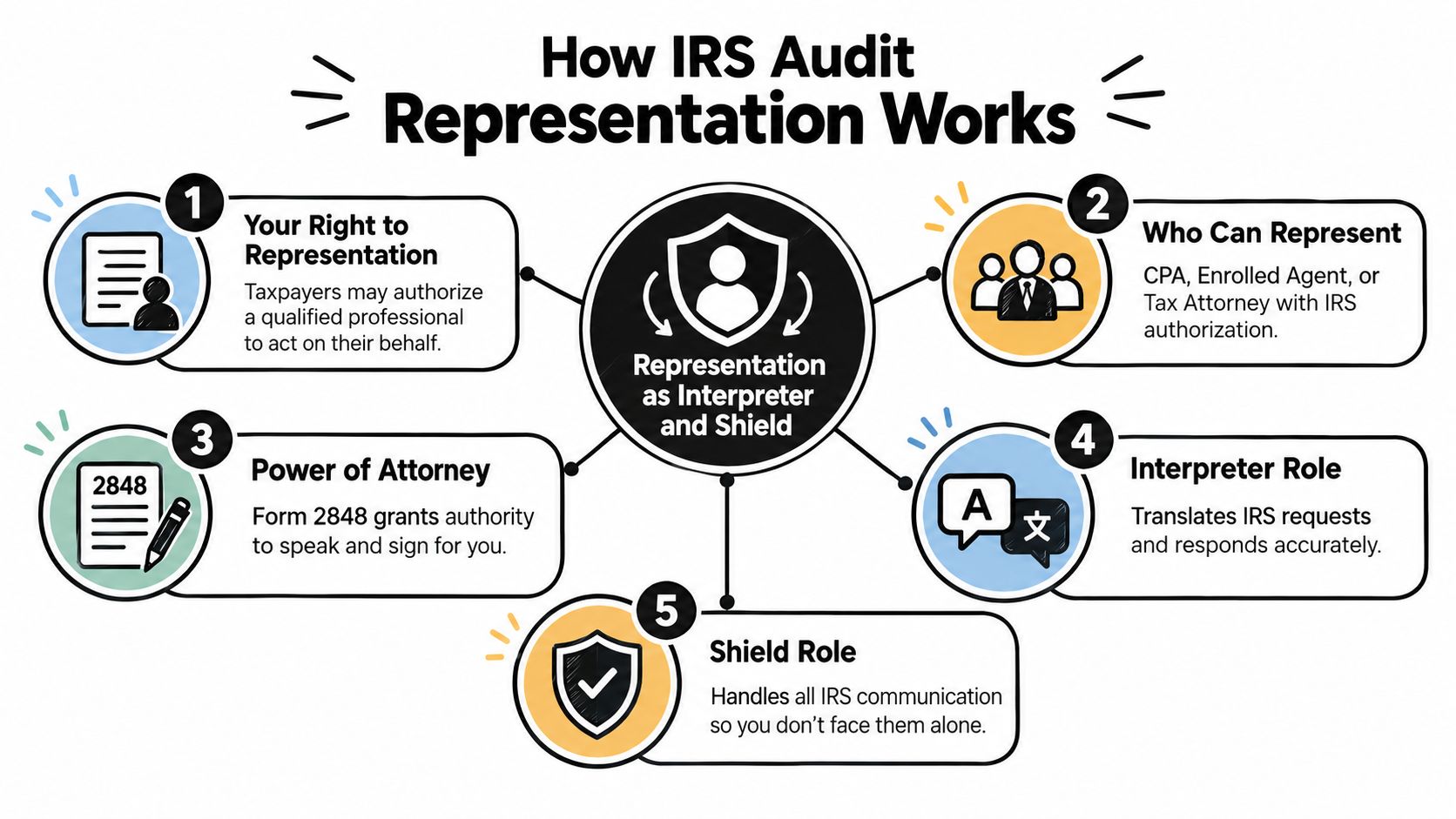
Think of your representative as both an interpreter and a shield. The interpreter explains what the IRS is asking and prepares an accurate answer. The shield manages the communication so you aren't improvising responses while trying to run your company.
The authorization process
Taxpayers have a right to retain an authorized representative of their choice during IRS dealings under the Taxpayer Bill of Rights. Enrolled agents, CPAs, and attorneys have unlimited representation rights before the IRS, so they can represent taxpayers in audits, appeals, and collection matters regardless of the state where the taxpayer operates. The IRS explains these credential and representation rules in its guidance on tax return preparer credentials and qualifications.
You generally authorize that relationship with Form 2848, Power of Attorney and Declaration of Representative. The form identifies the taxpayer, tax matters, periods, and professional receiving authority. Once the authorization is accepted, the representative can communicate with the IRS for the matters listed instead of leaving every call, letter, and deadline on your desk.
The representative can prepare responses, submit supporting records, request clarification, discuss proposed adjustments, and help evaluate appeal or payment options. They can't invent substantiation, conceal income, alter records, or promise a particular outcome. Good representation is accurate advocacy, not magic.
Your right to pause
The IRS says an interview will usually be suspended when you request time to consult a representative, and you generally don't have to attend with that representative unless the IRS formally summons you as explained in the IRS taxpayer rights guidance. You also have the right to stop an IRS interview and obtain reasonable time to seek help under audit representation rights guidance.
That pause gives you room to collect bank records, payroll reports, contracts, invoices, and other substantiation before answering. It also lets your representative narrow the question, identify what the IRS needs, and avoid sending irrelevant material that could distract from the issue.
Who Can Represent You Before the IRS and How They Differ
The credential matters because not every person who prepares books or taxes can represent a taxpayer in every IRS matter. Enrolled agents, CPAs, and attorneys have unlimited representation rights, while other authorized individuals may have narrower rights depending on their qualifications and the circumstances.
An enrolled agent is federally authorized to practice before the IRS. EAs often focus heavily on tax procedure, examinations, appeals, and collection matters. They can be a practical fit when the main challenge involves federal tax questions, substantiation, notices, or negotiating with an examiner.
A CPA combines tax representation with accounting expertise. That can be useful when the audit depends on general ledger activity, revenue recognition, payroll reconciliations, inventory, job costing, financial statements, or entity records. For a growing Jacksonville business, the CPA may also help correct the bookkeeping process that created the confusion.
A tax attorney brings legal training and may be the right choice when the matter involves potential criminal exposure, complex legal interpretation, privilege concerns, litigation, or a difficult appeal. Attorneys can represent clients in audits, appeals, and collection matters when properly authorized.
An enrolled actuary or another authorized person may be relevant in a specialized tax matter, but the key question remains the same: does this person have the authority and experience your case requires?
Choosing Your IRS Representative by Situation
| Representative Type | Unlimited Rights | Best Fit For Your Audit |
|---|---|---|
| Enrolled Agent | Yes | Federal tax procedure, notices, examinations, appeals, and collection matters |
| CPA | Yes | Accounting-heavy audits involving payroll, revenue, inventory, job costing, or entity books |
| Tax Attorney | Yes | Legal risk, privilege concerns, complex disputes, criminal exposure, or litigation |
| Other authorized professional | Depends on credentials and matter | Specialized situations requiring confirmation of scope before engagement |
A bookkeeper may be excellent at maintaining QuickBooks and reconciling accounts, but bookkeeping skill alone doesn't create unlimited IRS representation rights. Before signing an engagement letter, ask who will be named on Form 2848, what periods the authorization covers, and whether the professional has handled your industry.
A useful question to ask: “Will you personally communicate with the IRS, and what records will you need before you do?”
Written authorization also creates operational clarity. The representative can track correspondence, monitor deadlines, and prevent an owner from sending an incomplete answer while trying to keep a business moving.
Inside an IRS Audit From Notice to Resolution
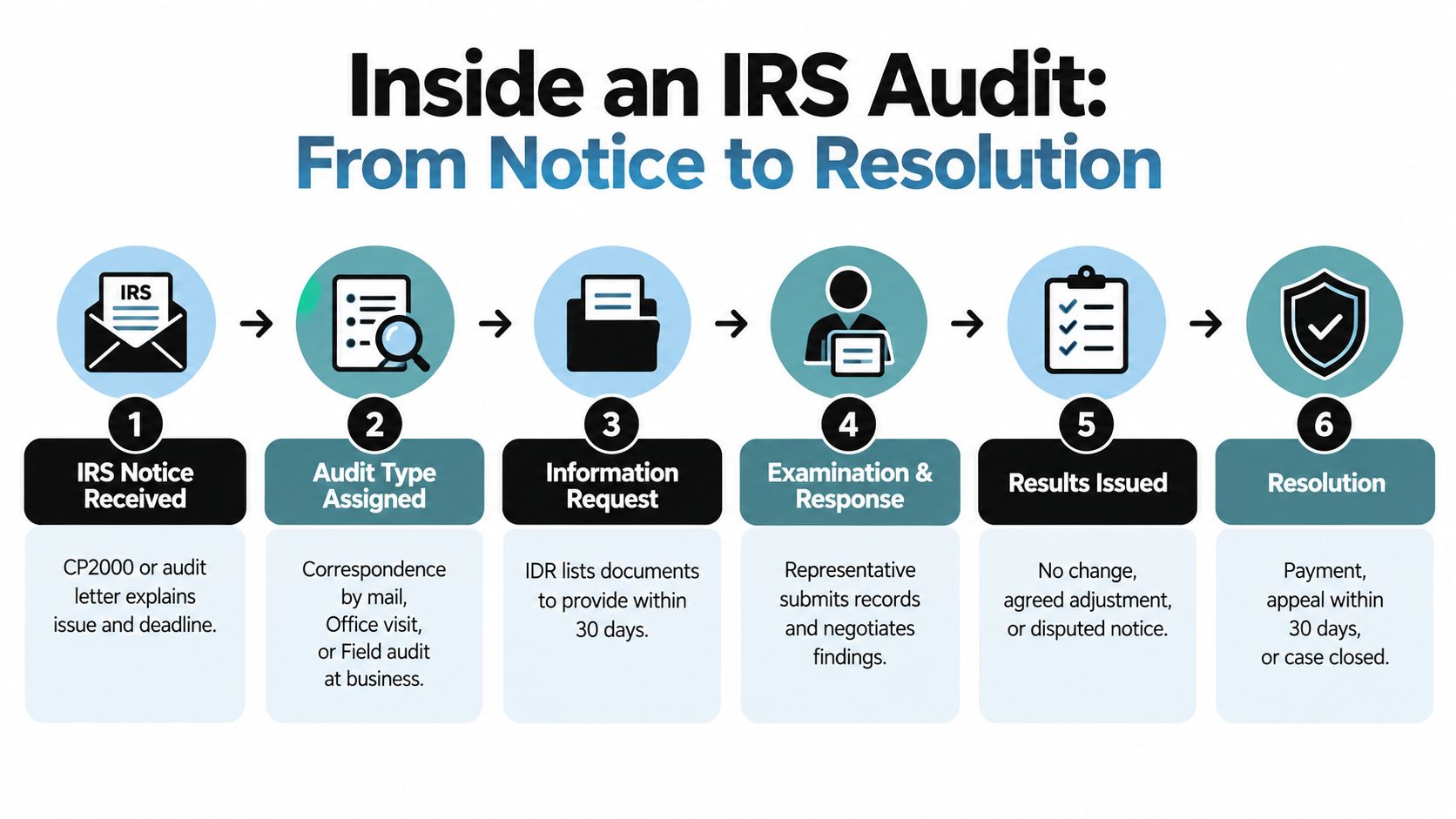
An IRS audit usually unfolds in stages, and the audit type affects the amount of contact and documentation involved. A correspondence audit happens through mail, an office audit involves an IRS meeting, and a field audit takes place at a business, home, or representative's office.
The audit timeline
Notice received: Read the letter carefully. Identify the tax period, questioned items, response date, and contact information. Don't assume the proposed amount is the final result.
Audit type identified: Determine whether the matter is correspondence, office, or field. A narrow notice about one document may need a focused response. A field examination involving several entities calls for broader planning.
Information request reviewed: The IRS may request bank statements, invoices, payroll records, contracts, receipts, accounting reports, or other substantiation. A representative maps each requested item to the relevant tax return line.
Examination and response: Your representative organizes the evidence, prepares explanations, submits records, and discusses questions with the examiner. The goal is a complete, limited, and supportable response.
Results issued: The case may produce no change, an agreed adjustment, or a disputed notice. Don't sign an agreement until you understand what it resolves and whether related periods or issues remain open.
Resolution selected: Depending on the result, the matter may close, move toward payment arrangements, or proceed through an appeal. Your representative should explain the consequences before you choose a path.
A clean response isn't the same as sending every file you own. The better approach is to match each document to a questioned item, reconcile totals to the return, explain discrepancies, and retain a complete copy of what you submit. Owners who want to strengthen their preparation can use this guide to preparing for an audit.
The interview stage deserves particular care. If the IRS asks a question you can't answer accurately, you can request time to consult your representative rather than guessing. That simple pause may prevent a casual comment from creating a larger problem.
When Representation Pays Off and Common Audit Triggers for Small Businesses
A Jacksonville owner may receive a short correspondence notice about one receipt, while a healthcare practice, construction company, or nonprofit may face questions spanning payroll, contractors, grants, or several tax years. Those cases call for different decisions. Evaluate audit type, potential tax exposure, issue complexity, and documentation quality before deciding whether to respond personally or hire representation.
A simple notice tied to one well-documented item may be manageable in-house. An office or field audit is different, especially when accounting software has flagged unusual transactions, records do not reconcile, or the IRS is asking about related entities. A representative can act like a fractional CFO for the audit: organize evidence, identify compliance gaps, and help the owner judge business risk before a small question grows.
IRS examination activity varies by taxpayer and return type. For tax year 2019, the average audit rate for domestic taxpayers with positive income filing individual returns was 0.29%, while EITC claimants faced a 0.78% rate, according to the Congressional Research Service summary of IRS examination statistics. The same discussion describes greater exposure for complex or higher-income taxpayers. A 2024 MassMutual summary of IRS data reported business audit rates around 0.1% for partnerships and S-corporations, about 0.4% for corporations, and near 7.9% for returns reporting $10 million or more in total positive income.
Recent enforcement data needs context. The IRS closed 497,621 audits in fiscal year 2025 and recommended $26.8 billion in additional tax, compared with 505,514 audits and $29 billion in fiscal year 2024. Examination and collections staffing fell from 27,217 employees in fiscal year 2024 to 17,517 by January 2026, according to this Treasury Inspector General for Tax Administration report. Fewer completed audits do not make a complicated notice harmless. They make organized evidence and a measured response more important.
Triggers that deserve a closer look
Healthcare practices: Insurance deposits, patient payments, payroll, contractor clinicians, and owner distributions must connect across bank activity, practice-management reports, payroll filings, and the return.
Construction companies: Job costing, subcontractors, equipment, retainage, payroll, and change orders need consistent treatment. A general ledger that cannot explain project profitability leaves revenue and expense questions harder to answer.
Nonprofits: Restricted funds, grants, payroll, program expenses, and reporting classifications require clear support. Small administrative teams often have records spread among volunteers, software, and outside vendors.
Use this forensic audit checklist when transactions need reconstruction. Representation deserves serious consideration when a notice covers multiple issues, a substantial adjustment, weak documentation, an in-person examination, or communication the owner cannot safely manage during business hours.
How to Choose and Work With Your Audit Representative in Jacksonville
Start with the notice, not a sales promise. A qualified Jacksonville representative should ask for the letter, the relevant tax return, prior correspondence, and a plain-language description of what happened before discussing strategy.
Prepare for the first consultation
Gather:
- The IRS notice: Include every page, not only the page showing the proposed adjustment.
- The filed return: Provide the complete return and schedules for the period under examination.
- Accounting records: Export relevant QuickBooks reports, general ledgers, bank reconciliations, trial balances, and financial statements.
- Supporting evidence: Collect invoices, receipts, contracts, payroll reports, vendor records, mileage records, and deposit documentation related to the questions.
- Prior communications: Include letters, fax confirmations, emails, and notes from calls.
Ask whether the professional has experience with your industry, entity type, payroll structure, and audit type. Ask how the firm handles document review, who communicates with the examiner, how deadlines are tracked, and whether the engagement includes appeals if the initial examination doesn't resolve the dispute.
Fees vary with complexity, records, tax periods, and regional practice costs. Request a written engagement scope that separates document organization, preparation, IRS communication, meetings, appeals, and any additional work. Be wary of anyone who guarantees an outcome before reviewing the notice or can't identify the specific credentialed professional who will represent you.
Build compliance before the notice
Audit readiness starts long before an envelope arrives. A reliable bookkeeping system should reconcile bank and credit-card accounts, classify expenses consistently, track payroll and contractor reporting, and preserve documents where the owner and CPA can find them. For Jacksonville businesses seeking help with tax preparation and IRS or state notices, tax services in Jacksonville can be coordinated with ongoing accounting support.
Tax planning also needs to reflect current rules. For 2026, the standard deduction is $32,200 for married couples filing jointly, $16,100 for single filers, and $24,150 for heads of household, and the top marginal rate of 37% applies above $640,600 for single filers or $768,700 for joint filers, according to this 2026 IRS tax update for small businesses. The same summary reports that the Section 199A qualified business income deduction was made permanent, making pass-through planning and accurate books especially important for eligible business owners.
A fractional CFO can connect those tax decisions to cash flow, hiring, pricing, debt, and growth. You don't need a full-time executive to receive senior-level financial guidance, but you do need someone who can turn accurate records into timely decisions.
Stay Compliant and Confident With the Right Florida Partner
Most small businesses don't know every filing, payroll, documentation, and tax requirement that applies to them. That's not a character flaw. Owners are busy serving patients, completing projects, managing programs, hiring staff, and collecting revenue. Compliance becomes risky when no one owns the complete financial picture.
The practical solution is a system that combines clean QuickBooks records, reconciled accounts, accurate payroll, tax preparation, organized substantiation, and responsive audit support. IRS audit representation then becomes one part of a broader risk-management process instead of an emergency purchase after records are already missing.
A fractional CFO adds another layer of guidance. That person can help review cash flow, interpret financial statements, plan for tax obligations, evaluate operating decisions, and identify reporting weaknesses before they become notice problems. For healthcare practices, construction companies, nonprofits, startups, and other Northeast Florida businesses, industry-aware accounting can make compliance more manageable and business decisions more grounded.
Before your consultation, bring the IRS notice, the related tax return, recent financial reports, and a short timeline of what happened. Ask for a clear plan, defined responsibilities, and practical steps to organize the records.
Bookkeeping and Accounting of Florida Inc. offers bookkeeping, payroll, tax preparation, audit support, QuickBooks organization, and fractional CFO guidance for Jacksonville businesses that need dependable compliance and financial direction. Visit Bookkeeping and Accounting of Florida Inc. to request a consultation and discuss your IRS notice or year-round accounting needs.