

A Jacksonville contractor can finish a project, collect every invoice, release retainage, and still lose money. The books may show cash coming in and a tidy closeout, while the job itself tells a different story: materials were over-ordered, overtime never reached the correct cost code, and two change orders were performed without approval or billing.
Thank you for reading this post, don't forget to subscribe!That's why job costing in accounting matters. It compares the original bid with what the job consumed while the work can still be corrected. It also creates the documentation your CPA, lender, surety, and tax preparer need. Most small businesses don't discover those requirements until audit season, when the spreadsheet cobwebs have become part of the furniture.
The Job That Looked Profitable Until It Wasn't
Friday afternoon, the owner thinks a Jacksonville commercial renovation wrapped up fine. The customer paid. The superintendent is already on the next job. On paper, the bid carried a 22% margin.
Then the job-cost report lands on the desk. The project finished at a 4% loss.
That is how contractors fool themselves. Cash came in, so everybody calls it a good job. Profit did not.
The leak was plain once someone bothered to sort costs where they belonged. Materials ran over because purchasing ordered beyond the actual scope. Field overtime sat in a general payroll bucket instead of the job's labor code. Two change orders got done to keep the customer happy, but no one secured written approval or added the work to billing. The company produced revenue. It gave away margin.
The practical test: If you can't explain a job's margin by labor, materials, subcontractors, equipment, and overhead, you don't know the job's margin.
A company-wide profit and loss statement will not save you here. It can show the business doing fine while one ugly project eats the profit from three decent ones. Job costing fixes that by tying costs to a specific contract, project, work order, or customer job and comparing actual cost against the estimate that won the work.
That comparison matters while the job is still alive, not after everyone has forgotten what happened. If labor is blowing the estimate, change the crew mix. If material waste is creeping up, tighten purchasing. If the field is doing extra work for free, stop it until the paperwork catches up. Waiting until closeout turns a management problem into an accounting obituary.
The compliance problem hiding behind the margin problem
The same records that protect margin also protect your tax position and your credibility with outsiders. Every employee timecard, purchase order, vendor bill, equipment charge, subcontractor invoice, and approved change order should carry the same job identifier and cost code. If they do not, you are guessing when payroll gets allocated, deductions get tested, or contract activity gets questioned.
The AICPA construction-industry guidance says accounting records should allow actual job costs to be compared with the original bidding estimates. That is not paperwork for paperwork's sake. It is how you forecast work in progress, price the next job with a straight face, and survive the compliance reality contractors are walking into, including the $2,000 1099 threshold, the Social Security wage base, and record retention that has to hold up when someone asks for support.
Lenders, sureties, customers, and the Florida Department of Revenue all want reliable records for different reasons. A real job-cost system gives them one answer. It also keeps your office out of six versions of “final-estimate-updated-new.xlsx,” which is never as funny as people think.
What Job Costing in Accounting Actually Means
Job costing accumulates direct materials, direct labor, and allocated overhead for an identifiable job, project, contract, or customer order. The related development of activity-based costing reinforced the idea that costs should follow the resources each job consumes instead of being spread uniformly across all work, as described in this history of activity-based costing.
For a contractor, the formula is straightforward:
Total job cost = direct materials + direct labor + allocated overhead
Direct materials are items purchased for that project, such as pipe, wire, fixtures, concrete, or specialty components. Direct labor is the work performed by employees on that job, including the properly burdened labor cost rather than only the gross wage. Allocated overhead covers shared resources such as supervision, insurance, office administration, rent, or equipment-related costs that support the work but can't be tied to one task by a single invoice.
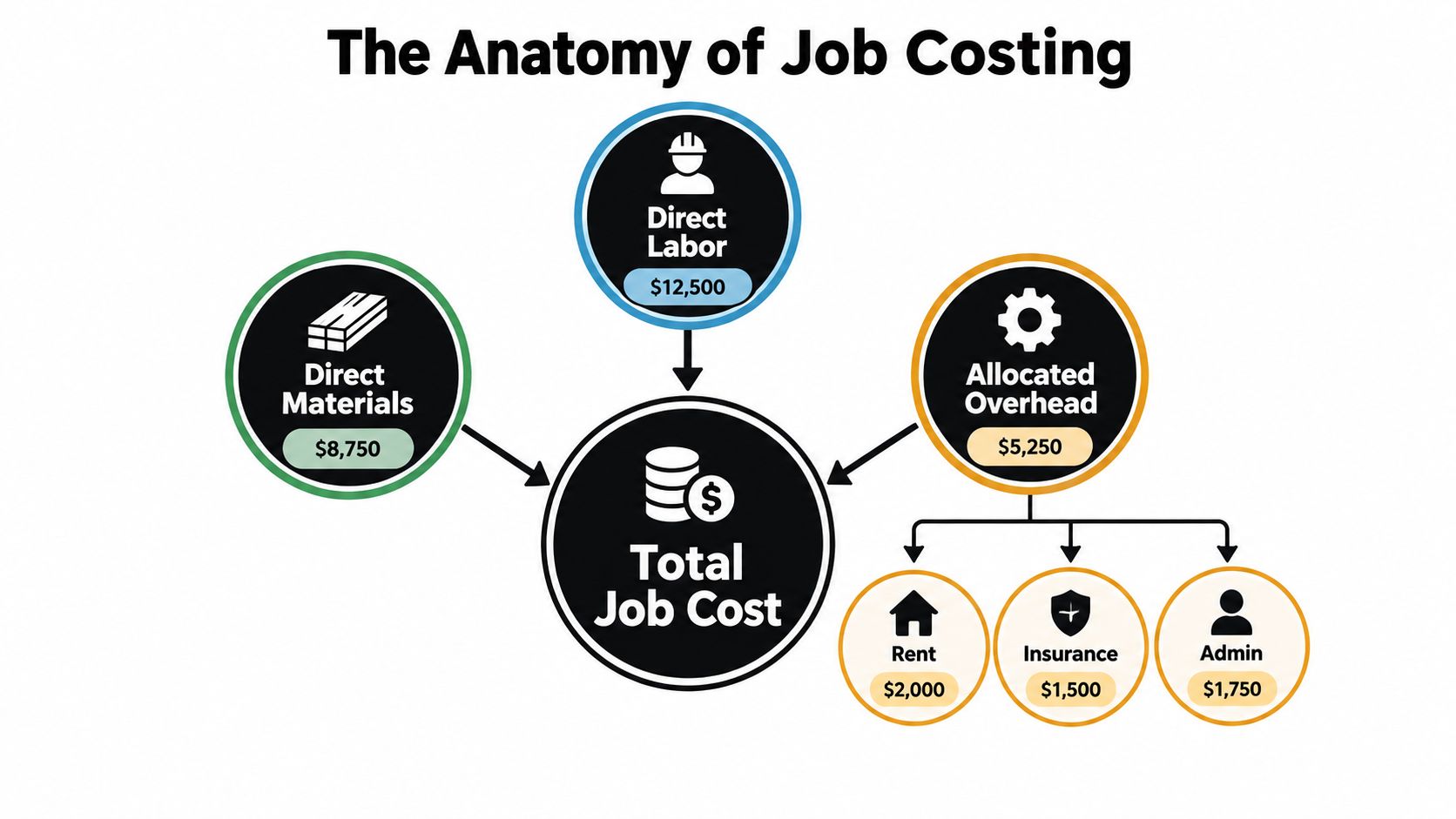
A Monday morning example
Suppose a plumbing company performs a $4,500 retrofit. The company assigns the pipe and fixtures directly to the job. Employees record their hours against the retrofit's job number and labor cost code. The business then applies a fair share of supervision, insurance, office support, and other indirect expenses.
The revenue is $4,500. The job cost is the sum of those three categories. The difference is the project's gross profit before the company considers broader operating results.
Cost codes make this usable. A contractor might separate labor, materials, equipment, subcontractors, and overhead, then add more detail for rough-in work, finish work, inspections, or change orders. The right level depends on how the company bids and manages work. Too little detail hides overruns. Too much detail causes field employees to abandon the system in self-defense.
Job costing versus process costing
Job costing fits unique work with a defined customer or contract, including construction, custom manufacturing, healthcare projects, and professional services. Each project gets its own financial record.
Process costing fits repetitive production, where a business averages costs across a continuous run of substantially similar output. A factory producing identical units needs a different structure from an electrical contractor installing a one-off system.
A chart of accounts, project list, classes, and cost-code structure turns the concept into something QuickBooks or another accounting platform can process. The owner should be able to open any active job and answer three questions: what was budgeted, what has been spent, and what remains to finish.
How Overhead Actually Gets Assigned to a Job
Overhead allocation is where many job-cost systems stop being accounting systems and start being guesswork. A contractor may track labor hours carefully, then dump insurance, supervision, equipment, and administration into one broad expense account. That produces tidy bookkeeping and unreliable margins.
A traditional predetermined overhead rate uses one allocation base. Consider a business with $120,000 of estimated overhead and 6,000 expected labor hours. The rate is $20 per labor hour. A project using 150 labor hours receives $3,000 of applied overhead, before direct materials and direct labor are added. These figures and the two-stage allocation logic are described in the cost-driver allocation research.
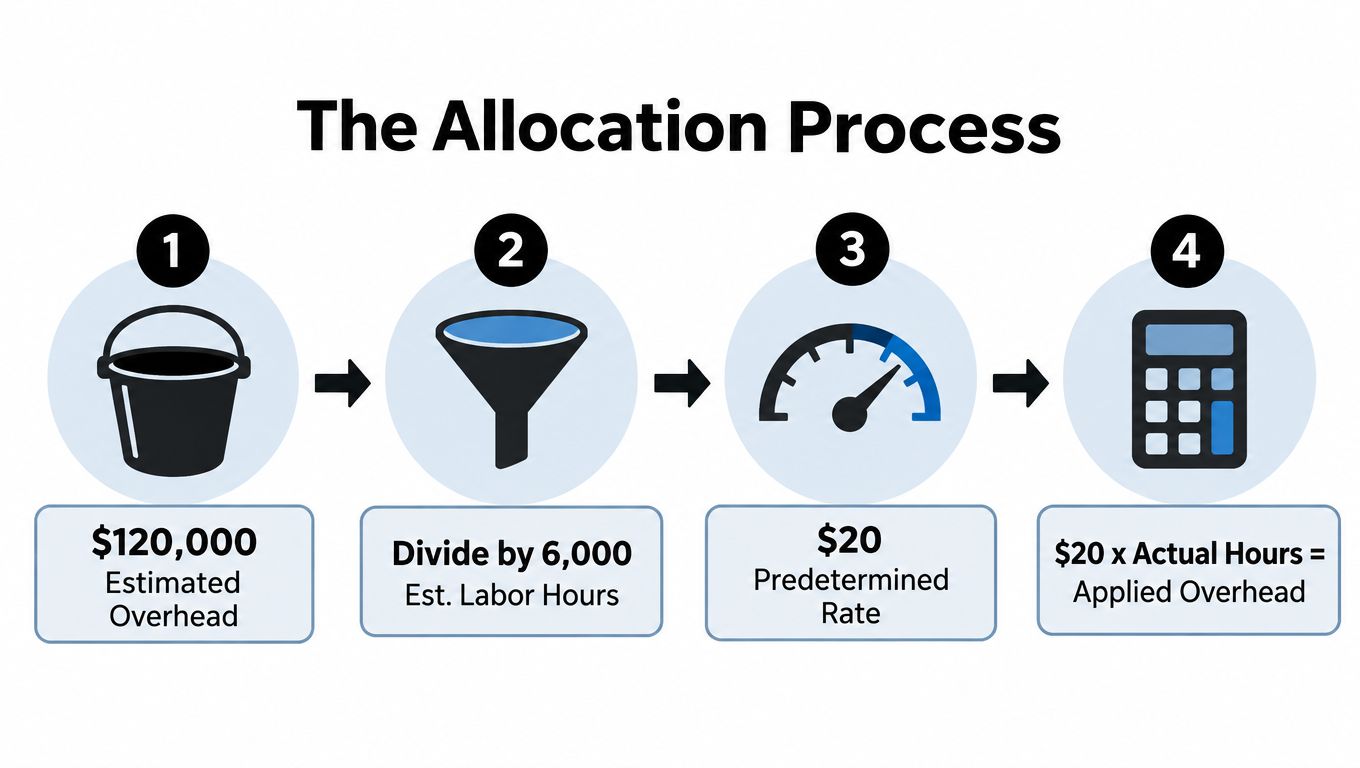
Why one rate can mislead
The $20 rate assumes labor hours explain overhead consumption. Sometimes they do. A simple project requiring steady field labor may fit the assumption. A complex project may not.
One job might require many purchase orders, inspections, equipment hours, engineering reviews, and change-order meetings while using relatively few labor hours. Another might use many labor hours but little equipment and administrative support. Applying the same labor-hour rate to both makes the first job look cheaper than it really is and makes the second carry too much overhead.
Modern systems solve that distortion with cost pools and cost drivers. Cost pools group overhead by activity. Drivers measure what causes each activity, such as purchase orders, equipment hours, inspections, or labor hours.
The allocation process works in two stages:
- Assign overhead to activity pools according to the resources consumed.
- Assign each pool to jobs according to each job's use of the relevant driver.
If equipment costs are driven by equipment hours, assign them that way. If purchasing support follows purchase orders, use purchase orders. If supervision follows labor hours, retain labor hours for that pool. This gives the owner a more credible explanation of why one job made money while another did not.
For a deeper explanation of how multiple activities improve cost analysis, this resource on activity based costing explained offers useful background.
The following video also illustrates the allocation process:
A small contractor doesn't need a laboratory-grade model on day one. Start with a defensible rate, document the assumptions, and upgrade to multiple drivers when the simple method repeatedly misstates project profitability. Consistency matters, but false precision isn't a virtue. A transparent model that management reviews beats a complicated model nobody maintains.
The Fully Burdened Labor Rate Most Contractors Forget
Gross wages are not the cost of labor. They're merely the most visible piece of it.
A contractor's fully burdened labor rate should capture wages, employer payroll taxes, workers' compensation, benefits, bonuses, training, certifications, overtime premiums, equipment time, and other labor-related overhead. Construction labor can represent roughly 20% to 35% of total project expenses, according to the labor-cost discussion in Construction Dive's contractor labor guidance. If the accounting system posts only gross payroll to the job, the job looks healthier than it is.
Use a burden-rate model that starts with the employee's productive job cost and adds the costs required to keep that employee available and compliant. Separate productive field hours from paid non-job time, office supervision, training, holidays, and other time that shouldn't be charged directly to a customer project.
| Component | Why It Belongs in the Burden |
|---|---|
| Wages | The direct compensation paid for work performed |
| Payroll taxes | Employer obligations attached to taxable payroll |
| Workers' compensation | Coverage cost connected to the employee and work exposure |
| Benefits | Health, retirement, paid leave, and other compensation costs |
| Overtime premiums | Additional labor cost created by extended schedules |
| Training and certifications | Required investment that supports productive field work |
| Equipment time | Cost of tools, vehicles, and equipment used to perform the labor |
| Supervision and related support | Shared labor resources that help crews complete jobs |
For a plain-language overview of coverage considerations, review this resource on workers compensation insurance. The accounting point is simple: the insurance premium belongs in the cost structure, and the allocation method should be documented.
Refresh the rate before old estimates become fiction
BLS-linked reporting cited by Construction Dive indicates that U.S. nonfarm productivity grew 1.8% in the fourth quarter of 2025, while unit labor costs increased 4.4% during that quarter. The same source provides those figures and the relevant labor-cost context. An estimate built on older wage and productivity assumptions can therefore understate the labor required to complete current work.
Refresh burden rates on a regular schedule, preferably when payroll, benefits, insurance, or production assumptions change materially. Preserve the prior rate so managers can compare jobs consistently, but don't let comparability become an excuse for using stale costs.
For contractors that need payroll records reconciled with job reports, payroll services for contractors can connect payroll coding, tax liabilities, and project-level labor reporting. That connection is where many spreadsheet systems fail.
A useful control: Every labor dollar should answer two questions, “Who was paid?” and “Which job and cost code consumed the time?”
Implementing Job Costing in QuickBooks or Your Stack
Friday afternoon is when weak job-cost systems show their teeth. Payroll is posted, vendor bills are stacked up, and the owner is staring at a job that looked fine on the estimate but suddenly feels thin. That problem rarely starts in QuickBooks. It starts with sloppy setup.
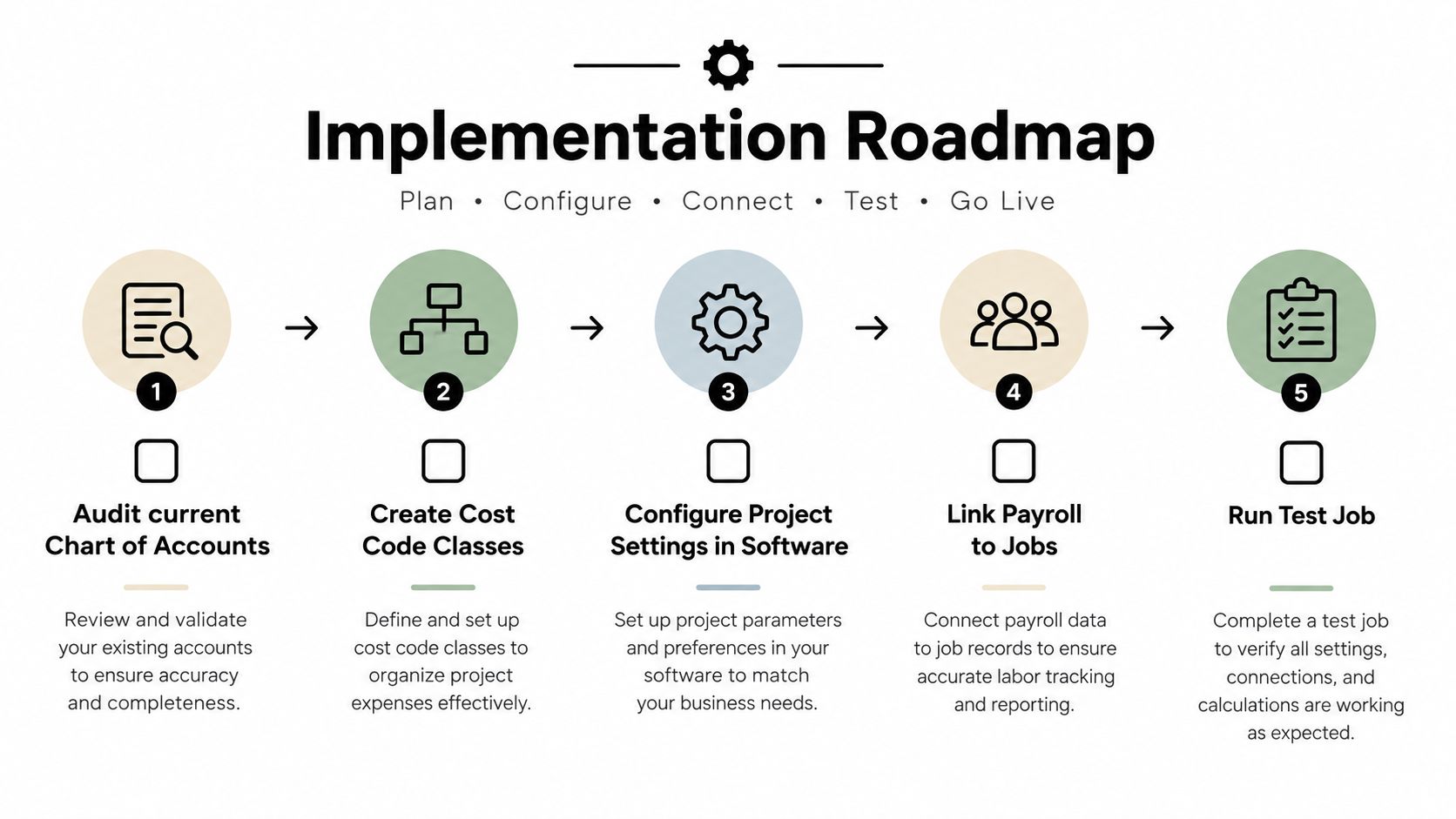
Build the structure before importing history
Clean up the chart of accounts first. Separate direct labor, materials, equipment, subcontractors, and overhead so reports answer real management questions instead of giving you one big mixed bucket. Then build cost-code classes that match how you bid, staff, and supervise work in the field. If estimating uses one structure and accounting uses another, your reports will be decorative, not useful.
A general contractor may need codes for site work, concrete, framing, mechanical, electrical, finishes, and approved changes. A plumbing contractor may need service, retrofit, new installation, materials, equipment, and emergency work. The point is simple. Your job-cost structure should mirror how the work is sold and performed.
Each project should be set up with a clear job number, cost-code classes, approved budget amounts, payroll links, and document rules. Preserve the original budget even when the forecast changes. Otherwise, nobody can tell whether the crew beat the estimate or whether the estimate got rewritten after the damage was done.
Require source documents to carry the job number and cost code before accounting touches them. That includes timecards, purchase orders, invoices, equipment logs, subcontractor bills, receipts, and approved change orders. If a document shows up without that coding, send it back. Accounting cannot read minds, and QuickBooks is not a Ouija board.
Run the system weekly
Review jobs every week. Monthly financials are too late for field decisions, especially when labor is drifting, materials are arriving in partial shipments, or change-order paperwork is lagging behind production.
Compare actual cost to budget by labor, materials, subcontractors, equipment, and overhead. Track two simple measures. Cost variance is actual cost minus budget. Efficiency ratio is actual cost divided by budget. If a category shows a 1.10 ratio, it has burned through 110% of its budget. That is not theory. That is a warning light.
Then estimate cost at completion. Add costs incurred to date to your latest estimate of what remains. Compare that total to the contract value and you get a current gross-margin forecast. Owners who wait until month-end to do this usually learn the truth after the profit is gone.
QuickBooks can handle this if it is configured around your workflow instead of forcing your team into accounting shortcuts. Contractors comparing connected tools may find QuickBooks software for job shops useful for feature comparisons. For construction-specific setup, reporting, and cleanup, review QuickBooks construction job costing.
Keep the rollout practical
Start with one test job. Make sure payroll hours, purchase orders, vendor invoices, equipment charges, and change orders hit the right reports before you roll the system across every active project. Then write a short operating procedure that assigns responsibility for coding, approvals, and variance review.
Use automation for repetitive entry. Standardize everything else.
That discipline does more than protect margins. It gives you clean records when vendor totals approach the higher 1099 threshold, when payroll detail needs to reconcile to taxable wages, and when job files need to hold up years later. If you want a system that satisfies both management and compliance, set it up right the first time. If nobody in-house owns that discipline, bring in fractional CFO help before growth turns the books into a salvage project.
2026 Compliance Stakes Every Small Business Should Know
Job costing creates more than a profitability report. It creates the audit trail behind vendor payments, payroll, deductions, and contract records.
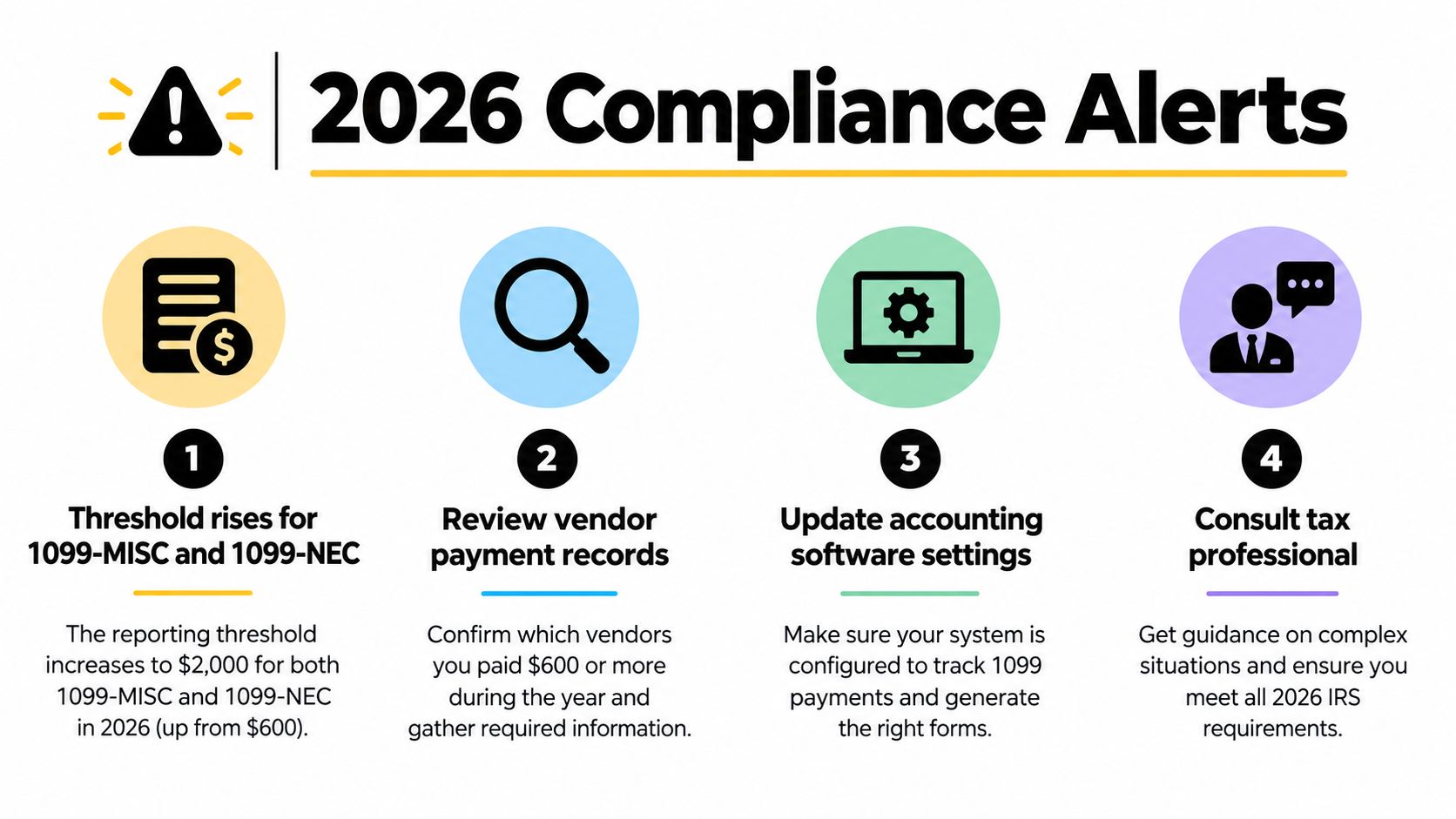
For payments made after December 31, 2025, the federal information-reporting threshold for Forms 1099-MISC and 1099-NEC increases from $600 to $2,000. The IRS estimates that about 3.6 million taxpayers are affected, roughly 98% are small entities, and qualifying businesses are expected to issue an average of 10 fewer information returns under the higher threshold, according to the IRS explanation of the business tax provisions.
That reduction in filing volume doesn't excuse weak vendor records. A subcontractor, supplier, equipment-rental company, or outside service provider should be identified, classified, paid, and coded consistently throughout the year. At year-end, the 1099 review should be a report query, not an archaeological dig through email attachments.
Payroll records need the same discipline
For 2026 payroll compliance, employers pay Social Security tax at 6.2% for both the employee and employer, up to the $184,500 Social Security wage base. Medicare tax remains 1.45% for both sides and has no wage-base limit, as stated in the IRS Form 941 instructions.
That means payroll records must track year-to-date taxable wages, employee withholding, employer payroll expense, and the point at which the Social Security wage base applies. Job costing must then connect the labor expense to the correct project without losing the payroll-liability detail needed for Forms 941 and W-2 reporting.
Retention is part of the system
The IRS doesn't require a particular bookkeeping platform. It does require a method that clearly and accurately reflects income and expenses and preserves supporting documentation. Employment-tax records generally must be retained for at least four years after the tax becomes due or is paid, whichever is later. Certain sick-leave, family-leave, and employee-retention-credit wage records may require six years, according to the IRS recordkeeping requirements for businesses.
Keep digital copies of time records, W-4 forms, tax deposits, filed returns, fringe-benefit support, vendor records, and reconciliations. Organized records also help businesses evaluate credits, including the qualified small-business research-credit payroll-tax offset, whose maximum election is $500,000 for eligible tax years beginning after 2022.
Compliance rule: A tax return is only as defensible as the records behind it.
Why Most Small Businesses Need a Fractional CFO
A job-costing system needs an owner who reviews it, a bookkeeper who maintains it, and a financial leader who turns the results into decisions. Most small-business owners are already bidding work, scheduling crews, collecting receivables, handling customers, and solving problems that never appear on a balance sheet. They don't need another dashboard to ignore.
They need someone to review labor and material variances, refresh burden rates, enforce change-order approval, update the forecast-to-complete, reconcile payroll, and prepare the vendor records for year-end reporting. A fractional CFO provides that senior guidance without the cost of hiring a full-time controller.
The role isn't to produce impressive reports. It's to ask why a job is over budget, whether the remaining scope is priced correctly, whether cash will cover upcoming commitments, and which work the company should stop accepting. It also includes training the bookkeeper and creating procedures that survive when one employee takes a vacation.
Fractional CFO services for small businesses give owners a practical way to add that financial oversight. Bookkeeping and Accounting of Florida Inc. supports Jacksonville and Northeast Florida companies with bookkeeping, payroll, tax preparation, QuickBooks setup, audits, and fractional CFO guidance. The firm's construction accounting work includes organizing direct and indirect costs by project and producing job-cost reports that compare estimates with actual results.
The alternative is expensive: mispriced bids, unbilled changes, missed payroll details, weak vendor files, and year-end surprises. Accounting shouldn't be a once-a-year cleanup project. It should help decide which jobs deserve the next bid.
Bookkeeping and Accounting of Florida Inc. can set up QuickBooks job costing, connect payroll and source documents to the right cost codes, and review active-project variances with you. Visit Bookkeeping and Accounting of Florida Inc. to schedule a conversation about managed bookkeeping, contractor accounting, tax compliance, or fractional CFO guidance in Jacksonville and Northeast Florida.