
You finish a project, send the invoice, and assume the margin is intact. Then payroll clears, supplier bills arrive, subcontractor costs need reallocation, and the profit you expected disappears. That isn't a pricing problem alone. It's a bookkeeping problem caused by failing to connect every cost to the job that created it.
Thank you for reading this post, don't forget to subscribe!A job costing sheet gives each project its own financial record. It captures direct materials, direct labor, applied overhead, committed spending, billings, and expected remaining costs. For Florida contractors, trades, healthcare organizations, and other project-based businesses, that information supports pricing, cash-flow decisions, payroll allocation, tax reporting, and compliance.
Why Job Costing Sheets Save Businesses From Hidden Losses
A Jacksonville general contractor bids a commercial renovation at $500,000. Three months later, the project is behind schedule and the owner knows the budget is deteriorating, but nobody can identify the source. Materials cost more than expected. Employees logged extra hours. Subcontractor invoices arrived without consistent job or cost-code assignments.
The owner doesn't need another month-end report. The owner needs a live view of the project.
That's the role of a job costing sheet. It assigns every relevant transaction to a specific job so management can compare the original estimate with actual spending while work is still underway. A construction job cost sheet commonly separates labor, materials, subcontractor fees, and overhead, then compares actual costs with budgeted amounts on an ongoing basis, as described in NetSuite's construction accounting guidance.

The blind spot most owners discover too late
Without job-level tracking, expenses sit in broad accounts such as materials, wages, repairs, or subcontractors. Those accounts may be accurate for general ledger reporting, but they don't answer the questions that determine whether a project is working:
- Which cost code is over budget?
- Which subcontractor invoice belongs to which phase?
- How much labor has the team consumed?
- What costs have already been committed but not invoiced?
- What will the job cost when it reaches completion?
A global database of more than 16,000 projects found only 47.9% finished within the original budget, according to construction job costing guidance. Transportation infrastructure projects were particularly difficult, with almost 9 in 10 underestimated and actual costs averaging 28% above original estimates. Those figures don't prove that every project will overrun, but they show why waiting until completion to investigate costs is reckless.
Practical rule: If you can't identify the cost, job, phase, and person responsible for an expense, you don't have adequate project control.
What the sheet changes
A properly maintained sheet turns an unpleasant surprise into an early warning. If labor is consuming the budget faster than production is progressing, the project manager can change staffing, revise the schedule, discuss a change order, or stop accepting similar work at the same price.
The sheet also improves estimating. Completed jobs provide actual cost information for future bids instead of relying on memory or optimistic assumptions. Owners can see which services produce acceptable margins and which clients, phases, or project types repeatedly consume cash.
Job costing isn't paperwork for its own sake. It's how a business stops confusing revenue with profit.
Anatomy of a Job Costing Sheet and What Each Field Means
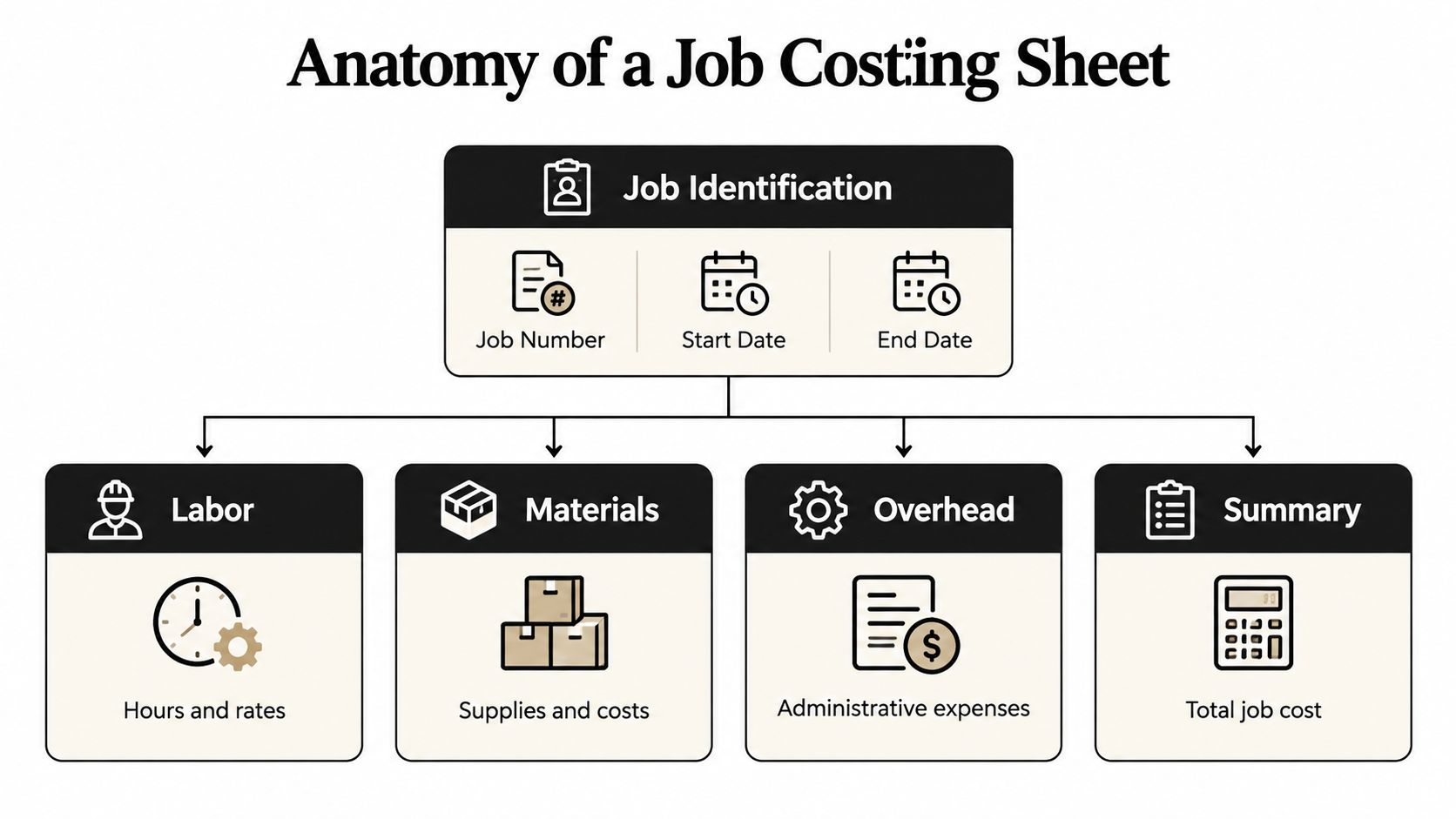
A job costing sheet should be simple enough for employees to use consistently and detailed enough for the accounting team to reconcile. It functions as a subsidiary ledger for Work-in-Process inventory, with each open job carrying its own accumulated costs.
The accounting relationship matters: the total of all open job cost sheets should equal the Work-in-Process balance in the general ledger. That connection helps expose timing issues, missing postings, duplicate entries, and expenses assigned to the wrong project. The core flow of materials, labor, overhead, WIP, Finished Goods, and Cost of Goods Sold is explained in this job-order cost flow resource.
Start with job identification
The top of the sheet should establish exactly what the record represents:
- Job number: Use one unique identifier across estimates, purchase orders, time entries, vendor bills, change orders, and invoices.
- Description: State the customer, project scope, location, or department clearly enough that another person can recognize the work.
- Start and completion dates: Record the planned dates and update the actual completion date when the work ends.
- Units completed: Use an appropriate production measure, such as installed units, completed phases, visits, or service deliverables.
These fields prevent costs from drifting between similar projects. They also make reports useful to people who weren't involved in the original sale.
Separate the three cost categories
Direct materials are supplies or components traceable to the job. Record vendor, invoice date, purchase order, quantity, cost, and cost code where practical. A materials purchase that sits in a general expense account without a job assignment weakens both profitability reporting and future estimating.
Direct labor includes the time people spend performing the work. A useful labor entry identifies the employee, classification, rate, job, cost code, and entity. Construction payroll guidance from Jonas Construction emphasizes this level of detail because payroll records may need to be assigned before wages, overtime, taxes, deductions, and fringe amounts are calculated.
Applied manufacturing overhead represents indirect production costs that support jobs but can't be traced to one project directly. The business applies overhead using a consistent rate or allocation method. The rate should be reviewed when operating conditions change, not treated as a permanent guess.
The cost summary should show budget, actual cost, committed cost, estimated cost to complete, projected final cost, billings, and margin. Historical actuals alone are inadequate.
A job costing sheet is not just a record-keeping tool. It is an accounting control system.
For a broader explanation of cost accounting structure outside the United States, the job costing guide for UAE businesses offers useful comparative context.
Industry Examples: How Construction, Healthcare, and Trades Use Job Costing
Job costing produces useful decisions only when each industry tracks the costs that reduce margin. Construction needs phase-level control. Healthcare organizations need department, facility, and capital-project visibility. Plumbing, HVAC, and electrical companies need service-level detail.
| Industry | Key Cost Categories | Primary Use Case |
|---|---|---|
| Construction | Labor, materials, subcontractors, equipment, overhead, change orders | Compare budget with projected final cost by project phase |
| Healthcare | Contractor costs, construction materials, equipment, staff time, departmental overhead | Control renovations, capital projects, and department-specific initiatives |
| Trades | Technician labor, parts, travel, equipment, callbacks, overhead | Measure profitability by service call, technician, customer, or work type |
Construction needs the deepest coding
A general contractor should assign every cost to a project and cost code. Vendor names and broad accounting accounts do not show whether concrete, framing, electrical work, permits, equipment, or subcontractors are driving an overrun. Track each category separately, then forecast the remaining cost before the project reaches closeout.
Give change orders their own treatment. The owner needs to see whether added revenue covers the added labor, materials, subcontractor charges, and overhead. That record also supports cleaner contract administration and year-end documentation, which matters as federal tax rules and compliance requirements change for 2026.
Industry research has repeatedly shown that large projects can exceed their budgets by substantial amounts. That risk makes disciplined coding and current forecasts management controls, not optional reporting. The construction job costing resource provides related guidance for organizing project costs.
Estimators may use specialized tools before work begins. For plumbing contractors, Exayard plumbing estimating software can support the estimate. The estimate still needs a controlled handoff into accounting, purchase commitments, payroll allocations, and job-cost reports.
Healthcare projects require accountability
A clinic renovating treatment rooms, adding equipment, or opening a location should separate project costs from routine operating expenses. Classify internal staff time, outside contractors, supplies, equipment purchases, and administrative allocations by department, facility, entity, or capital category.
The sheet should show whether spending remains within approved scope and whether each transaction reached the correct department or entity. It also gives leadership an audit trail for management review, financial reporting, and tax support. A fractional CFO can set the coding rules, review exceptions, and connect daily tracking with compliance work.
Trades need operational detail
An HVAC, electrical, or plumbing company can lose margin through unbilled return visits, excess parts, technician overtime, unquoted travel, or warranty work assigned to the wrong job. Link those costs to the customer, service ticket, technician, and work type.
Review results by service call and compare quoted work with actual performance. This view exposes which jobs, customers, technicians, and service categories produce acceptable margins. A monthly income statement alone will not identify those leaks or show which estimates need correction.
How to Build and Maintain a Job Costing Template in QuickBooks
A Florida contractor can finish a profitable-looking project and still discover a loss because labor, materials, purchase commitments, or change orders were assigned late. That problem starts with weak tracking, not with the income statement. A spreadsheet may work for a very small operation with one editor, few projects, and daily entry. It becomes risky when several people edit it, payroll allocations arrive late, purchase orders go unrecorded, and staff cannot identify the authoritative version.
QuickBooks gives the accounting team a stronger foundation when jobs, classes, locations, customers, vendors, payroll, and expenses follow consistent rules. Keep the accounting file as the source of truth, then use job-cost reports for operational decisions. This structure also supports the documentation needed for tax reporting and compliance work.

Build the structure before entering transactions
Create a unique job number and define cost codes before the first purchase. Use the same naming convention in estimates, customer records, purchase orders, time sheets, vendor bills, and invoices. If the naming changes between departments, month-end reconciliation becomes a manual investigation.
Decide how QuickBooks will represent each project. Depending on the workflow, use customer jobs, classes, locations, or a connected construction application. The label matters less than consistent assignment. Every transaction must reach the correct project and category without someone reinterpreting it later.
Use this setup:
- Create the job record: Add the customer, project name, location, contract details, start date, and expected completion date.
- Map estimate lines: Keep the estimator's cost categories so budget and actual reports remain comparable.
- Assign vendor bills: Code materials, subcontractor costs, equipment, and other expenses to the correct job and phase.
- Capture labor correctly: Require employees to enter time against the job and cost code, then reconcile those entries to payroll.
- Record billings and change orders: Keep revenue activity within the same project structure used for costs.
If field teams log time in a separate app, the Pebb QuickBooks connector can push those entries into QuickBooks automatically, eliminating manual re-entry that causes job-cost variances. Integrate only after deciding which fields, approvals, and exception checks the accounting team will control.
Maintain the sheet as a live control
Review job activity weekly. Match receipts, bills, purchase orders, time entries, subcontractor invoices, and payroll allocations to the correct job before memories fade. Assign one owner to investigate missing documents and coding exceptions.
At month-end, compare:
- Original budget with actual cost
- Committed cost with invoiced cost
- Cost incurred with work completed
- Projected final cost with contract value
- Billings with cash collected
Forecast cost to complete for every active job. Update each remaining cost line, recalculate projected final cost, and investigate variances while management can still correct them. Historical invoices show what the project has consumed. They do not show how much cash or labor the remaining work will require.
The QuickBooks construction job costing guide offers practical context for connecting estimate lines, invoices, payroll allocations, and vendor bills to a specific project.
Know when to stop using Excel
Multiple editors, changing formulas, missing approvals, and conflicting versions make spreadsheet-based costing unreliable. Errors can hide inside formulas until a project is complete, when correcting the margin becomes impossible. The risk grows as projects, employees, cost codes, and change orders multiply.
Use Excel only while its controls match the operation's complexity. Once they do not, move to integrated accounting, lock formulas, establish approval rules, assign an owner for data quality, and have a fractional CFO or other accounting professional review the workflow. Accurate job costing is a management control today and a compliance record when federal or Florida reporting questions arise.
Tax Law Changes and Compliance Requirements for 2026
A contractor finishes a project, but the books cannot show which vendor was paid, which job received the materials, or whether equipment was placed in service. That is more than a bookkeeping gap. It can create reporting, deduction, and audit problems before tax preparation starts. A job costing sheet should connect each transaction to its payee, project, cost category, and business purpose.
The projected 2026 changes make accurate records more important. Under the 2025 reconciliation act, the Form 1099-NEC and 1099-MISC reporting threshold is scheduled to rise from $600 to $2,000. The higher threshold does not remove the need to retain contractor records. Keep the payee's tax information, payment history, job assignment, and supporting invoices even when a form may not be required.
The Section 179 expensing limit is projected to increase to $2,560,000 for 2026. A deduction still depends on proper documentation. Record what the business purchased, when it was placed in service, how it was used, and which business activity or project benefited. Separate capital purchases from ordinary job costs so the tax preparer can apply the correct treatment.
Florida businesses still need organized records
Florida companies may work across several local jurisdictions, serve customers in multiple counties, or hire vendors who move between job sites. Consistent entity, project, payroll, and vendor coding gives owners, lenders, tax preparers, auditors, and regulators a usable record of what happened.
A Jacksonville-area company may assign work across Duval, Clay, and St. Johns counties. The county names do not create a substitute for proper accounting. They make consistent coding more important, particularly when payroll, materials, subcontractors, and equipment serve multiple locations.
Small business owners often know that a contractor received payment but cannot determine whether the payment requires information reporting, whether an equipment purchase qualifies for a deduction, or how payroll should be allocated across jobs. That uncertainty belongs in the accounting process, not at year-end.
Treat compliance as a process, not a deadline
Set up vendor onboarding, collect tax forms, code payments, review payroll allocations, track capital assets, reconcile accounts monthly, and prepare year-end records from the same underlying system. The job costing sheet must support accounting rather than sit apart as a spreadsheet assembled after the books close.
Compliance discipline: Record the transaction correctly when it occurs. Reconstructing the facts later is slower, more expensive, and less reliable.
Bookkeeping and Accounting of Florida Inc. provides bookkeeping, payroll, tax preparation, audits, reviews, healthcare accounting, and construction job-costing support. Professional oversight can connect daily records with federal reporting and Florida business obligations. Owners who need that support can review Florida fractional CFO and small-business accounting guidance.
Why Every Growing Business Needs a Fractional CFO Beyond Bookkeeping
Clean job costing answers what happened. A fractional CFO helps determine what to do next.
A bookkeeper may reconcile transactions, post bills, process payroll, and produce reports. Those functions are necessary, but they don't automatically tell an owner whether to raise prices, reject a type of work, renegotiate a supplier agreement, delay hiring, or preserve cash for a project that is consuming more working capital than expected.
A fractional CFO uses job-level information as a decision system. The work includes reviewing margins by project, testing pricing assumptions, analyzing cash requirements, monitoring backlog, evaluating customer profitability, and building forecasts that management can use.
Turn project data into management decisions
Suppose several completed projects show that a service line consistently requires more labor than the estimate allows. The response isn't to blame employees for being slow. A CFO investigates the estimating assumptions, production method, scope language, staffing model, and change-order process.
If the problem is pricing, the next quote must change. If the problem is scope, the contract needs clearer exclusions. If the problem is operations, management needs a different schedule or labor plan.
Job costing can also reveal that revenue growth is creating a cash squeeze. A project may appear profitable on paper while requiring substantial spending before customer collections arrive. A fractional CFO connects project billing schedules, vendor terms, payroll dates, debt obligations, and cash reserves.
Why small businesses need senior guidance
Growing businesses often can't justify a full-time CFO, but they still need someone to interpret financial information. A fractional arrangement gives the owner access to financial leadership without adding a permanent executive salary and benefits structure.
Bookkeeping and Accounting of Florida Inc. is a locally owned CPA firm based in Jacksonville that has supported businesses for more than 20 years across healthcare, construction, retail, and nonprofit organizations. Its team includes certified QuickBooks ProAdvisors and provides bookkeeping, accounting, payroll, tax preparation, internal and independent audits, reviews, forensic audits, and fractional CFO services.
The firm is also rated among the top ten firms in the region, according to the publisher information, and focuses on turning timely financial information into planning, cash-flow management, and decision-making support. That combination matters because a job costing sheet is only valuable when someone reviews the numbers, challenges weak assumptions, and acts before the margin is gone.
A business accounting partner should help you maintain accurate books, assign costs correctly, stay compliant, and understand the financial consequences of each major decision. Owners shouldn't have to guess whether a project is profitable or discover a reporting issue after the deadline.
Bookkeeping and Accounting of Florida Inc. can organize your QuickBooks job costing, reconcile labor and vendor costs, track committed spending, support 2026 tax compliance, and provide fractional CFO guidance for pricing and cash flow. Visit Bookkeeping and Accounting of Florida Inc. to schedule a consultation and replace uncertain project margins with financial control.