
Payroll compliance is the ongoing practice of paying employees correctly, withholding and depositing the right taxes, and filing required returns with federal, state, and local authorities on time. For 2026, that includes a Social Security wage base of $184,500, a 6.2% Social Security tax rate for both employees and employers, and a combined Social Security and Medicare rate of 7.65% for each side.
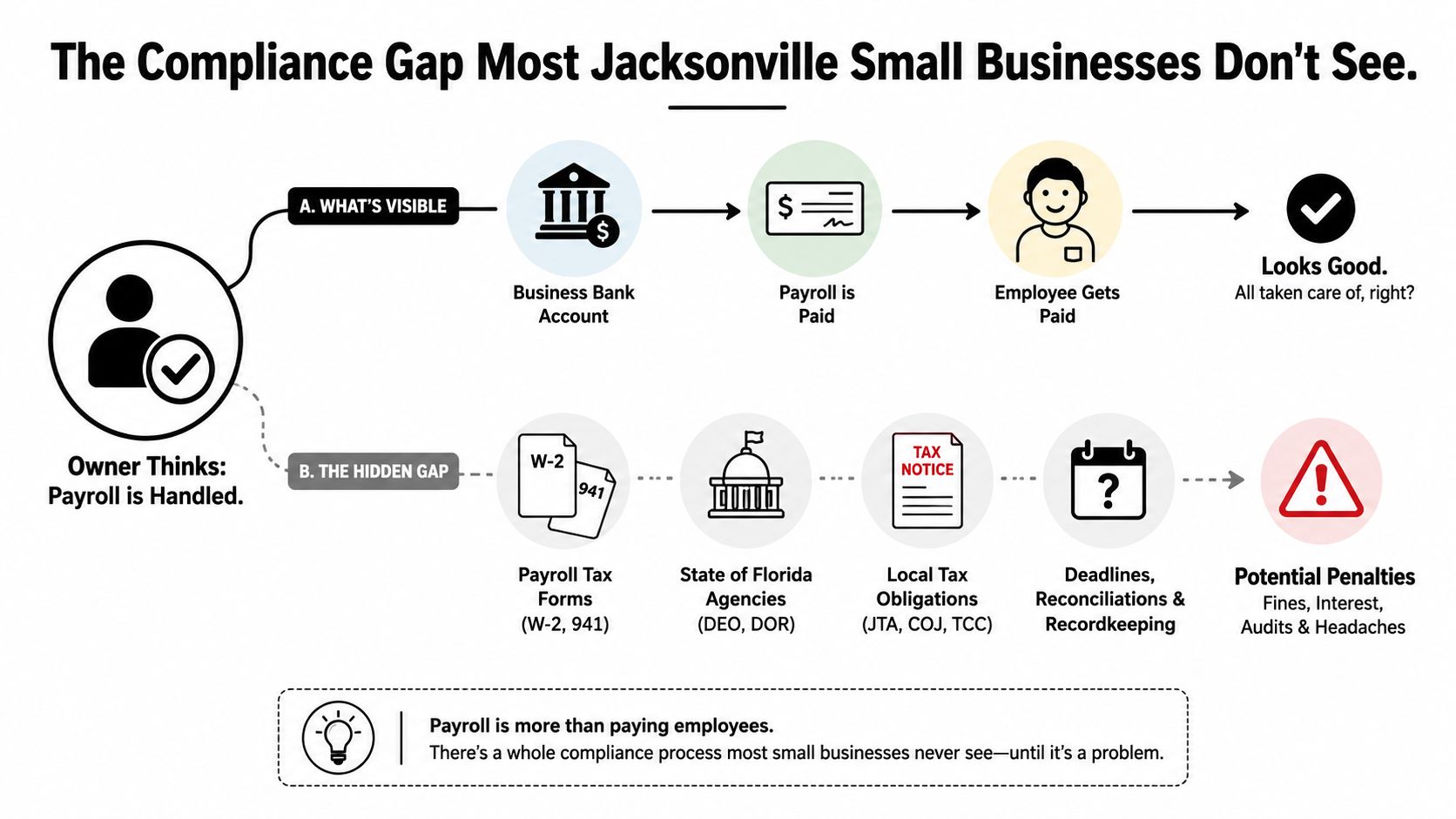
Thank you for reading this post, don't forget to subscribe!You may be sitting in your Jacksonville office right now with the bank account reconciled, payroll processed, and employees paid without a complaint. That feels like payroll is handled. But a successful direct deposit only proves money reached employees. It doesn't prove the business classified workers correctly, deposited payroll taxes on schedule, filed every return, or kept the evidence needed to defend those decisions.
For a Northeast Florida small business, payroll compliance is an operating discipline, not a button inside payroll software. Federal requirements sit alongside Florida reemployment tax rules, local obligations, wage-and-hour requirements, worker classification decisions, and changing tax instructions. The owners who stay out of trouble aren't necessarily payroll experts. They have a process, someone accountable for reviewing it, and a local accounting partner who notices when the process starts falling behind.
The Compliance Gap Most Jacksonville Small Businesses Don't See
A Riverside restaurant owner finishes the weekly payroll run before the lunch rush. The bank reconciliation agrees with the payroll report, employees receive their direct deposits, and nobody calls to say the amount looks wrong. The owner marks payroll complete and moves on to inventory.
That routine can hide a serious gap. Running payroll and proving compliance aren't the same job. A paycheck may be accurate while a federal tax deposit is late, a reemployment tax report is missing, an overtime calculation is wrong, or a worker's classification no longer matches the way that person works.
Consider a server who becomes a shift supervisor. The title changes gradually, the hourly rate gets adjusted, and payroll continues as usual. Or consider a contractor who starts working the same schedule as employees, follows the manager's daily instructions, and uses the company's tools. The business keeps paying on time, but the underlying facts may have changed the company's obligations.
The notice arrives after payday
Payroll failures rarely announce themselves during the payroll run. They often appear later as an agency notice, a missing-credit letter, an audit request, or an unexpected tax bill. By then, the person who entered the original information may not remember why a rate, address, pay code, or classification was selected.
The danger usually isn't one dramatic mistake. It's process lag, such as:
- Outdated employee data: A work location, address, pay rate, or withholding election no longer matches reality.
- Unassigned deadlines: Someone assumes the payroll provider filed the return, while the provider assumes the business approved it.
- Unreviewed exceptions: Overtime, tips, leave, bonuses, reimbursements, and deductions flow through without a manager confirming the underlying records.
- Missing evidence: The business paid the tax but can't quickly produce the confirmation, return, or calculation supporting it.
Practical rule: If nobody can explain who reviewed a payroll exception and where the supporting record lives, the process isn't under control.
A Jacksonville CPA adds practical value by connecting the worker, location, pay code, filing schedule, and agency requirement. Payroll compliance becomes a repeatable system of deadlines, evidence, and review instead of a quarterly chore that gets attention only after a letter arrives.
What Payroll Compliance Actually Means
So, what is payroll compliance in practical terms? It's the complete chain from collecting accurate employee information to paying wages, withholding and depositing taxes, filing returns, issuing year-end forms, and preserving records that support every step. Gross pay is not the finish line. It's one calculation inside a larger control process.
Before payroll closes, someone should verify:
- Worker status: Employee or independent contractor, based on the actual working relationship, not merely the contract label.
- Time and pay: Approved hours, pay rates, overtime eligibility, tips, leave, reimbursements, and deductions.
- Employee elections: Current Form W-4 information and properly completed employment documentation.
- Exceptions: New hires, terminations, raises, role changes, bonuses, garnishments, and unusual pay codes.
After payroll runs, the business must reconcile gross-to-net pay, withhold federal income tax, Social Security, and Medicare, account for employer taxes, make deposits, file required returns, deliver employee statements, and retain supporting records. The basics of payroll processing can help organize the mechanical sequence, but compliance depends on the review around the software.
Think in layers, not one rulebook
Federal rules form the foundation. The Fair Labor Standards Act established a nationwide baseline for minimum wage, overtime, recordkeeping, and youth employment standards, according to the International Labour Organization's labor statistics and standards resources. Florida requirements add another layer, including reemployment tax administration and state reporting. Local requirements may complete the structure, depending on the worker, location, and tax involved.
Satisfying one layer doesn't satisfy the others. A business can withhold federal taxes correctly and still mishandle Florida reemployment reporting. It can file a state return and still owe a correction for unpaid overtime. Payroll compliance is therefore ongoing, especially as rules change across jurisdictions. The ILOSTAT platform provides access to almost 100 million labor-statistics data points, a reminder of how extensively employment, earnings, and wage administration are measured across economies.
Payroll software can calculate and submit information, but the employer remains responsible for the source data, approvals, deadlines, and reasonable review. Strong compliance means each number traces to an approved source, each filing has confirmation, and each exception has a named owner.
This short video offers another visual explanation of the payroll process:
Federal and Florida Rules That Apply to Every Paycheck
A Jacksonville employer should treat each payroll run as a checklist of obligations, not merely a calculation of net pay. Start with the federal baseline. Maintain a valid Form I-9, collect Form W-4 withholding elections, calculate federal income tax using the current IRS method, withhold Social Security and Medicare, pay the employer share, and meet federal wage-and-hour requirements.
For 2026, Social Security applies up to a $184,500 wage base, with a 6.2% employee rate and 6.2% employer rate. The combined Social Security and Medicare payroll tax rate is 7.65% for each side, and wages above $200,000 are subject to an additional 0.9% Medicare withholding for employees, as summarized in this 2026 payroll tax update.
The IRS deposit schedule depends on the lookback period. Employers that reported $50,000 or less in employment taxes generally deposit monthly by the 15th day of the following month. Employers above that threshold generally deposit semiweekly, according to IRS Tax Topic 757. If accumulated employment tax liability reaches $100,000 or more on a day during a deposit period, the deposit is due by the next business day, regardless of the normal schedule. Keep the payroll tax deposit schedule accessible to the person who approves payroll.
Florida adds obligations of its own
Florida generally doesn't impose a state individual income tax, but payroll isn't tax-free. Register with the Florida Department of Revenue when required, file reemployment tax reports, pay contributions, provide required electronic earning statements, and address sales and use tax when the business's activities make that relevant. Jacksonville rules can differ from requirements in other Florida communities, so don't assume another Florida location uses the same workflow.
Worker classification deserves special care. A contract calling someone an independent contractor doesn't settle the matter if the working relationship looks like employment. Owners reviewing contractor arrangements may find this resource on exemption qualifications for contractors useful, but an edge case still deserves current-agency or professional review.
| Requirement Area | Federal Baseline | Florida or Local Requirement | Owner Control to Verify |
|---|---|---|---|
| Worker documentation | Form I-9 and Form W-4 | Maintain current state and local employee information | Confirm forms, addresses, status, and work location |
| Wage and hours | Minimum wage, overtime, final-pay, and recordkeeping standards | Apply Florida rules and any applicable local obligations | Approve hours, rates, tips, leave, and overtime |
| Payroll taxes | Federal income tax, Social Security, Medicare, FUTA, deposits, and returns | Florida reemployment tax and applicable local requirements | Confirm filing frequency, payment evidence, and confirmations |
| Reporting | Forms 941, 940, W-2, and applicable information returns | RT-6 and other required state filings | Match returns to payroll registers and deposits |
| Classification | Apply the facts of the working relationship | Review Florida-specific consequences and insurance considerations | Recheck roles when duties, control, or schedules change |
For 2026, IRS Publication 15 states that the threshold for certain reporting increased from $600 to $2,000 in a calendar year. Payroll owners should review the current IRS Publication 15 guidance before configuring reporting codes or approving year-end forms.
The Mistakes That Trigger the Most Pain
A long-time hourly crew leader gets treated as a 1099 contractor because the owner and worker both like the simplicity. The worker still follows the company's schedule, takes direction from a supervisor, and performs the same core work as staff. The mistake isn't the label. It's failing to evaluate the actual relationship, which can lead to incorrect withholding, wage calculations, reporting, and back-pay exposure.
Another Jacksonville business gives a salaried employee a raise, but the employee's duties and overtime treatment don't receive a fresh review. Compensation and classification drift apart. If the employee should have received overtime, the business may face back pay and equal liquidated damages under wage-and-hour enforcement rules.
Small operational shortcuts create large cleanup projects
A cash-flow crunch causes an owner to delay a federal tax deposit. That decision doesn't erase the liability. Federal failure-to-deposit penalties can increase according to how late the deposit becomes, and a late Form 941 creates another filing problem.
A growing employer also forgets that Florida reemployment tax administration requires attention as the business adds staff and wages. The company runs payroll correctly inside the software but never reconciles the payroll register to the bank statement. Months later, the general ledger, tax deposits, and payroll reports don't agree, and nobody knows whether the error came from a duplicate entry, an incorrect liability account, or an unrecorded payment.
The pattern is predictable:
- Classification drift: A contractor's day-to-day work begins looking like employment.
- Overtime drift: A role changes, but the pay setup stays frozen.
- Deposit delay: Cash pressure pushes a required payment past its deadline.
- State reporting lag: The business doesn't update or review its Florida reemployment tax setup.
- No reconciliation: Software totals never get compared with the bank and general ledger.
Businesses with seasonal or specialized labor face extra moving parts. If you need help with immigration-related seasonal staffing, a specialist can explain how to prepare a compliant H-2B case, while your CPA keeps payroll records and tax reporting aligned.
How Much a Payroll Mistake Really Costs
Payroll mistakes become expensive because different failures can stack. A late federal tax deposit can carry a penalty of 2% when it is 1 to 5 days late, 5% when it is 6 to 15 days late, 10% when it is 16 or more days late, and 15% if it remains unpaid 10 days after the first IRS notice, according to the payroll compliance penalty guidance from Hyring.
A late Form 941 filing can add 5% per month, up to 25% of unpaid tax. Wage-and-hour errors bring a different kind of exposure, because incorrect overtime or minimum-wage treatment can produce back pay plus equal liquidated damages. The point is simple: the cost depends on the error, the delay, and whether several obligations failed together.
| Violation | Federal Penalty | Florida Penalty |
|---|---|---|
| Late federal tax deposit | 2%, 5%, 10%, or 15%, based on timing | Not applicable to the federal deposit |
| Late Form 941 | 5% per month, up to 25% of unpaid tax | Not applicable to the federal return |
| Wage or overtime error | Back pay plus equal liquidated damages, with possible civil penalties for willful violations | Florida obligations may also apply depending on the facts |
| Unpaid payroll liability | Additional costs can continue while the balance remains unresolved | State consequences depend on the filing and payment involved |
Don't use unsupported penalty figures as a budgeting tool. The applicable rule depends on the specific return, liability, notice, and facts. Use the penalty ladder to justify prompt review, not to guess at an invoice from an agency.
The better financial decision is to fund a controlled payroll process before a notice forces an expensive cleanup. A local bookkeeper or fractional CFO costs money, but an owner who waits may pay for corrections, amended filings, employee disputes, professional fees, and lost management time.
Recordkeeping Best Practices That Keep You Audit-Ready
A payroll recordkeeping system should be boring, consistent, and easy for another person to follow. For payroll records, plan around the four-year retention period described in the IRS rules referenced by the required recordkeeping standard. Keep the material that explains how each pay period moved from approved work to reported wages.
For every pay period, preserve total pay, deductions, hours worked, tips, and Form W-4 elections. Store copies of W-2s, 1099s, state unemployment rate notices, workers' compensation certificates, tax returns, deposit confirmations, and approval records.
Give each cadence one owner
A weekly bank-to-payroll reconciliation catches mismatches while the source records are still easy to locate. Each month, compare the payroll register, general ledger, and bank statement in a three-way review. Each quarter, compare Form 941 with actual deposits before submitting the return.
Use digital storage with controlled access and a backup. Choose one file naming convention, such as employee or filing period plus document type, and keep a single source of truth. During an audit or agency inquiry, the owner should be able to retrieve a record quickly instead of searching through email attachments and personal desktops.
- Payroll records: Retain wage, deduction, hour, tip, and withholding support.
- Tax filings and deposits: Save submitted forms, payment confirmations, notices, and responses.
- Timekeeping and calculations: Preserve timesheets, overtime calculations, pay stubs, and approvals.
- Authorization and changes: Keep signed or documented approval for pay rates, deductions, direct deposit, and role changes.
The most useful test is practical. Ask an office manager to retrieve a particular payroll record without coaching. If the answer is “I think it's in the payroll portal,” the business needs a clearer retention and ownership process.
Why a Local CPA and Fractional CFO Change the Equation
Payroll compliance becomes manageable when one person owns the workflow and another reviews the financial effect. A local CPA can translate federal requirements, Florida reemployment tax administration, and Jacksonville-area operating realities into procedures your staff can follow. That includes reviewing FDOR correspondence, EDR reemployment tax rate notices, worker classifications, filing confirmations, and payroll-related general ledger accounts.
A fractional CFO works above the transaction level. The role isn't just to run payroll. It's to reconcile payroll to the books, forecast cash needed for upcoming withholding deposits, identify unusual labor-cost movement, and flag classification or pay-code risk before the problem becomes a Form 941 amendment or a Form SS-8 dispute.
Local knowledge matters operationally
A business in Riverside may have a different staffing pattern from a contractor working near the Beaches. A healthcare practice may need tighter controls over variable shifts, bonuses, and deductions. A construction company may need payroll and job-costing records to agree. A nonprofit may need clean payroll allocations for reporting and audit support.
That range is why small businesses need access to senior financial guidance without hiring a full-time CFO. A provider such as fractional CFO services for small business can help build a monthly close, cash forecast, payroll review, and management reporting cadence around the business's actual needs.
Payroll compliance isn't a software feature. It's a chain of decisions, approvals, payments, filings, and records. Someone has to own the chain.
The payoff is practical: fewer quarter-end surprises, cleaner books for lenders or investors, faster responses to agency questions, and a defensible record if an auditor asks how a number was calculated. The right advisor doesn't make the owner memorize every payroll rule. They make sure the business has a reliable way to identify, apply, document, and revisit those rules.
Your Payroll Compliance Checklist and Next Step
Use this as a working checklist, then assign every item to a named person. A task without an owner is just a future surprise wearing office clothes.
Every pay period
- Confirm employee data: Review work location, status, pay rate, deductions, and withholding elections.
- Approve time and wages: Check hours, overtime eligibility, tips, leave, reimbursements, and unusual pay codes.
- Reconcile the run: Match the payroll register to expected cash movement and investigate exceptions.
- Document approval: Keep evidence showing who reviewed and approved the payroll.
Monthly
- Verify deposits: Confirm the business followed its applicable federal deposit schedule.
- Reconcile liabilities: Compare payroll tax liability accounts with payments and confirmations.
- Review changes: Look for new hires, terminations, raises, role changes, contractors, and updated agency notices.
- Protect records: Back up payroll files and confirm access is limited to appropriate users.
Quarterly
- Review Form 941: Compare the return with payroll registers and actual federal deposits before filing.
- File Form 940-related records: Maintain the information needed for federal unemployment reporting.
- File Florida RT-6: Review Florida reemployment tax reporting and payment records.
- Check workers' compensation support: Keep policy documents, certificates, payroll classifications, and audit materials organized.
Annually and at year-end
- Issue W-2s and 1099s: Reconcile year-end totals before distributing or filing information returns.
- Review Form I-9 retention: Keep required employment eligibility records accessible and secure.
- Review classification: Reassess contractors and employees whose duties or working arrangements changed.
- Confirm four-year retention: Preserve payroll records under the applicable IRS retention standard.
- Update the system: Apply current tax thresholds, withholding instructions, pay codes, and filing settings before the next year begins.
Book a 30-minute Jacksonville payroll compliance review with a local CPA. The review should examine the last three months of filings, reconcile catch-up items, verify deposits and Florida reporting, and establish a monthly cadence before the next quarter closes. That's risk reduction, not paperwork for paperwork's sake.
Bookkeeping and Accounting of Florida Inc. provides bookkeeping, managed payroll, federal and Florida payroll tax filing support, year-end W-2 and 1099 preparation, tax services, and fractional CFO guidance for Northeast Florida businesses. Visit Bookkeeping and Accounting of Florida Inc. to schedule a payroll compliance review and turn your payroll checklist into a documented operating system.