
Payroll accounting is the process of recording employee compensation, calculating gross and net pay, tracking deductions, and documenting reporting obligations, including payroll records generally retained for at least three years and supporting records for two years. Small-business owners often underestimate that compliance exposure, which is why professional guidance matters long before a payroll notice arrives.
Thank you for reading this post, don't forget to subscribe!You're finishing a Jacksonville construction estimate when an employee texts about missing overtime. Your office manager says payroll went through, QuickBooks shows a bank withdrawal, and nobody can explain whether the job-cost report includes the correction. Employees got paid, but you still don't know whether the books are right.
That's the gap between running payroll and managing it. You don't need another dashboard to admire. You need someone responsible for checking the information, maintaining the evidence, and explaining what your labor costs.
Why Payroll Accounting Matters More Than You Think
Consider a hypothetical Jacksonville contractor whose crew works across different jobs. The owner approves payroll from a phone, the office submits the hours, and everyone assumes the payroll provider handles everything else. Then a filing question surfaces, and nobody knows who was supposed to resolve it.
The problem isn't necessarily the calculation. It's the missing ownership.
Payroll processing gets employees paid. Payroll accounting establishes what happened financially and what remains owed. A business can complete the first task while neglecting the second.
The exposure owners overlook
Small-business payroll survey reporting indicates that 84% experienced payroll errors, including incorrect wage calculations affecting 48%, late or missing payments 38%, incorrect hours 36%, and incorrect tax calculations 27%. Those categories explain why checking the final bank withdrawal isn't much of a control.
A wage correction can also require someone to revisit the job allocation, liability balance, and reporting records. When nobody owns that follow-through, management keeps making decisions from incomplete information.
Practical rule: Paying employees is the start of the accounting responsibility, not proof that you've finished it.
- For contractors: Assign labor to the work that generated it rather than leaving everything in an undifferentiated expense account.
- For healthcare practices: Review staffing costs by department or patient-care function.
- For nonprofits: Preserve documentation supporting labor allocations rather than reconstructing them when a reviewer asks.
A fractional CFO should establish accountability for these decisions. An outsourced bookkeeper should maintain the underlying records and identify exceptions.
My recommendation is simple: Every company needs financial guidance, but not every company needs a full-time CFO. Owners should run the business, not serve as the emergency research department for every payroll question.
The Four Building Blocks of Every Paycheck
A restaurant owner sees wages leaving the checking account. An accountant needs to distinguish employee earnings, amounts withheld, employer obligations, and benefit costs. Those aren't interchangeable categories.
Use this framework when reviewing a payroll register, whether it comes from QuickBooks Payroll or another system.
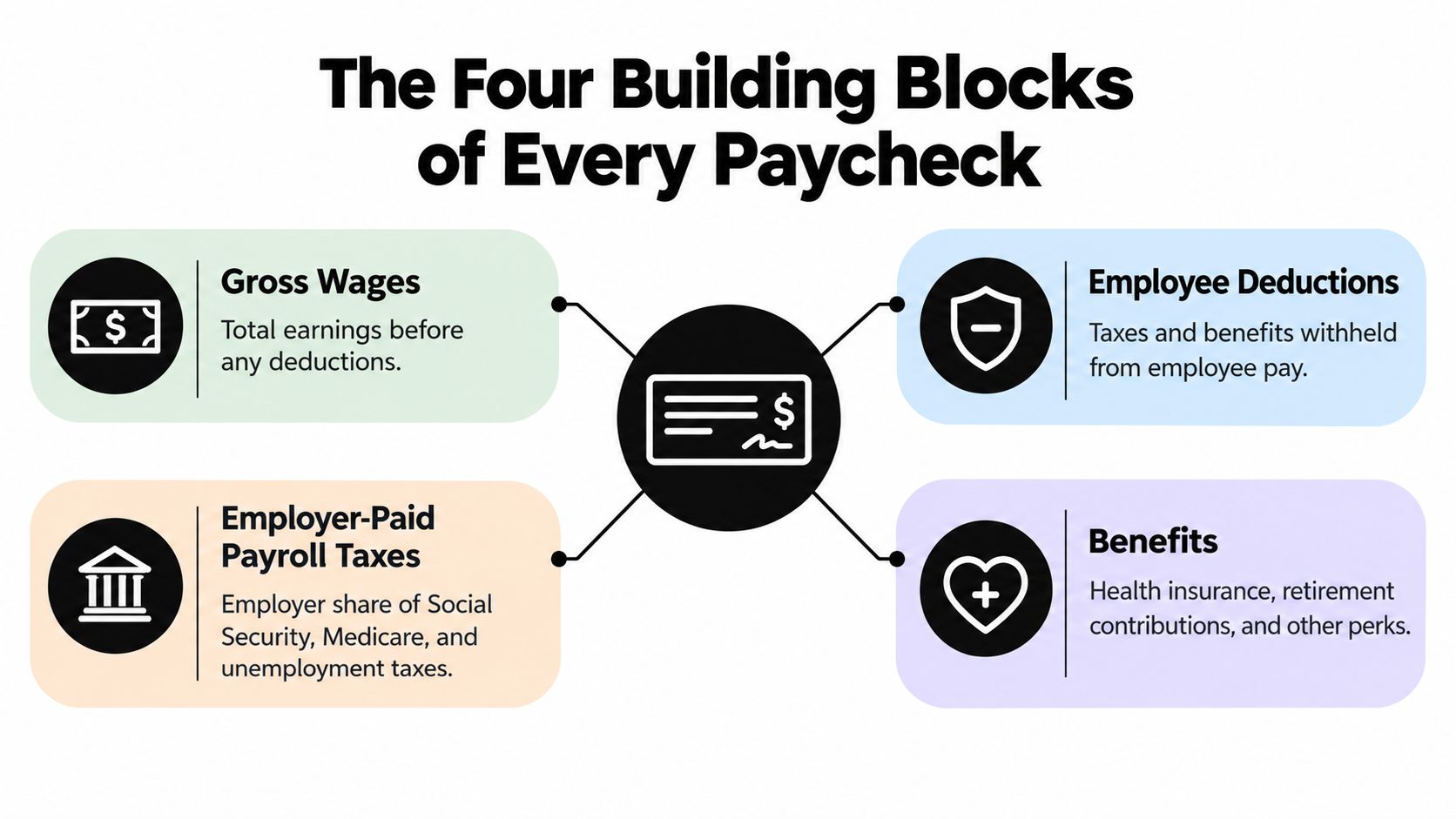
Read the paycheck and the employer cost separately
- Gross wages: Start with total employee earnings before deductions. For a restaurant, examine approved working time and applicable compensation details rather than treating the final payment as the starting point.
- Employee deductions: Separate tax withholding from insurance, retirement, and other deductions. These amounts reduce take-home pay, but they don't automatically reduce the employer's wage expense.
- Employer-paid payroll taxes: Track the employer's obligations separately from taxes withheld from employees.
- Benefits: Distinguish employer-funded benefits from employee contributions. Otherwise, you risk confusing a business expense with money held for another party.
The working relationships are straightforward:
Gross pay minus employee deductions equals net pay.
Gross wages plus employer-paid taxes and benefits determine total labor cost.
Keep the supporting detail
The Department of Labor's wage-recordkeeping requirements require covered employers to maintain accurate records for covered, nonexempt workers, including daily and weekly hours, pay basis, regular hourly rate, straight-time and overtime earnings, additions or deductions, total wages, and payment dates.
That detail belongs behind the payroll register. A summary expense line doesn't replace it.
Software selection should follow the same logic. A tutoring business evaluating tools can consider Tutorbase's tutor payroll software as an industry-specific option, while separately evaluating its accounting workflow and review responsibilities.
Your bookkeeping team should make these components understandable. Your fractional CFO should use the employer-cost view when discussing hiring, pricing, and staffing budgets. A paystub answers what an employee receives; it doesn't answer what your business can afford.
How Payroll Actually Flows Through Your Books
Payroll journal entries should tell a complete story without requiring the owner to decode a mysterious lump-sum withdrawal. The accounts must distinguish what you incurred, what you owe, and what you paid.
This flow illustrates the posting sequence.
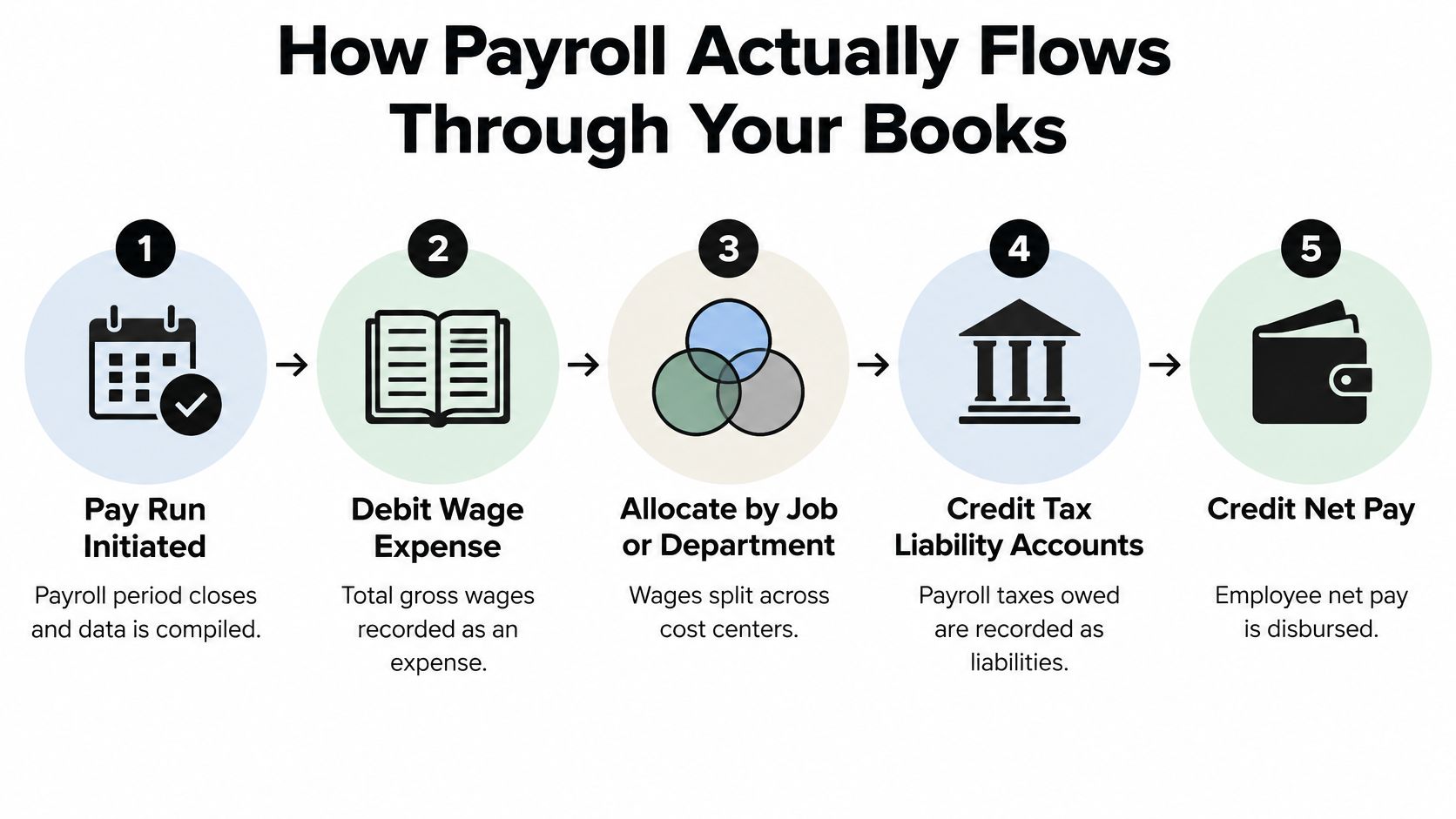
Follow the debits and credits
| Payroll event | Debit | Credit |
|---|---|---|
| Record employee earnings | Wage expense, allocated appropriately | Employee withholding and deduction liabilities, plus net wages payable |
| Record employer payroll taxes | Employer payroll tax expense | Employer payroll tax liabilities |
| Pay employees | Net wages payable | Cash |
| Remit withheld and employer taxes | Applicable payroll tax liabilities | Cash |
For a contractor, allocating wage expense means assigning labor to the appropriate jobs. For a medical practice, it might mean separating clinical departments from administration. The entry must reflect the underlying work, not merely the easiest software default.
Gross wages are the wage expense. Net pay is the employee payment. Treating those as the same amount understates what happened.
Under accrual accounting, earned but unpaid wages also need attention at period-end. Your accountant should identify the obligation and prevent the subsequent payroll posting from recording the expense again.
Keep deposits separate from reporting
IRS Publication 15 explains that federal income-tax withholding uses employee Form W-4 information and applicable withholding tables. It also distinguishes payroll from nonpayroll withholding deposits and identifies Forms 941, 943, or 944, depending on the employer's filing category.
A completed return doesn't, by itself, prove that the corresponding payment cleared. That's why your month-end review must connect payroll records, bank activity, liabilities, and filed returns.
Use this payroll reconciliation guide to organize that review. A fractional CFO should investigate unresolved balances, not accept them indefinitely because the software carried them forward.
For another way to follow payroll entries, use the accompanying video.
The Payroll Calendar Every Owner Should Live By
Build your payroll calendar around assigned responsibilities, not a collection of reminders nobody owns. “The provider handles it” isn't an assignment unless somebody has confirmed the provider's scope.
The SBA's business-management guidance identifies employer identification numbers, state and local tax IDs, W-4 collection, pay-period scheduling, worker classification, record retention, and quarterly and annual payroll reporting as core payroll responsibilities. It also calls for deciding who manages payroll and whether administration stays internal or moves outside.
Recurring 2026 Payroll Deadlines for a Jacksonville SMB
| Recurring Action | Typical 2026 Window | Owner |
|---|---|---|
| Confirm registrations and employee setup | Before processing affected payroll | Payroll lead and accounting adviser |
| Collect and review compensation changes | Before the relevant payroll cutoff | Manager and payroll preparer |
| Approve payroll funding | Each pay cycle | Authorized owner or finance lead |
| Make required tax deposits | According to the employer's assigned schedule | Designated payroll tax administrator |
| Prepare periodic payroll returns | Applicable quarterly or annual filing window | Filing preparer, with reviewer confirmation |
| Reconcile year-end employee reporting | During year-end preparation | Bookkeeper and tax adviser |
| Archive payroll evidence | Throughout the year | Assigned records custodian |
These are planning windows, not a substitute for your employer-specific deadlines. Have your adviser document the actual dates and use this payroll tax deposit schedule resource to frame the discussion.
Tax law changes require a documented review
Don't assume last year's setup remains appropriate. Ask your tax adviser to identify applicable tax law changes, withholding-table updates, filing instructions, and any configuration changes before implementation. Require a written explanation of what applies to your company rather than relying on a generic software notification.
Retention needs its own calendar. The DOL's FLSA recordkeeping fact sheet generally requires payroll records for three years and supporting wage-calculation materials for two years.
A deadline without a named owner is a wish, not a control.
Outsourced bookkeeping should maintain the calendar and evidence. Fractional CFO oversight should confirm that exceptions get resolved, including missing approvals, unsuccessful payments, and filings awaiting acceptance.
Why Payroll Is Really a Data-Control Problem
Payroll software doesn't know whether a supervisor approved the correct hours. It can process an incorrect pay rate with impressive efficiency. That's not a technology triumph.
The 2025 Global Payroll Week survey identified poor-quality source data, late or inaccurate time records, and submissions after payroll cutoff as leading causes of payroll inaccuracy; 57% of respondents considered local compliance their biggest global payroll challenge.
The useful conclusion isn't to abandon automation. It's to control what enters it.
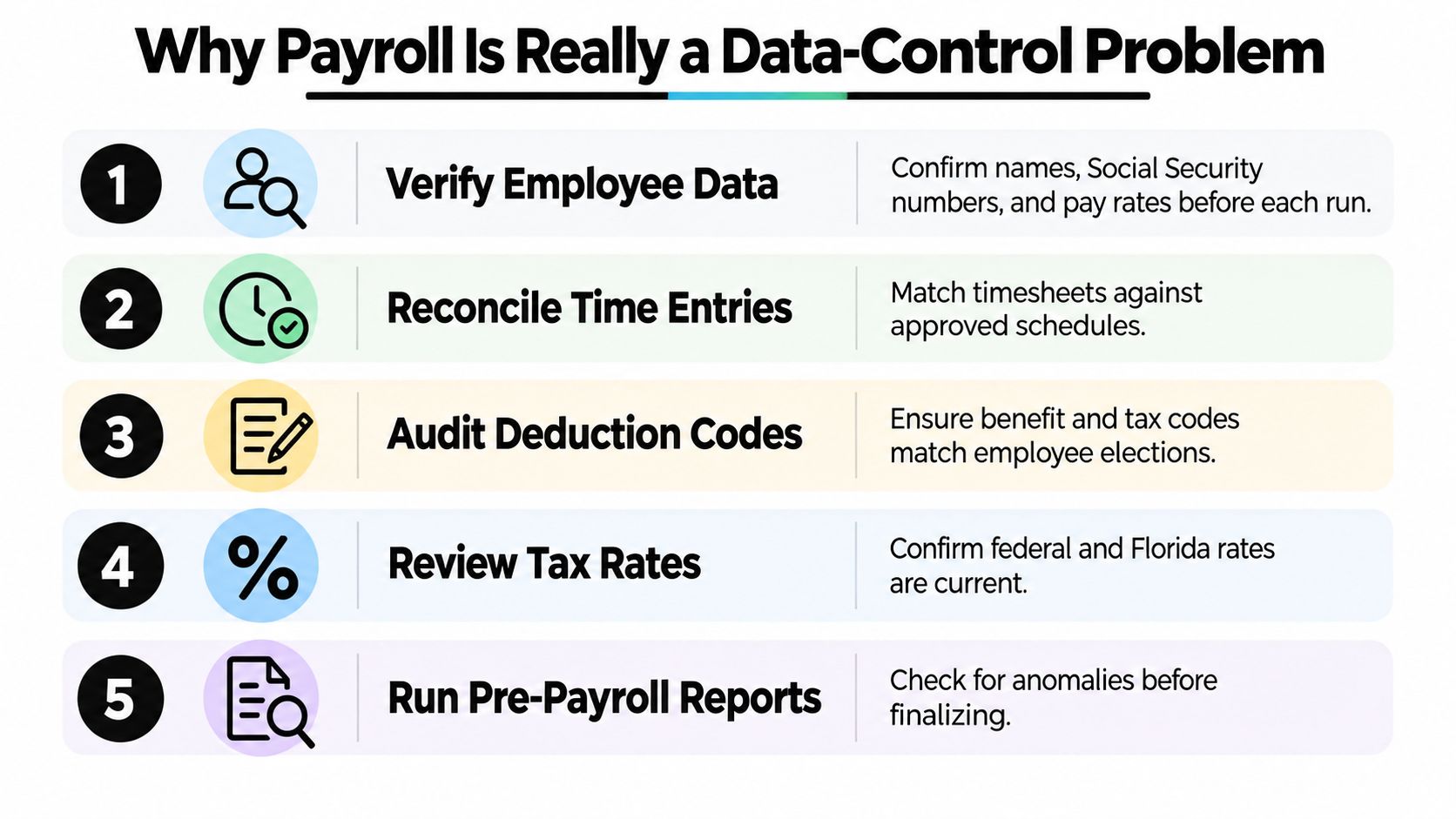
Put preventive checks before the release button
- Authorize source data: Require manager-approved time and documented compensation changes before processing.
- Enforce a cutoff: Route late submissions through an exception process instead of editing completed payroll without notice.
- Separate preparation from approval: Have someone other than the preparer review the final register where staffing permits.
- Inspect unusual results: Investigate unexpected overtime, changed deductions, unfamiliar employees, and unexplained allocation shifts.
- Preserve the evidence: Store approvals and corrections with the affected payroll records so a reviewer can reproduce the calculation.
For a small office that can't fully separate duties, arrange an independent review by the owner or an outside accountant. Limited headcount is a reason to design compensating controls, not an excuse to skip review.
Ask for proof rather than reassurance
Ask your bookkeeper to select a payroll transaction and trace it from approved source documentation into the accounting records. Then ask who authorized changes and where exceptions were resolved.
If the answer requires searching unrelated emails and guessing which spreadsheet was final, your process needs attention.
Your fractional CFO should define what constitutes an acceptable payroll close and who signs off. Your outsourced bookkeeping team should produce that evidence consistently.
Professional oversight reduces blind spots; it doesn't make risk disappear. Reject any promise that software or outsourcing can eliminate every payroll problem. A credible adviser explains the controls, responsibilities, and remaining exposure.
The Payroll Mistakes That Hurt Northeast Florida Employers Most
The payroll mistakes I'd prioritize for a Northeast Florida employer aren't typographical. They involve decisions that nobody revisits: who belongs on payroll, how unusual payments are treated, and who confirms obligations were satisfied.
An owner shouldn't have to discover those weaknesses during a financing request or agency inquiry.

Review the relationship before the payment method
Calling someone a contractor doesn't settle worker classification. The relationship and degree of control matter, and an owner should obtain professional advice when the facts are mixed.
For a hypothetical construction company using recurring subcontract labor, I'd recommend reviewing the actual working arrangement before approving another routine payment. Document the conclusion rather than assuming an invoice answers the employment question.
Group exceptions by their financial impact
- Classification and owner compensation: Request a documented review of recurring contractors and owner payments, including S-corporation compensation questions.
- Unusual compensation: Flag bonuses, benefits, reimbursements, and payroll advances before processing. Don't let an improvised payment code determine the accounting treatment.
- Compliance handoffs: Confirm responsibility for federal filings, Florida Reemployment Tax matters, and applicable new-hire reporting rather than assuming the payroll provider covers every task.
Healthcare staffing, construction trades, and nonprofit project work deserve particular attention when different payment arrangements coexist.
Employers operating outside Florida should also review the rules applicable to those workers. For California operations, the Lerner & Weiss APC meal break guide is a jurisdiction-specific starting point for discussion with employment counsel, not a Florida compliance rulebook.
The DOL's small-business compliance guidance makes clear that employers remain responsible for proper payment and required records. Use accounting support for the financial review and legal counsel for employment-law questions. Neither specialty replaces the other.
QuickBooks Recordkeeping Tips and the Case for a Fractional CFO
QuickBooks can organize your payroll accounting. It can't decide whether your account structure answers the questions you need answered.
Start by reviewing the chart of accounts and payroll mappings. A tidy screen isn't the same thing as a useful financial report.
Configure the books for review
- Separate expenses from liabilities: Keep wage expense, employer payroll taxes, and employer benefits distinct from withholding and deduction payables.
- Use meaningful dimensions: Assign jobs, classes, locations, or departments according to your reporting needs and available QuickBooks features.
- Control imported entries: Check how payroll summaries and bank-feed transactions interact so the same withdrawal doesn't become another expense.
- Retain supporting reports: Save payroll registers, tax-payment confirmations, and benefit documentation with the close records.
Before changing settings, review this QuickBooks Payroll setup guide. Have your accountant check the resulting account mappings rather than assuming the default configuration fits your business.
Separate bookkeeping execution from financial leadership
The SBA's financial-management guidance recommends assigning responsibility for accounts receivable, accounts payable, available cash, bank reconciliation, and payroll. Payroll shouldn't operate in isolation from those responsibilities.
An outsourced bookkeeper maintains the accounting detail and prepares reconciliations. A fractional CFO uses that information to challenge assumptions: Can the business fund the proposed hire? Does the staffing budget include employer costs? Are managers approving overtime without understanding its effect on job margins?
Owner's test: If your financial reports can't support a staffing decision, ask what information is missing before approving the next position.
Our certified QuickBooks ProAdvisors and CPA team can help organize the books, review payroll setup, address accounting cleanup, and connect reporting with fractional CFO guidance. An internal finance employee or another qualified outside adviser may also fill those roles; the important decision is assigning competent ownership.
Don't buy senior financial guidance merely to receive another report. Engage someone who will explain the numbers, identify unresolved questions, and give management a clear recommendation.
Turning Payroll From a Headache Into a Strategic Asset
Once the records are dependable, management can ask better questions. Which construction jobs absorb more labor than expected? Which clinic departments need staffing adjustments? Can a nonprofit support a proposed position within its operating plan?
Those questions require consistent information, not heroic spreadsheet work the evening before a meeting.
Payroll has value beyond the individual employer, too. The Bureau of Labor Statistics explains that payroll records support employment, hours, and earnings estimates. Inside your business, the same underlying discipline should support decisions you can use.
Choose support that follows through
When evaluating an accounting adviser, ask for specifics:
- Defined scope: Clarify who prepares payroll, reviews entries, handles filings, and responds to notices.
- Useful deliverables: Request a close package that identifies unresolved items and explains meaningful labor-cost changes.
- Industry understanding: Discuss construction job costing, healthcare departments, nonprofit allocations, or retail staffing as appropriate.
- Decision support: Establish when management will review forecasts, hiring plans, and cash requirements.
Our service approach combines bookkeeping and accounting, payroll, tax preparation, audit and review services, specialized healthcare and construction accounting, and fractional CFO guidance for Northeast Florida businesses. The scope should fit your organization rather than force you into an oversized package.
You don't need to become a payroll specialist. You do need a professional who can tell you what's incomplete, what needs attention, and what decision comes next. That's the standard I'd use when choosing business accounting support.
Bookkeeping and Accounting of Florida Inc. offers payroll, outsourced bookkeeping, tax preparation, and fractional CFO services that connect employee payments with reliable financial reporting. Visit Bookkeeping and Accounting of Florida Inc. to schedule a consultation, and bring your latest payroll register, payroll tax notice if you have one, and a list of responsibilities nobody currently owns.