
You finish a large project, send the final invoice, and still find yourself checking the bank account before approving payroll. The job appears profitable, yet retainage remains outstanding, a change order hasn't been priced correctly, and labor costs arrived before the customer's payment. Construction accounting methods determine how clearly you see that situation, not just how your bookkeeper categorizes transactions.
Thank you for reading this post, don't forget to subscribe!The right method can improve visibility into earned revenue, gross profit, working capital, lender reporting, and tax timing. The wrong method, or a method that no longer fits your company, can make a healthy job look weak, hide a shrinking margin, or create a tax surprise. For Jacksonville contractors, the practical answer starts with accurate job costing and ends with a system that keeps estimates, billing, payroll, retainage, and compliance connected.
Why Construction Accounting Feels Different From Other Businesses
A contractor can have strong sales and still experience a cash squeeze. That isn't a contradiction. Construction projects often generate costs steadily while billing follows milestones, progress applications, approved change orders, or contract terms. Retainage can keep part of an invoice out of your bank account even after your team has completed the related work.
Consider a commercial builder with several active jobs. The general ledger might show revenue, payroll, materials, subcontractors, and equipment, but those totals don't answer the questions the owner needs answered. Which project is losing margin? Is the company underbilled because work moved faster than invoicing? Did a pending change order increase the estimated cost without increasing the contract price? Will the next payroll run arrive before a customer releases retainage?
Construction accounting treats each job as its own financial story. Labor, materials, equipment, subcontractors, overhead, billing, and contract changes must connect to the project that created them. That project-level view supports WIP reporting and helps management compare actual cost-to-date with the original estimate, as described in construction job costing guidance.

The practical promise: your financial statements should help you decide what to do next, not merely explain what happened months ago.
The foundational choice between the percentage-of-completion method and the completed-contract method has shaped contractor reporting for decades. A 1959 AICPA contractor accounting guide called percentage of completion the “generally preferred method” for long-term contracts because it recognizes income as work progresses, while completed contract records income only when the job is completed or substantially complete. The historical framework remains relevant because timing affects reported profit, lender conversations, working capital, and tax planning. See the AICPA contractor accounting guide for that early framework.
How Job Costing Gives You Control of Every Project
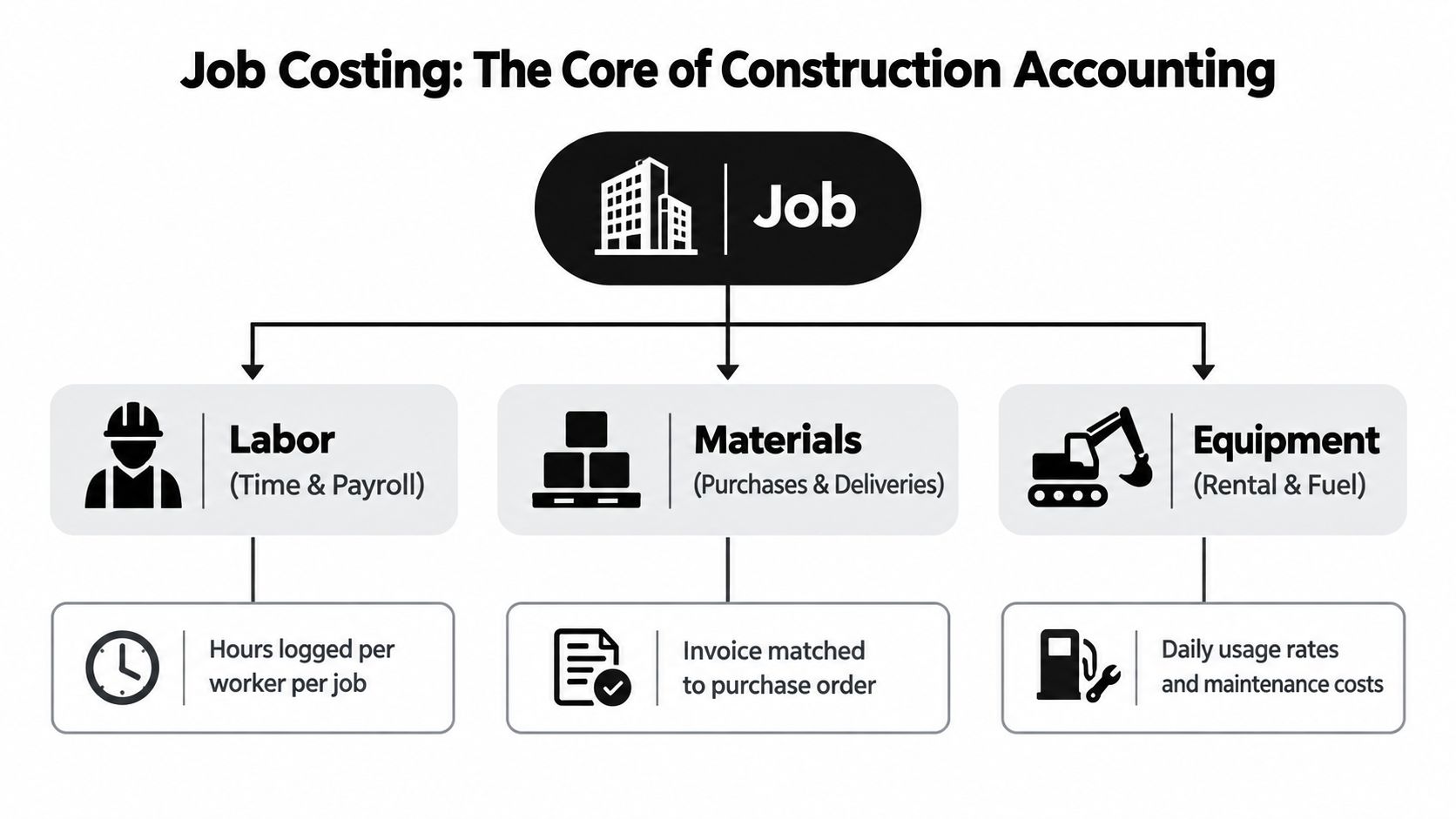
Job costing is the operating core of construction accounting. Think of each project as having its own wallet. Every dollar placed in that wallet should carry enough information to show the job, phase, cost code, and type of expense. A company-wide expense pool may tell you that spending increased, but it won't tell you whether framing, electrical work, site preparation, or equipment use caused the change.
Start by assigning direct costs to the job that used them:
- Labor: Time records and payroll allocations should identify the worker, project, phase, and hours worked.
- Materials: Purchases and deliveries should connect to the job and, when practical, the relevant cost code.
- Equipment: Rental, fuel, usage, repairs, and maintenance should follow the project that consumed the resource.
- Subcontractors: Subcontractor invoices and committed costs should match the contract, scope, and project ledger.
- Overhead: Indirect expenses should be allocated through a consistent policy instead of disappearing in a company-wide bucket.
Compare actual costs with the estimate
Once costs are assigned, compare actual cost-to-date with the original estimate and the current estimate at completion. If labor is running ahead of plan, the project manager needs to know while there is still time to adjust sequencing, staffing, procurement, or pricing. If a subcontractor's committed cost hasn't entered the books, the project can look healthier than it really is.
This process also improves future bids. Phase-level information shows whether the company consistently underestimates mobilization, concrete, supervision, equipment, or closeout work. Over time, those records help estimators replace guesswork with the company's own operating history.
Make the ledger useful to the field
A job cost report only works when field teams can provide timely information. Require consistent time entry, purchase-order matching, delivery documentation, subcontractor billing review, and change-order coding. A clean chart of accounts in QuickBooks or construction accounting software won't rescue a process that records costs weeks after the work occurs.
For a practical reference, review this guide to construction job costing for contractors. The goal isn't to create paperwork for its own sake. It's to give the owner and project manager a shared view of whether the job is performing as sold.
A project manager should be able to answer, “What has this job cost, what remains to be spent, and what changed?” without waiting for the month-end close.
Comparing Percentage of Completion and Completed Contract Methods
A contractor can have a profitable-looking job on paper and still face a cash squeeze. The accounting method determines when project revenue and profit appear in the financial statements, while retainage, billing terms, and payment rights determine when cash arrives. That timing matters when choosing or revisiting a method as the project mix changes.
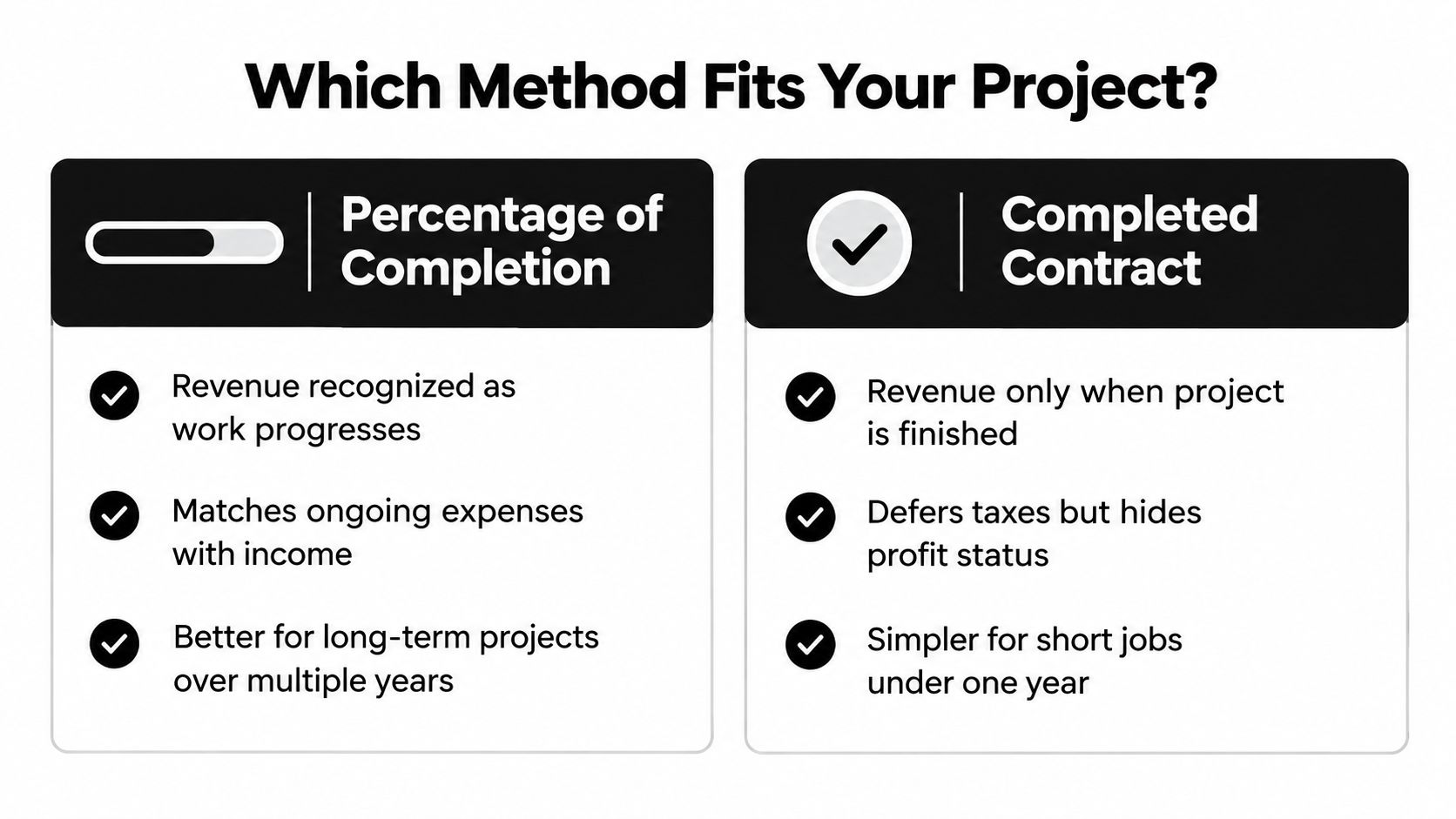
The percentage-of-completion method recognizes revenue and gross profit as qualifying work progresses. The completed-contract method accumulates billings and costs during construction but generally records interim profit only when the contract is completed or substantially complete.
Modern standards frame the choice through control and performance obligations, rather than relying only on those method names. Under ASC 606 and IFRS 15, revenue is recognized over time when the customer controls the asset as it is created or enhanced, when the asset has no alternative use and the contractor has an enforceable right to payment, or when the work creates a customer-controlled asset such as a building or road. This percentage-of-completion method overview explains how those principles commonly apply in construction.
Percentage of completion in plain English
For a cost-to-cost calculation:
Percentage complete = costs incurred to date ÷ total estimated cost
A representative $1,000,000 project that is 60% complete would recognize $600,000 of earned revenue under that logic. The calculation depends on reliable estimates. If expected total costs rise, the completion percentage and projected gross profit must be reassessed.
This method gives lenders and owners a running view of performance. It also matches revenue with the expenses used to earn it, which can make interim margins more meaningful. The trade-off is administrative discipline. Current job costs, updated forecasts, WIP reporting, approved change orders, and retainage tracking all affect whether the reported result reflects reality.
Completed contract in plain English
Completed contract defers revenue and gross profit until the job is complete or substantially complete. During construction, billings and costs accumulate, but the income statement may not show the project's profit. That can simplify accounting where reliable progress measurement is impractical, but it can also make interim financial statements look quiet while significant work is underway.
| Feature | Percentage of Completion | Completed Contract |
|---|---|---|
| Revenue timing | As qualifying work progresses | At completion or substantial completion |
| Cost information | Requires current total-cost estimates | Defers project profit recognition |
| Interim visibility | Shows evolving revenue and margin | Can hide project performance |
| Working capital insight | Supports WIP and billing analysis | May delay the financial picture |
| Main risk | Incorrect estimates can misstate results | Profit volatility and limited interim visibility |
See the comparison in motion below.
A contractor should base the decision on contract terms, customer control, enforceable payment rights, cost-estimation reliability, reporting needs, and tax rules. Retainage may be earned without being immediately collectible, so a method that shows profit is not automatically a method that predicts cash. Tax developments, including Rev. Proc. 2026-32, also give contractors a reason to revisit the choice when contract size, duration, or project type changes.
Retainage Change Orders and Payroll That Can Distort Your Numbers
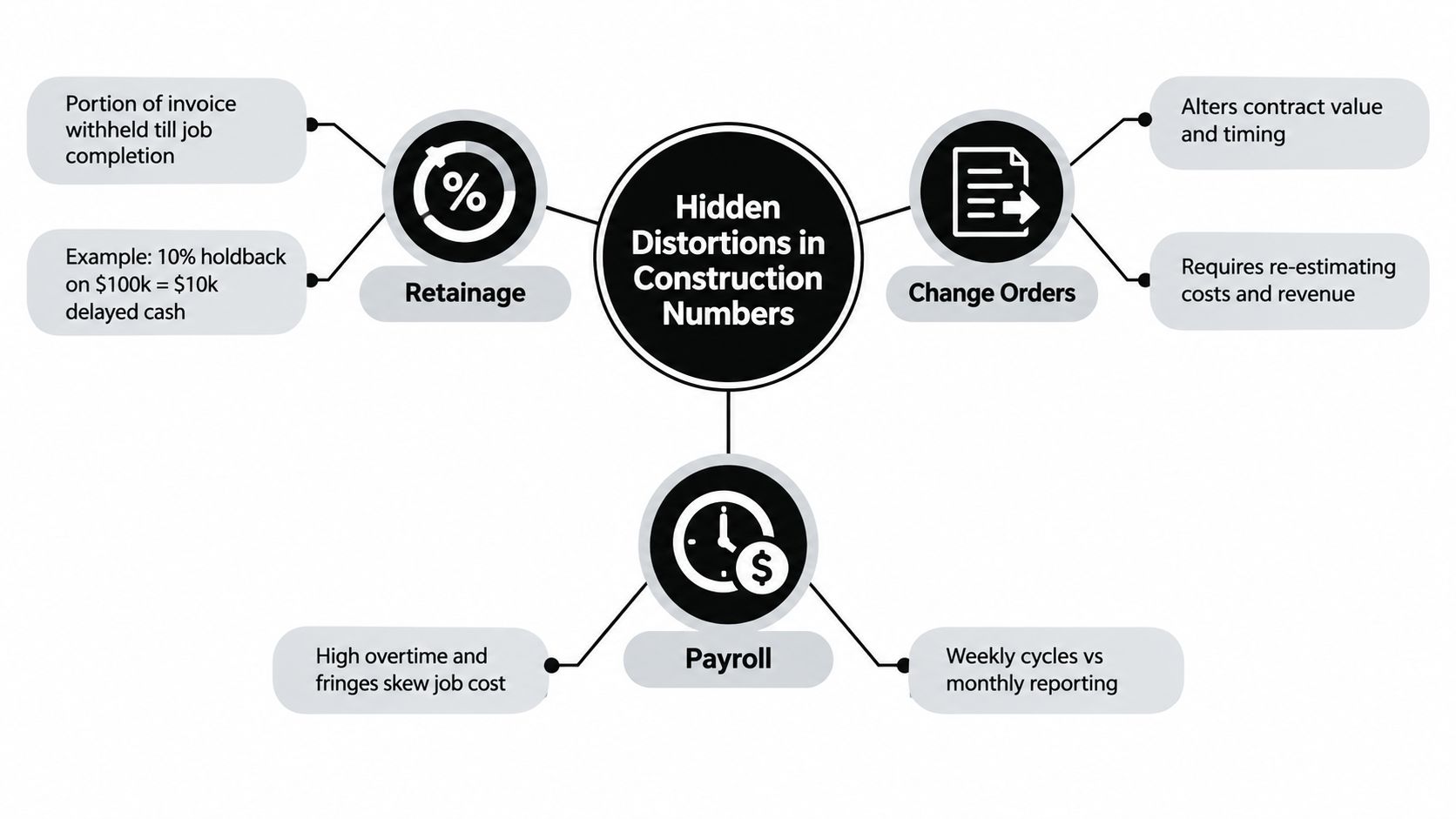
Accurate job costing can still produce a misleading cash forecast if billing mechanics are weak. Retainage, change orders, and payroll timing can each create a gap between project profitability and available cash.
Retainage must be tracked separately from ordinary receivables and payables. Under ASC 606, classification depends on whether the contractor's right to payment is conditional. A receivable may represent an unconditional right to payment, while a contract asset may reflect earned consideration that still depends on a condition other than the passage of time. The construction retainage accounting guidance addresses why this distinction matters.
Retainage changes the cash forecast
A project can show earned revenue while part of the related billing remains unavailable. That creates a working-capital gap. Your forecast should identify the amount retained, the release condition, the expected release date, the customer or prime contractor responsible for payment, and any documentation still required for closeout.
Don't bury retainage inside one accounts-receivable balance. Separate tracking makes it easier to distinguish an ordinary collection problem from a contractual holdback.
Change orders alter more than the contract price
An approved change order can affect scope, contract value, estimated cost, schedule, and revenue recognition. A pending change order needs its own status and documentation. If the field team performs extra work before approval, the accounting team needs to know whether the cost belongs in the original estimate, a separate pending-change-order bucket, or another project category.
Update the cost-to-complete estimate when the scope changes. A change order that adds revenue but also introduces difficult work may not improve margin. Conversely, extra work performed without timely billing can create underbilling and cash pressure.
Payroll arrives on a schedule of its own
Weekly payroll, overtime, payroll taxes, benefits, and certified payroll documentation can move faster than monthly financial reporting. If time is coded to the wrong job, the project margin is wrong. If payroll accruals are delayed, the month-end report is incomplete.
Use a consistent workflow:
- Collect time promptly: Require workers and supervisors to identify the correct project and phase.
- Review exceptions: Investigate unusual overtime, missing hours, and labor charged to the wrong cost code.
- Accrue unfinished periods: Record payroll earned by employees even when the payment falls in a later reporting period.
- Tie payroll to WIP: Confirm that labor costs in project reports agree with the general ledger and payroll records.
A contractor's accounting method can be technically correct and still fail operationally if retainage, change orders, and labor data arrive late.
2026 Tax Law Changes and When to Revisit Your Accounting Method
The IRS generally requires the percentage-of-completion method for most long-term contracts spanning two or more tax years, although qualifying smaller contractors and certain residential construction contracts may have other permissible options. That means a method chosen when a company handled smaller jobs may deserve a formal review after the business begins taking on larger commercial, public, or multi-year work. The 2026 accounting method guidance for contractors discusses this practical re-evaluation gap.
The IRS Construction Industry Audit Technique Guide states that, under IRC section 460(b)(1), taxpayers generally use percentage of completion for long-term contracts. Treasury Regulation section 1.460-1(c)(3) includes a bright-line completion test. A contract is treated as complete at the earlier of 95% of contract costs incurred with the customer having intended use, or final completion and acceptance, according to the IRS Construction Industry Audit Technique Guide.
Rev. Proc. 2026-32 creates a specific residential opportunity
For qualifying residential construction contracts entered into in tax years beginning after July 4, 2025, Rev. Proc. 2026-32 provides automatic consent for eligible taxpayers to change from the percentage-of-completion method or percentage-of-completion/capitalized-cost method to a permissible exempt-contract method. It also updates when taxpayers may begin or stop capitalizing costs under section 263A for those contracts. The summary of Rev. Proc. 2026-32 describes the change.
The procedure is generally effective for Forms 3115 filed after September 4, 2026. Separate 2026 guidance identifies a Section 179D cutoff for property whose construction begins after June 30, 2026, making dated compliance tracking especially important. Review the updated automatic procedures for research and construction before treating any method change or capitalization position as routine.
Triggers for a method review
Revisit your accounting method when:
- Contract size rises: Larger jobs create greater estimation, bonding, and reporting demands.
- Project duration changes: More work crossing tax years can affect the available tax treatment.
- Customer mix shifts: Public and commercial customers may demand stronger WIP and accrual reporting.
- Residential work expands: The new residential rules may create a method-change question for eligible contracts.
- Systems lag behind growth: If your reports arrive after decisions are already made, the method may not be the only issue.
Tax method changes can require elections, documentation, and Form 3115 procedures. Have a CPA evaluate the facts before changing how your company reports contract income.
Putting the Right System in Place Without Disrupting Jobs
A construction accounting method works only when the daily information feeding it is dependable. You don't need to turn every superintendent into an accountant, but you do need a workflow that captures job activity before the month-end close becomes a rescue operation.
Build a practical control routine
Use a consistent close calendar for every active project:
- Update estimates: Compare original budget, approved changes, committed costs, costs incurred, and remaining costs.
- Review WIP: Compare earned revenue with billings and investigate underbilling or overbilling.
- Reconcile payroll: Match timecards, payroll reports, and job allocations.
- Track retainage: Separate retainage from regular receivables and document release conditions.
- Document changes: Keep approved change orders, pending requests, subcontractor updates, and customer correspondence together.
- Review unusual variances: Ask the project manager to explain material, labor, equipment, and subcontractor deviations.
QuickBooks can support a construction company when the file uses consistent customers, projects, classes, items, cost codes, payroll mappings, and reporting rules. The setup should reflect how your company estimates and bills work, not how a generic chart of accounts happens to be arranged. This construction accounting QuickBooks resource can help contractors think through that structure.
Make billing match project reality
Standardize the schedule of values, progress billing review, retainage fields, invoice approvals, and supporting documents. Real-time project accounting and tighter job costing help reveal margin erosion and cash gaps before the reporting period closes. A clean system also makes it easier to explain numbers to a lender, bonding company, auditor, or tax professional.
The right approach may use QuickBooks with disciplined procedures, a construction-specific platform, or integrated payroll and project-management tools. The important part is consistency. Your method should produce the same answer whether the information comes from the office, a field supervisor, or a subcontractor invoice.
How a Fractional CFO Keeps You Compliant and Profitable
Small construction businesses often reach a point where the owner is expected to manage crews, customers, estimating, collections, banking, payroll, and tax deadlines. That workload makes missed coding, late WIP updates, and incomplete change-order documentation more likely. It doesn't mean the owner is careless. It means the company has outgrown informal financial processes.
A fractional CFO gives the business senior financial guidance without the cost of a full-time executive. The role can include cash-flow forecasting, project profitability analysis, lender and bonding support, budgeting, method evaluation, and management reporting. A fractional CFO can also help translate accounting information into decisions about hiring, equipment, bidding, collections, and growth.
Compliance needs more than tax preparation
Construction compliance may involve:
- Bookkeeping and accounting: Maintain accurate ledgers and project records.
- Payroll: Allocate labor correctly and keep required payroll documentation organized.
- Tax preparation: Apply the appropriate contract method and document elections or changes.
- Audits and reviews: Prepare schedules and supporting records that reconcile to the books.
- WIP reporting: Show earned revenue, billings, estimated costs, and margin changes.
- Cash-flow forecasting: Identify retainage delays, underbilling, upcoming payroll, and vendor obligations.
Many small businesses don't know every requirement that applies to their contracts, entity, workforce, and tax position. Guidance helps turn compliance from a year-end scramble into a recurring management process.
For contractors evaluating this support, the fractional CFO service for small businesses explains how senior oversight can fit alongside bookkeeping and accounting work. Bookkeeping and Accounting of Florida Inc. is a Jacksonville CPA firm with more than 20 years of experience supporting companies across Northeast Florida, including construction businesses that need job costing, payroll support, tax preparation, audits, QuickBooks organization, and cash-flow insight.
Don't wait for a tax notice, bonding request, or cash crisis to discover that your accounting method no longer fits. Ask for a review of your current method, active contracts, job-costing structure, retainage process, WIP reporting, and 2026 filing obligations.
Bookkeeping and Accounting of Florida Inc. provides construction bookkeeping, job costing, payroll, tax preparation, WIP reporting, and fractional CFO guidance for Jacksonville and Northeast Florida contractors. Visit Bookkeeping and Accounting of Florida Inc. to schedule a conversation about choosing and maintaining construction accounting methods that support compliance, cash flow, and profitable growth.