
You billed the job, deposited the check, and told yourself the month looked strong. Then your lender asked why profit did not match cash, your CPA asked for acceptance paperwork you never saved, and the customer disputed work you had already taxed yourself on. That gap between billing and earning is where revenue recognition accounting lives, and it's where good Jacksonville businesses get hurt behind the scenes.
Thank you for reading this post, don't forget to subscribe!The Invoice That Wasn't Really Revenue
A Jacksonville contractor finishes a milestone, sends the invoice, and books the full amount as revenue the same day. The check clears, payroll gets covered, and the owner moves on. Months later the customer says the work was never accepted, points to a retainage clause, and demands corrections before final approval.
Now the books say the company earned money it may have to give back or earn again through rework. Estimated taxes were paid on overstated profit. The bank relied on financials that don't hold up, and the owner can't tell which jobs made money.
Cash in the Bank Is Not the Test
Revenue is earned when you transfer what you promised, not when you invoice it and not when cash lands. Deposits, prepayments, and retainers often sit as liabilities until you perform, which is why clean handling of deposits, prepayments, and retainers in your books matters before anyone celebrates a strong month.
If you bill ahead of performance, you usually owe the customer work. That's deferred revenue, also called a contract liability. If you perform before you have an unconditional right to bill, you may have a contract asset instead of a receivable.
If your bookkeeper can't show you, contract by contract, what you've billed versus what you've earned, you don't have a revenue number. You have a guess.
Why Outsiders Care More Than You Think
Lenders use revenue to judge borrowing capacity and covenant compliance. Sureties, buyers, partners, and the IRS all read the same number through different lenses, and none of them accepts, well, we invoiced it, as support.
- Taxes get distorted: Overstated revenue inflates taxable income in the wrong period and creates messy corrections later.
- Loan decisions suffer: A banker who finds unsupported revenue stops trusting every other line on the statement.
- Job costing breaks: Owners keep bidding work at prices that looked profitable only because revenue landed too early.
You're going to get a plain English system here. You'll see the five steps, how change orders really work, what the journal entries look like in healthcare, construction, and nonprofits, which 2026 tax changes raise the stakes, and why year end cleanup is not a strategy. Get the timing right monthly and the rest of your financial decisions get far more honest.
The ASC 606 Five-Step Model Explained Simply
The current framework started in May 2014, when FASB issued Accounting Standards Update No. 2014-09 and the IASB issued IFRS 15, replacing fragmented industry guidance with a broadly aligned model described in the Sullivan and Cromwell summary of the converged standards. For U.S. public companies the FASB standard took effect for fiscal years beginning after December 15, 2017, nonpublic entities generally followed after December 15, 2018, and IFRS 15 applies to annual periods beginning on or after January 1, 2018, per that same summary.
The core principle is simple enough to write on a sticky note. Revenue should depict the transfer of promised goods or services in an amount reflecting what you expect to receive for them.
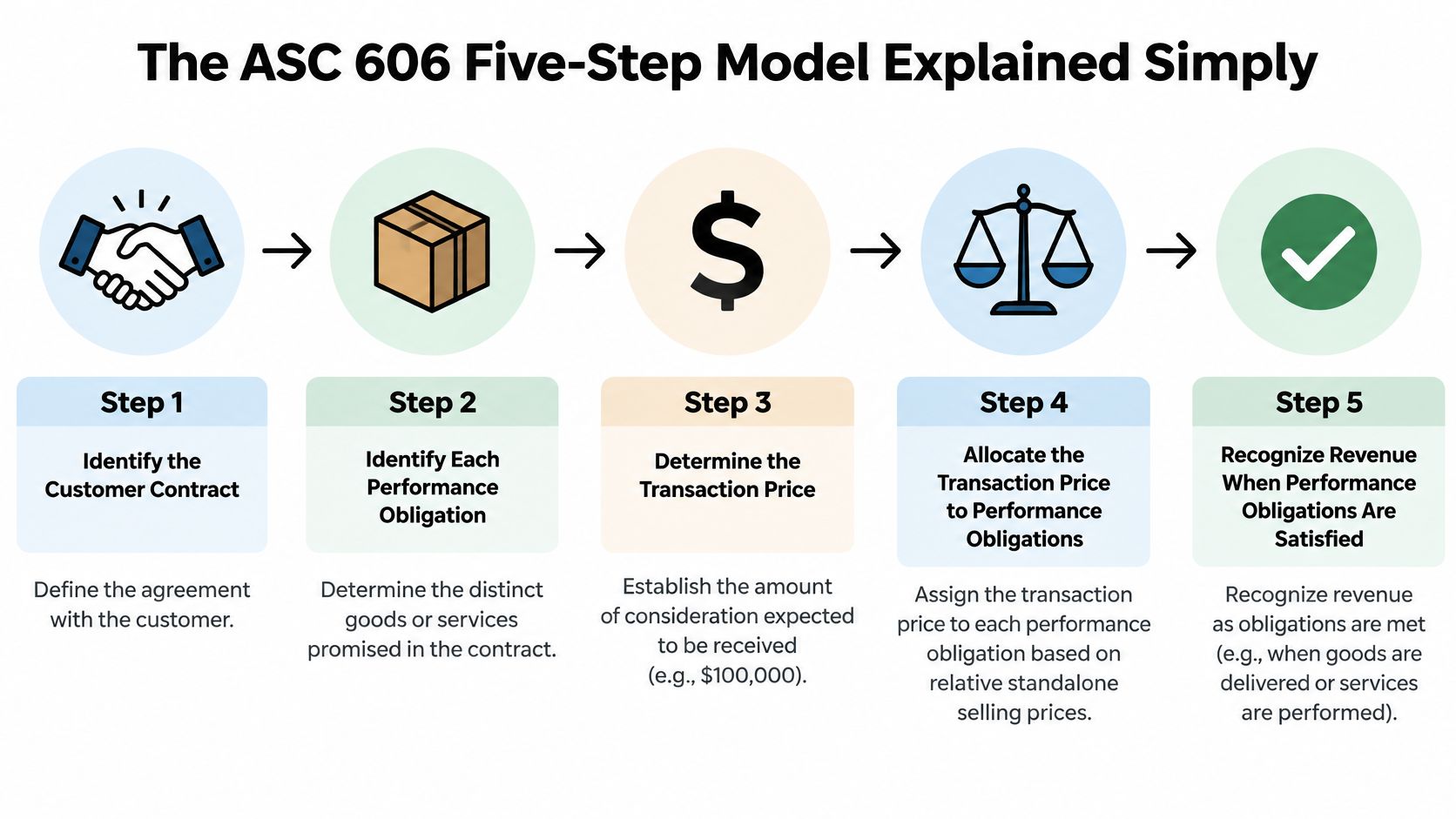
The diagram below maps the sequence you should run for every material contract.
The Five Steps in Plain English
Step 1, identify the contract. A signed document alone isn't enough. You need approved and enforceable rights, identifiable payment terms, commercial substance, and probable collectibility, as laid out in SEC filed ASC 606 accounting policy disclosure.
Step 2, identify performance obligations. Break the promise into distinct pieces. A radiology group might sell one arrangement that contains a scan, a professional read, and a follow up consult, and each piece the patient can benefit from separately can be its own obligation.
Step 3, determine the transaction price. That's the amount you expect to keep, after discounts, rebates, refunds, penalties, and other variable amounts. Sticker price is often a fantasy number.
Step 4, allocate the price. Split the transaction price across obligations using relative standalone selling prices. If you'd sell the scan, the read, and the consult separately, those standalone prices drive the allocation, not whatever split makes this month look better.
Step 5, recognize as you satisfy each obligation. Some obligations transfer at a point in time, like delivering equipment. Others transfer over time, like a retainer, a subscription, or work the customer controls as you perform it.
This short walkthrough reinforces how the steps connect before you apply them to messy contracts.
Three Different Clocks
Cash, billing, and recognition run on separate clocks, and forcing them to match is the most common small business error I see. You can collect cash in January, invoice in February, and earn the revenue from March through August.
Build a contract level schedule for every significant agreement. List each obligation, its standalone price support, billing terms, evidence of delivery, and recognition pattern, then tie that schedule to the general ledger monthly. If that schedule doesn't exist, your close process depends on memory, and memory is not an internal control.
Contract Modifications and Variable Consideration
Most revenue disasters don't start at contract signing. They start when scope creeps, a customer upgrades, an insurer adjusts a rate, or a project manager approves extra work in the field and tells accounting three weeks later.
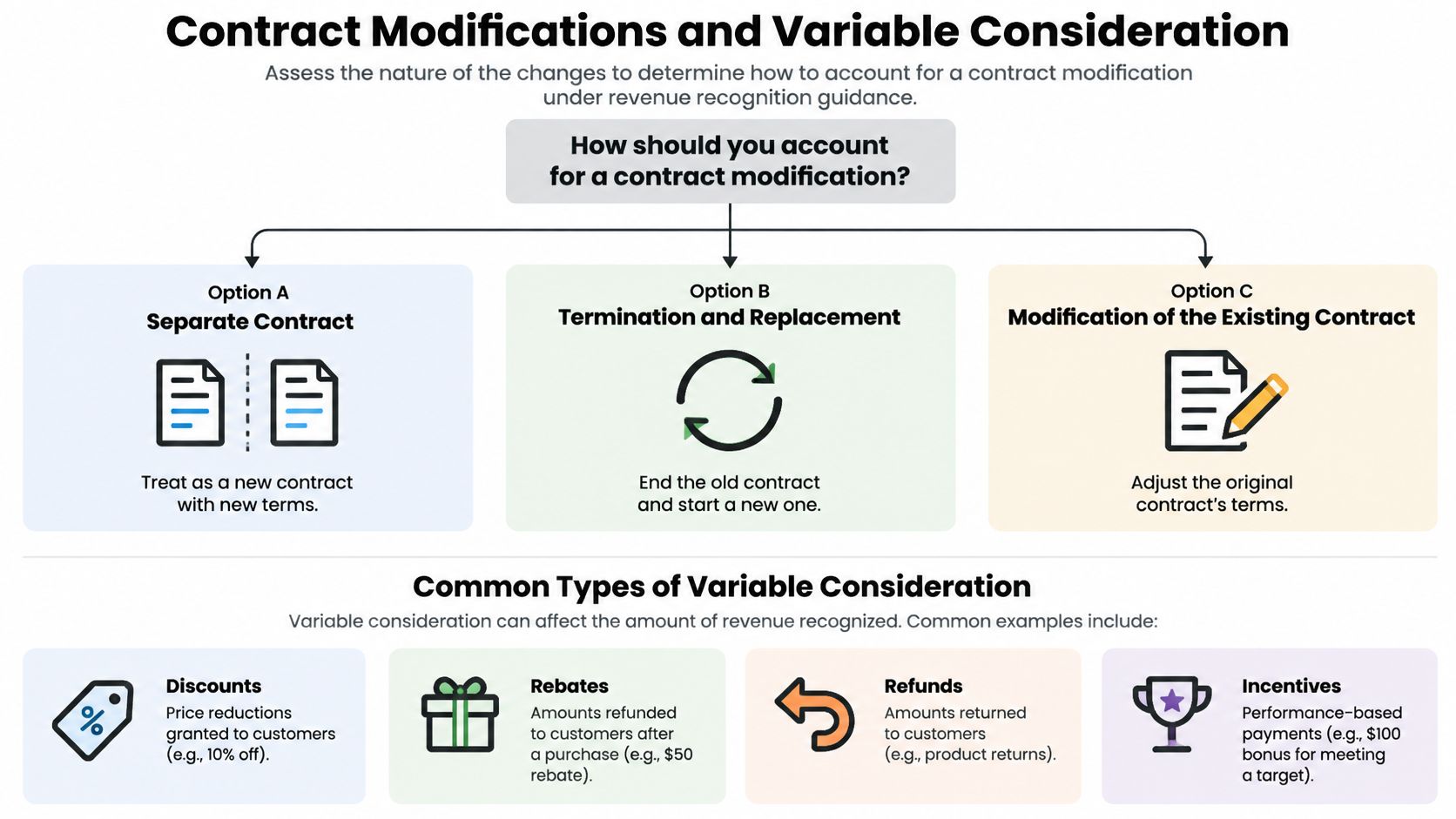
The visual below frames the decision your team has to make every time terms change.
The Three Way Modification Decision
First ask whether the change adds distinct goods or services and whether the price increase reflects their standalone selling price. If both answers are yes, you've generally got a separate contract, and you leave the original schedule alone.
If that test fails, look at what's left to deliver. When remaining goods or services are distinct from what you've already transferred, the change is commonly handled prospectively as a termination and replacement of the old contract. When the remaining work is not distinct and forms part of a partially satisfied obligation, you record a cumulative catch up adjustment that can change revenue you've already reported, an outcome described in IFRS 15 standard guidance on modifications and variable consideration.
A construction change order for a separate build out at a fair standalone price may stand alone. Extra work woven into an unfinished structure usually doesn't. A healthcare insurance adjustment that reprices services already rendered hits differently from a new authorization for future visits, and a nonprofit grant revision that changes deliverables midstream needs the same disciplined reassessment.
Variable Consideration and the Constraint
Bonuses, penalties, rebates, refunds, retainage at risk, volume discounts, and price concessions make the transaction price move. Under the IFRS 15 guidance linked above, those estimates enter the price only when it's highly probable a significant cumulative reversal won't occur, and you reassess as facts change.
Practical rule: If you'd be embarrassed explaining to your banker why the bonus might vanish, don't book it yet.
- Require written approval: No enforceable approval, no schedule change, no revenue change.
- Update the constraint assessment: Document why variable amounts will or won't reverse.
- Preserve the original schedule: Never overwrite history in QuickBooks or your spreadsheet, because auditors need the trail.
- Reconcile monthly: Tie contract assets and contract liabilities back to the general ledger every period.
Hand project managers a simple rule. Any scope or price change goes to accounting before work starts, with customer approval attached. That single habit prevents most premature change order revenue, and it turns a technical standard into an operating control your field team can follow.
Journal Entries for Healthcare, Construction, and Nonprofits
Rules mean little until they hit the ledger. These three patterns show how the same standard produces different entries depending on when control transfers and when you gain an unconditional right to payment.
Healthcare Package With Deferred Revenue
A practice sells a bundled package covering an implant, the procedure, and follow up care, and collects payment at booking. At collection, debit Cash and credit Deferred Revenue for the full amount, because you've been paid but you haven't performed.
As each obligation is satisfied, debit Deferred Revenue and credit Revenue for the allocated portion. The implant, procedure, and follow up visits earn their allocated amounts as they're delivered, supported by chart documentation and appointment records. Booking everything on the scheduling date overstates the month and understates every month where your clinical team does the real work.
Construction Work Recognized Over Time
A Jacksonville contractor earns revenue over time as work progresses, measured by costs incurred or another faithful progress method. When earned revenue exceeds what's been billed, debit Contract Asset and credit Revenue. When a milestone invoice goes out, debit Accounts Receivable and credit Contract Asset.
Retainage delays cash, but it doesn't automatically delay revenue if you've satisfied the obligation and collection is expected. It does belong where everyone can see it, aged and tracked by job, not buried in a general receivable balance. Owners who want the method comparison behind this pattern should review construction accounting methods and how they affect job profitability before picking a progress measure out of habit.
Nonprofit Conditional Grants
A conditional grant isn't revenue when the award letter arrives. If the funder imposes a barrier, such as delivering measurable program outcomes, and retains a right of return, cash received early is recorded as a refundable advance liability. Revenue is recognized as the barrier is met and documented.
That distinction protects boards from spending restricted money they haven't earned yet. It also keeps grant reports, audited financials, and Form 990 presentation telling the same story.
| Industry | Typical Obligation | Recognition Trigger | Likely Balance Sheet Account |
|---|---|---|---|
| Healthcare | Procedure and follow up package | Each service delivered | Deferred revenue |
| Construction | Work performed over time | Progress toward completion | Contract asset |
| Nonprofits | Conditional grant deliverables | Barrier substantially met | Refundable advance |
| Professional services | Retainer based advisory work | Services provided over term | Contract liability |
Accounts receivable means your right to payment is unconditional except for the passage of time. A contract asset means you've earned it but something else, like a milestone or acceptance, still stands between you and billing. Mixing those two accounts hides collection risk, and sloppy mapping in QuickBooks guarantees your balance sheet misleads you.
Why Revenue Errors Land Small Businesses in Hot Water
Owners tell me revenue timing is a public company problem. The enforcement record says the failure modes are universal, and private companies commit the same sins with weaker controls.
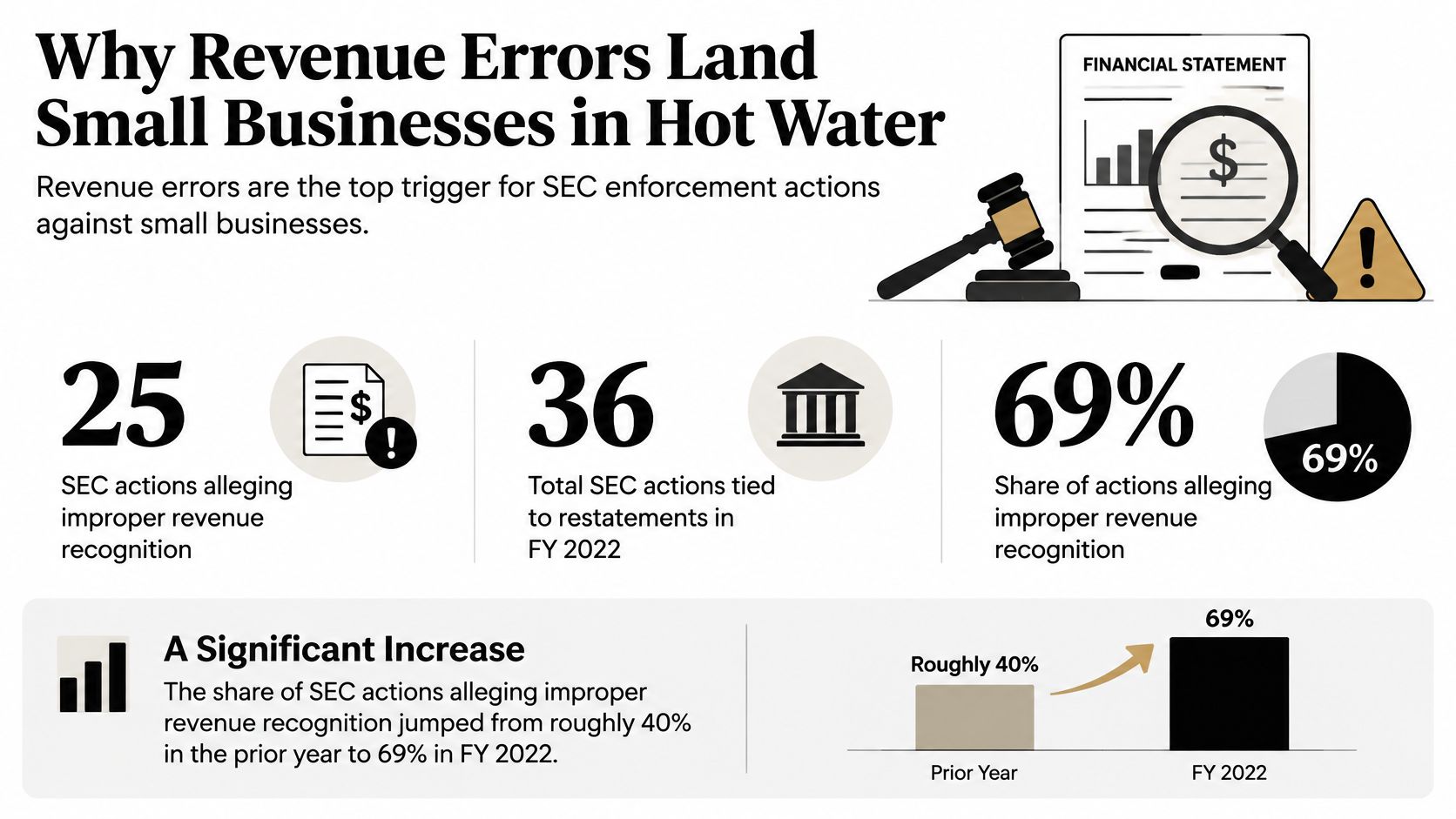
In fiscal year 2022 the SEC brought 68 accounting and auditing enforcement actions, and of the 36 actions tied to announced restatements, 25 alleged improper revenue recognition, approximately 69%, compared with a reported 40% share the prior year, according to compiled SEC enforcement statistics on revenue recognition. In fiscal year 2023, 17 of 35 restatement related actions, or 49%, alleged improper revenue recognition under that same compilation.
Those figures cover a specific slice of SEC actions, not every error in America. They still show which number regulators, auditors, and lenders distrust first.
The chart below puts that concentration in terms any owner can grasp quickly.
Failure Modes Translated to Your Office
Premature recognition is booking the sale before acceptance, delivery, or completion. Unsupported sales means invoices exist but delivery evidence doesn't. Bill and hold and channel stuffing show up in smaller firms as shipping early, billing unapproved change orders, or pressuring customers to accept product before period end.
Sloppy estimates do quieter damage. Unrealistic progress percentages, ignored refund history, and bonuses booked at full value all inflate the top line until reality collects its debt.
Controls a Small Team Can Run
- Set contract approval thresholds: Material contracts get reviewed before signing, not after year end.
- Enforce cutoff procedures: Match delivery, acceptance, and service dates to the recognition period by project.
- Reconcile billing to earned revenue: Investigate differences monthly while staff still remember the job.
- Separate sales from bookkeeping: The person chasing commission shouldn't control recognition entries.
A private company restatement may never make headlines. It still triggers loan defaults, lost bonding capacity, amended tax returns, partner disputes, and purchase price fights when you try to sell. Revenue timing isn't a classification preference. It's the credibility of your entire reporting package.
2026 Tax Changes That Change the Conversation
Clean revenue records matter even more when tax rules shift under your feet. Three 2026 developments should already be shaping how you code income, owner activity, payroll, and vendor payments.
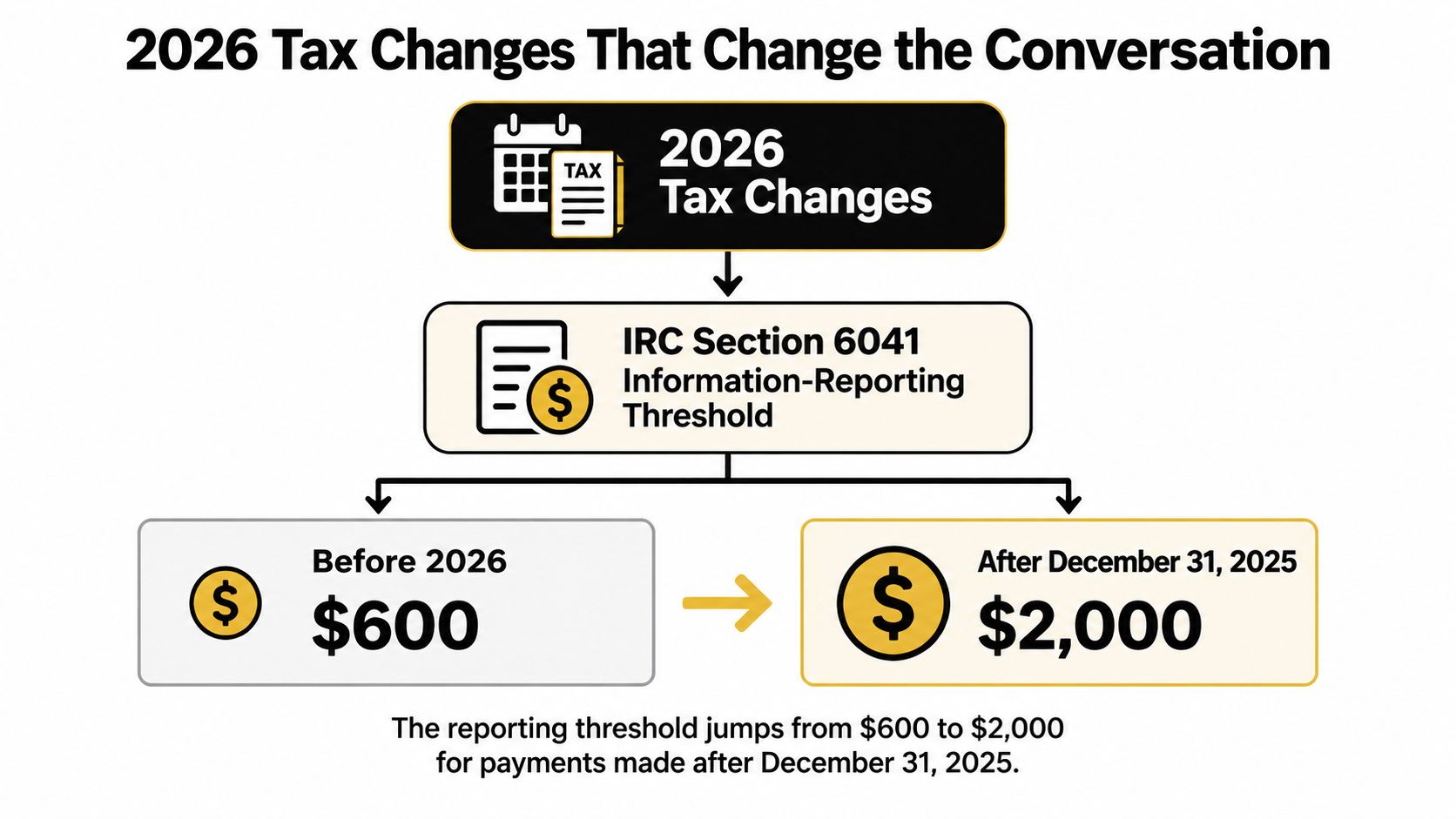
The reporting threshold change below will tempt owners to relax their vendor records. Don't.
The New Information Reporting Threshold
For payments made after December 31, 2025, the general threshold under Internal Revenue Code section 6041 rises from $600 to $2,000 for calendar year 2026, with inflation indexing after 2026, and the IRS estimates approximately 3.6 million taxpayers are affected, about 98% of them small entities with gross receipts under $40 million, per IRS Internal Revenue Bulletin 2026-19.
That change may reduce Form 1099-MISC and Form 1099-NEC filings for smaller payments. It doesn't repeal recordkeeping, employee payroll rules, or every reporting duty. You still need vendor totals, taxpayer identification information, and books that separate contractors, rent, services, reimbursements, and nonreportable payments, because January guesswork produces missed and duplicate forms.
QBI and Family Leave Provisions
The 20% qualified business income deduction under section 199A becomes permanent, alongside a new minimum $400 deduction for taxpayers with at least $1,000 of net qualified business income from active businesses in which they materially participate, and the paid family and medical leave credit becomes permanent with an election tied to qualifying insurance premiums, all as described in IRS guidance on the Working Families Tax Cuts business provisions.
None of that plans itself. Eligibility turns on entity structure, ownership, material participation, wages, benefits, and documented premiums, so your chart of accounts must separate owner activity from employee payroll and operating costs long before a return is prepared.
A deduction you can't document from clean monthly books is just a rumor at tax time.
Tie this back to revenue. Qualified business income starts with income measured in the right period, supported by contracts and reconciliations. Sloppy recognition corrupts estimated taxes, QBI planning, and cash flow forecasts at once. Treat 2026 as a planning year, not a filing season surprise, and review vendor coding, payroll categories, and revenue cutoff now while corrections are still cheap.
Why a Fractional CFO Is the Missing Piece
Most small businesses don't know everything that's required of them. That's not an insult, it's arithmetic. Owners run operations, sales, hiring, and customer fires, while ASC 606 judgments, 1099 thresholds, payroll classifications, and lender reporting keep moving.
A bookkeeper records what happened. A fractional CFO builds the system that decides how it should be recorded, then checks whether the numbers still make sense.
What That Role Actually Does Monthly
- Builds contract schedules: Obligations, standalone prices, and recognition patterns documented once and maintained.
- Sets cutoff discipline: Delivery evidence and change order approvals arrive before close, not during an audit.
- Reviews estimates: Variable consideration, progress measures, and refund exposure get challenged by someone senior.
- Connects tax and cash flow: 2026 provisions become forecasts and estimated tax decisions, not missed deductions.
Our Jacksonville CPA team handles bookkeeping, payroll, tax preparation, and fractional CFO consulting services for growing companies under one roof, which removes the handoffs where contract terms get lost between software and tax files. You don't need to memorize the standard. You need a process that produces reliable numbers every month, reviewed by someone accountable for asking uncomfortable questions before your banker does.
Your Implementation Checklist and Next Step
Start with discipline, not software. Work through this list with whoever closes your books.
- Review active contracts: Run every material agreement through the five steps and document obligations and standalone prices.
- Set a cutoff calendar: Fix dates for delivery evidence, approvals, and reconciliations.
- Control change orders: Require written customer approval before schedules or revenue move.
- Reconcile monthly: Tie deferred revenue and contract assets to supporting schedules and the general ledger.
- Refresh disclosures: Align lender, tax, and internal reporting language with your actual policies.
- Schedule 2026 tax planning: Review vendor coding, QBI records, and payroll categories now.
For owners who need a broader framework for turning these habits into documented routines, how to implement business processes offers useful structure you can adapt to your close calendar. Pair that discipline with senior accounting review and your revenue number becomes defensible.
Book a discovery call with our Jacksonville team and we'll review your active contracts, revenue schedules, and 2026 tax readiness, then map the bookkeeping, payroll, tax, and fractional CFO support your company needs. Visit Bookkeeping and Accounting of Florida Inc. to schedule that conversation and start closing each month with numbers you can defend.